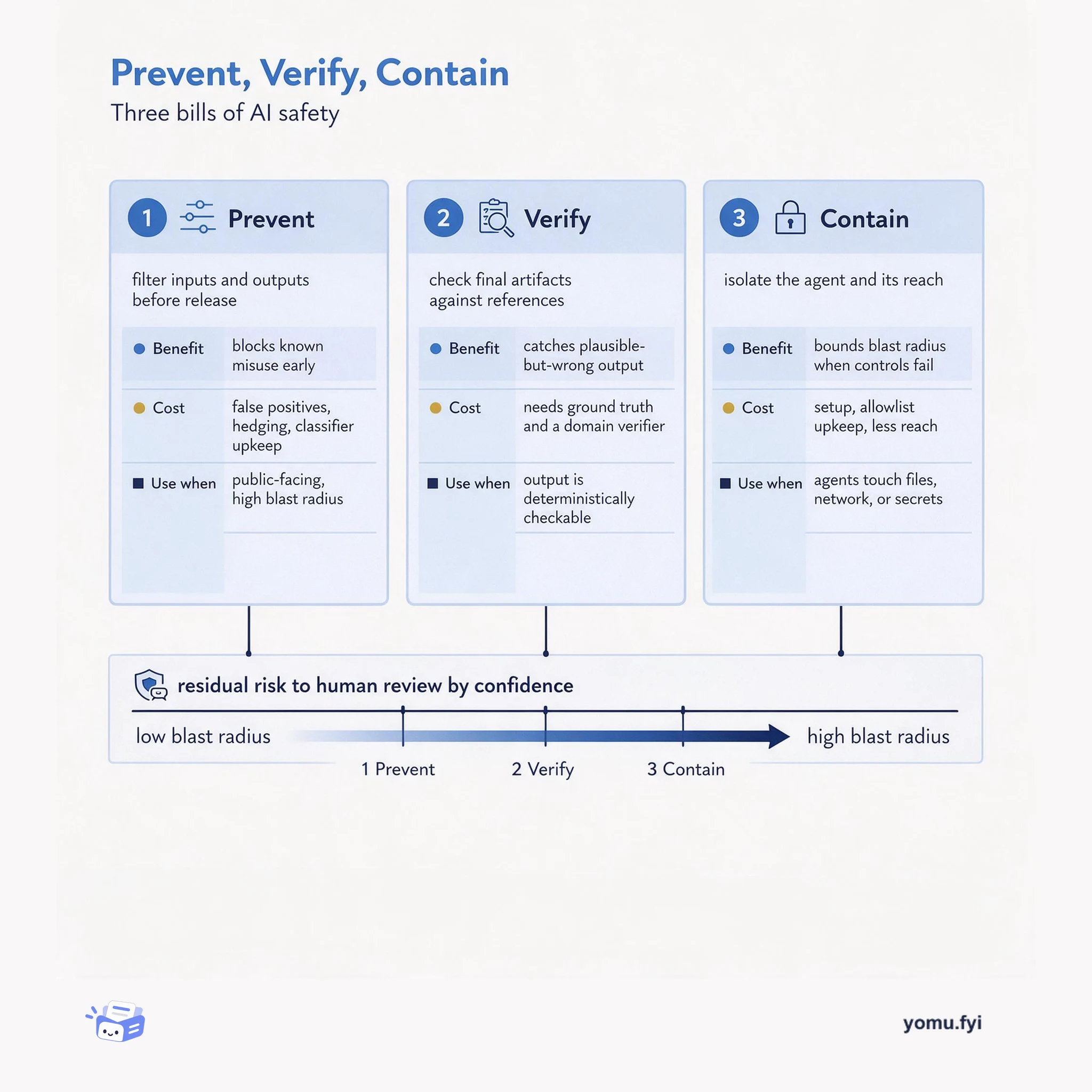
Prevent, Verify, Contain: The Three Bills of AI Safety
AI safety is a budget: prevention, verification, and containment each buy different protection at a different cost. This map shows what each control costs and when it pays off.
APAC is a federation of markets, not a single deployment region. This diagram maps the tradeoff between local autonomy and one shared platform, and the conditions that decide it.
APAC spans five of the world's top 13 economies, and each market brings its own residency rules, languages, and buying behaviour. The tradeoff: regionalized autonomy fits local demand and keeps regulated data in place, but a single standardized platform avoids duplicate builds and divergent definitions. This explainer lays out the benefit, the cost, and the conditions that should tip the decision. It draws on patterns such as redacting data before export, publishing only aggregate signals above minimum-count thresholds, and sharing common data contracts while each party keeps custody of its own records.
When residency or privacy rules apply, or when the raw records carry identity the use case does not need. The outbreak-detection concept shows the alternative: aggregate eligible purchases into broad symptom classes, use coarse geography and minimum-count thresholds, and avoid individual-level inference. Centralize the derived signal, not the raw records.
Fragmentation. Local teams interpret the same concept differently and definitions change fast, so every agent or service rediscovers the business from scratch. The first cost is duplicated platform work; the second is answers that disagree between markets.
Yes: a shared contract with local custody. Contractors in a federated exchange publish validated records to named recipients while raw data stays with the owner, and small suppliers use the same data contracts as large primes. Apply that shape to APAC: one governed definition, many local holders.
The posts behind it
 Grab · · Explainer
GrabMart transaction data could supplement clinical surveillance because over-the-counter demand sometimes shifts before confirmed case reports. The concept aggregates eligible purchases, maps SKUs to broad symptom classes, and compares demand series against seasonal and historical baselines to produce an Early Outbreak Detection Index. Public health experts would review that aggregate signal alongside independent evidence, and the method excludes identity linkage and individual-level health inference. Statistical evaluation would need sensitivity, false-alert rate, calibration, geographic stability, and retrospective testing against approved public health data, with ongoing monitoring for catalogue changes, promotions, and shifting purchasing behaviour. Privacy relies on data minimisation, coarse geography, aggregate time windows, minimum-count thresholds, and possibly differential privacy under an approved budget; the authors state this is early-stage planning only, with no deployment, measured performance, or integration claimed.
 Databricks · · Problem & solution
The post argues that model intelligence is no longer the bottleneck for enterprise AI; the real gap is business context — the unique knowledge about an organization’s processes, customers, and products. Without proper grounding, agents resort to brute force, iterating through guesses and burning tokens while producing unreliable answers. While building a well-grounded agent for a single domain is now easier, scaling context across hundreds of agents in an enterprise remains unsolved due to fragmentation, fast-changing definitions, and differing team-specific interpretations of the same concepts. Genie Ontology addresses this by providing a unified, governed context layer that combines intentionally curated knowledge with automatically learned observations from system usage. This enables every agent connected to Databricks to work from the same consistent business understanding, supporting accurate answers without each agent rediscovering the business from scratch.
Databricks · · AnnouncementClara Kurian, Databricks’ first university recruiter for APJ, leads the company’s early career hiring in India. Databricks has invested over $250 million in India, treating it as a strategic hub rather than a satellite office, with workforce growth of 270% since 2022 and leadership expansion of 350% across all business units. Clara designed the first structured India Intern Program with 51 interns, aiming to give them a genuine experience of the company’s pace, people, and culture through Speed Mentoring with engineering leadership and activities like Sneaker Art and Pickleball socials. She advises early career candidates to build strong fundamentals, curiosity, and a builder mindset, noting that the field moves fast and thrives on continuous learning. Candidates stand out by showing genuine curiosity, authenticity, and a willingness to figure out unknown problems, as the technical bar is almost a given.
 Cloudflare · · Announcement
Cloudflare Logpush now supports Transformers, allowing teams to filter, redact, and reshape log streams using SQL before export to SIEMs, analytics platforms, or object storage. This eliminates the need for a separate processing service that teams would otherwise have to deploy, scale, and maintain. Transformers are SQL queries applied per batch within Logpush’s high-throughput pipeline, using Apache DataFusion and Arrow for columnar execution. The implementation embeds DataFusion in Bufstream, the Go-based delivery service, using cgo and Arrow IPC to pass typed batches across the language boundary without introducing network hops. Customers can create, preview, and version Transformers via the dashboard or API, and attach them to NDJSON Logpush jobs to reduce downstream data volume and cost.
 MongoDB · · Explainer
MongoDB’s go-to-market organization in APAC has nearly tripled in size over the past three years, driven by the region’s massive database opportunity. IDC forecasts the global database market will grow to $137 billion by 2027, and MongoDB has reached $1 billion in annual recurring revenue, with APAC containing five of the world’s top 13 economies by GDP. To serve diverse markets like India, Australia, and Singapore, MongoDB deploys regionalized business leaders who tailor go-to-market strategies while collaborating on shared best practices at the leadership level. The company’s culture, shaped by six core values including “Embrace the Power of Differences,” emphasizes psychological safety and accountability, encouraging teams to learn from setbacks. MongoDB’s APAC teams prioritize three goals: ensuring customer success, building technical champions, and driving new workloads, as exemplified by Cathay Pacific’s Flight Folder application powered by MongoDB.
Databricks · · Problem & solutionThe Department of War cannot obtain cost transparency across its supply chain of over 200,000 suppliers due to reliance on manual data calls and fragmented spreadsheets. The proposed solution is a federated data exchange where each contractor publishes validated cost and pricing evidence from existing records to named government recipients using open-source sharing protocols. Databricks provides the platform, enforcing governance, access controls, CUI markings, and audit lineage without storing raw records centrally or requiring contractors to adopt Databricks. Small and mid-tier suppliers submit through validated intake forms that produce the same governed data contracts as large primes, requiring no new accounting systems. The reporting obligation already exists through CSDR, FlexFile, and DD Form 1921, so a pilot exchange can launch in months by defining two data contracts on a single program.
More like this
AI safety is a budget: prevention, verification, and containment each buy different protection at a different cost. This map shows what each control costs and when it pays off.
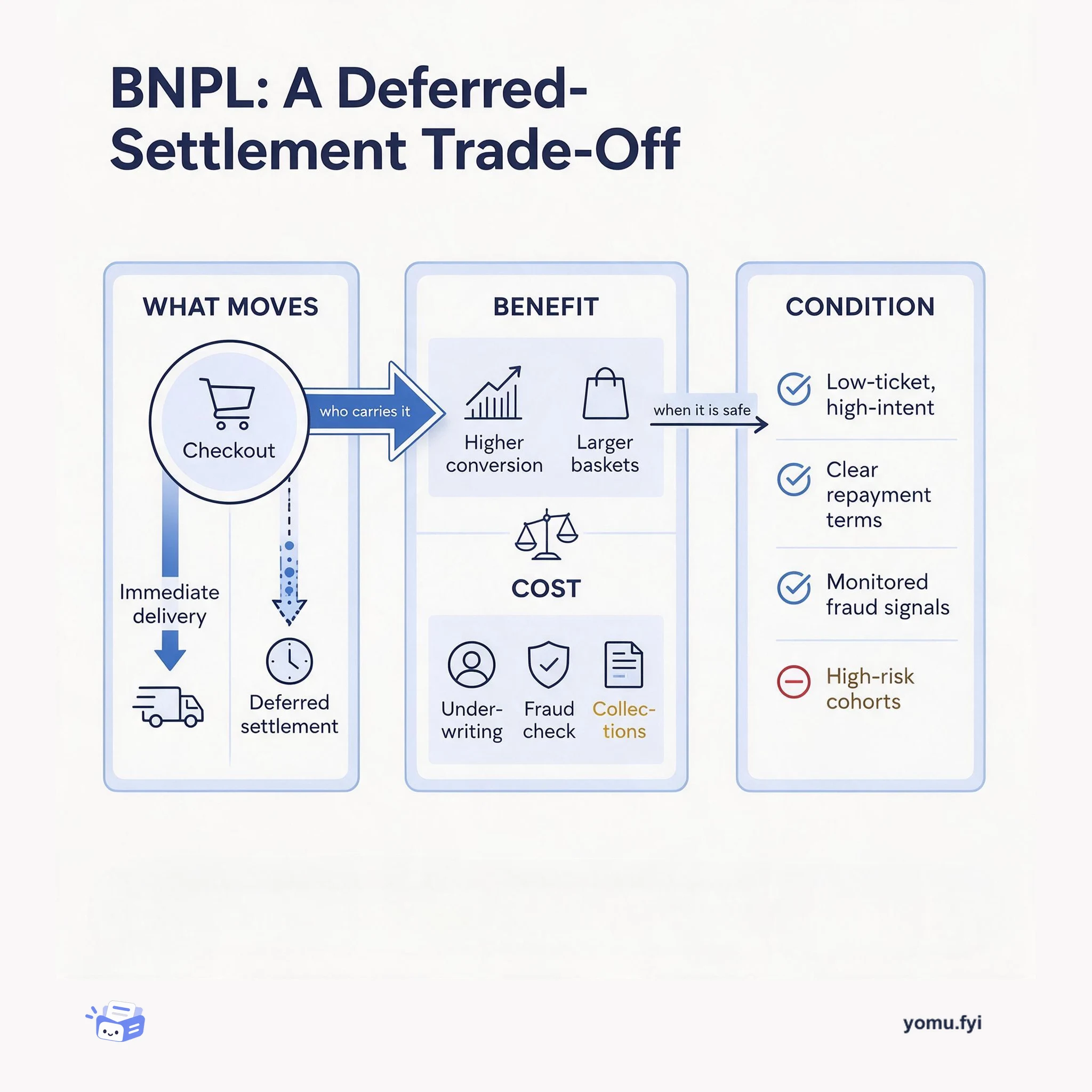
Buy Now, Pay Later is a deferred-settlement trade-off: merchants gain conversion while underwriting, fraud, and collections risk move elsewhere. This diagram maps the benefit, the cost, and the condition that decides.
Bare metal gives engineers direct control over GPU, network, and virtualization layers, but it shifts elasticity and lifecycle work onto the team. This trade-off map shows when that bargain pays off.
The Good Stuff
Paid picks we use ourselves. Links carry a referral code — a subscription through one earns us a commission at no extra cost to you.
One useful email. Unsubscribe anytime.