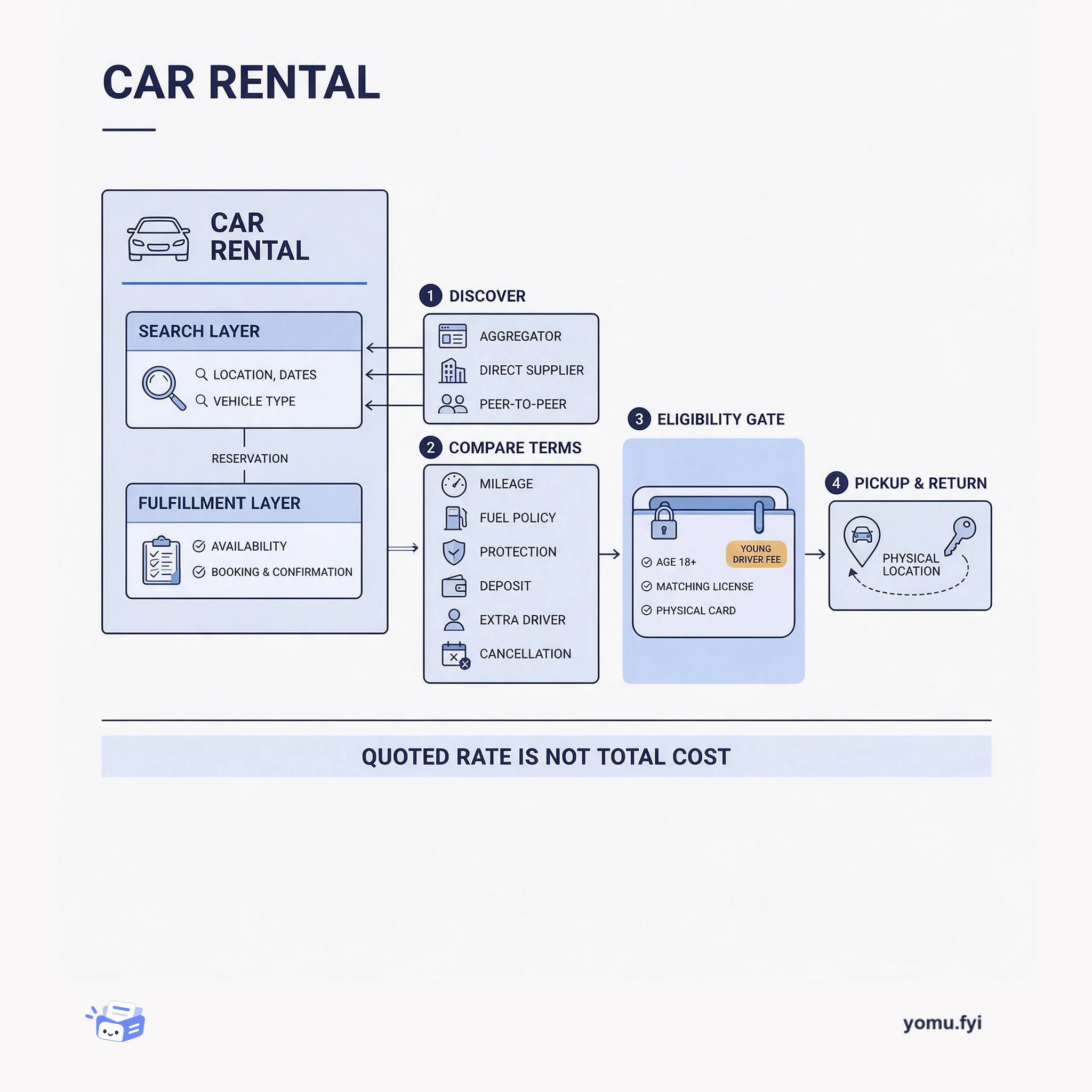
Car Rental: A Search Layer, a Contract, and a Handover
A car rental is a search layer over many fleets plus a contract enforced at the counter. This explainer maps its four parts and why the advertised daily rate never equals the total cost.
Arabic is not a single target for a language model. This explainer maps its four parts — dialect surface, data pipeline, model, and evaluation — so you can tell where an Arabic feature really succeeds or fails.
Arabic is not a single target for a language model. Modern Standard Arabic, Gulf dialects, and Emirati Arabic each carry their own vocabulary and cultural context. This explainer breaks dialect adaptation into four parts you can reason about: the language surface, a data pipeline of authentic plus glossary-guided synthetic text, the model, and the benchmarks that prove it worked. Falcon-Emirati-7B shows the pattern in practice, so reading this helps you judge where an Arabic feature actually succeeds instead of treating it as a checkbox.
Modern Standard Arabic models miss the distinct vocabulary and cultural context of Gulf dialects, which is exactly what a dialect-specialized model has to recover. Falcon-Emirati-7B was built on Falcon-H1-Arabic specifically to understand and generate Emirati Arabic, coverage that MSA-focused training does not provide.
Adaptation required authentic Emirati web content, MSA material about Emirati culture, and synthetic data guided by strict glossaries and style rules to cover gaps in available dialectal text. The synthetic layer fills missing coverage, and the glossary and style rules act as the quality gate on what gets generated.
Falcon-Emirati-7B scored 84.83% on the Alyah dialect benchmark and 85.57% on the UAE cultural understanding task in ArabCulture-Dialogue, outperforming larger multilingual models. The 7B size was chosen as the best balance of quality against training and inference cost, not as a maximum.
The posts behind it
 Hugging Face · · Announcement
Falcon-Emirati-7B is a dialect-specialized language model built on Falcon-H1-Arabic to understand and generate Emirati Arabic, a Gulf dialect with distinct vocabulary and cultural context that Modern Standard Arabic models miss. The model uses a hybrid architecture combining Mamba state-space models and Transformer attention running in parallel inside every block, with fused outputs for efficient long-context processing. Training required a dedicated data pipeline of authentic Emirati web content, MSA material about Emirati culture, and synthetic data guided by strict glossaries and style rules to cover gaps in available dialectal text. On the Alyah benchmark, Falcon-Emirati-7B scored 84.83%, outperforming larger multilingual models, and achieved 85.57% on the UAE cultural understanding task in ArabCulture-Dialogue. The 7B parameter size was chosen as the best balance of quality against training and inference cost for dialect adaptation.
 Salesforce · · Explainer
Enterprise AI agents without persistent memory suffer from the “Groundhog Day” problem, repeatedly asking users to re-explain themselves. Agentforce Memory addresses this by giving agents persistent memory that retains user preferences, conversation history, and context across sessions. The team first established a shared terminology document to define concepts like semantic and episodic memory before architectural discussions could proceed. The architecture evolved incrementally, starting with conversation history injection and later adding semantic retrieval to find relevant past information regardless of recency. Memory retrieval uses keyword search during pre-orchestration to balance context quality with low latency, and moving memory into the Reasoner simplified configuration for administrators. Privacy and user trust were treated as architectural requirements from the start, enabling individual user controls over memory creation and management.
 Databricks · · Problem & solution
General-purpose AI agents fail on business questions because they lack enterprise context such as authoritative tables, business rules, and trusted experts; the missing institutional knowledge is scattered across dashboards, documents, and people. Databricks’ Genie Ontology addresses this by continuously updating institutional knowledge from certified Unity Catalog concepts and automatically learned snippets from dashboards, notebooks, SQL queries, and connected apps. OntoRank ranks sources by authority using certification, usage, and authorship signals, so Genie grounds answers in the most trusted and relevant data. In a weekly adoption review, a product manager prompts Genie, which uses MCP to search Google Docs and Jira while running live SQL for fresh analysis. The resulting report includes citations, forecasting, scheduling, and even conversion into a shareable Genie Agent, all within permission boundaries.
 Clickhouse · · Announcement
Executable user-defined functions (UDFs) have moved from public beta to general availability on ClickHouse Cloud across AWS, GCP, and Azure. The GA release adds a Native runtime for precompiled statically linked binaries in Rust, Go, C++, and JavaScript, requiring both amd64 and arm64 architectures, alongside the existing Python support. UDFs now have network access to public endpoints, a per-process memory limit, a deterministic flag that enables query caching, and are not billed separately, running inside service pods. ClickHouse 26.6+ provides eight ProfileEvents counters and two asynchronous metrics for per-query UDF cost monitoring, and the Cloud API and Terraform provider support UDF management with per-service version pinning. The post demonstrates counting LLM tokens and grading completions using these UDFs, showing how to put tokenization libraries next to the data in ClickHouse.
 Red Hat · · Tutorial
LangGraph agents can call tools and follow prompts but lack safety guardrails, risking unsafe responses like explaining fraud. NeMo Guardrails acts as a transparent proxy between the agent and LLM, inspecting every request and response without requiring agent code changes. On Red Hat OpenShift AI, the guardrails service is deployed via a NemoGuardrails custom resource managed by the TrustyAI Operator, and the agent’s BASE_URL points to this service instead of the model endpoint. The example demonstrates three rail types: regex filtering for jailbreak patterns, content safety classification against S1-S13 categories, and topic safety to keep the agent within a banking domain, with optional tracing using MLflow and OpenTelemetry. Rails execute sequentially, with the first failure short-circuiting the chain, and the separation lets safety policy be owned by guardrails while the agent handles reasoning and tools.
More like this
A car rental is a search layer over many fleets plus a contract enforced at the counter. This explainer maps its four parts and why the advertised daily rate never equals the total cost.
An app store is a distribution surface, a versioned contract, and a health loop between a platform and its developers. Here is how those parts fit together and why each one fails loudly if ignored.
A GPU-resident astronomy pipeline keeps every stage of image analysis — load, align, subtract, detect, review — inside GPU memory instead of round-tripping through the CPU.
The Good Stuff
Paid picks we use ourselves. Links carry a referral code — a subscription through one earns us a commission at no extra cost to you.
One useful email. Unsubscribe anytime.


