Pass@1 vs. pass@k: Two Ways to Read One Benchmark
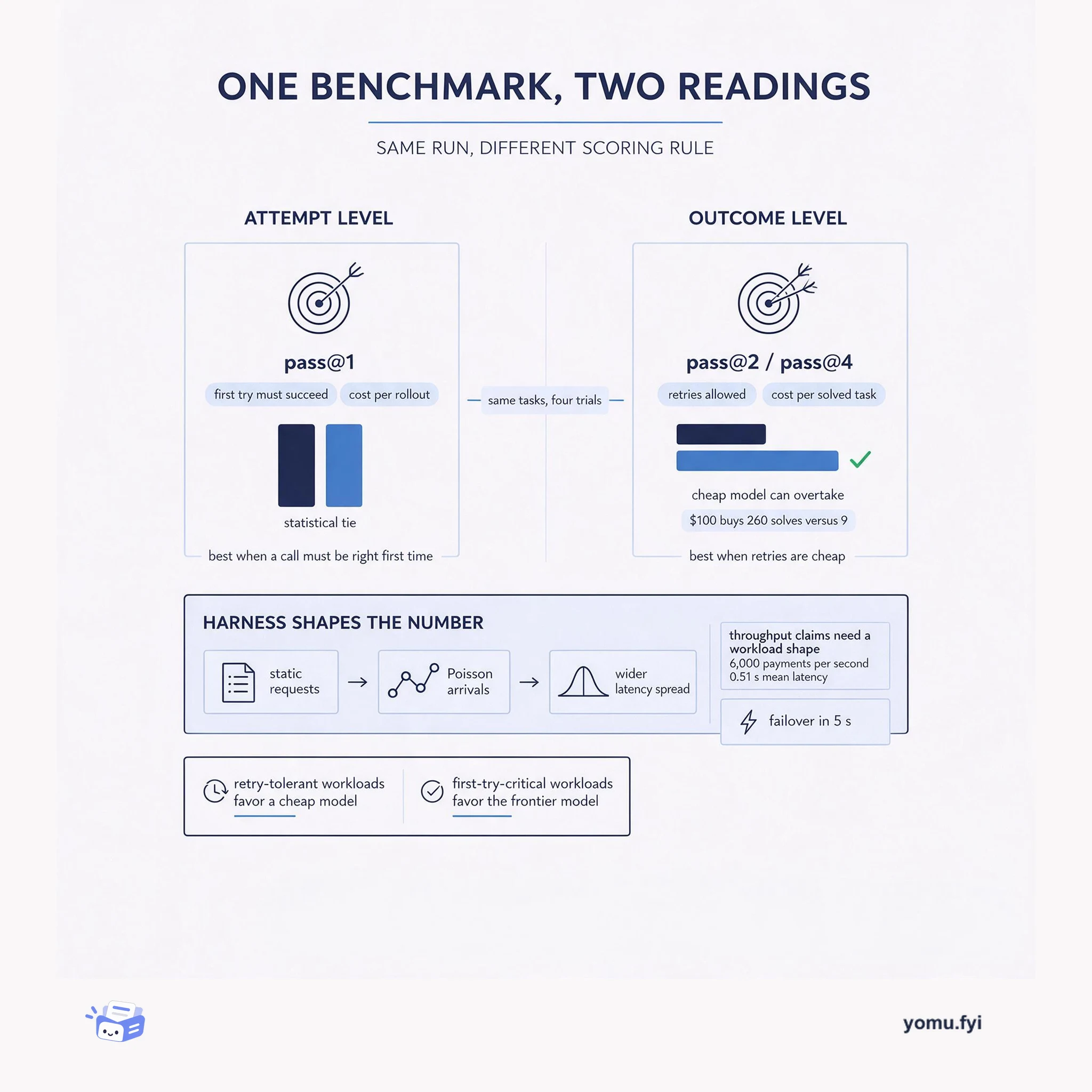
A benchmark can support two different verdicts: pass@1 on the first attempt, or pass@k with retries measured as cost per solved task. This comparison shows which reading matches your workload.
Loading…
Topic
64 posts about Model Evaluation. Every summary links to the original.
See the idea
A benchmark can support two different verdicts: pass@1 on the first attempt, or pass@k with retries measured as cost per solved task. This comparison shows which reading matches your workload.
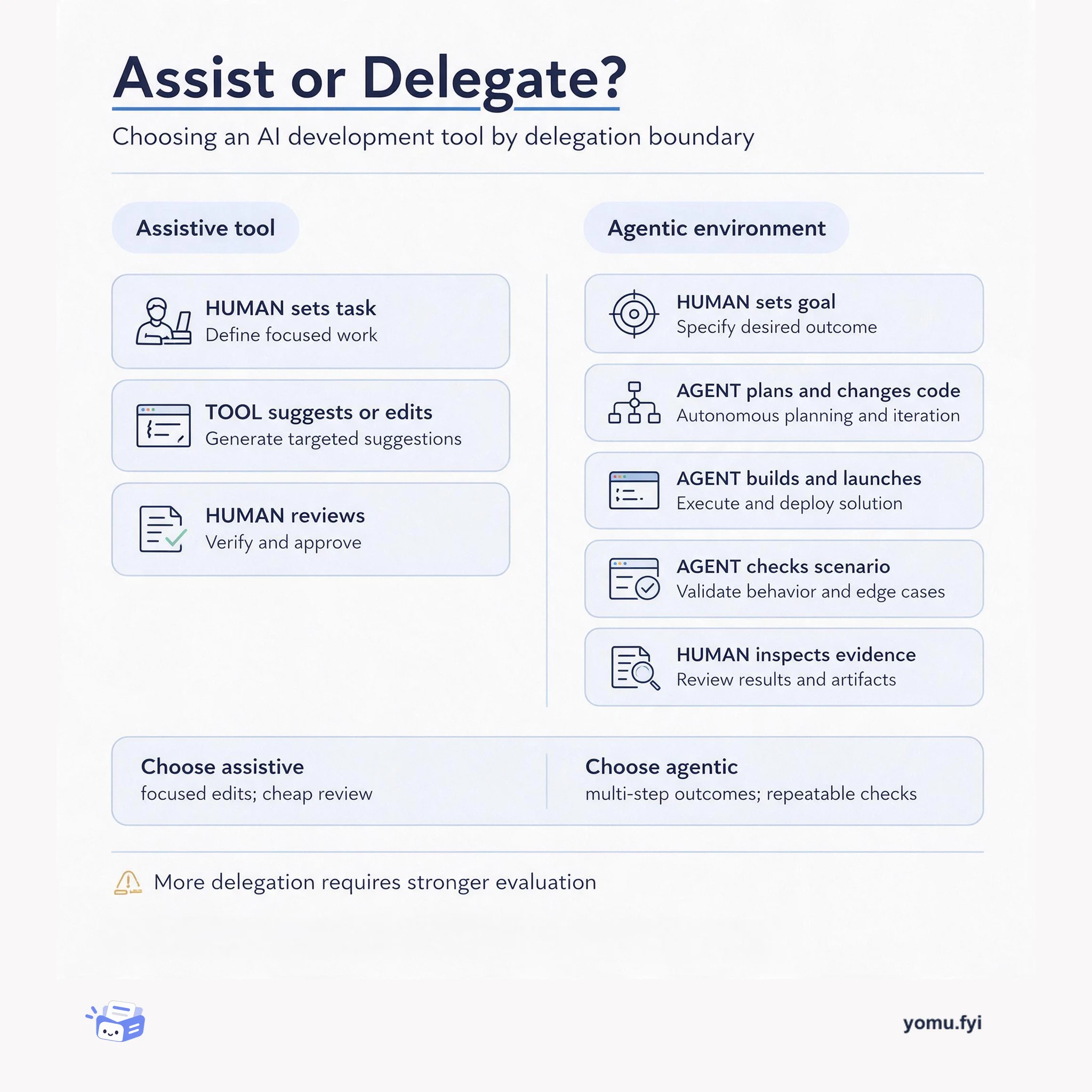
Compare assistive coding tools with agentic development environments to see where human control, automation, verification, and evaluation belong in the workflow.
The Good Stuff
Paid picks we use ourselves. Links carry a referral code — a subscription through one earns us a commission at no extra cost to you.
Newest first
This installment evaluates local NeMo Guardrails configurations against large-scale risk datasets using EvalHub, following earlier manual testing. EvalHub provides a unified interface for AI evaluation, with provider integrations, reusable benchmarks, Hugging Face dataset inputs, and both local and Kubernetes deployment options. The benchmark configuration maps dataset prompt and label columns to block and pass labels, while balanced safe and risky examples prevent an always-block guardrail from appearing perfect. On the prompt-injection benchmark, the nuanced regex configuration achieved 51.1% accuracy with 13.7 ms median latency; DeBERTa reached 88.93% accuracy with 45.2 ms median latency. The conclusion favors layered guardrails: targeted regex checks can provide speed, with DeBERTa handling other cases, and EvalHub supplies reproducible measurements of the latency–efficacy trade-off.
The conversation examines the economics and platform implications of operating dozens or hundreds of AI agents rather than a small number of human-driven workflows. Andi Gutmans argues that many current models are already sufficient for automation, shifting the optimization problem to the complete system: model, harness, context, personalization, and evaluation. The goal is the least sophisticated model and smallest viable context that produce a reliable outcome at the lowest cost, with better trajectories reducing reasoning loops and token processing; Google’s stated approach is to hill climb models and data together. The discussion also addresses cost governance, search and observability for agents as a distinct persona, human-in-the-loop handling, and the continuing importance of computer-science fundamentals, agentic fluency, and business judgment.
Reliable AI agents can fail in production through incorrect tool use, off-topic reasoning, or plausible but incorrect answers that unit tests, static benchmarks, and logs may not expose. This tutorial builds an eval-driven trace-evaluation pipeline on Red Hat OpenShift AI 3.4 or later, using MLflow to store structured agent traces and evaluation artifacts, IBM CLEAR to score reasoning quality, relevance, and tool usage with an LLM judge, and EvalHub to orchestrate OpenShift jobs. It uploads eight prerecorded multistep research-agent traces, each containing at least 30 spans, then verifies them in MLflow before deploying EvalHub, registering the ibm-clear provider, and configuring judge-model credentials. Standard mode evaluates steps holistically, while SPARC mode gives tool calls separate scoring rows; the resulting workflow produces critiques and ranked failure patterns with frequency, severity, and step or agent attribution.
This guide presents a low-cost recipe for improving structured-output compliance in Liquid AI’s LFM2.5-350M, a task where parseable, schema-adherent responses determine whether an LLM can feed downstream systems. It fine-tunes the model with Group Relative Policy Optimization (GRPO) through TRL, using about 500 samples, 100 steps, three weighted rewards for format, field count, and JSON Schema validation, and a LoRA adapter training roughly 6M parameters. Prompt augmentation covers fenced-code-block instructions and top-level-array tasks, while evaluation uses IFStruct with llama.cpp on an OpenAI-compatible local server. On 2,000 IFStruct samples, the BF16 base model passes 22.6%, rising to 29.7% after tuning. JSON improves from 18.0% to 31.9%, bare-list compliance from 16.6% to 29.7%, while YAML changes little.
REFACTOR-VLA addresses the weakness of monolithic vision-language-action (VLA) models, which generate raw commands or short action sequences and struggle with long-horizon tasks and interpretability. Its wake/sleep architecture uses a Behavioral-Equivalence Kernel (BEK) to cluster motor-program segments by outcomes from a learned latent world model, then produces typed lambda terms for a library-conditioned rectified-flow action decoder. Skills are admitted only when they satisfy both Minimum Description Length (MDL) and return-preservation gates, while training proceeds through world-model warmup, wake-phase policy optimization, and sleep-phase skill discovery. On the full LIBERO benchmark, expanding the world model from 188 million to 430 million parameters worsened results on all four suites, showing that scale alone was not beneficial. Adding supervised contrastive InfoNCE loss during warmup substantially improved sleep-phase clustering, with reported NMI scores of 0.462, 0.867, 0.915, and 0.754 for the Object, Spatial, Goal, and LIBERO-10 suites, respectively, under n = 3 multi-seeding.
BenchMIRT is a method for auditing LLM benchmarks at the individual-prompt level, where questions may measure capabilities beyond a benchmark’s stated goal. It applies multidimensional Item Response Theory (MIRT) to model and question results, estimating model abilities plus each item’s difficulty and discrimination across dimensions. Trained on 100 LLMs, 16 benchmarks, and more than 34K questions, it independently recovered safety and general reasoning as dominant dimensions, repeatedly producing the same result. The analysis found, for example, that BBQ and WMDP aligned more strongly with reasoning than safety, while HarmBench combined safety- and reasoning-associated question groups; retaining 10% of items generally preserved capability rankings, and held-out correctness prediction reached 79% versus 70% for a baseline. BenchMIRT’s dimensions depend on the benchmark set, and its item-level transparency can also enable evaluation trimming.
The GLM-5.3 Flash, a distilled variant of the full GLM-5.3, achieves a pass@1 of 63.4% on the DeepSWE benchmark at $0.24 per rollout, 17 times cheaper than the full model’s 69.0% at $3.99. The pass@4 gap narrows to 2.6 points (87.6% versus 85.0%). Distillation removed consistency rather than capability: the Flash solves 93 of the 99 tasks the full model solves, but its ability to convert extra effort into a win is lost (46% win rate on flaky tasks versus 61%). A cascade that runs Flash first and escalates to the full model only when the answer is rejected solves 80.9% of tasks at $1.70 each, 57% lower cost than using the full model alone.
An evolving framework addresses AI harms beyond catastrophic risks, covering concerns such as biological threats, child safety, disinformation, and fraud. It complements the Responsible Scaling Policy by examining physical, psychological, economic, societal, and individual-autonomy impacts, then assessing likelihood, scale, affected populations, duration, causality, technology contribution, and mitigation feasibility. Policies and practices include a Usage Policy, pre- and post-launch evaluations, red teaming, adversarial testing, misuse detection, and enforcement ranging from prompt modifications to account blocking. Examples include computer-use safeguards for banking platforms and communications tools, plus hierarchical summarization intended to detect harms while maintaining privacy standards, alongside model-response evaluations balancing helpfulness with harmlessness. For Claude 3.7 Sonnet, encouraging safe, helpful responses to ambiguous prompts produced a reported 45% reduction in unnecessary refusals while maintaining safeguards against truly harmful content; the broader approach remains under development.
AI red teaming is presented as adversarial testing intended to identify vulnerabilities and risks in AI systems, but inconsistent practices make safety comparisons difficult. The post surveys domain-specific expert testing, policy vulnerability testing, frontier-threat assessments, multilingual and multicultural work, language-model-assisted attacks, automated red teaming, multimodal testing, and crowdsourced or community-based approaches. It describes an iterative process in which experts articulate threat models and probe systems qualitatively, then standardize inputs and use language models to generate many variations for more quantitative automated evaluation. In automated red teaming, a red team model generates attacks and a blue team model is fine-tuned on those outputs to improve robustness. The conclusion calls for technical standards, independent testing capacity, professional services, third-party access, and links between red teaming and model release conditions.
A $5 million grant program will fund independent research into how AI affects user wellbeing, offering direct funding, model access, and technical support for open-source evaluations. The initiative addresses the difficulty of judging wellbeing-related behavior, where risks may emerge only across long, shifting conversations and where otherwise reasonable advice can become harmful in a different context, such as disordered eating. Grantees will work independently and publish reusable evaluations or benchmarks, with guidance asking projects to define pass/fail criteria, involve clinical and subject-matter experts, test overcompliance and overrefusal, model realistic multi-turn scenarios, and validate graders against experts. Applications are due September 21, with selected full-proposal applicants notified by October 5.
Medium revisited its aging NSFW text-classification model, which had outdated code, infrequent retraining, and poorly documented training and performance history. The replacement uses an LLM prompt containing NSFW guidelines and story content, requesting a 0-to-100 score, structured output, and a short reason rather than requiring a training set. To evaluate it, the team created a curator-labeled dataset with deliberate oversampling of NSFW stories, then compared several LLMs with the legacy model using false-positive and false-negative metrics. Some models matched or exceeded the legacy model; the team selected Mixtral 8×7b based on cost and performance and ran inference in Snowflake. The post presents this as a strong fit where training data is costly, trends are relatively stable, and only distribution-eligible stories need scoring, while topic and spam models still benefit from continuously updated datasets.
Fin’s new Evals and Releases provide an evaluation and rollout system for testing changes before launch, controlling deployment, and assessing live conversations, alongside Monitors. Evals group multi-turn Simulations built from real conversations around a theme, then score them pass/fail using deterministic checks and an LLM judge against criteria such as required responses, Procedures, or data connector calls. Releases let teams edit content, Procedures, and Guidance away from live Fin, run Evals on proposed changes, collaborate, and publish to everyone, ramp traffic, A/B test, or roll back. Monitors evaluates every live conversation and can turn failures into new Simulations for subsequent testing. The combined workflow addresses probabilistic behavior, regression risk, and drift as support content and policies change, while Operator can draft changes, tests, and Releases for review and approval.
Enterprise intelligence requires more than the plausible answers produced by general-purpose LLMs: it needs accurate insights from vast real-world brand data, supported by statistics, governance, and domain expertise. LLMs can hallucinate, miss context, produce inconsistent answers, and rely on limited, non-randomly sampled sources, making them unsuitable as the sole basis for high-stakes decisions. The article argues for matching technologies to tasks, using statistical models for quantitative problems such as social and online-news Reach, specialized classifiers for other tasks, and generative AI to synthesize model outputs. At enterprise scale, crisis and reputation use cases also demand near-real-time speed, consistency, predictability, explainability, auditability, monitoring, and bias testing. LLMs still have a role, including as orchestrators grounded in high-quality data, workflows, specialized models, and rigorous evaluation; the proposed future combines varied models rather than choosing between LLMs and traditional AI.
Claude Sonnet 5 is introduced as an agentic Sonnet model that plans, uses browser and terminal tools, and operates autonomously. The post says it approaches Opus 4.8 performance at lower prices while improving on Sonnet 4.6 in reasoning, tool use, coding, and knowledge work. Comparisons on BrowseComp and OSWorld-Verified across effort levels show a wider cost-performance range, with higher-effort results matching Opus 4.8 on some tasks. Safety assessments found lower overall undesirable behavior, hallucination, and sycophancy rates than Sonnet 4.6, while default cyber safeguards address dangerous usage; the model is available across all plans and via the Claude API for $2 per million input tokens and $10 per million output tokens.
Agent and model evaluations in Agent Platform are now generally available, providing one engine and consistent metrics for measuring agents and models during development and against live production traffic. The service offers more than 20 pre-built metrics across quality, safety, grounding, tool use, trajectories, and reference-based tasks, plus adaptive rubrics that generate case-specific criteria and a versioned, org-wide registry for custom code-based or LLM-as-a-judge metrics. Experiments can run locally or server-side, with Cloud Storage artifacts supporting auditability and reproducibility, while case generation, user simulation, and environment simulation expand coverage and model slow or failing backends. Online monitors grade sampled production traces, chart scores over time, and issue drift alerts through configured channels. Access is available through the SDK, REST API, agents-cli, console, and ADK; model-based metrics incur standard model-call charges, while code-based and computation metrics add no additional cost.
Anthropic CEO Dario Amodei states that Anthropic has never advocated banning open-weights models, while distinguishing models without dangerous capabilities as a public good from risks associated with sufficiently capable systems. The post identifies two concerns: authoritarian governments gaining military superiority or enabling repression, and powerful models being misused for cyberattacks, biological attacks, or serious alignment problems. It argues open weights can increase misuse risk because guardrails and monitoring are difficult after release, but says banning their use by US businesses would not address bad actors. Instead, Amodei supports restricting powerful chips and chipmaking equipment exports to China, disrupting industrial-scale distillation, and requiring global pre-release safety testing for sufficiently capable open and closed models. He agrees open weights can expand access, competition, and customer control, but says claims about safeguards should be tested empirically.
Claude Opus 5 is available as a new model positioned near the frontier intelligence of Claude Fable 5, at half its price, while remaining behind Mythos 5 on cybersecurity tasks. Reported results show state-of-the-art performance on coding and knowledge-work evaluations, including Frontier-Bench, alongside strong results on ARC-AGI 3, Zapier AutomationBench, and OSWorld 2.0. The model uses configurable effort settings to trade intelligence for token use, speed, and cost, and is described as stronger at verifying work, iterating, and handling long agentic tasks. It costs $5 per million input tokens and $25 per million output tokens, with Fast mode running about 2.5 times faster at twice the base price. Safeguards allow vulnerability finding while blocking binary-based scanning, penetration testing, and exploit generation, with flagged requests able to fall back to Opus 4.8.
Claude Opus 4.7 is generally available as an upgrade to Opus 4.6, with stated gains in advanced software engineering, difficult long-running tasks, instruction following, self-verification, and higher-resolution vision. The announcement reports benchmark and tester results including a 13% resolution increase on a 93-task coding benchmark, a 0.715 tie for top score across six research-agent modules, and 90.9% on BigLaw Bench at high effort. It also describes safeguards that detect and block prohibited or high-risk cybersecurity requests, while legitimate security professionals can apply to the Cyber Verification Program. The model is offered across Claude products, its API, Amazon Bedrock, Vertex AI, and Microsoft Foundry at $5 per million input tokens and $25 per million output tokens. New controls include xhigh effort, task budgets, Claude Code’s /ultrareview, and auto mode, while migration may increase token counts because of tokenizer and reasoning changes.
The release introduces Claude Sonnet 4.5 as a model aimed at complex coding, agentic work, computer use, reasoning, and math, with claimed gains in alignment. It reports state-of-the-art SWE-bench Verified performance and a 61.4% OSWorld score, up from Sonnet 4’s 42.2%, while noting more than 30 hours of observed focus on complex multi-step tasks. Alongside the model, the company released Claude Agent SDK, added Claude Code checkpoints, a refreshed terminal interface, native VS Code extension, context editing, and a memory tool, and brought code execution and file creation to paid Claude apps. Sonnet 4.5 is available through the Claude API as claude-sonnet-4-5 at $3/$15 per million tokens, the same pricing as Sonnet 4. It is released under AI Safety Level 3 protections, with reported reductions in concerning behaviors and improved defenses against prompt injection, while the temporary Imagine with Claude preview is available to Max subscribers for five days.
Claude Opus 4.6 improves on Opus 4.5 with stronger coding, planning, debugging, code review, long-running agentic work, and performance in large codebases. It is the first Opus-class model with a beta 1M-token context window, while API features include adaptive thinking, four effort levels, context compaction, and up to 128k output tokens. In reported evaluations, it achieves the highest score on Terminal-Bench 2.0, leads frontier models on Humanity’s Last Exam and BrowseComp, and exceeds GPT-5.2 by around 144 Elo points and Opus 4.5 by 190 points on GDPval-AA. The release also adds Claude Code agent teams, upgraded Excel capabilities, a PowerPoint research preview, and availability on claude.ai, the API, and major cloud platforms, with base pricing of $5/$25 per million tokens.
The best engineering reads, once a week.