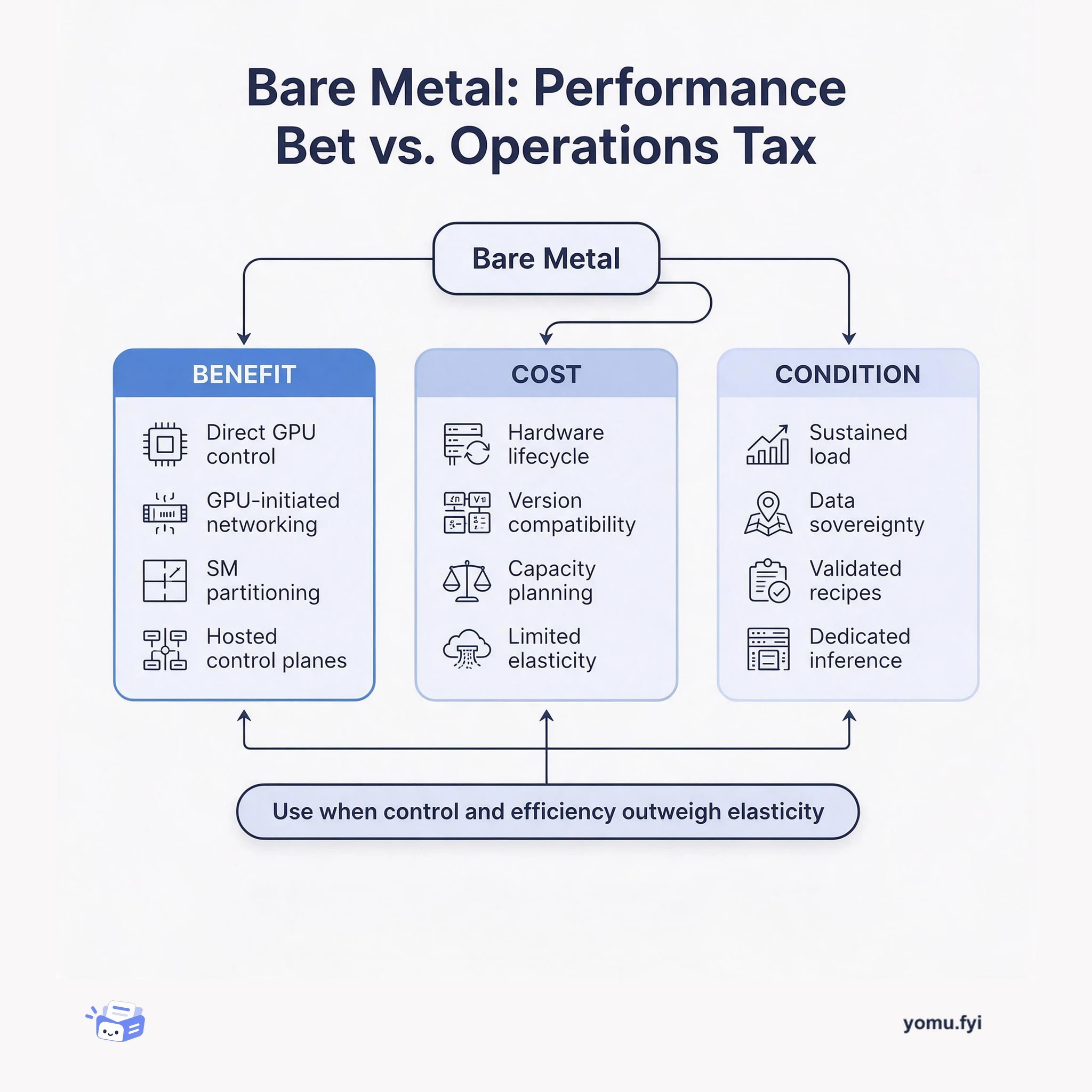
Bare Metal: Performance Bet vs. Operations Tax
Bare metal gives engineers direct control over GPU, network, and virtualization layers, but it shifts elasticity and lifecycle work onto the team. This trade-off map shows when that bargain pays off.
Loading…
Topic
807 posts about Performance. Every summary links to the original.
See the idea
Bare metal gives engineers direct control over GPU, network, and virtualization layers, but it shifts elasticity and lifecycle work onto the team. This trade-off map shows when that bargain pays off.
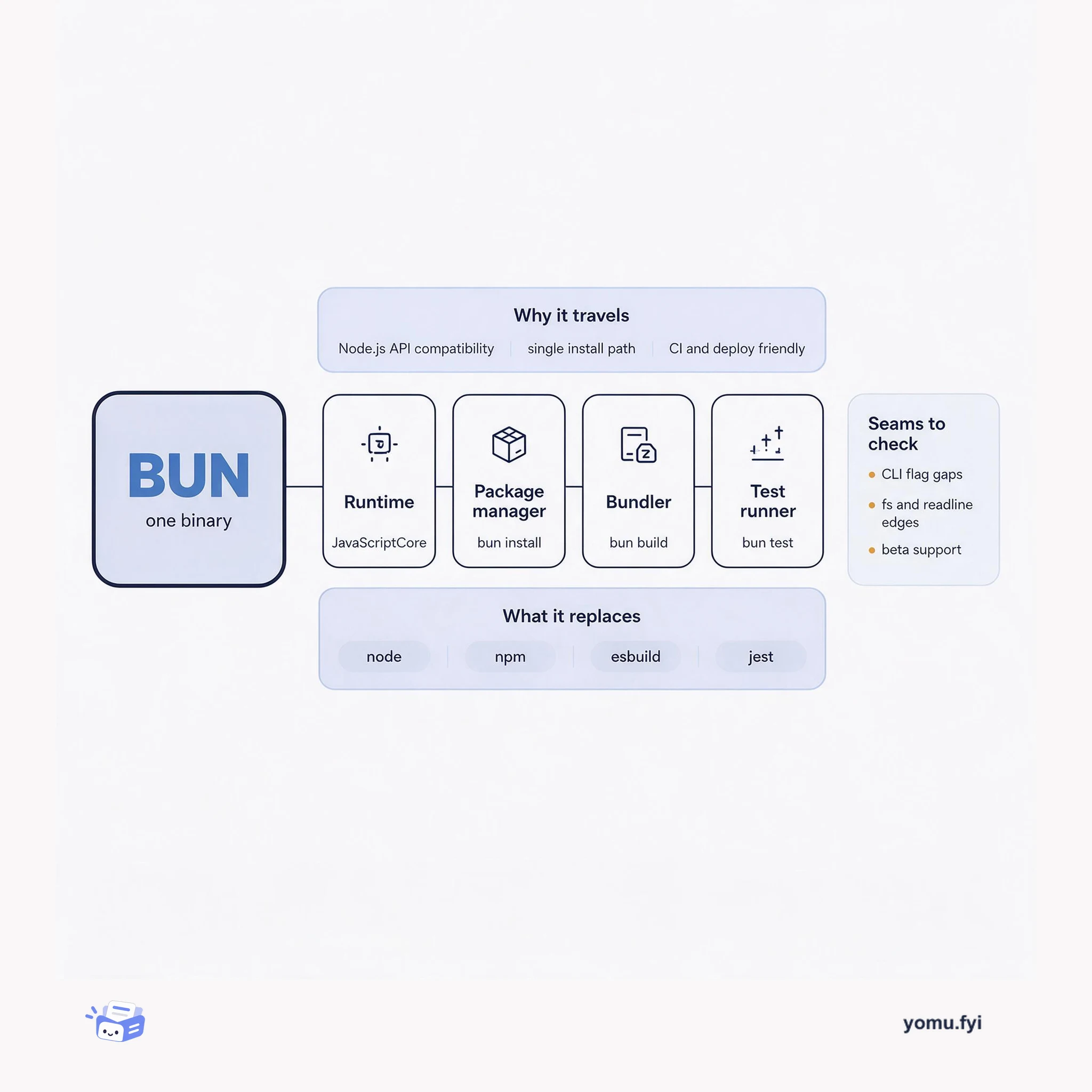
Bun packs a runtime, package manager, bundler, and test runner into one binary. Here is how those four parts fit together and where the seams still show.
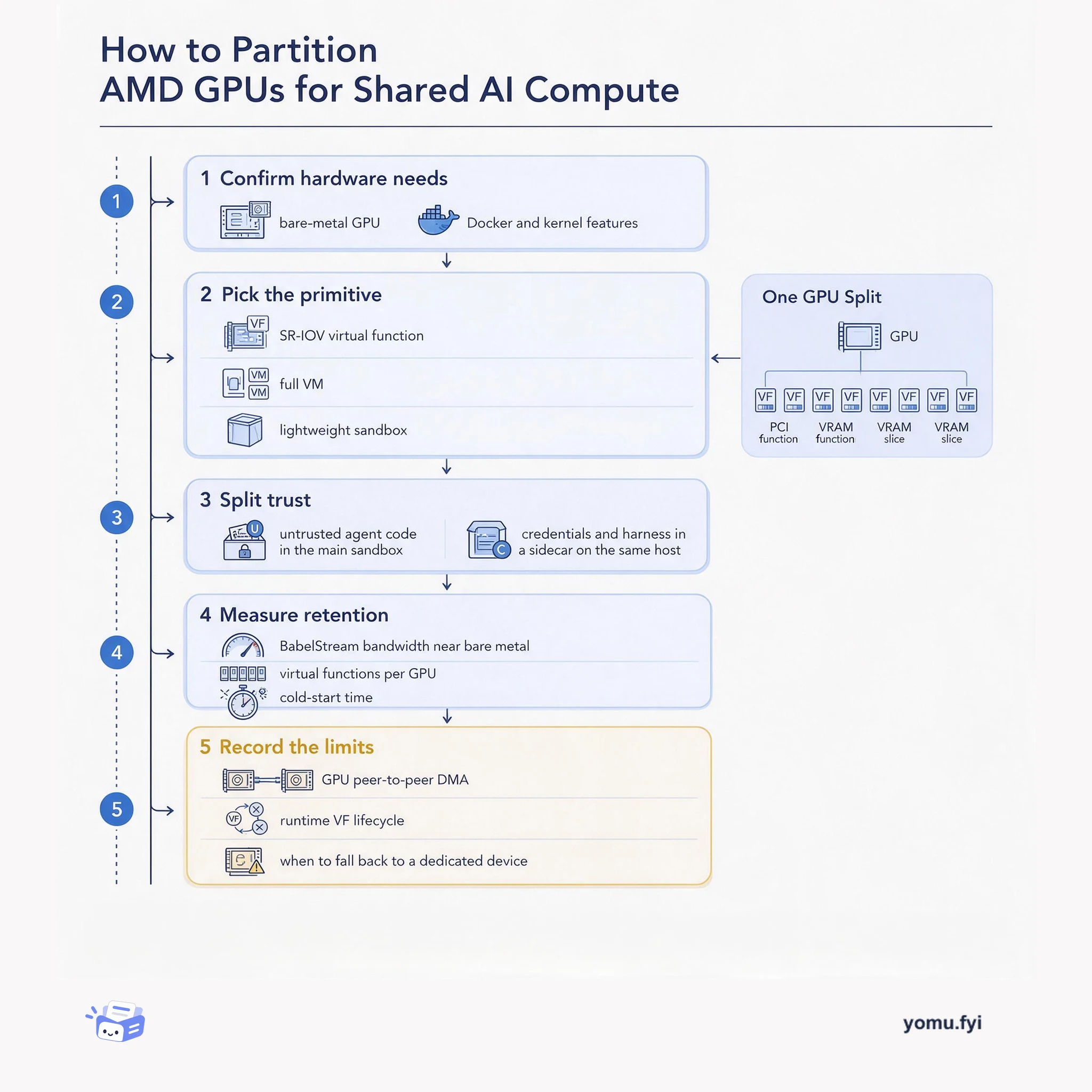
A five-step how-to for deciding when an AMD Instinct GPU should stay dedicated and when SR-IOV virtual functions, VMs, or sidecar isolation can safely share it.
The Good Stuff
Paid picks we use ourselves. Links carry a referral code — a subscription through one earns us a commission at no extra cost to you.
Newest first
Pinterest home feed candidate generation relies on large-scale retrieval, but standard two-tower models produce single embeddings that struggle to capture diverse concurrent user intentions. To solve this, Pinterest expanded Conditional Learned Retrieval (CLR) to generate condition-aware embeddings conditioned on explicit interest, Pin, and Board contexts. The team evolved model representations by appending condition tokens to user sequences in transformers, integrating the PinFM foundation model, and introducing hierarchical semantic IDs to improve cold-start coverage. On the serving side, engineers consolidated duplicate feature requests and shifted inference to GPU instances using NVEmbed under a one-query-to-many-documents paradigm. These infrastructure and modeling changes unlocked new condition types, achieved seven-figure cost savings, and reduced p90 model retrieval latency from 80ms down to 12ms.
Session replay software varies fundamentally based on architecture, distinguishing tools designed for product analytics from those built for developer debugging. Recording approaches split into DOM snapshot and mutation capture, which optimizes for compression and structured debugging, versus pixel capture, which favors visual fidelity for complex animations. Privacy depends heavily on masking location, where client-side masking redacts data before network transmission, whereas server-side scrubbing acts after transmission. For engineering teams, integration depth connects replays natively to traces, console errors, and backend issues rather than requiring timestamp lookups across separate products. Performance costs across CPU, memory, and network require benchmarking on target applications alongside strategies like error-based sampling.
The ClickHouse .NET Driver moved from its 1.0 stable release to versions 1.1–1.3, changing how applications insert, read, and parameterize data while expanding type coverage, configurability, observability, and .NET ecosystem integrations. The largest ergonomic change is registered POCO support: RegisterPocoType() validates mappings up front, pre-compiles getters and setters, and enables InsertBinaryAsync with IEnumerable plus lazy QueryAsync() results through IAsyncEnumerable. Attributes customize column and ClickHouse type mappings, JSON serialization supports POCOs with paths and ignored properties when JsonWriteMode is Binary, and three optional extension points govern parameter type inference, wire formatting, and read conversion. The announced 1.4 roadmap targets allocation reductions, pluggable compression, and box-free POCO operations; version 1.5 is planned to add a Native/TCP client with columnar transfer and server progress information.
Sentence Transformers v6.0 adds MultiVectorEncoder, a fourth model type for ColBERT-style late-interaction retrieval, alongside a training approach for finetuning existing models or building them from base transformers. Multi-vector models retain one small vector per token and score query-document pairs with MaxSim, where each query token selects its best document-token match and the scores are summed. The guide covers models, datasets, loss functions, training arguments, evaluators, trainers, callbacks, and multi-dataset training, with examples using pip install -U "sentence-transformers[train]". On a medical retrieval evaluation, the finetuned multi-vector-encoder/mLateOn-medical model, trained for 14.5 hours on a single RTX 3090, outperformed every general-purpose retrieval model tested across dense, sparse, lexical, and multi-vector systems.
Stripe replaced Envoy in its service mesh after reliability, connection-cardinality, rollout-risk, and customization problems became increasingly difficult at its scale. Mesh-proxy, a Go proxy, implements HTTP/1.1 and HTTP/2, connects directly to Stripe’s service registry, and supports retries, hedging, rate limiting, and dynamic priority-based routing. Unlike Envoy’s worker-per-core model, it uses one read and one write goroutine per connection and multiplexes requests over a shared connection, reducing connection counts from one per worker to one per host. Load tests and deployment results showed about half the CPU under high load and roughly 50% lower latency, equivalent to around 3,000 days of cumulative inter-service latency saved daily. Direct registry integration also reduced unnecessary xDS updates, while custom Ruby balancing added 15–20% headroom before bursts overwhelm machines; Stripe is now pursuing anomaly detection and smart routing.
Recent advancements in large language models necessitate efficient deployment options within constrained inference budgets. While structured pruning offers better token efficiency than training target-sized models from scratch, previous work frequently ignores the pretraining of enlarged models. To resolve this gap, researchers developed an integrated enlarge-and-prune pipeline that unifies enlarged model training, pruning, and recovery under a single cosine annealing learning rate schedule. This system incorporates an iterative structured pruning technique to gradually eliminate parameters, redistributing model capacity across surviving neurons and avoiding the knowledge loss seen in naive approaches. Evaluated on compressing 2.8B parameter models to 1.3B across up to 2T pretraining tokens, the approach yields superior downstream model performance.
LLM engine process failures typically trigger cold restarts that reload weights into HBM, compile kernels, and recapture CUDA graphs, leaving surviving workers to absorb displaced traffic for minutes. Shadow engine recovery, a preview feature in NVIDIA Dynamo, keeps a fully initialized standby on the same GPUs as the active engine. GPU Memory Service (GMS) preserves one physical weight copy across engine processes, while the parked shadow precomputes its CUDA context, graphs, communicators, and mappings but defers KV cache materialization. In a GLM-5.2 test, the shadow resumed service in 7.3 seconds after a worker failure, compared with 283 seconds for a cold restart, reducing post-fault p50 TTFT from 23,815 ms to 1,311 ms and improving decode rate from 12 to 46 tok/s/user. The preview does not cover hardware, node, or multi-node failures and currently starts promoted shadows with empty KV caches.
Capital markets finance must protect returns on a balance sheet exposed continuously to market, funding, and liquidity risk, while funding costs, capital consumption, and liquidity needs can change intraday. Fragmented desk P&L, treasury, and risk data require shared business context, with ontology and governance linking numbers to desks, products, positions, funding, capital, and permissions. Databricks’ Genie One is presented as a data-smart AI coworker that lets authorized finance users investigate governed data, trace emerging funding or profitability issues, and surface the definitions and source evidence behind capital and valuation figures. One top global bank reduced regulatory data processing for liquidity reporting from 10 hours to 8 minutes, while pricing, funding, risk, and capital decisions remain with accountable people.
Suprema Gaming migrated its analytics platform from Snowflake to ClickHouse Cloud on AWS as part of a company-wide move toward agentic operations. The previous stack delivered data about four hours late, required heavy dbt rebuilds, and often took minutes to answer queries, limiting real-time investigations and interactive analysis. Suprema rebuilt ingestion with ClickPipes for supported sources and Debezium plus Kafka for others, while dbt and GitHub Actions deploy the warehouse-layer structure without external cron jobs, Airflow, or a separate orchestrator; governed access uses role-based controls and query-time PII masking. Before cutover, every metric was validated against the reference source, and the resulting platform reduced warehouse spend by roughly 62%, improved direct-read performance 27x, and maintains about one-minute p95 freshness, supporting an early production deployment of ClickHouse Agents.
Databricks is extending declarative ETL patterns into the Lakehouse SQL Editor so SQL practitioners can define recurring transformations without a dedicated pipelines-oriented environment. The initial operations cover append-only updates, change data capture through AUTO CDC, and targeted batch overwrites through REPLACE WHERE; flows can be scheduled, triggered by upstream updates, run on demand, or orchestrated through SQL tasks in Jobs. APPEND tracks processed source data, AUTO CDC handles keys, sequencing, deletes, and SCD Type 1 or Type 2 results, while Enzyme can incrementally process changed data for REPLACE WHERE. In Lakehouse benchmark testing, Enzyme-powered REPLACE WHERE ran 3.4x faster and 2.5x cheaper than traditional REPLACE WHERE, while users can retain procedural SQL and later move to the Lakeflow Pipelines Editor for multi-file development, dependencies, validation, and deployment.
CUDA Python 1.0, released with CUDA 13.3, presents Python as a supported way to access the full NVIDIA CUDA platform. It addresses a fragmented ecosystem in which libraries used separate binding layers, complicating shared GPU memory, streams, and resource ownership, and forcing developers toward either CUDA C++ extensions or higher-level libraries. The release combines independently versioned components, including cuda.core, cuda.compute, cuda.bindings, cuda-pathfinder, and nvmath-python, with semantic-versioning and deprecation commitments. cuda.core supplies common Python objects for devices, streams, and buffers, allowing NVIDIA and external libraries to compose on shared resources, while cuda.bindings offers 1:1 CUDA C API coverage. The stack spans runtime services, tuned CUDA libraries, communication tools, and kernel-authoring systems, although some newer kernel languages remain experimental and outside the 1.0 guarantees.
PostgreSQL 19 introduces the top-level SQL command WAIT FOR, addressing stale reads that can occur when an application writes to a primary and immediately reads from an asynchronously replicated standby. After the write, the client or pooler obtains an LSN with pg_current_wal_insert_lsn() and sends it to the reading session, where WAIT FOR blocks until the requested WAL position reaches the selected stage. The default standby_replay mode makes the change visible, while standby_write, standby_flush, primary_flush, TIMEOUT, and NO_THROW provide other durability and error-handling choices. The command waits without holding a snapshot, avoiding a replay self-deadlock, and exposes related wait events in pg_stat_activity. The feature preserves asynchronous writes by making only reads that require read-your-writes consistency wait, though timeline changes after promotion require caution.
ClickGap addresses defects that survive ClickHouse’s extensive CI, human review, and in-house automated review, including untested behavior, silent resource waste, and performance regressions. The autonomous QA daemon examines eligible merged pull requests against verified builds, uses separate bug and coverage analysts, and requires hypotheses to become executed tests. An adversarial reviewer and ten evidence gates check consequences, source citations, complete-file review, reproducibility, and other conditions before a report can be filed. Five months after launch, ClickGap had filed roughly 500 issues and opened around 200 coverage or fix pull requests; more than half of the issues were closed, with over 200 linked to a fix PR. The system’s central design goal is to make reports trustworthy rather than merely prolific.
Structural compression and 4-bit quantization can reduce an LLM’s reasoning, mathematical, and coding capabilities, while conventional healing methods either require costly quantization-aware training or distill from an already degraded checkpoint. Quantization-Aware Healing (QAH) instead distills the original, full-size, full-precision model into a structurally compressed student running in MXFP4, using KL divergence over teacher logits. A chunked KL loss allows healing on documents up to 32k tokens within a fixed GPU memory budget. Applied to GPT-OSS 120B compressed to 60B parameters, QAH’s 4-bit model outperformed its 60B bfloat16 counterpart on 7 of 9 benchmarks, including gains of 7.4 points on AA-LCR and 5.6 on AIME 2025. In a separate comparison, QAH reached its peak about seven times faster than QAT and avoided QAT’s later 19-point collapse.
Open table formats add metadata layers over Parquet or ORC files in object storage, enabling ACID transactions, schema evolution, time travel, and database-like consistency for data lakes. Apache Iceberg uses manifests and manifest lists in a metadata tree, supports partition evolution without rewriting existing files, and creates immutable snapshots for auditing, rollback, and reproducible queries. Delta records atomic writes in an ordered transaction log with checkpoints and is closely associated with Spark, while Hudi uses record-level indexes for frequent updates, change-data-capture, and near-real-time ingestion. All three share core capabilities but differ in partition evolution, update and delete strategies, and multi-engine support; Parquet and ORC remain file formats rather than table formats. The overview recommends scheduled compaction, metadata maintenance, health monitoring, and a production-volume proof of concept when selecting a format.
Cloudflare migrated its official blog to EmDash, an Astro-focused content management system, acting as internal Customer Zero to evaluate scaling and usability. To prepare for traffic spikes reaching thousands of requests per second, engineers used k6 to execute ramp, breakpoint, and burst load tests. The resulting production architecture runs EmDash on Cloudflare Workers, pairing it with Workers Cache, an object cache backed by Workers KV, and Hyperdrive connected to PlanetScale. This layered caching design serves 99.5 percent of static files and 70 percent of requests from cache, flattening p95 latency under real-world loads reaching 850 requests per second. The migration also introduced a frontend redesign using the Kumo design system and added Model Context Protocol servers for automated agent workflows.
MTIA 300 is Meta’s first in-house training and inference accelerator optimized for ranking and recommendation models. These workloads require frequent AllReduce, AllToAll, and AllGather operations because embedding tables can contain over 99% of model parameters, making communication a bottleneck that competes with computation on GPUs. Its package-integrated network uses two chiplets with twelve custom 800 Gbps RDMA NICs, while 16 message engines and near-memory compute handle collectives independently of the 12×6 processing-element grid. Co-designed HCCL compiles collectives into dependency-aware subgraphs for autonomous execution, with topology-aware algorithms spanning scale-up and scale-out links. In production, HCCL reaches up to 940 GB/s within a rack, and a 150-billion-parameter model across 40 accelerators completed communication 3.9 times faster than an equivalent GPU cluster; concurrent GEMMs degraded less than 0.5%.
Selecting between relational and non-relational databases requires matching the data store to requirements for structure, consistency, scale, and query complexity. Relational systems organize data in predefined tables, enforce schemas and keys, and provide ACID transactions, making them suited to structured, transactional workloads and complex joins. Non-relational systems support documents, key-value pairs, graphs, or wide-column structures, often using flexible schemas and schema-on-read while scaling horizontally and accepting eventual consistency for throughput and availability. The trade-offs include vertical versus horizontal scaling, SQL versus database-specific query languages, and database-enforced versus application-level integrity. The guidance recommends documenting workload needs, prototyping with realistic volumes and failure scenarios, and considering polyglot persistence when different workloads require specialized systems.
Transactional and analytical databases serve different workloads: OLTP handles high-volume, real-time reads and writes with ACID guarantees, while OLAP supports complex queries over large historical datasets for reporting and business intelligence. The comparison focuses on trade-offs involving latency, concurrency, data freshness, schema design, transaction size, and storage format. Row-oriented storage and normalized schemas support precise operational updates, whereas column-oriented storage and denormalized designs improve compression, scans, and aggregations across millions of rows. The source describes transactional systems as foundational for applications such as banking, e-commerce, healthcare, and reservations, while analytical systems support dashboards, forecasting, and ad-hoc analysis. Its recommended architecture is to run both systems independently and connect them with Change Data Capture, balancing operational reliability with analytical throughput.
Generative AI training across hundreds of thousands of GPUs makes the scale-out network a first-order performance bottleneck, because synchronized collectives expose weaknesses in conventional Ethernet. Static ECMP, packet loss controls such as PFC, and slowly tuned congestion control can create stragglers, head-of-line blocking, latency spikes, and multi-tenant interference. Spectrum-X Ethernet addresses these conditions with hardware-accelerated adaptive per-packet routing, targeted ECN- and RTT-based congestion control, and a SuperNIC Plane Load Balancer that distributes traffic across independent network planes. Spectrum-X Multiplane uses shallow two-tier fat trees and host-edge optical devices to provide path diversity while scaling a two-tier design to over 128,000 endpoints. In the cited tests, Spectrum-X sustained 98% of theoretical line rate across GPU pairs, held P99 tail latency to 8–9 microseconds under 75% load, recovered from a link flap in 2.68 milliseconds, and limited bandwidth loss under 10% fabric failure to 11%.
The best engineering reads, once a week.