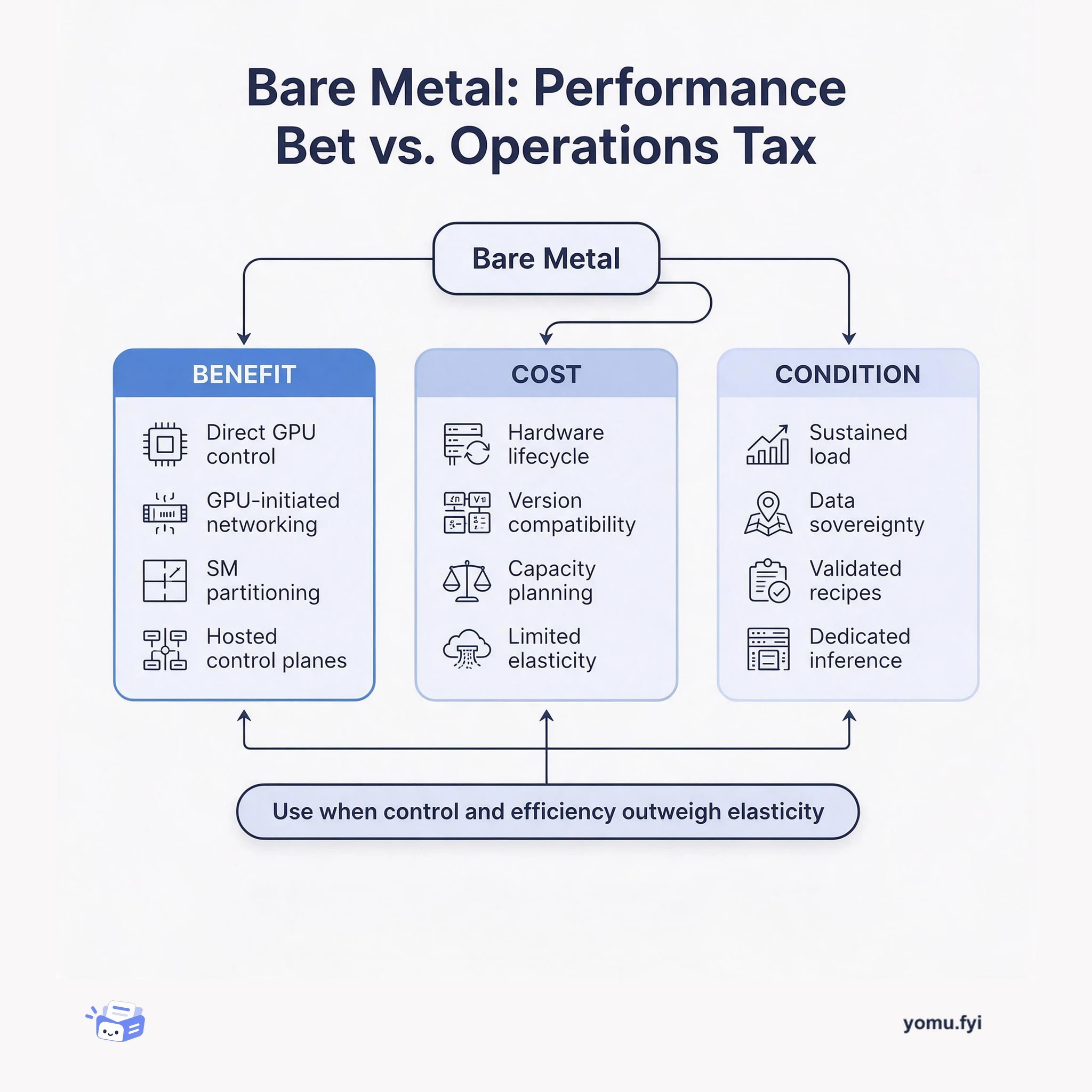
Bare Metal: Performance Bet vs. Operations Tax
Bare metal gives engineers direct control over GPU, network, and virtualization layers, but it shifts elasticity and lifecycle work onto the team. This trade-off map shows when that bargain pays off.
Loading…
Topic
812 posts about Performance. Every summary links to the original.
See the idea
Bare metal gives engineers direct control over GPU, network, and virtualization layers, but it shifts elasticity and lifecycle work onto the team. This trade-off map shows when that bargain pays off.
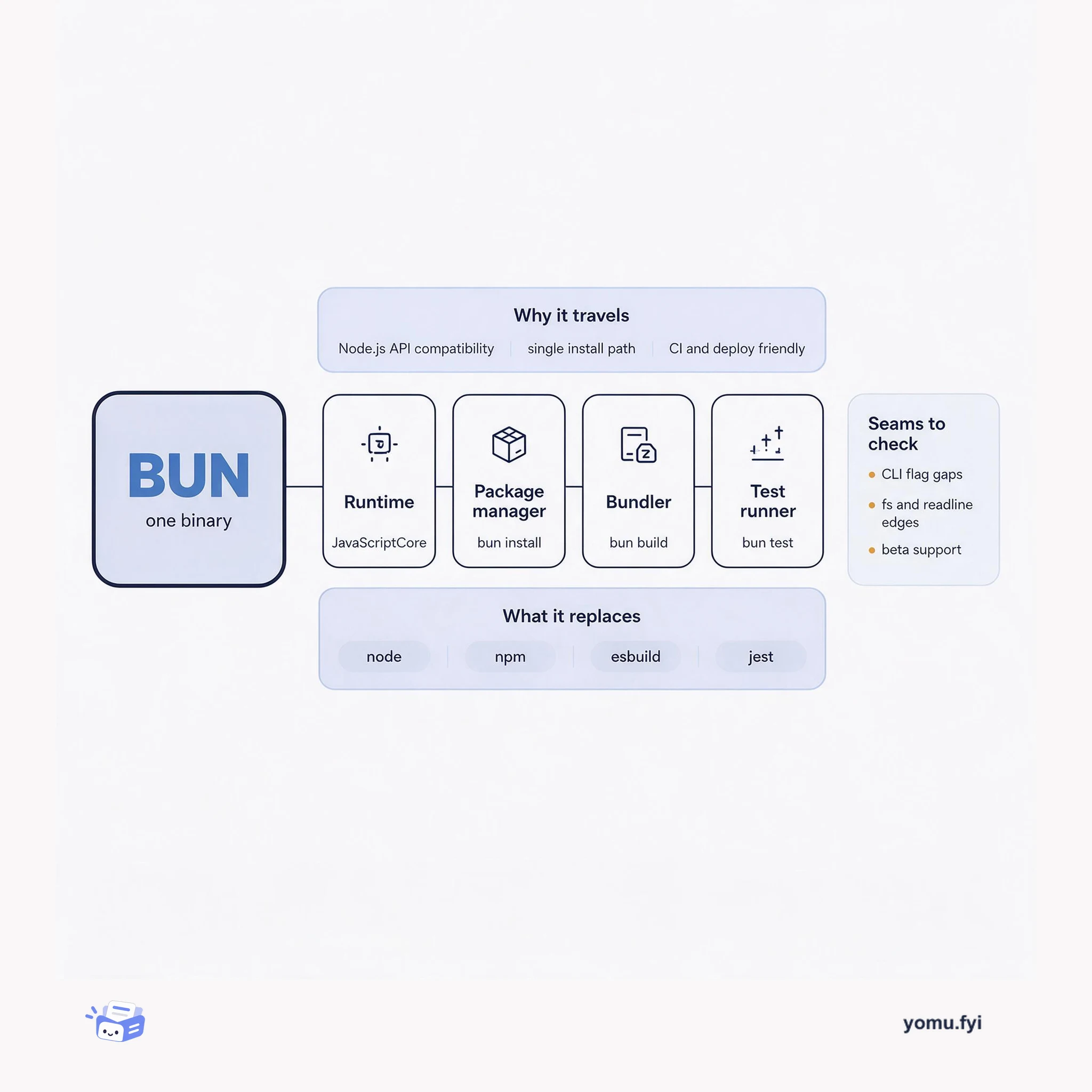
Bun packs a runtime, package manager, bundler, and test runner into one binary. Here is how those four parts fit together and where the seams still show.
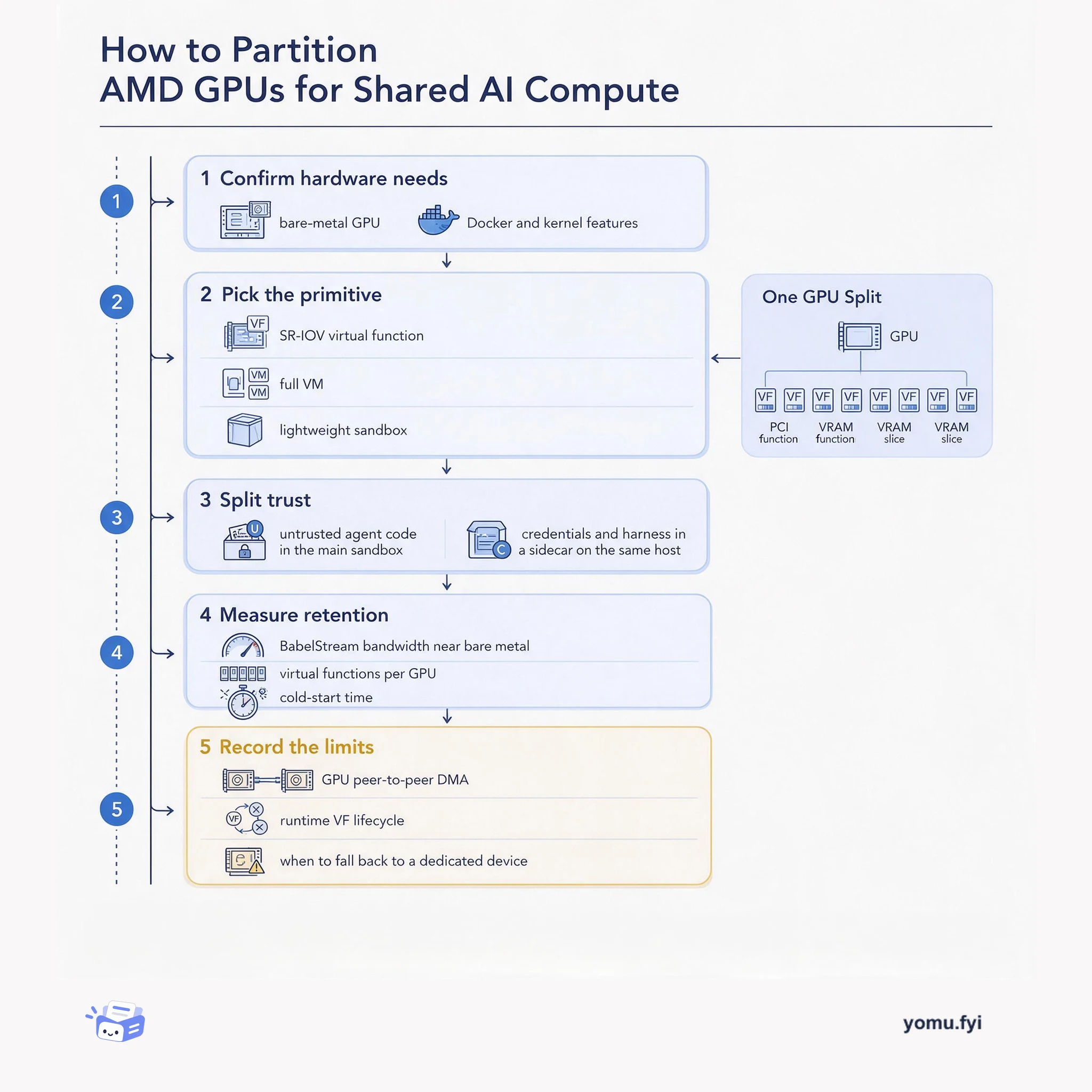
A five-step how-to for deciding when an AMD Instinct GPU should stay dedicated and when SR-IOV virtual functions, VMs, or sidecar isolation can safely share it.
The Good Stuff
Paid picks we use ourselves. Links carry a referral code — a subscription through one earns us a commission at no extra cost to you.
Newest first
Cloudflare migrated its official blog to EmDash, an Astro-focused content management system, acting as internal Customer Zero to evaluate scaling and usability. To prepare for traffic spikes reaching thousands of requests per second, engineers used k6 to execute ramp, breakpoint, and burst load tests. The resulting production architecture runs EmDash on Cloudflare Workers, pairing it with Workers Cache, an object cache backed by Workers KV, and Hyperdrive connected to PlanetScale. This layered caching design serves 99.5 percent of static files and 70 percent of requests from cache, flattening p95 latency under real-world loads reaching 850 requests per second. The migration also introduced a frontend redesign using the Kumo design system and added Model Context Protocol servers for automated agent workflows.
MTIA 300 is Meta’s first in-house training and inference accelerator optimized for ranking and recommendation models. These workloads require frequent AllReduce, AllToAll, and AllGather operations because embedding tables can contain over 99% of model parameters, making communication a bottleneck that competes with computation on GPUs. Its package-integrated network uses two chiplets with twelve custom 800 Gbps RDMA NICs, while 16 message engines and near-memory compute handle collectives independently of the 12×6 processing-element grid. Co-designed HCCL compiles collectives into dependency-aware subgraphs for autonomous execution, with topology-aware algorithms spanning scale-up and scale-out links. In production, HCCL reaches up to 940 GB/s within a rack, and a 150-billion-parameter model across 40 accelerators completed communication 3.9 times faster than an equivalent GPU cluster; concurrent GEMMs degraded less than 0.5%.
Selecting between relational and non-relational databases requires matching the data store to requirements for structure, consistency, scale, and query complexity. Relational systems organize data in predefined tables, enforce schemas and keys, and provide ACID transactions, making them suited to structured, transactional workloads and complex joins. Non-relational systems support documents, key-value pairs, graphs, or wide-column structures, often using flexible schemas and schema-on-read while scaling horizontally and accepting eventual consistency for throughput and availability. The trade-offs include vertical versus horizontal scaling, SQL versus database-specific query languages, and database-enforced versus application-level integrity. The guidance recommends documenting workload needs, prototyping with realistic volumes and failure scenarios, and considering polyglot persistence when different workloads require specialized systems.
Transactional and analytical databases serve different workloads: OLTP handles high-volume, real-time reads and writes with ACID guarantees, while OLAP supports complex queries over large historical datasets for reporting and business intelligence. The comparison focuses on trade-offs involving latency, concurrency, data freshness, schema design, transaction size, and storage format. Row-oriented storage and normalized schemas support precise operational updates, whereas column-oriented storage and denormalized designs improve compression, scans, and aggregations across millions of rows. The source describes transactional systems as foundational for applications such as banking, e-commerce, healthcare, and reservations, while analytical systems support dashboards, forecasting, and ad-hoc analysis. Its recommended architecture is to run both systems independently and connect them with Change Data Capture, balancing operational reliability with analytical throughput.
Generative AI training across hundreds of thousands of GPUs makes the scale-out network a first-order performance bottleneck, because synchronized collectives expose weaknesses in conventional Ethernet. Static ECMP, packet loss controls such as PFC, and slowly tuned congestion control can create stragglers, head-of-line blocking, latency spikes, and multi-tenant interference. Spectrum-X Ethernet addresses these conditions with hardware-accelerated adaptive per-packet routing, targeted ECN- and RTT-based congestion control, and a SuperNIC Plane Load Balancer that distributes traffic across independent network planes. Spectrum-X Multiplane uses shallow two-tier fat trees and host-edge optical devices to provide path diversity while scaling a two-tier design to over 128,000 endpoints. In the cited tests, Spectrum-X sustained 98% of theoretical line rate across GPU pairs, held P99 tail latency to 8–9 microseconds under 75% load, recovered from a link flap in 2.68 milliseconds, and limited bandwidth loss under 10% fabric failure to 11%.
Agentic AI inference has shifted from single-turn requests to long, stateful workflows that reason, invoke tools, coordinate subagents, and reuse growing context, increasing token and power demands. The post presents SemiAnalysis AgentX, an InferenceX benchmark that replays prerecorded Claude Code sessions turn by turn, preserving context, input/output lengths, reasoning time, tool-call latency, and KV-cache pressure while varying concurrency. It evaluates tokens per megawatt alongside E2E normalized interactivity, standard interactivity, E2E latency, and TTFT; NVIDIA-measured Vera Rubin NVL72 results, pending SemiAnalysis review, show up to 30x higher throughput per megawatt than GB300 NVL72 at 160 tokens per second per user. GB300 also delivers up to 15x H200 throughput per megawatt, up to 10x lower cost per million tokens, and roughly 80x higher throughput on Kimi K3 2.8T, supported by MoE runtimes, communication overlap, Dynamo, and NVLink.
Power-constrained AI factories measure efficiency by AI output per watt, because facility overhead, rack losses, and operational inefficiency reduce the power available to compute. In an illustrative 100 MW budget, 60% reaches AI load, while static rack provisioning can strand headroom that another rack could use. NVIDIA DSX MaxLPS addresses this with dynamic power allocation, workload-profile power optimization, and 45° C thermal and site design, including warm-water liquid cooling. Its Dynamic Power Software, currently in Developer Preview, models topology from utility to GPUs and reallocates unused capacity within policy-defined budgets, with optional DSX Exchange integration. For Vera Rubin NVL72, NVIDIA projects up to 40% more Rubin GPU capacity within the same power budget, while validation compares unmanaged and managed runs using throughput, latency, errors, power, utilization, and compliance.
Agentic AI factories connect diverse users, agents, applications, data sources, and storage systems to massively accelerated compute, making dedicated DPU processing essential for line-rate networking, storage, and security. Scale-In evolves north-south access into a coordinated infrastructure domain built with BlueField-4, NVIDIA DOCA, and Spectrum-X Ethernet. BlueField-4 combines programmable control-plane processing with inline data-path engines, a 64-core Grace CPU, LPDDR5X memory, PCIe Gen6 host connectivity, and an 800 Gb/s network interface. The architecture offloads security, tenant isolation, storage protocols, provisioning, and telemetry from host CPUs; the source states that Spectrum-X storage paths can provide up to 1.45x the throughput of off-the-shelf Ethernet, while independent control and observability support more consistent operations as AI infrastructure scales.
Agentic AI fleets must handle unpredictable trajectories in which long sequential reasoning chains are interrupted by short bursts of parallel tool calls, retrieval, sandbox, or sub-agent work. Telemetry from 163,594 sessions found over 97% had unique trajectory profiles, making fleet sizing around several specialized CPU designs impractical; the sequential path is latency-bound while fan-out requires concurrency. It presents NVIDIA Vera CPU as a single balanced design point, combining strong loaded per-core performance, concurrency, memory bandwidth, and a low-latency monolithic architecture, with Olympus cores using a wide front end, branch prediction, and deep out-of-order execution. Using estimated SPEC CPU® 2026 results across four agentic workloads, it reports up to 1.5x the agentic performance of AMD Venice, while noting that Venice figures were estimated from SPECrate® 2026 data and that results may vary.
Serving agentic AI at more than 3,000 output tokens per second while retaining a 100K-token KV cache creates a small-batch tensor-parallelism challenge: fixed communication and coordination costs can offset distributed-compute gains. NVIDIA Groq 3 LPX addresses this with compiler-scheduled execution across 256 LP30 local processing units, 128 GB of collective SRAM, and 96 112-Gbps C2C links per chip, planning transfers before execution and overlapping communication with computation at 320-byte-vector granularity. Artificial Analysis measured 3,431 output tokens per second at 100K context on Gemma 4 31B, and 3,382 tokens per second at 10K context. On SPEED-Bench coding tasks, the same system reached a median 4,767 tokens per second and a P80 of 5,520. The post describes pairing LPX with Vera Rubin NVL72 through prefill-decode, attention-FFN, or external-drafter speculative-decoding configurations for projected large-model agentic workloads.
Deploying the Junie coding agent locally on Apple MacBook M5 hardware requires overcoming steep performance bottlenecks during model execution. Engineers optimized the entire stack using Qwen3.6-27B rather than Qwen3.8-27B, which severely degrades without token-heavy reasoning enabled. At the agent layer, Junie appends requests directly into a rolling context and caches initial prompt prefixes to maximize KV-cache reuse across tasks. For model inference, the team disabled reasoning, selected 4-bit quantization, and patched MLX-VLM to execute self-attention prefill matrix operations using faster 8-bit instructions on the M5 processor. Combining these prefill improvements with simultaneous multi-token prediction and n-gram speculative decoding delivered up to a 2x generation speedup.
JetBrains has introduced Junie Local, a feature that runs the Junie coding agent entirely on local hardware without cloud dependencies, subscriptions, or credit meters. Users execute a single command inside Junie to download a 4-bit quantized Qwen3.6-27B model, requiring an Apple M5 Mac with 64 GB of RAM. The team prioritized prefill throughput over pure generation speed by utilizing 8-bit arithmetic instructions on the M5 Neural Accelerator, which increased prefill throughput by approximately 40%. Performance optimizations also include KV-cache reuse, speculative decoding to double generation speed, and disabling reasoning to preserve performance. In JetBrains' evaluations, the local configuration performed comparably to cloud-based Sonnet 4.5 on everyday tasks while ensuring source code, diffs, and prompts never leave the local environment.
Visual chain-of-thought methods allow multimodal large language models to reason through intermediate image generation, but synthesizing explicit visual steps creates major inference overhead during proactive video reasoning. To eliminate runtime synthesis, Internalized Visual Thinking introduces a post-training framework that jointly optimizes textual prediction and next-embedding prediction across unlabeled videos. By predicting latent representations of future frames alongside target text answers during training, the model captures motion, object transitions, interactions, and latent intent. At inference time, the model produces answers directly without generating or re-encoding future frames. IVT outperforms text-only post-training across six evaluation settings while matching or exceeding Visual CoT performance and cutting end-to-end latency by more than 5x.
Quantitative strategies need instrument groupings that capture both ordinary co-movement and dependence during market stress, while remaining stable and inexpensive to recompute. The workflow constructs rolling absolute Pearson-correlation and tail pairwise dependence matrices (TPDM), factorizes them with nonnegative SymNMF using AdaptGrow, and derives soft loadings, hard argmax labels, and structural-break diagnostics. A trace-based formulation reduces estimated peak storage from approximately 20n2 to 4n2 bytes, while row-sharded distributed execution communicates O(nk) data; the system uses eigenspectrum-based selection between full-batch and block-stochastic AdaGrad. Across 250 synthetic windows, the setup tests planted membership changes and a joint tail-stress episode: ARI is intended to identify reclassification, whereas TPDM reveals co-crash dependence that ordinary correlation can miss. Reported factorization timings include 13.0 and 12.4 seconds for 100,000 instruments across four GB200 GPUs, and approximately two and four minutes for one million instruments across 64 GPUs on 16 nodes, not end-to-end timings.
The Postgres VM described here runs PgBouncer instances, a backup agent, metrics exporters, a local Prometheus, a log collector, and watchdog timers alongside the database. Those processes share machine-wide resources outside Postgres’s huge-page-backed shared_buffers, so leaks, CPU saturation, or disk exhaustion can threaten database availability. ClickHouse Managed Postgres places supporting services in a cgroup v2 slice and combines Go runtime GOMEMLIMIT targets with systemd memory.high and memory.max enforcement. GOMEMLIMIT encourages earlier garbage collection, memory.high applies reclaim and throttling, and memory.max provides a hard ceiling whose OOM scope excludes Postgres because it uses a separate cgroup. CPU weights, bounded buffers, log and metric controls, disk thresholds, and exemptions for replication and monitoring sessions extend isolation across other failure modes; these controls are enabled by default.
NVIDIA’s Agentic Variation Operators (AVO) is a general-purpose agent architecture designed to make frontier language models reliable on extended, multistep tasks. It combines tool use and execution with persistent memory, an iterative inspect-plan-implement-evaluate loop, and a supervisor that can redirect work when progress stalls. In a seven-day GPU-kernel optimization study, AVO explored more than 500 directions, produced 40 committed versions, and outperformed cuDNN by up to 3.5% and FlashAttention-4 by up to 10.5% across evaluated configurations. On the ARC-AGI-3 public set, the same architecture achieved a 100.00 RHAE score across 25 environments, completing all 183 levels in 6,624 actions; the post cautions that comparisons with other systems are not controlled ablations.
The August 2026 newsletter rounds up ClickHouse product releases, research, managed services, observability, community work, and upcoming events. It introduces Andy Pavlo’s arrival to establish ClickHouse Labs, describes the 26.7 release’s join optimizations, token-position text indexes, and EXPLAIN ANALYZE, and reports a 40× phrase-search improvement on a Hacker News dataset. It also covers an interactive ClickBench playground for more than 100 database systems, running isolated workloads in Firecracker microVMs on AWS EC2, plus guidance on combining Postgres for mutable data with ClickHouse for immutable analytical workloads. Additional items address Managed Postgres notifications and backups, TTL-related disk growth, vector-search trade-offs, and hdx-evals, which found a purpose-built ClickStack MCP server scored 7–20 percentage points higher than direct SQL access in five reproducible scenarios.
Papers with Code needs a search engine that supports exact titles and arXiv identifiers, semantic requests, navigational queries, typos, and fast responses when model services are cold or unavailable. The system uses hybrid retrieval: PostgreSQL full-text search provides a lexical baseline, pgvector stores dense embeddings, and reciprocal rank fusion combines them. Full-corpus embeddings for more than 110,000 papers run in burstable GPU Jobs from repeatable-read database snapshots, with checksummed JSONL inputs and resumable Parquet outputs stored in Buckets. An Inference Endpoint serves low-latency query embeddings and bounded hourly updates for changed papers, while lexical retrieval remains a fallback. The embedding contract pins the model revision, dimension, prompts, normalization, and source hash; production uses Qwen/Qwen3-Embedding-0.6B with 256-dimensional L2-normalized vectors, and stored vectors also support related-paper retrieval without a request-time model call.
Public voice AI benchmark scores can overstate speech-recognition ability when models learn benchmark-specific patterns rather than improve underlying transcription. Traditional evaluations may miss reliability, naturalness, contextual appropriateness, and other real-world conditions, motivating held-out sets in Real World VoiceEQ, the Open-ASR Leaderboard, and the Far-field ASR Leaderboard. The study introduces three tests and evaluates 11 widely used open-source ASR models, finding that several reproduce VoxPopuli and LibriSpeech reference transcripts when audio contradicts them, words are silenced, or two written forms sound identical. Models also sometimes use acoustic cues to identify dataset membership and select its expected transcription policy, while fresh post-cutoff data and other interventions often restore more audio-faithful output; the findings support fully held-out evaluation and broader metrics than a single public WER score.
Quantum-augmented applications treat Quantum Processing Units (QPUs) as targeted coprocessors for NP-hard subroutines rather than standalone computing replacements. Near-term noisy intermediate-scale quantum systems handle tasks like combinatorial optimization, high-dimensional state sampling, and kernel mapping while classical stacks retain business logic and pipeline control. A hybrid runtime architecture routes parameterized ansatz circuits through middleware to the QPU, returning raw measurements for error mitigation and classical optimization. A Python implementation using Qiskit demonstrates this interaction by running a parameterized variational ansatz inside a classical COBYLA minimization loop. Operating this hybrid model requires navigating physical constraints including coherence limits, circuit transpilation latencies, and network bandwidth bottlenecks across the classical-QPU boundary.
The best engineering reads, once a week.