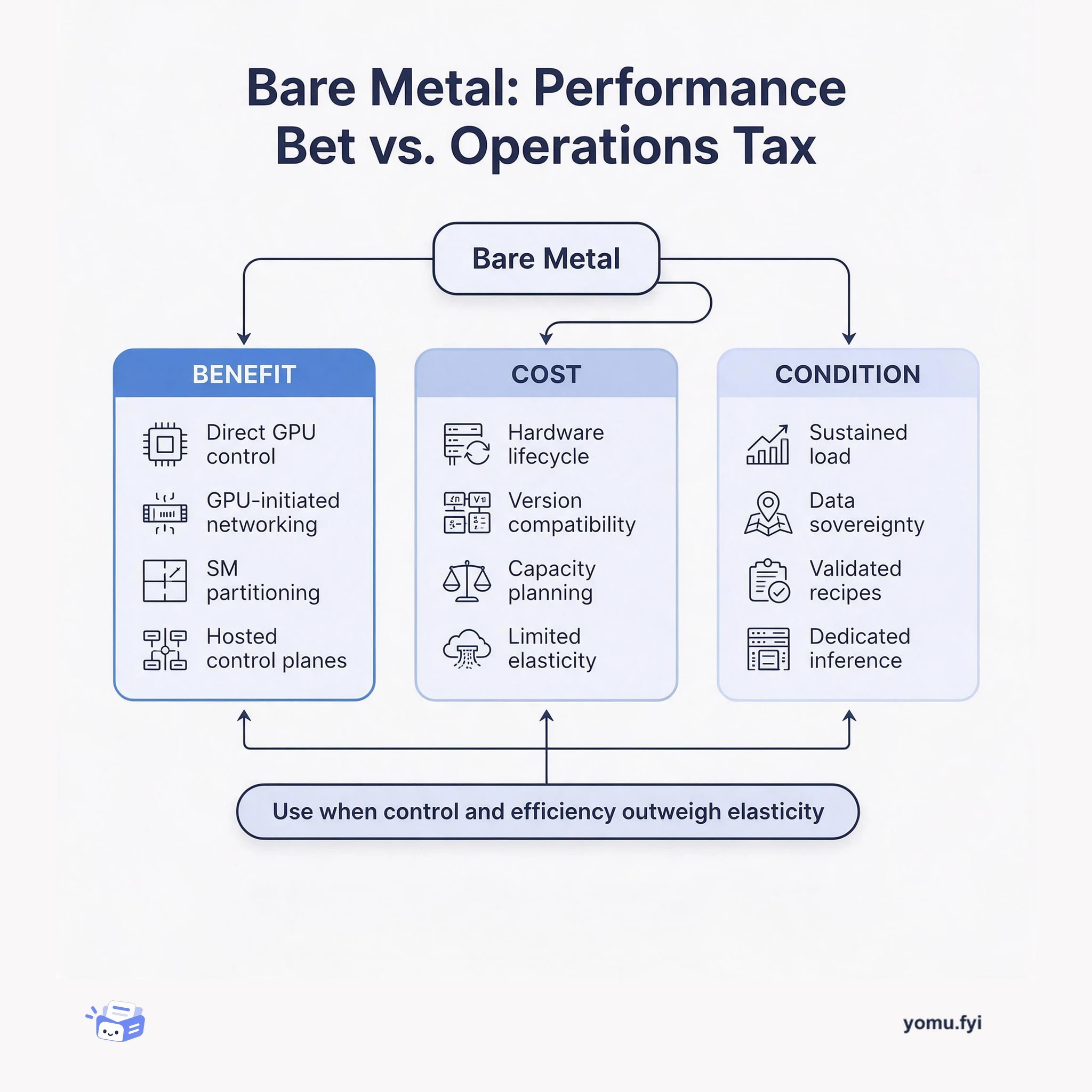
Bare Metal: Performance Bet vs. Operations Tax
Bare metal gives engineers direct control over GPU, network, and virtualization layers, but it shifts elasticity and lifecycle work onto the team. This trade-off map shows when that bargain pays off.
Loading…
Topic
812 posts about Performance. Every summary links to the original.
See the idea
Bare metal gives engineers direct control over GPU, network, and virtualization layers, but it shifts elasticity and lifecycle work onto the team. This trade-off map shows when that bargain pays off.
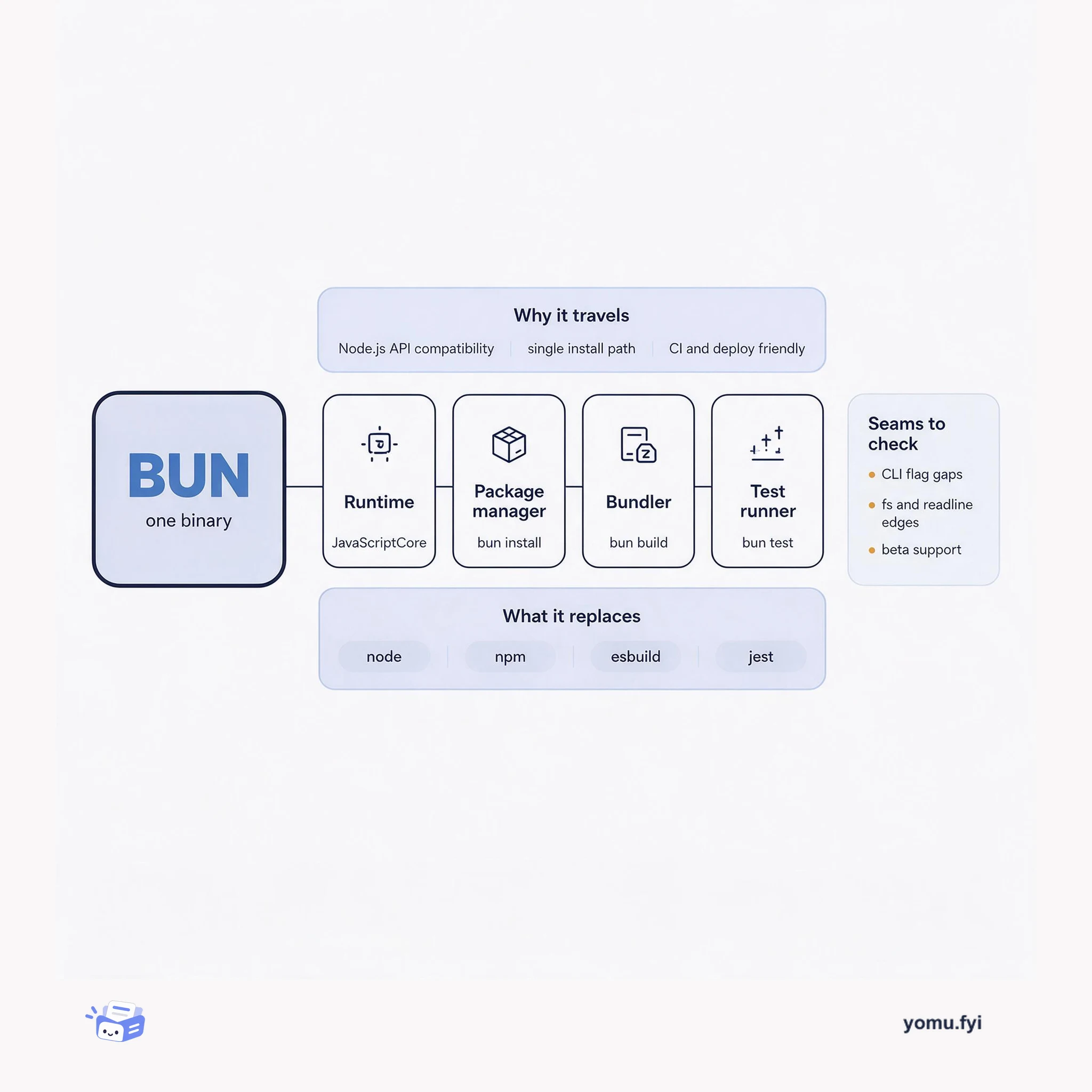
Bun packs a runtime, package manager, bundler, and test runner into one binary. Here is how those four parts fit together and where the seams still show.
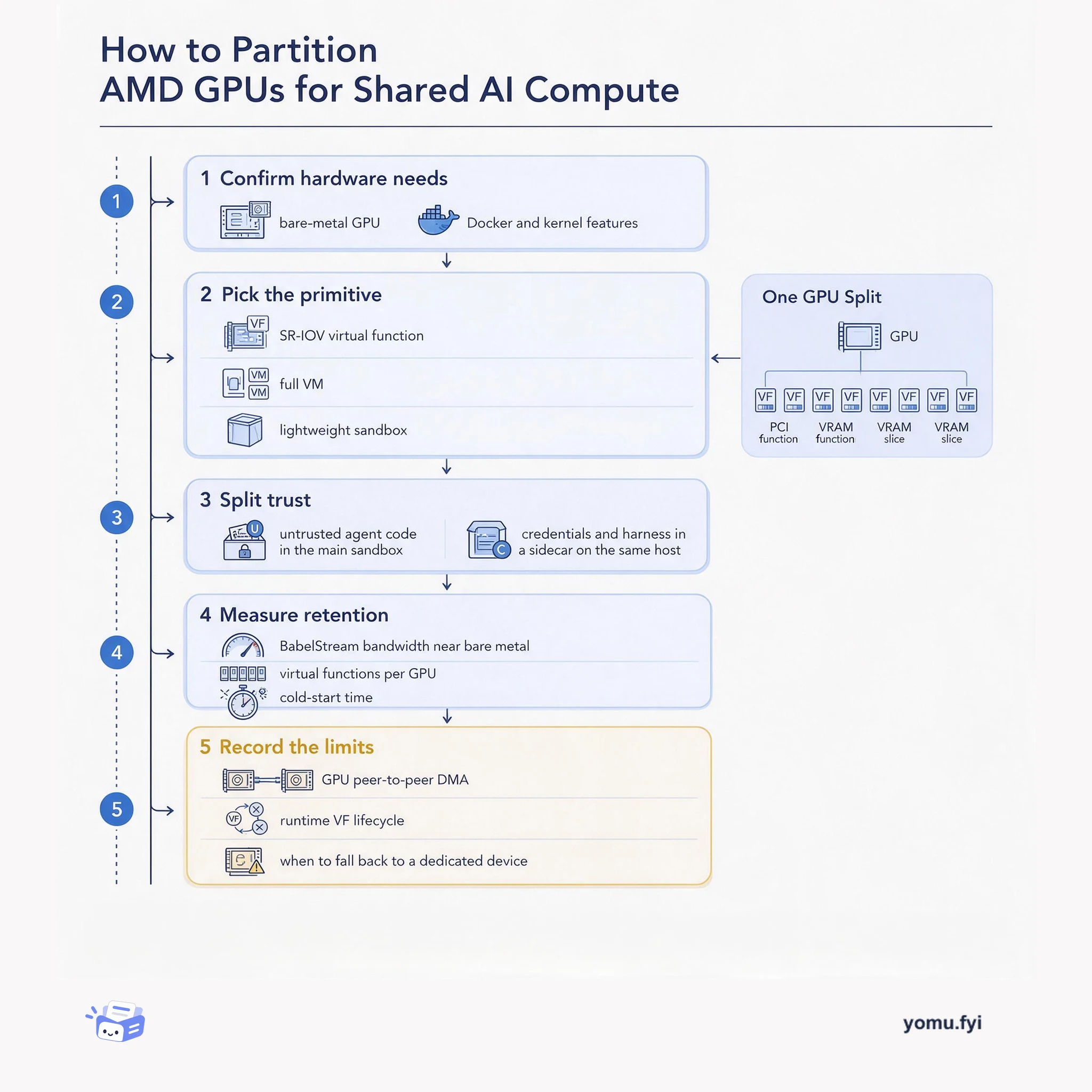
A five-step how-to for deciding when an AMD Instinct GPU should stay dedicated and when SR-IOV virtual functions, VMs, or sidecar isolation can safely share it.
The Good Stuff
Paid picks we use ourselves. Links carry a referral code — a subscription through one earns us a commission at no extra cost to you.
Newest first
Production inference systems often use generic GPU kernels even though operation shapes combine static model parameters with request-time dimensions such as token counts. Proteus addresses this mismatch by having agents propose specialized kernels, then applying controlled-reference validation, static checks, isolated repeated timing, hidden tests, and consistency checks before retaining measured winners. Its knowledge layer uses actionable, scoped lessons retrieved through hierarchical tags and hybrid keyword-semantic search, while background jobs handle deeper distillation instead of burdening each attempt. On NVIDIA B200 GPUs with a Triton backend, a Gated DeltaNet packed-decode case for Qwen 3.5 122B produced shape-specific wins, including 1.6× for a Batch=4, Key=128, Value=128 path and 0.018 ms latency for Candidate 030. Across the reported kernels, Proteus achieved 1.8–5.2× speedups over the best available in vLLM, with validation and context management identified as the main difficulties.
GitHub Copilot’s AI coding efficiency work focuses on completed task cost rather than tokens in individual tool calls, because shorter responses can trigger recovery work. Using agentic coding benchmarks and controlled online experiments, the team evaluated selective output compression, removal of unused line-number prefixes, prompt shortening, and direct delivery of completed background results. The shipped compressor preserves source-like and arbitrary output, reorganizes search results without dropping content, and compresses repetitive install, build, test, and progress output while retaining a recovery path to originals. Removing line-number prefixes cut offline model-inference cost roughly 5% and online daily cost about 3%; direct background-result delivery reduced AI Credit usage about 2.3%, while prompt changes required workload-specific validation.
An image-processing pipeline serves as the test case for a modern CUDA toolbox, starting with RGB-to-grayscale conversion, 32-by-32 tile median computation, and host/device transfers. It advances through six incremental changes: adopting CCCL and Compute Sanitizer for indexing bugs, adding NVTX for Nsight Systems benchmarks, replacing hand-rolled work with CUB algorithms, using pooled device containers and pinned host containers, and assigning each image its own stream with asynchronous copies. The implementation uses cuda::stream, cuda::copy_bytes, cuda::device_buffer, and CUB calls on per-thread streams, allowing kernels and transfers to overlap instead of executing sequentially on the default stream. The reported total duration falls from 6.8 seconds to about 23 milliseconds for three images, a roughly 300x improvement, while the post characterizes the code as safer and easier to maintain without low-level optimizations.
GPU sizing for AI inference depends on use case, token patterns, latency targets, concurrency, cache hit rate, model choice and deployment strategy rather than raw hardware specifications alone. The post proposes a core-and-flex capacity model, combining baseline on-prem or reserved cloud capacity with elastic spot or on-demand GPUs for surges, launches and experiments. It also recommends matching GPU memory to prompt lengths and concurrency, while using quantization, pruning and distillation to reduce footprint and operating cost. A NeMo example prunes Qwen3-8B from 36 to 24 layers or narrows its dimensions toward a roughly 6B student before teacher-student distillation. In the illustrative run, width pruning reached lower final validation loss than depth pruning, 3.21 versus 3.60, while depth pruning converged faster.
Cloudflare prototyped Cache Transcoding, a Pingora-based architecture that stores eligible cache responses as Zstandard (zstd) rather than their original representation. On a fill, the proxy compresses qualifying uncompressed text at zstd level 3, records the compressed representation and original content length, keeps it compressed on disk and between Tiered Cache layers, and decodes it on the client-facing path. Eligibility requires a 200 OK response, compressible text, no existing Content-Encoding, known Content-Length of at least 4 KiB, and excludes several request and binary-content cases. In initial tests, eligible assets shrank to roughly one-third of their original on-disk size, with a 2.834x ratio, while encoding cost 4.31 ns per byte and decoding 1.56 ns; the modeled CPU increase stayed within budget, though broader testing remains necessary.
This practical comparison examines how YOLO12, YOLO26, and RF-DETR behave when moved from COCO to specialized real-world object-detection datasets, and how fine-tuning changes the outcome. The authors first evaluate six pretrained checkpoints on COCO val2017, then use cable-damage, bone-fracture, and soda-bottles datasets from RF100-VL for zero-shot testing, fine-tuning, and accuracy/latency comparison. Because the model implementations require incompatible dependencies, the workflow uses one PyCharm project with three isolated uv environments and remote GPU execution; the reported latency stays in native frameworks rather than TensorRT. All models perform well on COCO, but direct performance on specialized data falls close to zero, while 10 fine-tuning epochs adapt the detectors well to cable damage and soda bottles. Bone-fracture remains difficult despite fine-tuning, with RF-DETR performing best, indicating that domain shift may require more data, longer training, or domain-specific pretraining.
Resolve rate alone can hide how coding agents reach the same outcome. This evaluation compares Claude Opus 4.7, Gemini 3.5 Flash, GPT-5.5, and Qwen 3.6 27B FP8 through a Junie pipeline across four benchmark datasets, combining test results with trajectory, cost, efficiency, patch quality, and process measures. In one private benchmark, Opus and Gemini solved the same number of tasks, but Opus averaged 184 steps at USD 2.79 per run versus Gemini's 271 steps at USD 1.24. Across 523 tasks, Opus resolved 267 (51.1%) and Gemini 254 (48.6%); shared outcomes masked differences in navigation, validation, redundancy, hallucination, and patch scope. The wider comparison found GPT-5.5 had the highest resolve rate and always ran an executable check, Opus led patch-quality metrics, and Qwen delivered lower cost with lower resolution, while the authors caution that profiles depend on the Junie scaffold and LLM judges are diagnostic rather than ground truth.
Indra Renewable Technologies consolidated a fragmented EV-charging data estate spanning Cosmos DB, Synapse, Azure Data Lake Storage, Azure Functions, Power BI, and other services onto Databricks. The migration began with a parallel Synapse prototype and expanded to Delta tables, a consolidated fleet pipeline, and greater use of Databricks for operational workloads. A medallion architecture stores raw fleet data in bronze, transforms it with PySpark in silver, and publishes gold tables for reporting and client delivery; one pipeline now serves three clients and improved performance by 60% to 70%. Unity Catalog, serverless SQL warehouses, AI/BI dashboards, and Genie Agents support governed self-service analytics, while reported results include 80% to 90% business cost savings, 90% storage savings, and query latency falling from 24.4 seconds to 3.5 seconds.
Deploying open models into native applications can require model-specific conversion, preprocessing, post-processing, and runtime code. NVIDIA TensorRT Model Connect addresses this with reference implementations that turn a Hugging Face model ID or local checkpoint into a deployment bundle containing TensorRT engines and runtime assets, then load it from a native C++ application. Its semantic API exposes task-level inputs and outputs, while its module-level API provides named tensors and individual TensorRT components; TVM FFI can connect custom GPU kernels to targeted pipeline stages. Python is used during preparation, but production inference does not require PyTorch or a Python interpreter. The project uses AI-assisted development, human review, nightly releases, and automated validation, and the post states that supported, validated workloads can deliver faster inference than torch.compile.
Netflix treats artwork and video previews as personalized assets, but ID-based models struggle with newly launched titles and assets that have little interaction history. The systems encode artwork with 768-dimensional CLIP image embeddings and combine those vectors with learned asset IDs, allowing visual preferences to transfer across titles and enabling one model to serve five canvases. Reward-based weighting balances pooled canvas data by the long-term value of interactions, while inverse propensity scoring on randomized exploration traffic supports offline evaluation. For video previews, MediaFM combines visual, audio, and text signals and ranked ahead of SeqCLIP in a linear probe, offline IPS evaluation, and online A/B testing; the Netflix Embedding Store supplies consistent embeddings to production models.
ClickHouse Managed Postgres introduces a four-step onboarding experience designed to move users from provisioning a service to working with operational data and ClickHouse analytics. Existing onboarding placed new users on an empty Overview page, while the documentation quickstart required users to track progress outside the product. The new flow guides users through creating a service, migrating or ingesting data, running a query in the SQL Console, and configuring Postgres CDC to ClickHouse. Data can arrive through a managed Postgres-to-Postgres ClickPipe, a language client, a sample dataset, or a table created from scratch; pg_clickhouse provides a PostgreSQL query layer over ClickHouse foreign tables. The article reports less than a minute of replication lag and benchmarks showing five aggregations falling from 555 ms to 164 ms and a JOIN with aggregations from 1,246 ms to 170 ms on one million-row data set.
At scale, training jobs face frequent GPU interruptions, while remote-storage input pipelines can leave accelerators idle. Distributed Checkpoint (DCP) has each rank write a shard plus a .metadata file, allowing parallel saves and reloads onto a different number of GPUs; DCP is presented as useful for DDP as well as sharded training. Asynchronous saves stage data locally and upload in the background; cited measurements report 1.8x savings for a 2.8B-parameter DDP model and 58x for a 20B-parameter FSPD model on 32 H100s, though the comparison excludes torch.save network storage time. UCVolumeDataset and the accompanying DataLoader cache files on local NVMe and prefetch disjoint rank/worker slices while computation runs. Correct recovery also requires checkpointing data position plus seeds and RNG state so resumed sampling remains consistent.
Stripe's extensibility SDK was built with AI involved across prototyping, architecture, implementation, and refinement, but the main change was to the development loop rather than code-generation speed. For a custom-object design, one engineer produced a working prototype, demo, and documentation site in roughly two days instead of an estimated two to three weeks, allowing the team to evaluate boundaries and reprioritize the feature for the next major launch. The team then used reviewed, detailed specifications and persistent domain guidance to delegate bounded work, including about twenty ESLint rules covering authoring constraints such as sandbox boundaries, imports, and type safety. AI also helped keep scripts, workflows, SDK generation, runtime enforcement, tooling, documentation, examples, and tests aligned, while human judgment remained responsible for abstractions and trade-offs. The post concludes that AI's leverage came from making more artifacts concrete earlier, enabling earlier feedback and a tighter deliverable.
Voice Arena and Hugging Face have added two Monsoon evaluation sets, en-IN and hi-IN, to the Open ASR Leaderboard, introducing Indian English and Hindi coverage. The initiative addresses a limitation of aggregate WER: existing test sets record what was said but little about who spoke, making disparities across geography, age, gender, accent, devices, and other conditions difficult to see. The four speaker-disjoint public and private splits contain 4,888 speakers and vary across nine collection axes, using unscripted dual-channel conversations, broad district and device coverage, and 12 speaker metadata attributes. Because Hindi has extensive valid orthographic variation, its references use manually curated lattices and are scored with Orthographically-Informed Word Error Rate (OIWER); comparisons with flattened references show higher, non-uniform error rates and changed system rankings.
LLMs are deployed in medicine, science, and law, where observed evidence may not determine a single correct answer and systems must represent and update uncertain beliefs. The work treats LLMs as information processing rules and measures an information processing gap, defined as deviation from Bayes updates, to quantify internal consistency in probabilistic belief updates. Extensive experiments compare multiple ways of incorporating evidence: some yield nearly Bayesian updates, while others rely on learned heuristics. Although exact Bayesian updating is optimal information processing, the non-Bayesian heuristic updates often achieve better downstream task performance, suggesting that the LLMs’ probabilistic models of the world are misspecified. The measure also serves as a diagnostic for issues in LLM-powered inferential systems.
The article examines whether ClickHouse is “winning” observability by separating the storage-and-query question from the broader work of collection, schema design, correlation, visualization, alerting, and investigation. It argues that ClickHouse fits telemetry because its columnar layout stores fields separately, enabling compression and allowing analytical queries to read only selected columns across millions or billions of events; ordering keys, sparse primary indexes, and data-skipping indexes further reduce work. The discussion covers both rich, wide events and conventional logs, traces, and metrics, and presents ClickStack as a combination of ClickHouse, an OpenTelemetry Collector, and a UI that preserves familiar workflows. The conclusion is qualified: ClickHouse has become the de facto storage and query engine for many teams and a strong default for large telemetry workloads, but it has not won observability as a whole, while full-text indexes, PromQL support, and broader product layers remain important.
Cloudflare's Big Pineapple platform, which powers 1.1.1.1 and other DNS services, stores over 250 billion cache entries simultaneously. To decrease fleet-wide memory consumption, engineers implemented five changes to in-memory cache data structures. Key modifications included swapping growable types like Vec and String for Box slices to eliminate capacity overhead, combining distinct record sections into a single list indexed by offsets, omitting redundant owner domain names, and serializing record bytes into contiguous buffers. In benchmarks, these optimizations decreased per-entry memory footprints by 56% while improving cache lookup latency by 19% and insert throughput by 43%. Across production instances, the rollout reduced working-set memory by approximately 100 terabytes.
Databricks previews its VLDB 2026 keynote, four accepted papers, a demo, and a sponsor talk covering database architecture, streaming, and Lakehouse optimization. Reynold Xin will introduce Lakebase, which separates serverless PostgreSQL compute from storage, and LTAP, a transactional-analytical model intended for AI-agent workloads; Lakebase stores data and write-ahead logs in cloud object storage and supports sub-second cold starts and copy-on-write branching. The papers describe a decade of Spark Structured Streaming evolution, including microbatch pipelining that improved throughput by up to 3x, stateful APIs, and fine-grained access control, alongside AutoLiquid’s CLUSTER BY AUTO and Ultron’s history-based query optimization. AutoLiquid outperformed customer-selected clustering keys on over 95% of evaluated workloads, while Ultron improved median join latency by 25% in production workloads. The program also includes an Enzyme demonstration of incremental materialized-view maintenance and a sponsor presentation on LakehouseRT and the Reyden engine.
Traditional QSR reporting can show that a limited-time offer (LTO) missed systemwide expectations, but not whether the cause was weak demand, lower franchise participation, ingredient shortages, inconsistent execution, slower service, or menu cannibalization. The post presents Lovelytics’ QSR Executive Performance Control Tower, an AI blueprint/solution built on Databricks that connects corporate performance, supply chain and operations, customer and digital, and financial signals. It is designed to distinguish demand from operational and participation issues, link changes to likely drivers and financial impact, and give corporate and franchise leaders a daily briefing on what changed, why it matters, and where to focus. The stated advantage is faster, more actionable decision-making based on a governed, reusable intelligence layer rather than disconnected reports.
Enterprise retrieval agents often struggle with questions that require reading values, labels, or patterns in charts, because text-only indexes and captions omit fine-grained visual data. The post evaluates structured chart extraction as a way to improve retrieval and answering, comparing caption-only figures with figures enriched by chart JSON from ai_parse_document. Its pipeline uses ai_prep_search to create retrieval chunks, a 300-million-parameter text embedding model for indexing, and Genie for retrieval and answer generation. Evaluation covers 310 chart-heavy questions from ViDoRe V3 and 114 visually grounded questions in the synthetic Chart-RAG dataset, with answer correctness, Hit Rate@10, and nDCG@10 measured across three runs. Chart JSON improves retrieval and answer quality; adding the top three retrieved images raises correctness further, reaching 75.9% on ViDoRe V3 and 75.1% on Chart-RAG, exceeding four multimodal embedding baselines.
The best engineering reads, once a week.