Bloom Filters: The Cheap Gate Before the Expensive Question
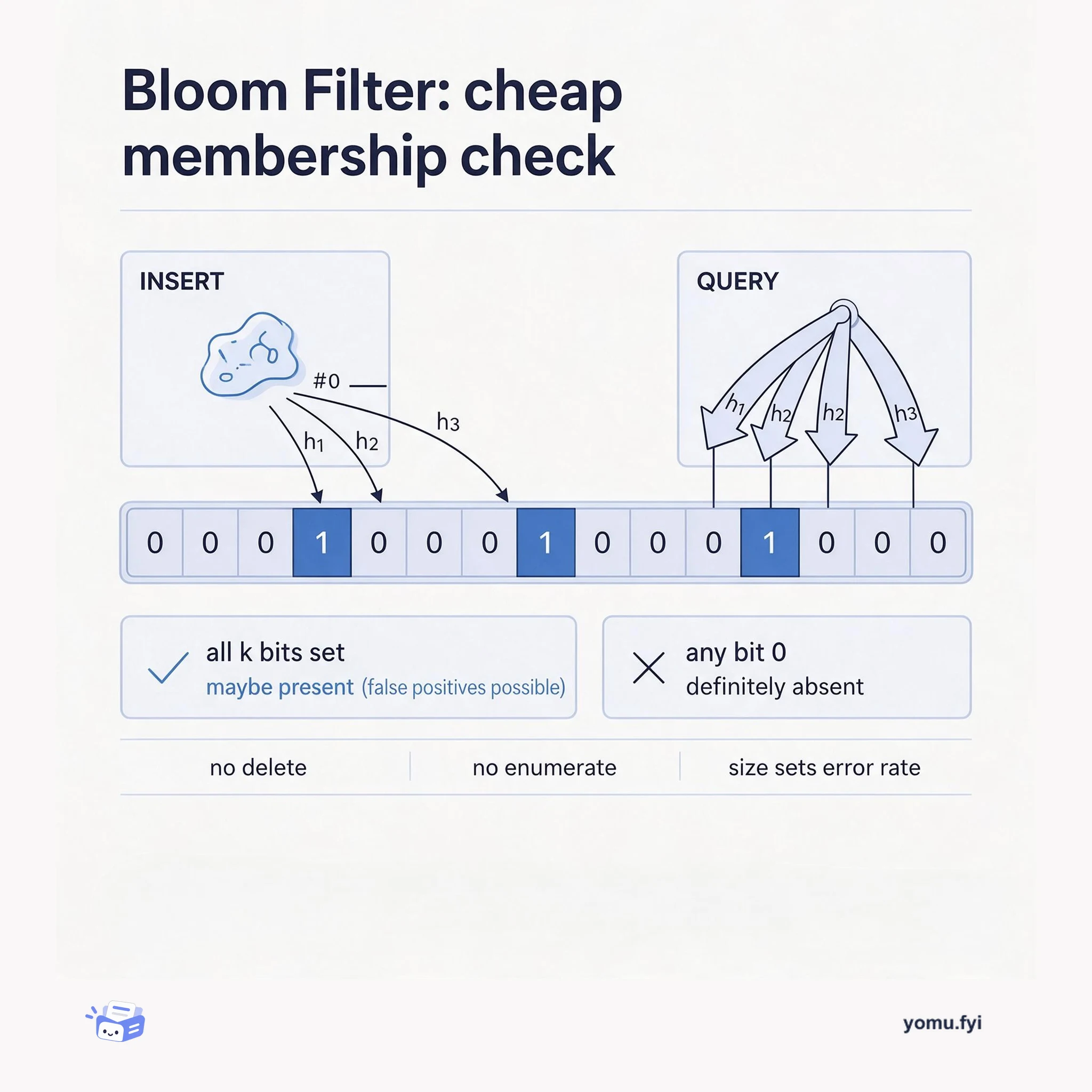
A Bloom filter is a small bit array plus a few hash functions that answers "has this been seen?" with no false negatives and a false-positive rate you choose up front.
Loading…
Topic
184 posts about Search. Every summary links to the original.
See the idea
A Bloom filter is a small bit array plus a few hash functions that answers "has this been seen?" with no false negatives and a false-positive rate you choose up front.
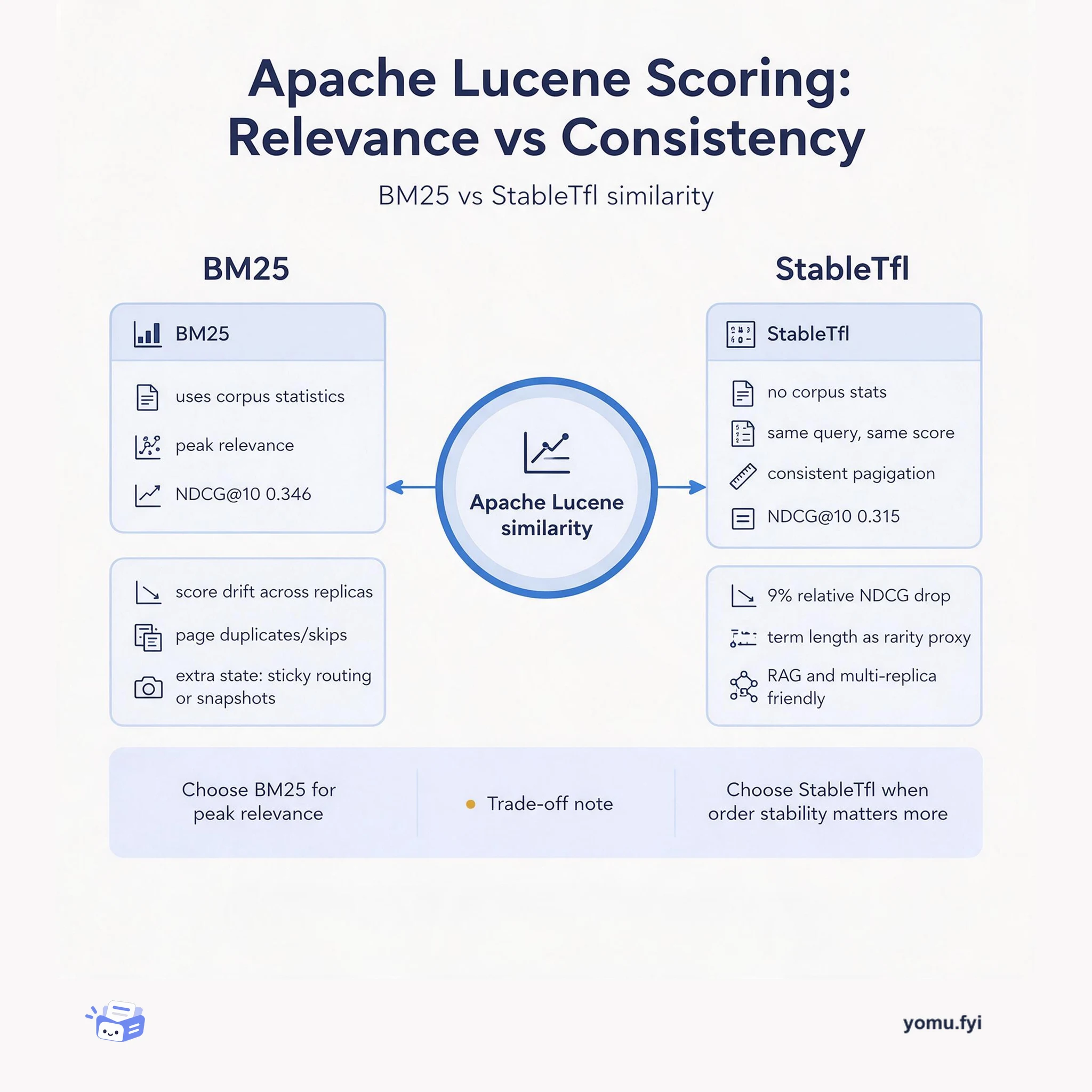
A comparison of Apache Lucene's BM25 scoring and StableTfl for paginated search: BM25 maximizes relevance, while StableTfl trades a small relevance drop for consistent ranking across replicas and pages.
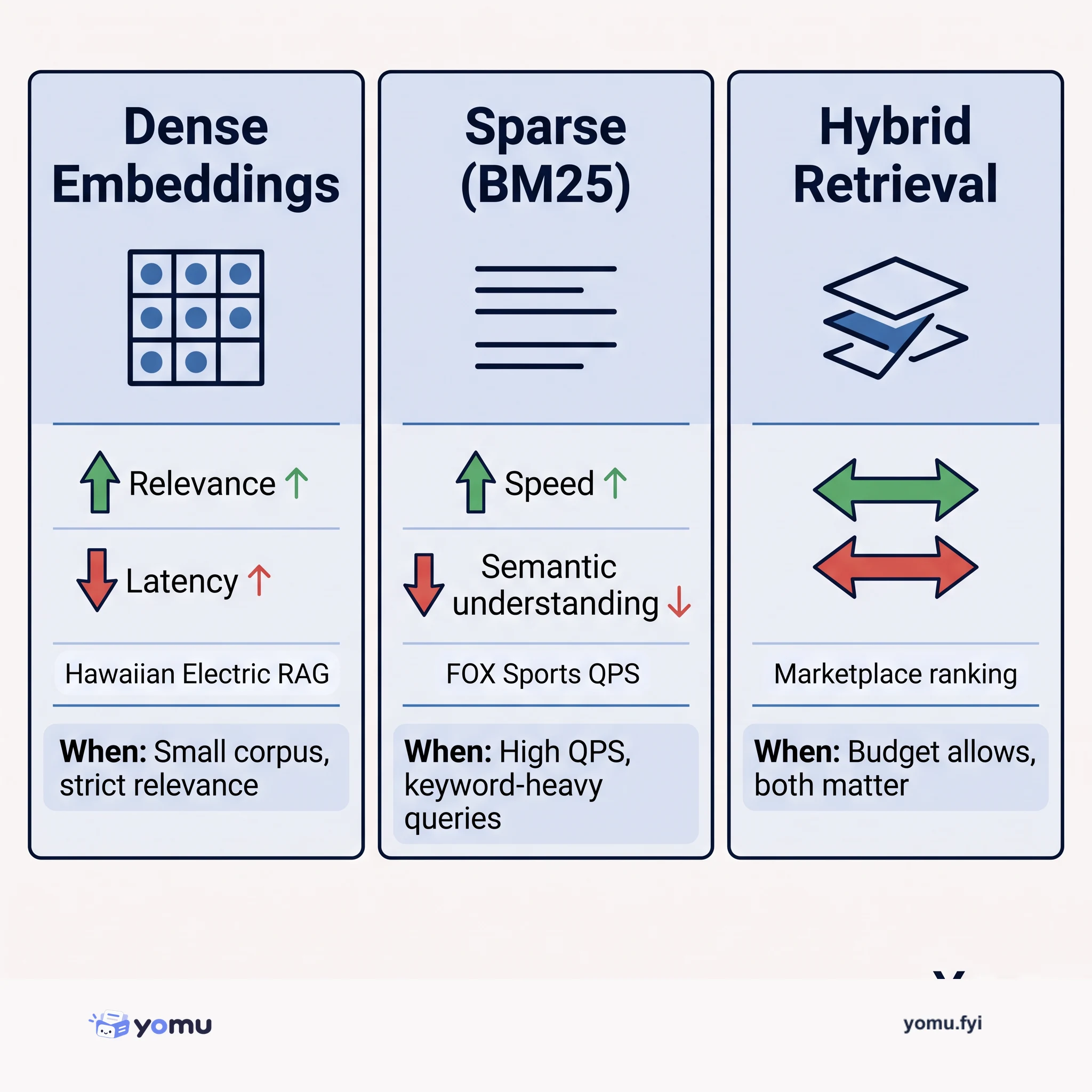
AI Search balances retrieval speed and result quality by choosing between dense embeddings, sparse lexical search, and hybrid approaches. Understand which trade-off fits your workload.
The Good Stuff
Paid picks we use ourselves. Links carry a referral code — a subscription through one earns us a commission at no extra cost to you.
Newest first
Physical Intelligence, which builds robotics foundation models, needed a data stack that could support both transactional operations and high-cardinality analytical workloads. Its previous single RDS Postgres instance could not handle those demands, so the team migrated to ClickHouse Cloud and adopted Postgres managed by ClickHouse for OLTP alongside ClickHouse for OLAP. Postgres is automatically replicated into ClickHouse through ClickPipes, while materialized views, full-text indices, and a query agent help researchers search across the company’s data. The resulting stack supports faster, easier exploration as data volume grows from the 10 billion to 100 billion row range, and also handles telemetry through ClickHouse with ClickStack and Grafana.
GitHub's code search engine, Blackbird, must case-fold over 480TB of source code across 180 million repositories during indexing and query matching. To accelerate this operation on source code that is overwhelmingly ASCII, the engineering team replaced early-exit branching with an unconditional branch-free loop. The implementation tests uppercase ASCII ranges using wrapping arithmetic, modifies bits in place, and detects non-ASCII bytes with an accumulator register tested only after the loop completes. Eliminating data-dependent exits allowed LLVM to generate SIMD instructions and achieve throughput exceeding 45 GiB/s on an Apple M4 processor. The optimized implementation was released as the open-source Rust crate casefold.
Dynamic catalogs in food delivery and e-commerce make knowledge-graph (KG) maintenance difficult: LLM- or scraper-generated relationships can be semantically wrong, manual review does not scale, and bad edges can degrade query expansion, CTR, and trust. The proposed feedback-driven verification engine treats unverified edges as hypotheses and uses the search interface as a validation environment. It separates verified and candidate edges, injects a limited number of candidates into lower-risk interface positions through an exploration-versus-exploitation policy, and records context-anchored user interactions with weighted positive and negative signals. An offline engine aggregates exposure and engagement into a confidence ratio, promoting candidates above a verification threshold and pruning those below a failure threshold. The framework is presented as a continuous human-in-the-loop method for validating parent-child and sibling relationships at scale; planned extensions add confidence tiers and defenses against spam, bots, and Sybil attacks.
Databricks AI Search now offers generally available high-QPS scaling for Standard endpoints, addressing production workloads such as search bars, recommendations, and real-time entity resolution. Operators set a human-readable target_qps value when creating or updating an endpoint through the Python SDK, REST API, or UI, while Databricks provisions the required compute without manual replica counts, node sizing, or load balancers. Existing Unity Catalog governance and Delta Sync remain in place, and scaling progress is exposed through scaling_info as it moves from SCALING_CHANGE_IN_PROGRESS to SCALING_CHANGE_APPLIED; endpoint observability shows requests per second, latency, and health. Service principal authentication is recommended for high-QPS traffic, while personal access tokens are capped at a few tens of QPS, and new capacity applies when an index is created or synced.
Notion announces it has acquired ZeroEntropy, whose team will join Notion. In less than two years, ZeroEntropy built high-efficiency training and inference for task-specific models using custom kernels, an inference stack, and model-specialization recipes. As a Notion customer, its reranker made unified search up to 30% faster, cut reranking latency by 85%, maintained constant answer quality, and lowered inference cost. ZeroEntropy has also trained zembed-1 and zerank-2 and published the zELO method; founder and CEO Ghita Houir Alami will lead Notion’s newly formed Model Research team. The acquisition supports Notion’s goal of delivering AI that is fast, affordable, and tailored to specific work for businesses of every size.
An evaluation compared Genie Code with three widely used coding agents from major AI labs on 401 real internal data tasks, using a shared 20-minute wall-clock budget and independent grading. Genie Code achieved 76.6% accuracy at an estimated $0.55 per task, outperforming rivals at 55.9–72.1% accuracy and $0.91–$1.16 per task. Its advantage is attributed to semantic search across catalog and workspace assets, persistent memory of tables and business logic, and enterprise-context understanding, which reduce exploratory tool use. On discovery-heavy tasks, general-purpose agents often wandered through large workspaces or timed out on inefficient scans, while Genie Code averaged 8.3 tool calls per task. The benchmark found no accuracy-cost trade-off, although the authors note that Genie Ontology was disabled and expect it to strengthen the advantage.
Airbnb replaced hundreds of hand-crafted ranking features with a Transformer-based sequence model that captures both long-term booking history and short-term browsing behavior. To keep latency low and throughput high, sequence representations are generated via daily batch jobs and combined with real-time queries using a co-trained setwise ranker.
Large-taxonomy classification must map freeform text to 35,000–100,000 labels while meeting quality, cost, and throughput requirements. The benchmark compares vector search, a two-step vector-search-plus-AI-Classify workflow, and direct frontier-model calls across transaction, company, and biomedical datasets, using hybrid semantic and BM25 retrieval with Reciprocal Rank Fusion for the search stages. The combined workflow performed best, reaching 0.81 average accuracy versus 0.76 for Gemini 3.5 Flash, while costing roughly one-hundredth as much per document; its strongest average setting shortlisted the top 20 labels. Vector search alone was nearly 100 times cheaper than the workflow but scored more than 20 points lower, while full-taxonomy frontier calls could exceed context limits. Taxonomy updates can be handled by embedding and ingesting changed labels rather than retraining or redeploying classifiers.
Unified Logs enters open beta, bringing events from the API gateway, Postgres, Auth, Storage, PostgREST, Realtime, and connection poolers into one searchable dashboard view. Before this, debugging a single request required separate log pages, service-specific filters, and manual correlation across tabs, which slowed investigation and risked losing context. Users can filter by log type, level, status, method, or pathname, search event messages, share URL-based filter states, stream new events live, and zoom into timeline ranges colored by log level. Clicking a row opens a detail panel that presents network timing, gateway, database query, and Auth blocks alongside raw JSON, while Log Drains forward events to external destinations. The feature is rolling out to all projects during open beta, with the classic Logs Explorer still available and feedback requested.
Gemini Enterprise Agent Platform now natively integrates Parallel Web Systems as a web-grounding provider, expanding developers’ choice of sources for real-time, verifiable information. Grounding with Parallel Web Search connects Gemini models to Parallel’s structured, LLM-optimized search results, combines the provider’s web index with Gemini’s prompt decomposition and synthesis, and adds precise citation annotations. The capability is available through the Gemini API and Agent Studio, and can be subscribed to through Google Cloud Marketplace with usage charged on an existing Google Cloud invoice; zero data retention is available for sensitive workloads. Developers can make programmatic calls at scale, extract and cache web data, post-process results with other LLMs, and build catalog enrichment, autonomous-agent, and multi-agent workflows. Setup requires subscribing, accepting the terms, reviewing pricing, and selecting Parallel Web Search under Agent Studio’s partner-grounding settings.
Historical market-data systems separate a durable archive from the real-time trading path, but the archive still must support research, backtesting, transaction-cost analysis, and regulatory reconstruction. The worked example uses Binance’s public archive to load trades and quotes for five USD-M perpetual-futures symbols into ClickHouse, with a MergeTree table ordered by (symbol, ts) and codecs including DoubleDelta and ZSTD. SQL queries calculate VWAP, hourly OHLC candles, and as-of joins, while ClickHouse’s sparse primary index skips most granules for symbol-and-time filters. Across ten months, 16.2 billion rows compress to 76 GiB on disk; the post reports a ClickHouse Cloud cost of $1.88 per month and argues that typical symbol-and-time queries retain low latency at that scale, while broader scans read more data.
An update adds side chats for exploring tangents alongside a main agent conversation without interrupting it. Each side chat is a durable, full agent conversation with main-chat context, can be revisited, followed up on, and at-mentioned back into the main thread. In the Agents Window, users can search agent transcripts through Cmd+K using a local index designed to scale to thousands of conversations, or search within a conversation with Cmd+F. Redesigned project and repo pickers support creating projects and connecting GitHub, GitLab, or Azure DevOps without leaving the picker, with search scoped to the current location. New cloud agent hooks expose prompts, responses, thinking, subagents, compaction, and turn completion for observation and control.
CipherStash’s integration for Supabase adds searchable field-level encryption to Postgres applications without requiring a schema change. The encrypted Supabase SDK wrapper encrypts marked fields in the application, stores each value as a JSON payload containing ciphertext and Searchable Encrypted Metadata (SEM), and converts queries to SEM so Postgres can filter, sort, and join without plaintext access. ZeroKMS keeps keys under the customer’s control, while decryption policies determine who can read each value; the source states that neither CipherStash nor Supabase can access plaintext data. The integration supports Supabase.js, Drizzle, and Prisma Next, with a one-command setup, and CipherStash Proxy covers analytics, background workers, and other direct database access through the Postgres wire protocol.
pg_re2 is a Postgres extension that brings RE2-powered regular expression functions and operators to Postgres, designed to address both execution speed and syntax compatibility with ClickHouse. It uses finite-automata-based RE2 rather than Postgres's backtracking POSIX engine, and version 0.4.0 adds the @~ operator plus btree and GIN index support. Benchmarks on an AWS m6g.2xlarge with PostgreSQL 18 report RE2's functions running at 1.8x to 8.6x the speed of native equivalents, while indexed operations are 1.1x to 1.8x faster. With pg_clickhouse, using RE2-backed functions such as re2match() keeps regex behavior consistent between Postgres execution and ClickHouse pushdown, including patterns such as Quake\b. The extension duplicates ClickHouse's suite for string search, replacement, extraction, and splitting.
ClickHouse 26.6 is a release marking the 10-year anniversary of ClickHouse becoming open source, with 56 new features, 79 performance optimizations, and 366 bug fixes. Hypothetical skip indexes let users evaluate set indexes in a session without building them; on a 487.24-million-row UK property dataset, the example estimated skip ratios of 77.0% at granularity 128 and 92.2% at granularity 1. The release overhauls dependencies between refreshable materialized views, addressing schedule drift that could make dependent stages lag or miss a refresh cycle. It also introduces experimental continuous queries, the aiEmbed function, embedding quantization to 8 bits and below, and workload-level memory reservations.
The 2026 Built-On Databricks Startup Challenge recognized early-stage startups building B2B applications on Databricks, with winners presented at the 2026 Data + AI Summit. VisionHeight won the Grand Prize for an agentic threat-intelligence platform that maps adversary infrastructure across the Internet while it is being constructed, aiming to give defenders earlier warning. Linkup took second place with a production-grade Web Search API that independently crawls and indexes the open web at the fact level, delivering sourced results in about two seconds. Intelo placed third with five coordinated AI Agent Teams covering retail merchandising and planning, while Clarecast, Gemini Sports, and LakeFusion received Honorable Mentions. Judges assessed market potential, founding-team caliber, and innovative Databricks use; the announced Startup Program also offers qualifying startups up to $200,000 in combined Databricks and Neon credits.
Retrieval Augmented Generation (RAG) connects a large language model to external knowledge at inference time, addressing outdated training data and access to proprietary or real-time information. The workflow ingests and normalizes sources, splits documents into chunks, embeds them in a vector store, retrieves context, assembles a prompt, and generates an answer. Semantic search can be combined with BM25 keyword search through reciprocal rank fusion, while reranking can improve precision; the same embedding model must be used during ingestion and querying. The guide presents evaluation and deployment considerations, including separate measurement of retrieval precision and generation faithfulness, versioning, monitoring, and containerized components. It identifies poor retrieval as the most common failure mode and explains that RAG reduces, but does not eliminate, hallucinations.
Vector search retrieves results by comparing embeddings that represent meaning across text, images, audio, and other content rather than matching exact words. A model creates embeddings, an index stores them for fast similarity search, and a query embedding is matched against the index using nearest-neighbor methods. Exhaustive k-nearest neighbor search can become too slow at millions of items, so production systems commonly use approximate nearest neighbor search, trading some precision for speed. The guide positions vector search behind semantic search, RAG, recommendations, and multimodal or cross-language retrieval, while hybrid search combines dense and sparse vectors, keyword results, metadata filtering, and reranking to improve reliability. Quality depends on embeddings, filters, index freshness, and infrastructure, with vector search requiring more memory and compute; Databricks AI Search is presented as a managed service supporting these capabilities and Unity Catalog governance.
ClickStack’s May and early-June release focused on making observability dashboards more useful during investigations and expanding access to related workflows. Dashboard table actions can open searches against selected sources with templated WHERE clauses or link to other dashboards, while scoped filters prevent source-specific conditions from affecting unrelated tiles. Number visualizations gained fixed or threshold-based colors and automatic text scaling, and the service map added latency percentiles, throughput metrics, server-side filtering, and focus mode. The release also includes a Browser RUM dashboard template, experimental PromQL support through the ClickHouse TimeSeries Engine, expanded MCP tools, AI Notebooks beta for Managed ClickStack, and ClickStack Cloud in private preview.
Shopify’s Catalog must reconcile billions of listings whose merchants use different product and variant structures, so AI shopping agents can identify the same real-world product. Product clustering groups related listings under a Universal Product Identifier, with precision prioritized over recall because wrong products can lead to incorrect purchases while missed variants remain findable. The intra-store system starts with rules-based singleton detection, then uses ANN and sparse average linkage for pre-chunking, and applies a two-stage LLM process that proposes clusters and critiques them using the core value proposition framework. Dynamic per-chunk strict JSON schemas enforce complete product coverage, support arbitrary chunking, and improved recall by 8% on the Toloka evaluation dataset in one schema change. The resulting pipeline is presented as a scalable intra-store foundation, while cross-store clustering into global UPIs is identified as the next step.
The best engineering reads, once a week.