Bloom Filters: The Cheap Gate Before the Expensive Question
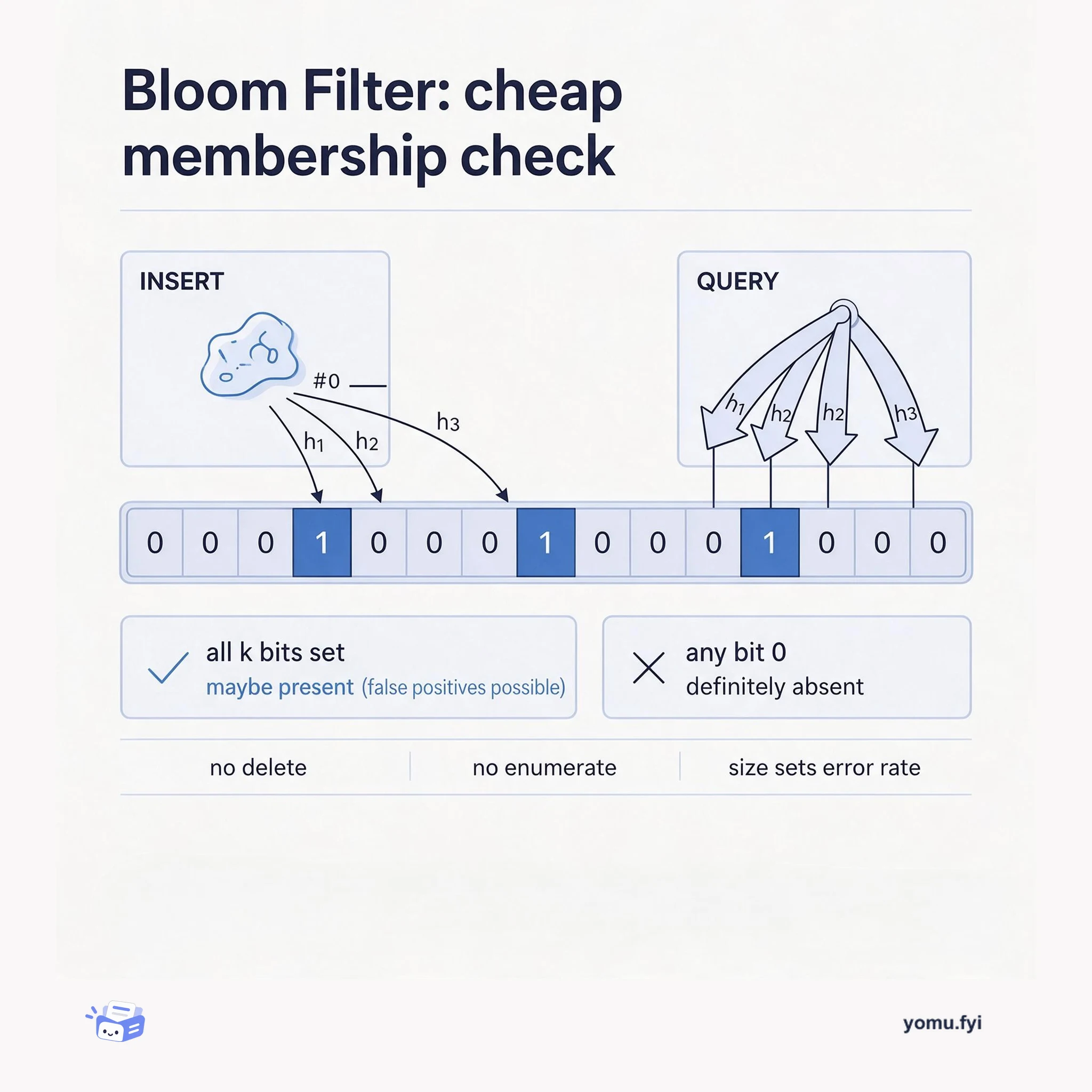
A Bloom filter is a small bit array plus a few hash functions that answers "has this been seen?" with no false negatives and a false-positive rate you choose up front.
Loading…
Topic
180 posts about Search. Every summary links to the original.
See the idea
A Bloom filter is a small bit array plus a few hash functions that answers "has this been seen?" with no false negatives and a false-positive rate you choose up front.
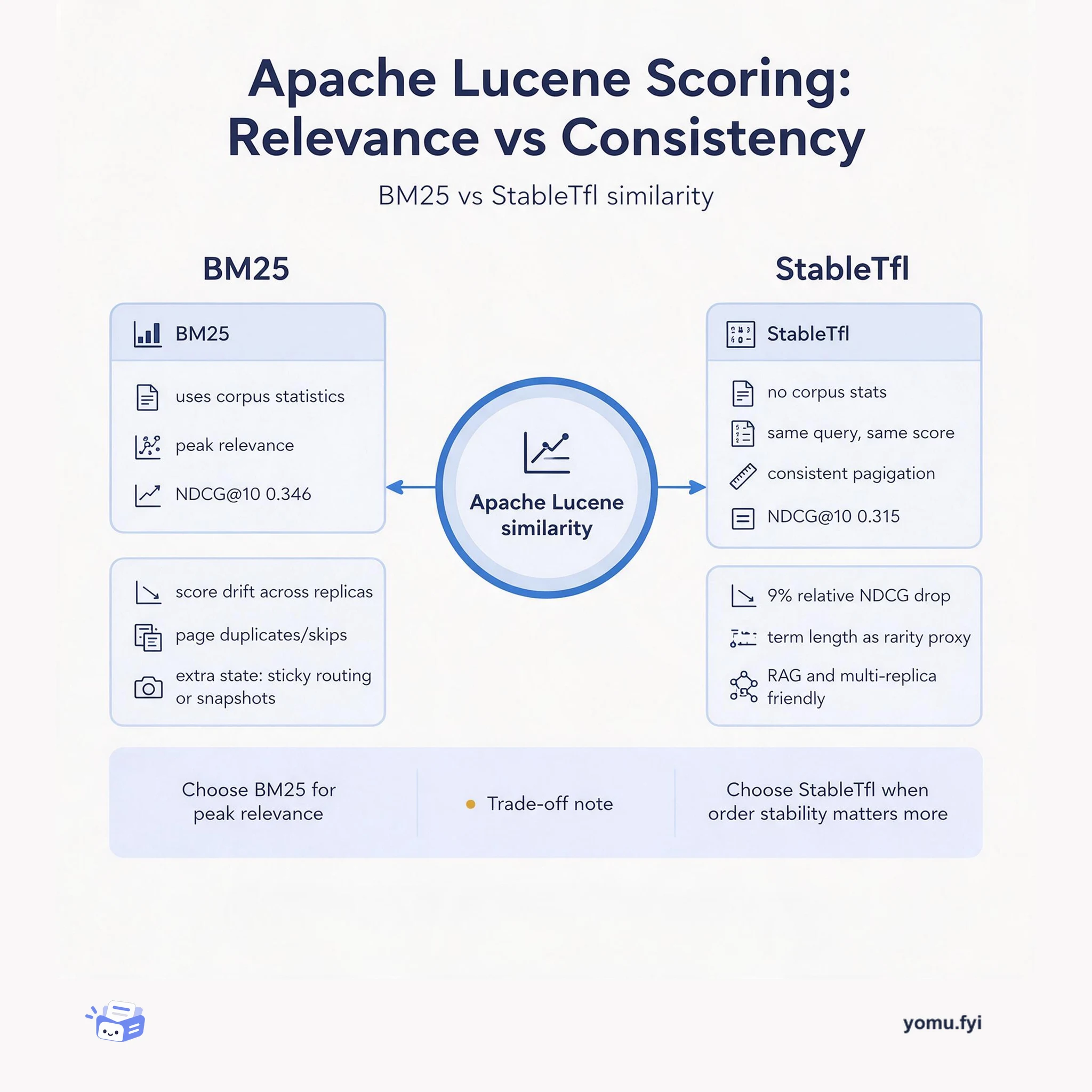
A comparison of Apache Lucene's BM25 scoring and StableTfl for paginated search: BM25 maximizes relevance, while StableTfl trades a small relevance drop for consistent ranking across replicas and pages.
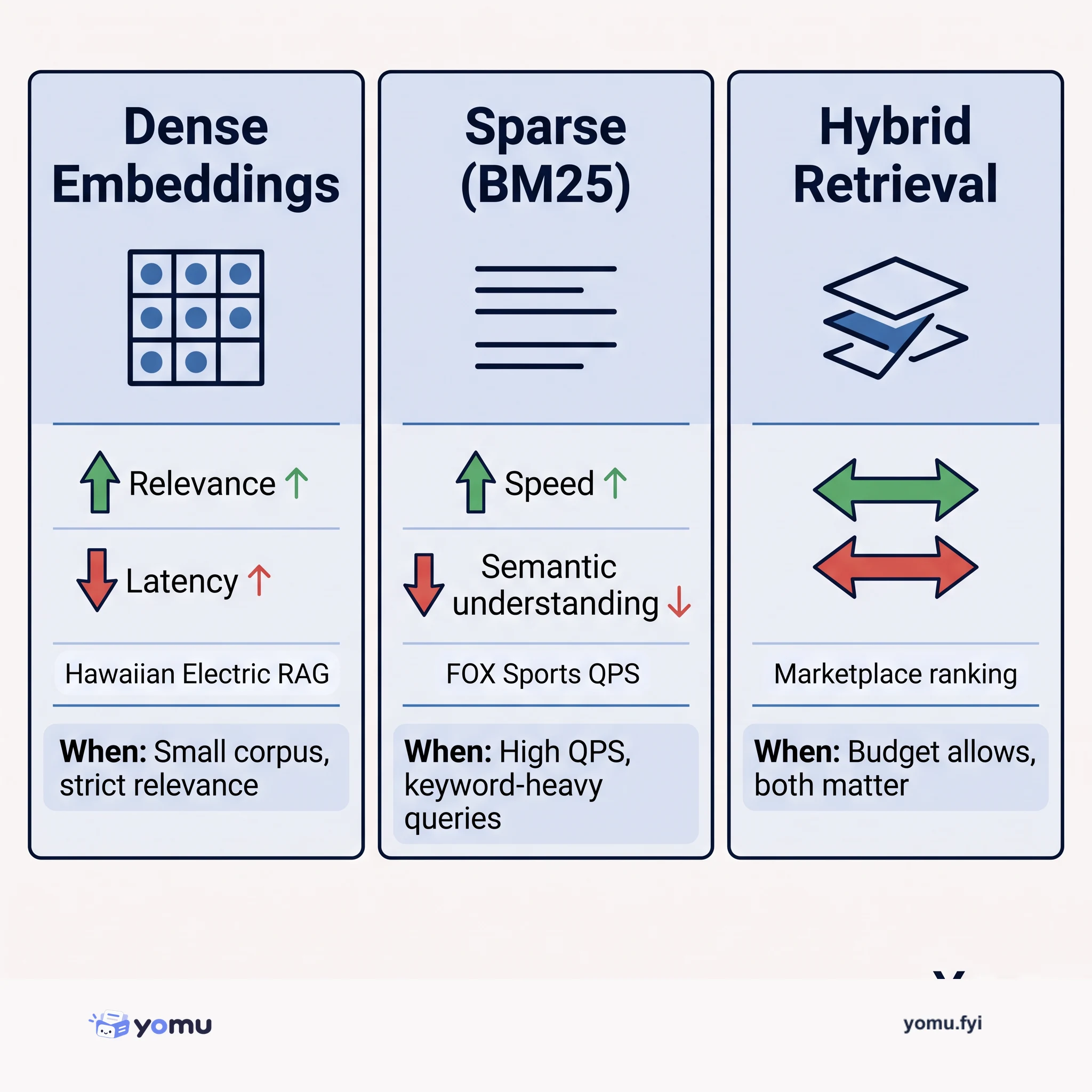
AI Search balances retrieval speed and result quality by choosing between dense embeddings, sparse lexical search, and hybrid approaches. Understand which trade-off fits your workload.
The Good Stuff
Paid picks we use ourselves. Links carry a referral code — a subscription through one earns us a commission at no extra cost to you.
Newest first
Modern artificial intelligence startups frequently face operational bottlenecks when deploying autonomous agents and dynamic interfaces on rigid relational schemas or restricted database engines. To address these limitations, platforms including Modelence, Thesys, Emergent Labs, and Heidi integrated MongoDB Atlas as their operational data foundation. Emergent Labs eliminated recursive schema migration failures previously encountered with PostgreSQL by adopting document structures that match native JSON generation, supporting millions of deployed applications. Meanwhile, Heidi migrated from Amazon DocumentDB to utilize MongoDB Vector Search for retrieval-augmented generation pipelines under a single unified API without requiring external search databases. These architectural transitions streamlined continuous agent iterations, eliminated operational scaling downtime, and accelerated deployment cycles across diverse production environments.
Notion describes two years of scaling vector search for AI Q&A, where semantic embeddings retrieve workspace and connected-tool content by meaning rather than exact keywords. The initial system combined Apache Spark batch indexing with Kafka-driven real-time updates, workspace-based sharding, and generation routing; rapid demand drove a 600x increase in daily onboarding capacity and cleared a waitlist of millions of workspaces by April 2024. A serverless migration cut vector database costs 50 percent from peak usage, while a later move to turbopuffer reduced search-engine spend 60 percent, lowered AWS EMR costs 35 percent, and improved p50 query latency from 70–100ms to 50–70ms. Further work uses xxHash-based page-state caching in DynamoDB to reprocess only changed spans and shifts embeddings generation from Spark and query embeddings away from a third-party API to Ray on Anyscale, with early rollout results pointing to a projected 90+ percent reduction in embeddings infrastructure costs.
Traditional movie search mechanisms depend on coarse filters such as genre, actor, or title, which fail to capture emotional context and narrative nuances. This guide demonstrates building a mood-based semantic recommendation system by combining the voyage-4-nano open-weights embedding model, Hugging Face datasets, and MongoDB Atlas Vector Search. The architecture uses Sentence Transformers to generate embeddings and exposes an endpoint through FastAPI to match user moods against movie plots. Truncating the Matryoshka embeddings from 2048 to 1024 dimensions balances semantic retrieval quality, storage footprint, and query latency. Testing shows that while abstract emotional queries return moderate similarity scores around 0.62 to 0.67, concrete descriptive queries exceed 0.75 without requiring exact keyword matches.
Cursor describes a secure way to index large codebases for semantic search, where naive processing can delay availability for hours. The system builds a Merkle tree of file and directory hashes, synchronizes only divergent branches, and caches embeddings by chunk content to reduce repeated work. For new users, a client-generated simhash finds a similar index within the same team or user's indexes, which is copied while background synchronization reconciles differences. Content proofs derived from the client's full Merkle tree filter search results so users see only files they can prove they possess. Reported time-to-first-query falls from 7.87 seconds to 525 milliseconds for the median repository, and from 4.03 hours to 21 seconds at the 99th percentile.
Etsy’s Search Relevance team addresses a limitation of engagement-based search signals: popular listings can attract clicks even when they are not the best match for a query. It introduces semantic relevance, measured through a framework combining human-curated golden labels, an LLM annotator, cascaded models, and production integrations, with categories for relevant, partially relevant, and irrelevant query-listing pairs. The data pipeline uses sampled search-log pairs, dual human annotation, an evolving guideline, few-shot chain-of-thought prompting with o3 in LangGraph, and self-consistency sampling; a Qwen 3 VL 4B teacher then labels data at scale before distilling into a BERT-based two-tower student. The student supports real-time use with less than 10ms additional latency, while the framework evaluates and enhances search relevance alongside engagement signals.
MongoDB announced several features aimed at streamlining AI application development across its database and search ecosystem. The Voyage 4 embedding model family is now generally available, introducing cross-model compatibility within a shared embedding space alongside the video-capable voyage-multimodal-3.5 model. For in-database operations, MongoDB Community Edition introduced Automated Embedding in public preview to eliminate external synchronization pipelines for vector generation. Vector Search gained Lexical Prefilters, replacing the knnBeta operator with a dedicated vectorSearch operator and vector data type inside $search aggregations. Additionally, MongoDB made its intelligent assistant generally available in Compass and released the source code for its mongot search engine under the SSPL.
Traditional retrieval-augmented generation relies on text parsing and optical character recognition to extract data from complex visual documents. These legacy techniques introduce high engineering effort, inconsistent accuracy, and heavy scaling costs. Vision RAG resolves these challenges by embedding entire visual documents directly through multimodal models like Voyage AI's voyage-multimodal-3.5, removing the need for text extraction pipelines. In this pipeline, dense vector embeddings map both text queries and visual assets into a unified representation space. At query time, the system retrieves relevant document images and supplies them alongside the text prompt to Anthropic's Claude 3.5 Sonnet to generate visually grounded responses.
MongoDB recapped its product releases, executive transitions, and enterprise adoption milestones throughout 2025 alongside predictions for 2026. The company acquired embedding and reranking specialist Voyage AI to mitigate large language model hallucinations and launched MongoDB AMP to accelerate legacy application modernization. Vector search and full-text search capabilities were expanded from MongoDB Atlas to Community Edition and Enterprise Server, enabling on-premises and hybrid retrieval-augmented generation workloads. Enterprise implementations included pharmaceutical distributor McKesson scaling tracking infrastructure to handle 1.2 billion containers annually after replacing its monolithic legacy system. Executive predictions for 2026 emphasized human-in-the-loop verification, grounding language models with factual retrieval, and building multi-cloud resilience against outages and data sovereignty constraints.
Serving embedding models for short search queries often suffers from poor GPU efficiency because traffic is spiky and memory-bound. Traditional time-window and request-count batching strategies lead to inconsistent GPU utilization, while tensor padding wastes compute on empty tokens. To resolve these bottlenecks, Voyage AI implemented token-count-based batching paired with padding removal in inference engines like vLLM. The architecture uses Redis with Lua scripts to atomically aggregate pending requests until reaching an optimal hardware saturation token threshold. Across production deployments, this approach achieved a 50% reduction in GPU inference latency with 3X fewer GPUs and improved throughput by up to 8×.
Shopify introduces Tangle, an open-source, platform-agnostic machine-learning experimentation platform built for Search and Discovery workflows at commerce scale. It targets six stated failure modes, including repeated data preparation, poor reproducibility, slow deployment, unstructured notebooks, manual query tracking, and limited sharing. Users compose visual directed acyclic graph pipelines from reusable YAML components that wrap containerized or inline command-line programs in multiple languages, while file-based execution moves artifacts through storage. Tangle’s content-based caching reuses results when output content hashes remain identical, including artifacts from still-running executions, rather than relying only on lineage changes. Shopify reports a ten-hour pipeline completing in twenty minutes after one component changes, more than a year of compute time savings, and production use across ranking, semantic search, recommendation, and feature engineering workloads.
Building production AI research agents presents challenges around context window pollution, escalating token costs, and architectural brittleness across model updates. To resolve these issues, Tavily rebuilt its deep research system around simplified orchestration, compact tooling, and active context curation. The agent mimics human research workflows by distilling tool outputs into concise reflections for ongoing reasoning, withholding raw retrieved web data until the final deliverable stage. Compared to traditional ReAct propagation architectures where token consumption scales quadratically, this reflection-based approach achieves linear token growth. As a result, the system reduced token consumption by 66% compared to Open Deep Research while reaching state-of-the-art performance on DeepResearch Bench.
Shopify describes a product-search stack built for multi-tenant commerce, where real-time indexing, retrieval, ranking, experimentation, and merchant controls must operate at global scale. Commerce ranking combines classical information retrieval with transformers, neural rankers, LightGBM, Catboost, and signals such as relevance, purchase popularity, brand trust, and navigational intent, while supporting privacy, multi-language, and accessibility requirements. RankFlow, a Python-like domain-specific language, lets data scientists change ranking logic without C++ expertise, while TurboDSL compiles and executes it with type safety, vectorized operations, cache optimization, predictable latency, and efficient memory use. The team first shipped SimScorerDSL in C++, then built TurboDSL without changing the DSL syntax, enabling continued experimentation during the transition. TurboDSL achieved a 48% speedup in ranking feature computation, and automated pull-request analysis compares component timings, statistical significance within a ±2% tolerance, and side-by-side results to detect performance or accuracy regressions.
Cursor describes semantic search as a complement to grep for helping coding agents locate relevant code in large codebases. Its evaluation used Cursor Context Bench across widely used models, comparing tool sets with and without semantic search, and found an average 12.5% accuracy improvement, with gains ranging from 6.5% to 23.5%. In an online A/B test, semantic search increased code retention by 0.3% overall and 2.6% on codebases with at least 1,000 files, while its absence produced a 2.2% increase in dissatisfied follow-up requests. The retrieval system uses a custom embedding model trained from agent session traces, with an LLM ranking helpful content and training aligning embedding similarity scores to those rankings. The conclusion is that combining semantic search with grep produces the best outcomes, especially for large codebases.
Sentence Transformers is officially transitioning its stewardship from the Ubiquitous Knowledge Processing Lab at TU Darmstadt to Hugging Face. The open-source embedding library was introduced in 2019 by Nils Reimers using a Siamese network architecture to overcome standard BERT limitations on sentence-level semantics. Tom Aarsen of Hugging Face has maintained the project since late 2023 and will continue leading its development. Under Hugging Face, the project retains its Apache 2.0 license and leverages infrastructure such as continuous integration and automated testing. Sentence Transformers currently serves over one million monthly unique users, with more than 16,000 community models publicly hosted on the Hugging Face Hub.
Modern vision-language OCR models can transcribe handwritten text, multiple scripts, mathematical expressions, and chemical formulas while also interpreting tables, charts, and images. The guide compares open OCR models and explains how output choices—including DocTags, HTML, Markdown, and structured JSON—affect digital reconstruction, LLM input, and programmatic processing. It also covers locality awareness through anchors or bounding boxes, prompt-based task switching, fine-tuning versus out-of-the-box use, and factors for selecting a model. Practical deployment options include local or managed inference, vLLM, Hugging Face Endpoints, and batch scripts that add OCR results to datasets. The discussion extends document AI beyond transcription to visual retrieval and direct document question answering with vision-language models, especially where converted text can lose layout or visual context.
Etsy’s seller-created inventory spans more than 100 million items and thousands of categories, making it difficult to capture attributes such as color, material, or niche properties without global SKUs. Because sellers often provide descriptions, titles, and photos instead of complete structured fields, Etsy uses LLMs to distill unstructured listing data into attributes for search filters, comparisons, and other experiences. The pipeline combines seller data, expert-selected few-shot examples, taxonomy logic, and category rules; parallel prompts are routed through LiteLLM, then responses are validated with Pydantic dataclasses and monitored with tracing, metrics, alerts, and performance checks. Human-reviewed silver labels support evaluation, while target categories increased complete attribute coverage from 31% to 91%, and inferred attributes improved search-filter engagement and overall post-click conversion.
Online car marketplace Cars24 previously operated a dual architecture where relational databases like Postgres synchronized data into separate search engines like Elasticsearch. As service offerings expanded globally for 300 million users, multiple engineering teams piping data into a single search index caused severe synchronization challenges, operational overhead, and developer friction. To simplify this infrastructure, Cars24 migrated to MongoDB Atlas hosted on Google Cloud, utilizing integrated Apache Lucene-powered MongoDB Atlas Search directly within the database layer. This architectural shift eliminated synchronization pipelines while accelerating search feature delivery through a unified API. Cars24 also replaced its ArangoDB geospatial search deployment with MongoDB Atlas, achieving robust multi-document ACID transactions across shards and cutting operational costs by 50%.
Shopify’s product classification system processes over tens of millions of predictions daily, while its taxonomy contains more than 10,000 categories and 2,000 attributes that must adapt as commerce changes. Manual curation created bottlenecks, expertise gaps, and inconsistencies that could reduce discoverability, search quality, filtering, and classification quality. The proposed AI multi-agent system combines structural analysis with product-driven analysis grounded in merchant titles, descriptions, and categories, then uses intelligent synthesis, equivalence detection, and quality assurance to recommend taxonomy improvements. Agents can search and validate hierarchical relationships, while human experts retain oversight; Shopify tested the method in Electronics > Communications > Telephony against its previous manual expansion approach and presents it as a proactive, scalable way to improve taxonomy consistency before gaps affect merchants and customers.
MongoDB Atlas has announced the general availability of its integration with the Pureinsights Discovery Platform to deliver a unified keyword, vector, and generative search experience. The combined solution pairs MongoDB Atlas Search for standard text matching with MongoDB Atlas Vector Search and Voyage AI embeddings to interpret ambiguous or multilingual queries. Pureinsights provides the orchestration layer that ingests content, coordinates retrieval, and integrates large language models such as GPT-4 to generate cited responses. Users can customize generated outputs according to preferred technical depth, length, language, and role-specific requirements. The architecture enables enterprises to apply retrieval-augmented generation and semantic search across technical documentation, community forums, and internal knowledge bases.
Public embedding benchmarks often fail to measure true generalization because training sets overlap with public evaluation data, rewarding memorization over general search quality. The Retrieval Embedding Benchmark (RTEB) beta introduces a standardized evaluation framework designed for real-world enterprise retrieval applications. To prevent overfitting while preserving transparency, RTEB combines fully public datasets with private evaluation sets managed exclusively by MTEB maintainers. The suite spans 20 languages across domains like healthcare, law, finance, and code, measuring ranked retrieval quality using NDCG@10 on datasets of at least 1,000 documents. While currently limited to text-only retrieval and containing repurposed question-answering datasets, the benchmark provides clear signals when models degrade on unseen data.
The best engineering reads, once a week.