Bloom Filters: The Cheap Gate Before the Expensive Question
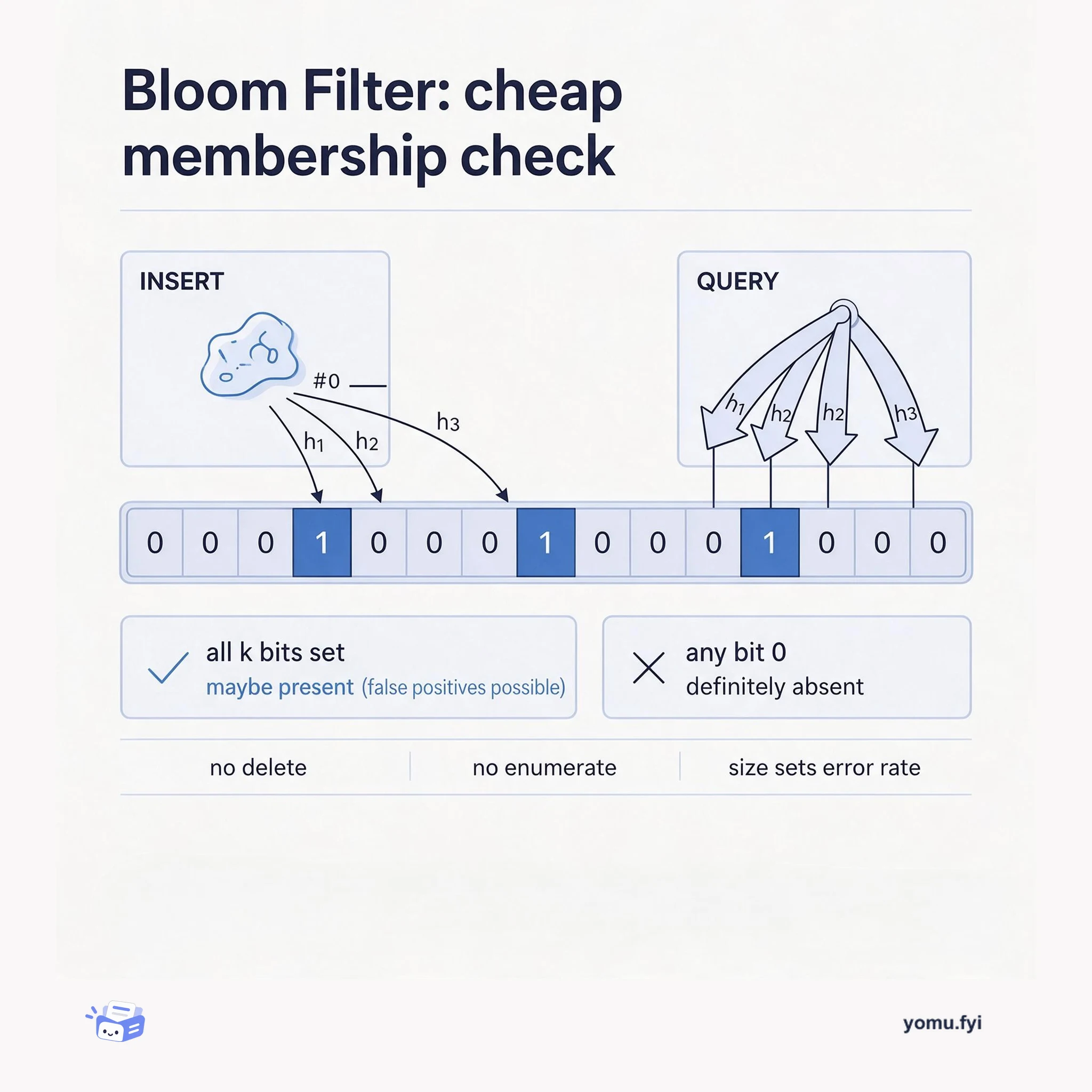
A Bloom filter is a small bit array plus a few hash functions that answers "has this been seen?" with no false negatives and a false-positive rate you choose up front.
Loading…
Topic
180 posts about Search. Every summary links to the original.
See the idea
A Bloom filter is a small bit array plus a few hash functions that answers "has this been seen?" with no false negatives and a false-positive rate you choose up front.
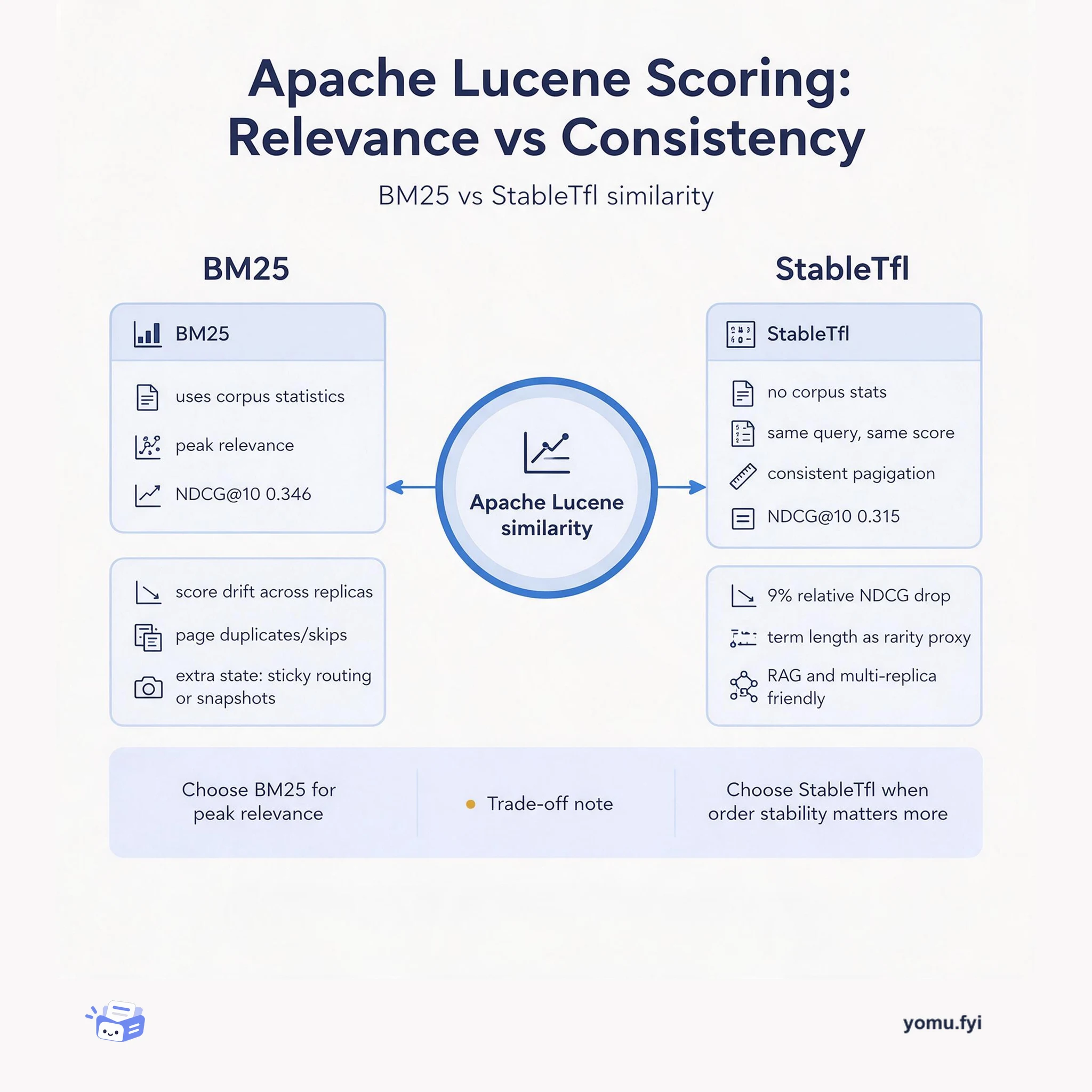
A comparison of Apache Lucene's BM25 scoring and StableTfl for paginated search: BM25 maximizes relevance, while StableTfl trades a small relevance drop for consistent ranking across replicas and pages.
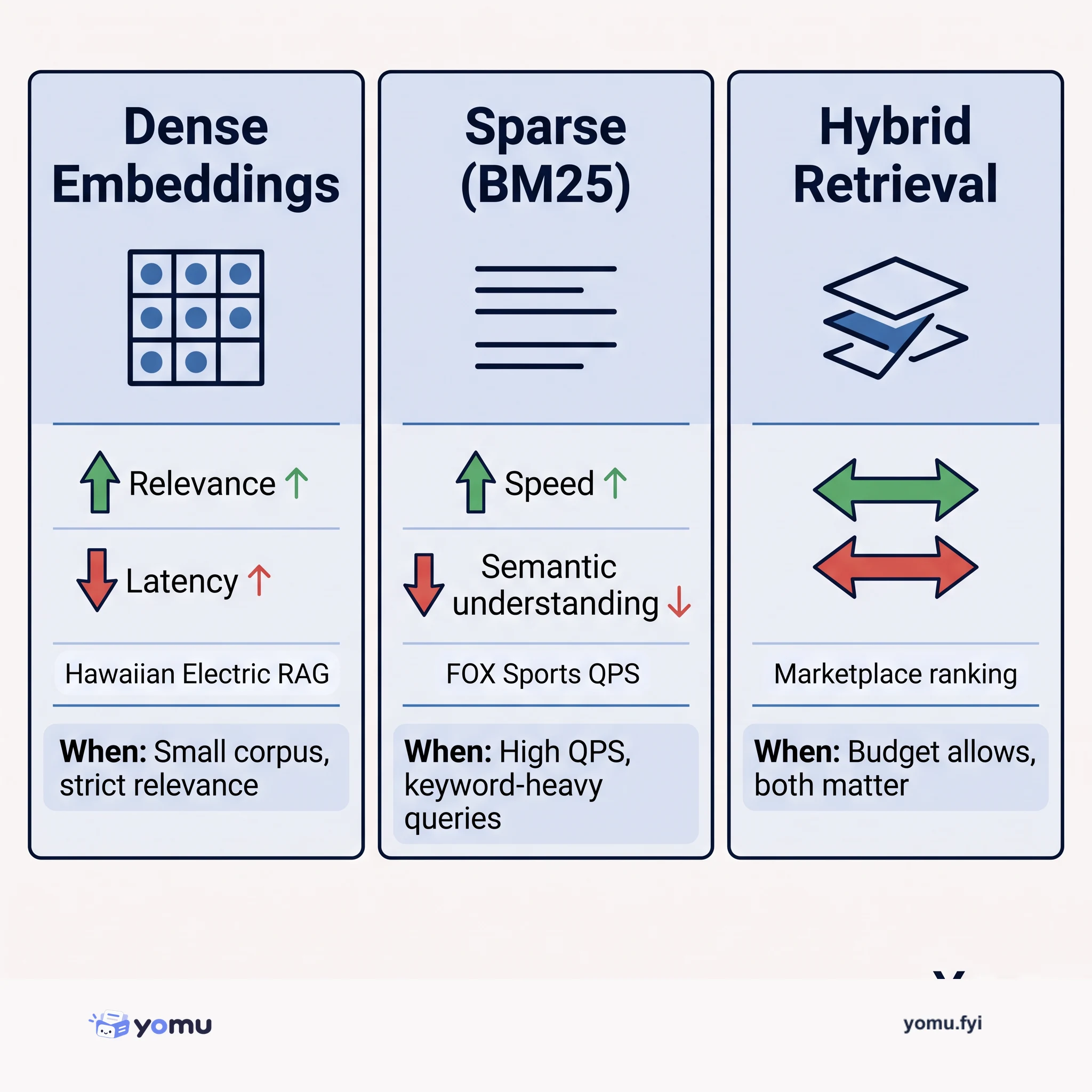
AI Search balances retrieval speed and result quality by choosing between dense embeddings, sparse lexical search, and hybrid approaches. Understand which trade-off fits your workload.
The Good Stuff
Paid picks we use ourselves. Links carry a referral code — a subscription through one earns us a commission at no extra cost to you.
Newest first
Natural language queries and generative AI workflows like retrieval-augmented generation have exposed the limitations of standalone vector search, particularly for tokens outside an embedding model's training corpus. Hybrid search addresses these gaps by merging traditional lexical precision with dense vector context. Platforms combine these modalities using techniques such as reciprocal rank fusion and relative score fusion, often complemented by downstream cross-encoders or learning-to-rank models. Architecture choices center on the trade-offs between lexical-first systems using inverted indexes and vector-first platforms employing sparse vectors. MongoDB has integrated vector search indexes alongside its existing lexical indexes, releasing native hybrid search functions across Atlas, Community Edition, and Enterprise Server to unify operational data and search retrieval.
MongoDB centers its engineering architecture around resilience, intelligence, and simplicity to minimize developer cognitive and operational burdens when building distributed applications. Security is enforced through dedicated clusters in isolated virtual private networks alongside Queryable Encryption, which allows equality and range queries on ciphertext without decryption keys ever leaving the client. High availability is built on replica sets across independent availability zones and multi-cloud topologies, utilizing consensus mechanisms that commit writes only after majority acknowledgment in the active term. Operational friction in artificial intelligence workloads is addressed by integrating vector search directly into the core query engine, eliminating brittle extract-transform-load pipelines and separate vector databases.
Early perceptions categorized MongoDB alongside eventually consistent NoSQL databases, creating doubts regarding its suitability for mission-critical enterprise workloads. Over fifteen years of development, the platform addressed enterprise requirements by introducing replica sets with Raft-style consensus, native horizontal sharding, tunable read and write concerns, and multi-document ACID transactions across sharded clusters. Security capabilities were expanded through Role-Based Access Control, Field-Level Encryption, and Queryable Encryption supporting prefix, suffix, and substring searches. Current initiatives focus on decoupling compute and storage scaling, developing AI-driven tooling within the Application Modernization Platform to translate legacy relational applications to microservices, and optimizing query execution for non-denormalized data models. MongoDB Atlas now incorporates Atlas Search, Atlas Vector Search, native Stream Processing, and embedding generation powered by Voyage AI models.
The page associated with the title “MongoDB.local NYC 2025: Defining the Ideal Database for the AI Era” is rendered as a MongoDB Resources page rather than an event article. Its metadata describes a collection of webinars, video presentations, white papers, datasheets, and other resources, with controls for content type and language. The visible resource content includes “MongoDB Search Fundamentals: Powering Modern Search Experiences,” which presents MongoDB Search as an integrated full-text search capability and covers lexical search, search indexes, autocomplete, fuzzy queries, scoring, filters, and facets. The provided text does not state details about the NYC event or establish a conclusion about an ideal database for AI.
At MongoDB.local NYC, MongoDB introduced new database capabilities, AI integrations, and modernization tools designed for agentic and generative AI workloads. The release of MongoDB 8.2 arrives alongside public previews of Search and Vector Search for both MongoDB Community Edition and Enterprise Server. MongoDB also highlighted Voyage AI embedding models and rerankers to improve retrieval accuracy across raw data, metadata, and embeddings. To address the costs and constraints of legacy infrastructure, the new MongoDB Application Modernization Platform combines AI-assisted tooling and specialized expertise to migrate legacy systems. According to MongoDB, early migrations using this platform run two to three times faster, while code rewriting tasks accelerate by an order of magnitude.
At MongoDB.local NYC 2025, MongoDB introduced new capabilities and product updates tailored for artificial intelligence workloads. MongoDB 8.2 was unveiled alongside public previews of full-text and vector search for both MongoDB Community Edition and Enterprise Server. The company also detailed its integration with Voyage AI embedding and reranking models to deliver precision retrieval across raw data, metadata, and vectors. To address legacy infrastructure migration hurdles, MongoDB launched the Application Modernization Platform, which combines AI-assisted tooling and specialized workflows to accelerate legacy application refactoring two to three times faster. These architectural updates aim to position the JSON document model as the persistent memory and context store required by autonomous, agentic AI workflows.
At the MongoDB.local NYC 2025 event, MongoDB unveiled several platform updates aimed at modernizing enterprise database architectures and supporting emerging agentic artificial intelligence workloads. The newly released MongoDB 8.2 version provides enhanced performance alongside expanded developer features across the broader document database ecosystem. The company also integrated Voyage AI embedding and reranking models to improve context retrieval precision and efficiency when building production-grade AI systems. Furthermore, dedicated Search and Vector Search capabilities have reached general availability across both MongoDB Community Edition and Enterprise Server environments. To streamline infrastructure transitions, the newly introduced Application Modernization Platform leverages AI-powered tooling and specialized techniques to migrate legacy database systems two to three times faster.
At MongoDB.local NYC, new product capabilities were unveiled to support modern enterprise workloads and artificial intelligence applications. The release of MongoDB 8.2 delivers improved performance alongside embedding and reranking models from Voyage AI for AI application development. Additionally, search and vector search capabilities have entered public preview for both MongoDB Community Edition and Enterprise Server across customer runtime environments. To address the high operational costs of legacy database systems, MongoDB introduced the Application Modernization Platform to accelerate migration and automated code rewriting using AI-driven tooling. These capabilities position the JSON-based document database as a foundational data layer providing persistent state, contextual retrieval, and memory for agentic AI systems.
MongoDB presented multiple updates at MongoDB.local NYC 2025 aimed at supporting modern AI workloads and enterprise modernization. The event detailed MongoDB 8.2 alongside Voyage AI embedding models and rerankers designed to enhance accuracy and efficiency in AI applications. Search and vector search capabilities have expanded into public preview for MongoDB Community Edition and Enterprise Server. Furthermore, the company launched the MongoDB Application Modernization Platform, which combines AI-driven tools and expert workflows to migrate legacy systems to MongoDB two to three times faster. MongoDB positions its JSON document model as a foundation providing memory, facts, and state continuity for agentic AI applications.
MongoDB unveiled several core database updates aimed at supporting artificial intelligence workloads during MongoDB.local NYC 2025. The release of MongoDB 8.2 introduces performance enhancements alongside Voyage AI embedding models and rerankers for AI applications. Furthermore, Search and Vector Search are now available in public preview for both MongoDB Community Edition and MongoDB Enterprise Server. To address the costs and operational friction of legacy systems, MongoDB launched the Application Modernization Platform (AMP), which combines AI-powered tools with specialized talent to accelerate database migrations. These capabilities position the JSON-based document model to supply the persistent state, memory, and retrieval mechanisms required by emerging agentic AI architectures.
MongoDB announced several product releases and platform updates aimed at supporting artificial intelligence and agentic workflows at MongoDB.local NYC. The release of MongoDB 8.2 arrives alongside integrations with Voyage AI embedding and reranker models designed to enhance data retrieval precision. In addition, MongoDB launched Search and Vector Search in public preview for both Community Edition and Enterprise Server deployments, bringing vector capabilities to self-managed environments. To assist organizations transitioning away from rigid legacy database systems, MongoDB also introduced the Application Modernization Platform, which combines AI-driven tooling and specialized migration expertise. Early benchmarks from the modernization platform demonstrate legacy migrations running two to three times faster while accelerating code rewriting tasks by an order of magnitude.
mmBERT is a massively multilingual encoder model trained on more than 3T tokens across over 1,800 languages to improve upon existing multilingual architectures like XLM-R. Built upon ModernBERT with a Gemma 2 tokenizer, mmBERT employs a three-phase training curriculum consisting of pre-training on 60 languages, mid-training on 110 languages, and a final decay phase covering 1,833 languages. The training pipeline integrates an inverse mask ratio schedule, dynamic language temperature annealing, and TIES merging across three decay variants. Benchmark evaluations demonstrate strong natural language understanding on English GLUE and multilingual XTREME, as well as competitive retrieval performance on MTEB v2 and CoIR. The release includes standard base and small models alongside open training data and checkpoints.
Google DeepMind released EmbeddingGemma, a multilingual embedding model with 308 million parameters and a 2048-token context window designed for on-device applications. Based on the Gemma3 transformer backbone, the architecture replaces causal attention with bidirectional attention to function as an encoder, followed by mean pooling and two dense layers producing 768-dimensional vectors. The model incorporates Matryoshka Representation Learning, allowing outputs to be truncated down to 512, 256, or 128 dimensions for reduced memory and storage footprints. Trained on approximately 320 billion multilingual tokens across more than 100 languages, the quantized model operates under 200 MB of RAM. In domain-specific evaluations on the MIRIAD dataset, fine-tuning increased NDCG@10 from 0.8340 to 0.8862, outperforming larger baselines.
Shopify’s Global Catalogue addresses fragmented, multilingual, multimodal product data that makes semantic search, faceting, matching, and AI-driven discovery difficult across millions of merchants. The system combines product data, understanding, matching, and reconciliation layers to standardize metadata, identify duplicate listings, and create canonical records with Universal Product IDs. Shopify fine-tunes vision large language models for multiple tasks per catalogue entity, while streaming infrastructure processes more than 10 million product updates daily and serves 40 million multimodal LLM-powered inferences. The resulting data supports merchant-admin suggestions, search, recommendations, embeddings, and conversational commerce, although scalability, accuracy, latency, model consolidation, graph reasoning, and continuous retraining remain active challenges.
Shopify frames commerce as a complex, continuous optimization problem in which merchants have different definitions of success and need support across the business lifecycle. Its machine-learning work uses a historical dataset covering millions of businesses to optimize product metadata, transaction fraud assessment, merchant assistance, product discovery, capital decisions, behavioral modeling, and search query rewriting. The systems include fine-tuned Qwen multimodal models, LLaMa models and MCPs for Sidekick, Nomic embeddings for billions of products, a tabular transformer for forecasting merchant GMV, and experiments with HSTU sequence models. To support this work, Shopify partners with GCP, Nebius, CentML, and Toloka, while providing access to GPUs, data services, frontier models, and internal tooling; the post also presents these efforts as part of its hiring pitch.
Notion introduces Notion AI for Work, an all-in-one set of AI capabilities built into its workspace to address time spent searching for answers, writing updates, and following up after meetings. The release adds AI Meeting Notes, Enterprise Search across connected tools, Research Mode for drafting documents from workspace sources and the web, access to top AI models, and bundled pricing. AI Meeting Notes transcribes conversations, summarizes them, surfaces action items, and stores meetings in Notion so they can be searched and connected to projects; connectors support Slack, Microsoft, Jira, Google Workspace, and GitHub, with more planned. Research Mode can produce project updates, research reports, and internal best-practice documents from a single prompt, while the offering starts at $20 per user per month versus the stated $150–300-plus range for separate tools. Research Mode and AI Meeting Notes are available, while Enterprise Search and connectors are rolling out.
Tinder modernized its recommendation system by migrating its core Elasticsearch infrastructure from an end-of-life Elasticsearch 6 deployment to Elasticsearch 8 on Kubernetes. The legacy setup relied on manual EC2 provisioning and custom scripts, preventing the engineering team from utilizing modern vector search capabilities while incurring substantial operational overhead. Tinder implemented Elastic Cloud on Kubernetes integrated with its in-house Infrastructure as Code framework, Scaffold, while refactoring custom Java ranking plugins to handle Elasticsearch 8 breaking changes like prohibited negative scoring. The migration was validated through offline benchmarking, online verification, and a three-wave A/B testing rollout. This transition completed with zero outages and under 0.2% data discrepancy, reducing p99 search latency by 12% to 56% and cutting annual infrastructure costs by over one million dollars.
Stripe has introduced an AI Assistant in its VS Code extension to answer developer questions using current Stripe knowledge rather than relying on LLM pre-training. The extension retrieves API reference entries, integration guides, code examples, and curated summaries of developer Discord threads, while inserting the user’s API key into generated snippets and supporting either GitHub Copilot’s @stripe agent or its own chat interface. Its retrieval pipeline classifies queries, combines BM25 keyword and k-nearest-neighbor embedding search, reranks results, and sends selected sources, code, user code, and the question to Claude Sonnet through a RAG prompt. A nightly Temporal workflow refreshes indexed content, while evaluation uses golden and synthetic datasets, Mean Reciprocal Rank, and human and automated review. On its synthetic test dataset, the system includes the best source about 91.11% of the time and reports an MRR of about 78%.
Payment processors such as Stripe emit numerous transaction events, while dashboard and API-based or batch approaches can limit historical analysis, real-time visibility, and correlation with business metrics as volumes grow. The proposed pipeline sends signed Stripe webhooks through API Gateway to Lambda for validation and enrichment, buffers them in Kinesis Data Streams, and uses a second Lambda to transform and index records in OpenSearch. OpenSearch Dashboards provides visualizations, while CloudWatch tracks pipeline health; Kinesis retention and replay support recovery and reprocessing. The post also describes a Kinesis Data Firehose route that can remove the consumer Lambda and reduce costs but may add batching latency. The resulting design is presented as scalable to millions of transactions per day, with sub-minute payment metrics visibility and flexible historical querying, while security guidance includes encryption, IAM configuration, and regular audits.
Social listening queries filter relevant brand, product, industry, or consumer mentions from large volumes of online conversation, beginning with the research questions the analysis should answer. The guide explains Boolean operators including quotation marks for exact phrases, OR for alternatives, AND for context, NEAR/x for proximity, NOT for exclusions, wildcards for variations, and brackets for grouping. It recommends adding misspellings, hashtags, account handles, websites, and exclusions, then testing and adjusting the query while keeping its structure simple where possible. Brandwatch Consumer Research offers Boolean, non-Boolean, and blank query options, with editor validation and Iris AI suggestions for entities, keywords, hashtags, subreddits, and multilingual terms.
The best engineering reads, once a week.