How to Give an Agent a Query Language Instead of a Code Interpreter
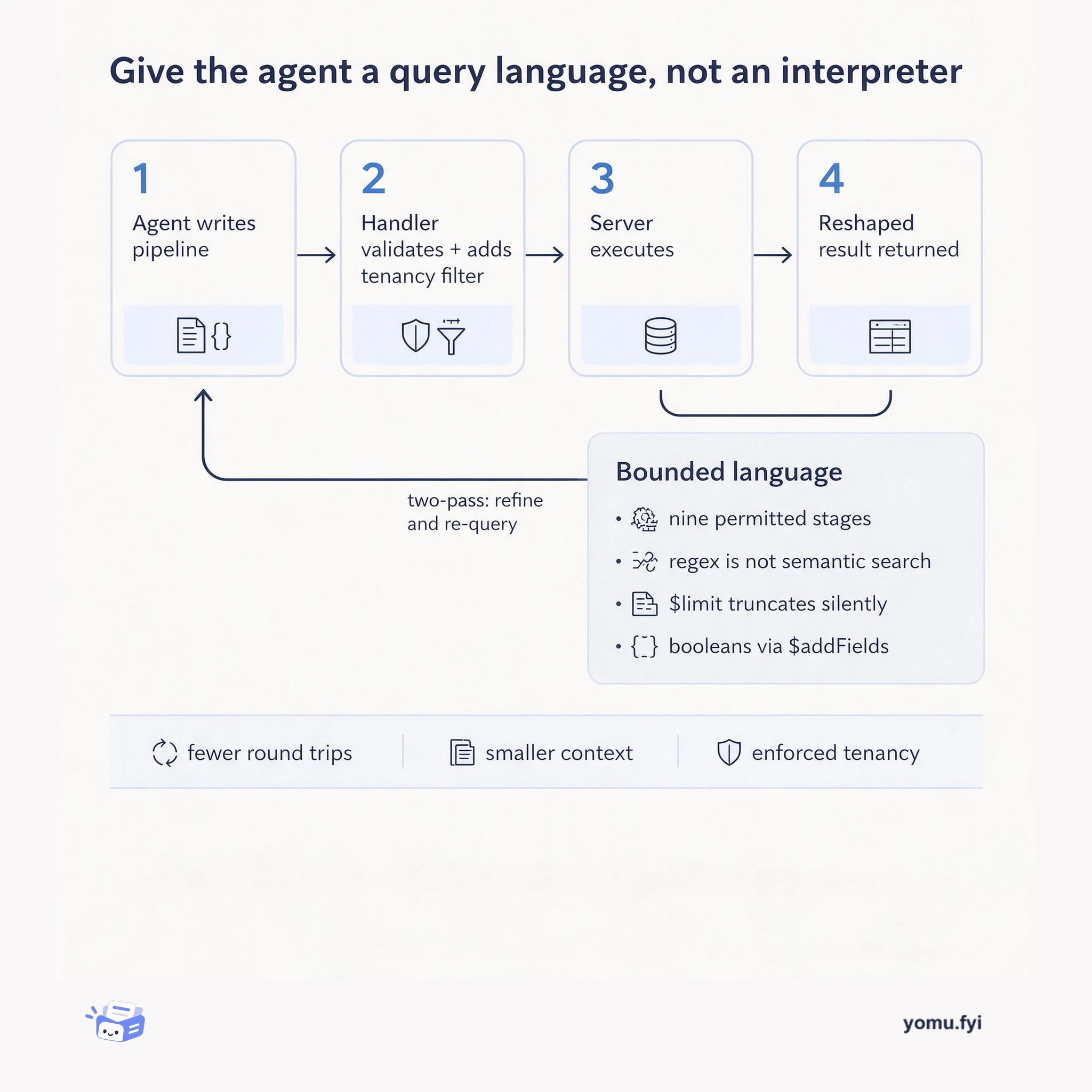
A four-step pattern for letting a document agent write validated aggregation pipelines instead of arbitrary code, so results come back shaped and tenancy stays enforced.
Loading…
Topic
172 posts about Security. Every summary links to the original.
See the idea
A four-step pattern for letting a document agent write validated aggregation pipelines instead of arbitrary code, so results come back shaped and tenancy stays enforced.
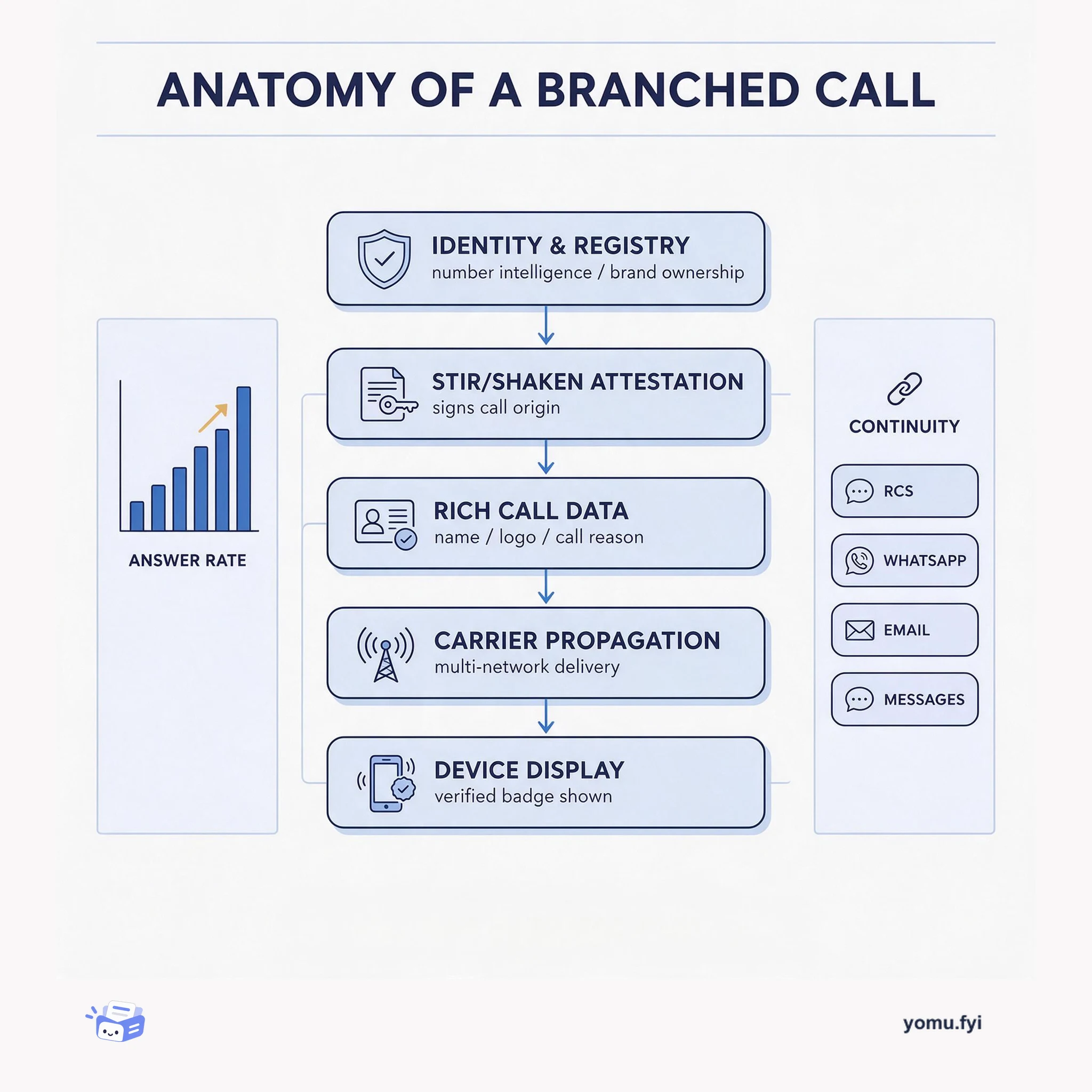
The Branded Calling trust chain, layer by layer: how identity, STIR/SHAKEN attestation, Rich Call Data, and carrier delivery combine so a verified brand name reaches the recipient's screen.
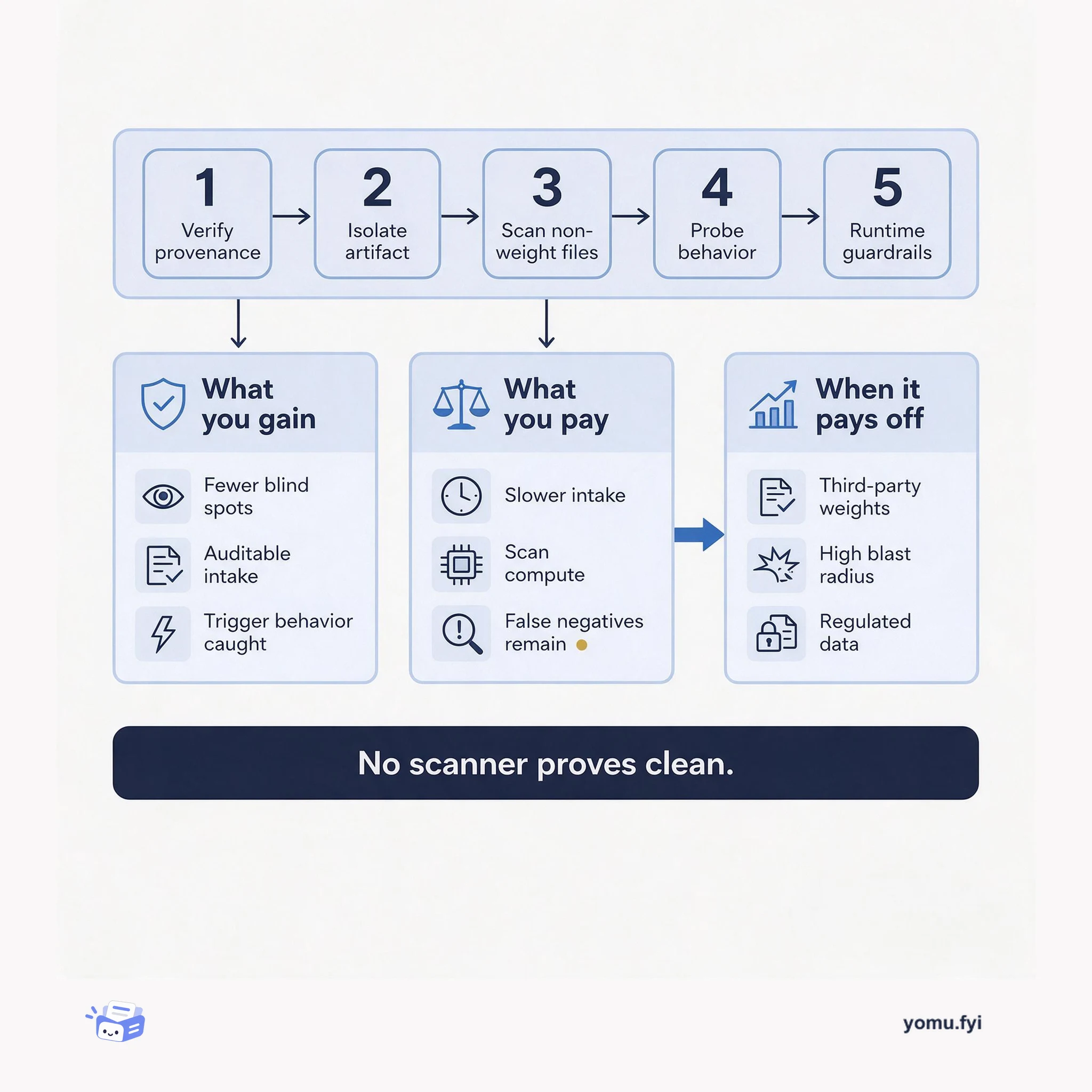
A model that passes benchmarks can still defect only on a trigger. This explainer maps the trade-off between deeper backdoor verification and the friction, latency, and cost it adds.
The Good Stuff
Paid picks we use ourselves. Links carry a referral code — a subscription through one earns us a commission at no extra cost to you.
Newest first
Google introduces Credentio, an open-source C++ library for local validation of C2PA Content Credentials, initially supporting specification versions 2.2 and 2.4. The library is the code used by nearly 40 conformant C2PA-enabled Google products to process tens of billions of generated images, videos, audio files, and documents across many formats. Its API keeps validation inside the developer’s application, avoiding media transmission while providing immediate verdicts, privacy, and zero bandwidth overhead; it is also designed to maintain a small memory footprint for assets ranging from images to multi-gigabyte videos. Credentio parses manifests, assertions, digital signatures, and claims, accepts official or custom trust lists, and reports verification statuses and integrity errors, while planned work includes generating and embedding Content Credentials.
Claude Sonnet 5 is introduced as an agentic Sonnet model that plans, uses browser and terminal tools, and operates autonomously. The post says it approaches Opus 4.8 performance at lower prices while improving on Sonnet 4.6 in reasoning, tool use, coding, and knowledge work. Comparisons on BrowseComp and OSWorld-Verified across effort levels show a wider cost-performance range, with higher-effort results matching Opus 4.8 on some tasks. Safety assessments found lower overall undesirable behavior, hallucination, and sycophancy rates than Sonnet 4.6, while default cyber safeguards address dangerous usage; the model is available across all plans and via the Claude API for $2 per million input tokens and $10 per million output tokens.
Supabase found that coding agents increasingly use its documentation to configure projects, creating risks when pages omit or bury critical instructions. To measure this, the team built an evaluation for the Row Level Security (RLS) guide, running an agent through realistic tasks and grading outcomes with checklist-based and agent-based judges. The initial runs found unauthenticated anon access with write privileges across tables and showed that test guidance was skipped when separated from the policy code. Supabase responded by adding procedural revocation steps, explicit policy snippets, and colocated test examples; the eval then passed the affected checks. The project concludes that agents and humans both benefit from selective-reading-aware structure, clear sections, explicit signposting, and recurring documentation evaluations, with the RLS scenario moving into the public supabase/evals benchmark.
Notion investigated public claims that a large dataset of its data was offered for sale on X and Breached Forums. The investigation began after the claim surfaced on June 23, 2026, and included review of publicly shared materials, sample data, and support from a third-party partner. The sample did not match data in Notion systems and contained internal duplicates and inconsistent fields; the claimed asking price and the forum user’s history also raised concerns. A deeper investigation found further inconsistencies indicating that the alleged dataset could not have come from Notion’s systems, and forum administrators later flagged the user as fraudulent. Based on the reviewed information, Notion found no evidence of a breach, customer-data access, or compromise, concluding that the alleged materials were fabricated.
Claude Opus 5 is available as a new model positioned near the frontier intelligence of Claude Fable 5, at half its price, while remaining behind Mythos 5 on cybersecurity tasks. Reported results show state-of-the-art performance on coding and knowledge-work evaluations, including Frontier-Bench, alongside strong results on ARC-AGI 3, Zapier AutomationBench, and OSWorld 2.0. The model uses configurable effort settings to trade intelligence for token use, speed, and cost, and is described as stronger at verifying work, iterating, and handling long agentic tasks. It costs $5 per million input tokens and $25 per million output tokens, with Fast mode running about 2.5 times faster at twice the base price. Safeguards allow vulnerability finding while blocking binary-based scanning, penetration testing, and exploit generation, with flagged requests able to fall back to Opus 4.8.
Claude Opus 4.7 is generally available as an upgrade to Opus 4.6, with stated gains in advanced software engineering, difficult long-running tasks, instruction following, self-verification, and higher-resolution vision. The announcement reports benchmark and tester results including a 13% resolution increase on a 93-task coding benchmark, a 0.715 tie for top score across six research-agent modules, and 90.9% on BigLaw Bench at high effort. It also describes safeguards that detect and block prohibited or high-risk cybersecurity requests, while legitimate security professionals can apply to the Cyber Verification Program. The model is offered across Claude products, its API, Amazon Bedrock, Vertex AI, and Microsoft Foundry at $5 per million input tokens and $25 per million output tokens. New controls include xhigh effort, task budgets, Claude Code’s /ultrareview, and auto mode, while migration may increase token counts because of tokenizer and reasoning changes.
Cross App Access (XAA) provides an identity framework for securing token-based communication when software or AI agents access external ecosystems through trusted identity providers. It replaces long-lived API keys and hardcoded secrets with real-time identity propagation, while allowing enterprises to control connected apps, requested scopes, and user access. The guide explains prerequisites for requesting and resource apps, including OIDC or SAML SSO, authorization-server support, protected resources, scopes, an Okta Integrator Free Plan org, and tested workflows. It then describes token exchange testing: requesting apps obtain an ID token and mint an ID-JAG, while resource apps validate the ID-JAG and issue a scoped access token. To seek OIN listing and XAA enablement, applicants submit SSO integration details, metadata, testing evidence, and a questionnaire to Okta.
Anthropic announces its Responsible Scaling Policy (RSP), a set of technical and organizational protocols for managing catastrophic risks from increasingly capable AI systems, including deliberate misuse and autonomous behavior contrary to designers’ intent. The policy introduces AI Safety Levels (ASL), loosely modeled on biosafety levels, with requirements for safety, security, and operations increasing alongside a model’s potential for catastrophic risk; current LLMs, including Claude, are described as ASL-2. ASL-3 would require unusually strong security and no deployment when adversarial testing by world-class red-teamers finds meaningful catastrophic misuse risk, while ASL-4 measures remain unwritten and may depend on unresolved interpretability research. Approved by Anthropic’s board, the RSP is presented as an initial, revisable framework that may temporarily pause scaling when safety procedures cannot keep pace, while incentivizing solutions needed for further development and leaving current Claude uses and product availability unchanged.
Claude Fable 5 has been redeployed globally, accompanied by additional detail about its cybersecurity safety classifiers and a proposed AI jailbreak severity framework. The classifiers distinguish prohibited use, high-risk dual use, low-risk dual use, and benign use, with intended responses ranging from blocking to allowing with monitoring; the model uses a larger safety margin than previous models, accepting more false positives to increase protection against harmful outcomes. Other safeguards include access controls, model safety training, and offline monitoring, while a HackerOne program invites researchers to submit potential cyber jailbreaks. The draft framework measures capability gain against the available baseline and illustrates scoring with Log4Shell cases, where severity changes as discoverability and existing tools change.
Heroku CLI 11.8.0 changes credential storage by making the system keychain the default and retaining .netrc as a fallback. The transition began in 11.6.0, when the CLI stored tokens in both locations to preserve existing workflows. The credential manager uses macOS security, Linux Secret Service through secret-tool, or Windows PasswordVault, storing credentials under “heroku-cli” with the account email as the identifier. Authentication lookup prioritizes HEROKU_API_KEY, then HEROKU_NETRC_WRITE, keychain storage, and .netrc files; unsupported or failing keychain access falls back to .netrc. Version 11.8.0 also adds a Git credential helper, so commands such as git push heroku main continue without configuration changes, while CI/CD can keep using HEROKU_API_KEY and Linux users may need secret-tool.
Uber for teens is now available in Los Angeles, allowing teens to request their own rides while guardians can book rides on their behalf. The service lets guardians track trips live, sends realtime notifications, pairs teens with highly rated drivers, and keeps PIN verification and RideCheck enabled for every ride. Guardians and teens can also message the driver in a shared group chat, while on-demand pickups and dropoffs must remain within the designated service area; Reserve trips remain available outside it. To book, a guardian selects “Where to?”, changes the rider from “For me” to the relevant teen, and chooses “Uber for teens.” Trips to or from airports cannot currently be requested.
Anthropic and DXC Technology announced a multi-year global alliance to bring Claude into mission-critical systems used by banks, airlines, insurers, manufacturers, and government agencies. DXC will train tens of thousands of Claude-certified forward-deployed engineers, while adding its own curriculum for regulated, mission-critical environments to Anthropic Academy’s certification. DXC first used Claude internally, including as the default foundation model for DXC OASIS, an AI-native managed-services orchestration platform whose code was more than 95% generated by Claude and reviewed by engineers; DXC estimates this accelerated development tenfold. The alliance initially targets insurance, legacy modernization, cybersecurity, and application services, including an always-on security engineer subagent for security operations centers. OASIS serves more than 50 DXC customers, with broader rollout planned.
Aasawari Sahasrabuddhe describes moving from backend software development into developer relations after finding that coding alone felt incomplete. Her DevRel work combines community engineering, content creation, strategy, workshop building, technical writing, hands-on workshops, and public speaking, while retaining a technical base in Java, Quarkus, and Spring Boot. She also discusses deeper interests in containers, Kubernetes, Docker, CI/CD, and GitOps, along with recognition as a MongoDB Champion for community contributions. The announcement introduces her move to Okta, where she wants to examine the intersection of identity, security, and AI, including how identity supports trust, access, and governance for AI systems. She frames this role as a way to stay close to community while continuing to work with code and content.
Palana is Grab’s Kubernetes-native platform for running autonomous and semi-autonomous agents with isolation, controlled access, and operational oversight. The post describes why laptop-based tools and simply running agents in containers do not adequately address persistent state, identity, credentials, network access, auditability, and emergency control. Its architecture gives each agent a namespace, service account, storage, network policy, and Vault scope, while Envoy, ext-authz, and OPA mediate and log HTTP(S) egress; proxy-only secrets keep underlying credentials out of agent processes. A portal and pcli manage lifecycle, and external kill switches and idle shutdown provide controls outside the agent. Palana is used for development environments, Slack automation, framework testing, and long-running internal workloads, with deeper architecture details reserved for Part 2.
Agentic Resource Discovery (ARD) is an open specification for publishing, discovering, and verifying AI capabilities across the web, addressing the lack of a standard that works across organizations and ecosystems. It uses organization-hosted catalogs, including an ai-catalog.json file at a well-known domain path, plus federated registries that crawl, index, and return capabilities with trust metadata. Clients can query a registry with plain-language intent or fetch a known catalog directly, verify the publisher’s cryptographic identity, then connect at runtime through the capability’s native protocol or API. Google Cloud is bringing ARD to Gemini Enterprise Agent Platform through Agent Registry, which supports hosted discovery and governance features including namespaced URNs, egress policies, specification pinning, and Agent Identity trust-manifest verification. The specification is available under Apache 2.0, with native Agent Platform support planned in the coming months.
Sign in with Google now provides verified applications with two OpenID Connect session metadata claims, auth_time and amr, in ID tokens. auth_time records the last successful Google authentication time, distinguishing session freshness from token issuance, while amr is a JSON array identifying authentication methods such as pwd, mfa, hwk, swk, tel, and sms. The claims are available across Android, iOS, and web client and server applications, and can support audit logging, step-up authentication based on session age, and authorization rules requiring stronger methods for sensitive operations. Verified applications request them through the standard OIDC claims parameter without significantly changing an existing Sign in with Google authentication flow.
Agents that call shell commands can damage their host, so the post separates the agent’s durable home from the environment where untrusted code executes. It presents Sprites as disposable, isolated sandboxes, with one Sprite per session for the multi-user SpriteDoc and one persistent Sprite per task for Hermes Agent. SpriteDoc injects each user’s flyctl credential only for the command that needs it, avoiding token storage while preserving the user’s permissions; Hermes can omit approval prompts because the sandbox protects the host. The same separation applies when Hermes itself runs inside a Sprite: its commands are dispatched to another Sprite with a different identity and boot. Copy-on-write checkpoints provide an undo path, restoring deleted files and tools in about nine seconds.
The author recounts a career path from creative interests and technical writing to developer relations, emphasizing that storytelling remained central while the audience changed. She began by producing API documentation, user guides, onboarding content, and other developer resources, then joined JDoodle, where conversations with developers shifted her focus from writing for them to connecting with them. Attending events and conferences, giving product demos, staffing booths, participating in community conversations, organizing hackathons, and running internal events helped her discover that developer advocacy matched her strengths in empathy, clear storytelling, and helping people succeed. She now announces a new role at Okta, where she will work with developers, creators, builders, and community members in identity and security while creating content, attending events, learning, and building connections.
Organizations struggled to determine whether files leaving their environment contained business-critical information, personal data, or non-essential content. Uber’s File Semantic Analyzer (FSA) addresses the limits of keyword- and pattern-based DLP by extracting text from documents, using OCR for image-based files, chunking large inputs, and sending context-rich text to a fine-tuned large language model. The model produces summaries, named entities, key phrases, inferred intent, classifications, and explanations, which a rule-based engine uses for policy enforcement while analysts validate high-fidelity findings and provide feedback. The system reduced incident-response time from multiple hours to a few minutes per case, saves an average of five minutes per file, and is expected to analyze 150,000 files annually; the post reports a 97% reduction in false positives.
Cursor is introducing organizations, a top-level structure that lets Enterprise customers manage multiple teams, budgets, security policies, governance, and feature controls from one dashboard. Organizations contain teams for departments or subsidiaries and groups for user cohorts; separate configurations can govern model access, spending, agent permissions, and network access, while the most permissive setting applies when users belong to multiple teams or groups. The organization dashboard aggregates spend and token usage across teams and supports filtering by team, user, service account, or cloud agent, while identity-provider and SCIM setup is centralized and membership can be managed through the dashboard, API, or CSV. Generally available to all Enterprise customers, the structure supports sandbox teams for testing features, scoped administration and chargebacks, and differentiated controls across functions; Cursor says policy controls, onboarding, and SCIM-driven assignment are still being expanded.
The best engineering reads, once a week.