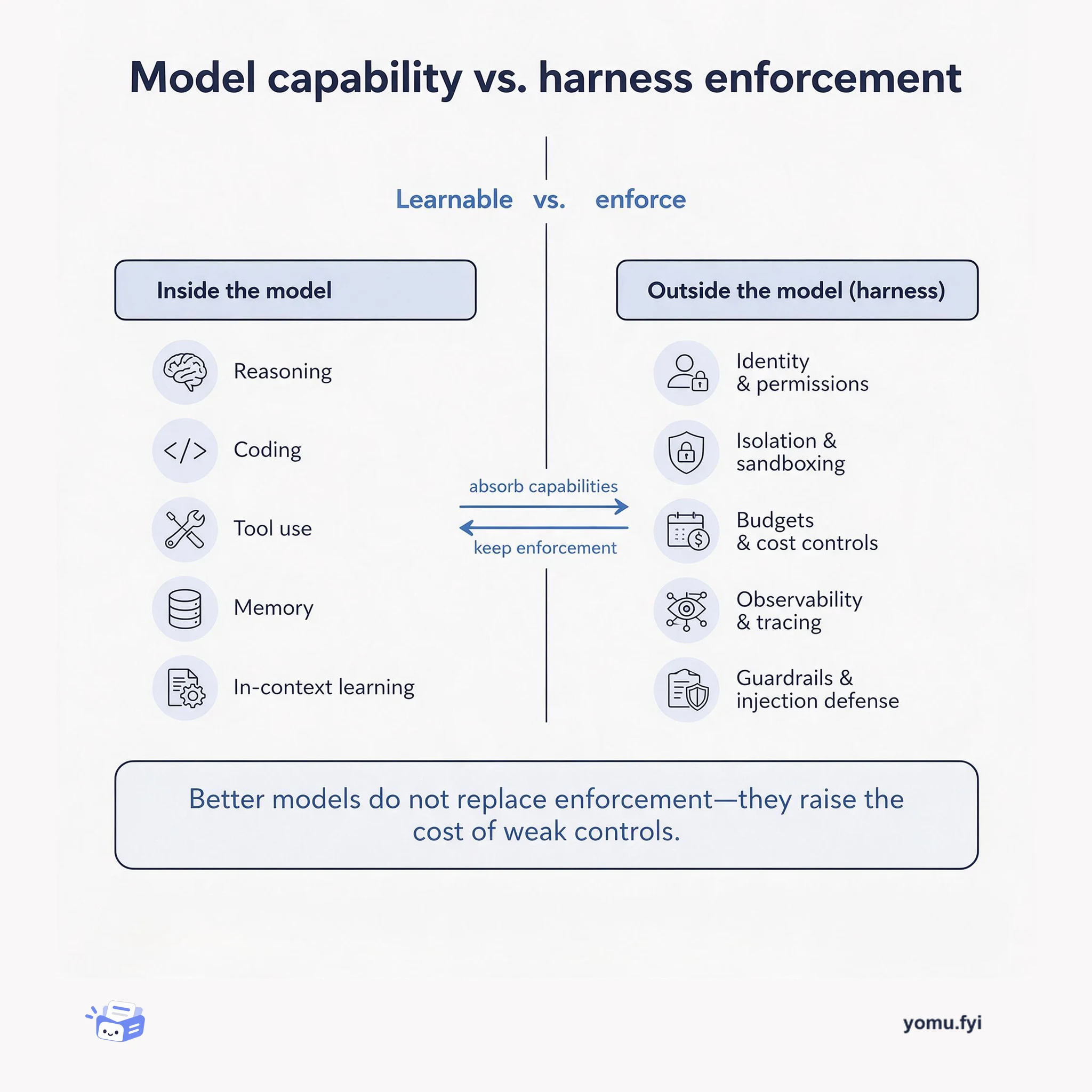
Model vs. Harness: Where AI Agent Controls Belong
A comparison of what AI models should learn versus what agent infrastructure must enforce. See how reasoning, permissions, isolation, budgets, and observability split across the boundary.
CIMD uses an HTTPS URL as an OAuth client identifier that points to a metadata document. This comparison shows when to pre-register clients manually and when to let dynamic discovery handle agent onboarding.
CIMD, or Client ID Metadata Document, replaces an opaque OAuth client ID with an HTTPS URL that points to a machine-readable document describing the client. Auth0 supports two registration paths: manual pre-registration, where an administrator reviews and approves the metadata URL, and dynamic registration, where clients are discovered just in time during authorization. Both paths can be governed by Application Profiles that centralize policies such as refresh token rotation and DPoP, while shared caching reduces database pressure as dynamic clients scale. The comparison helps engineers choose between tighter control and lower onboarding overhead for MCP servers and agentic applications.
Manual pre-registration requires an administrator to submit a metadata address for review and approval, so it fits known or higher-risk clients. Dynamic registration discovers clients just in time during authorization, which reduces onboarding overhead when many agent or MCP clients appear. Application Profiles can still apply shared policies to both paths.
CIMD uses an HTTPS address as the client identifier and points to a metadata document containing the client name, redirect URIs, and authentication methods. The identifier is therefore resolvable metadata rather than an opaque pre-issued ID. Auth0's implementation uses shared caching to reduce database write pressure and support more dynamic clients without latency.
Application Profiles centrally manage security policies such as refresh token rotation and DPoP across dynamically registered clients. Shared caching reduces database write pressure so more dynamic clients can be supported without latency. This separates client onboarding from policy enforcement, making scale less risky.
The posts behind it
 Fly.io · · Tutorial
Building a Slack bot with OAuth usually requires setting up a server with a public URL, handling callbacks, storing tokens, and maintaining them across restarts. Sprites simplifies this by providing an internet-accessible environment with a persistent filesystem, eliminating the need for Ngrok or separate hosting. To create the bot, users initialize npm, install @slack/bolt and express, and build an OAuth handler for Slack’s callback that stores tokens to the filesystem. The bot is registered as a Sprite service with sprite-env services create , which enables auto-start on HTTP requests, automatic request routing to port 8080, and persistent registration across hibernations. When idle, the Sprite hibernates to save costs and wakes in under a second, and users can create a checkpoint snapshot for easy restoration.
Fly.io · · ExplainerSprites are isolated virtual computers that can create and manage other Sprites via an API, and Claude can use that API when authorized by a token from sprites.dev/account. This enables automated workflows like central OAuth token management, where an Auth Sprite handles token refresh and storage for other Sprites. For CI, an orchestrator Sprite spins up a worker for each test file, locks its network to only pypi and github, runs the test, collects results, and destroys the worker. Preview environments are created per pull request, with each PR getting its own Sprite that is redeployed on updates and destroyed on merge. Additional use cases include agent delegation with network-policy-locked workers, running untrusted code in a deny-all network Sprite, and team provisioning via a provisioner Sprite that creates and configures new Sprites with checkpoints enabling fast restoration.
Fly.io · · Problem & solutionThe author recounts the chaos of local development across multiple projects, where version managers (asdf, nvm), separate databases (Postgres, MySQL), and conflicting environment variables cause constant friction. To solve this, they use Sprites, a Fly.io product that provides each project its own persistent, hardware-isolated Linux computer with 100 GB storage, incurring cost only when active. Each Sprite has dedicated versions, services, env vars, and ports, waking from sleep in seconds and avoiding all collisions. Sprites expose real public URLs with automatic TLS, eliminating the need for ngrok or tunneling for OAuth callbacks and webhooks. The author also values checkpoint snapshots for safe experimentation and the ability to maintain specialist coding agents per project, each with its own claude.md and skills, without context pollution.
 Notion · · Explainer
Notion’s four-chapter story begins with early struggles from 2013 to 2018, throwing away a visual programming app and a productivity app before launching version 1.0. The breakthrough came in 2018-2022 with general-purpose databases, leading to product-market fit and global growth, with 70% of revenue from outside the US. In late 2022, Notion defensively added AI features like Writer, Enterprise Search and Meeting Notes, later releasing Agents that now create half of all pages. AI usage within Notion grew 9x this year, but external MCP volume surged 60x as companies like Stripe, Uber and Meta built their own context systems. To become the universal context system, Notion reorganized its tech under one leader, split marketing, and evolved finance, aiming to bridge AI, data, and UI for every agent.
 Auth0 · · Announcement
The rise of AI agents and MCP-based ecosystems introduces identity challenges when onboarding numerous clients without manual overhead. Auth0 expands its Client ID Metadata Document (CIMD) support with two registration modes — manual pre-registration and dynamic registration — for OAuth clients. Manual pre-registration requires an administrator to submit a metadata URL for review and approval, while dynamic registration enables just-in-time client discovery during authorization flows. CIMD uses an HTTPS URL as the client identifier pointing to a metadata document with the client’s name, redirect URIs, and authentication methods; Auth0’s implementation uses shared caching to reduce database write pressure and support more dynamic clients without latency. Application Profiles centrally manage security policies such as refresh token rotation and DPoP across dynamically registered clients, aiming to provide a practical identity foundation for MCP servers and agentic applications.
More like this
A comparison of what AI models should learn versus what agent infrastructure must enforce. See how reasoning, permissions, isolation, budgets, and observability split across the boundary.
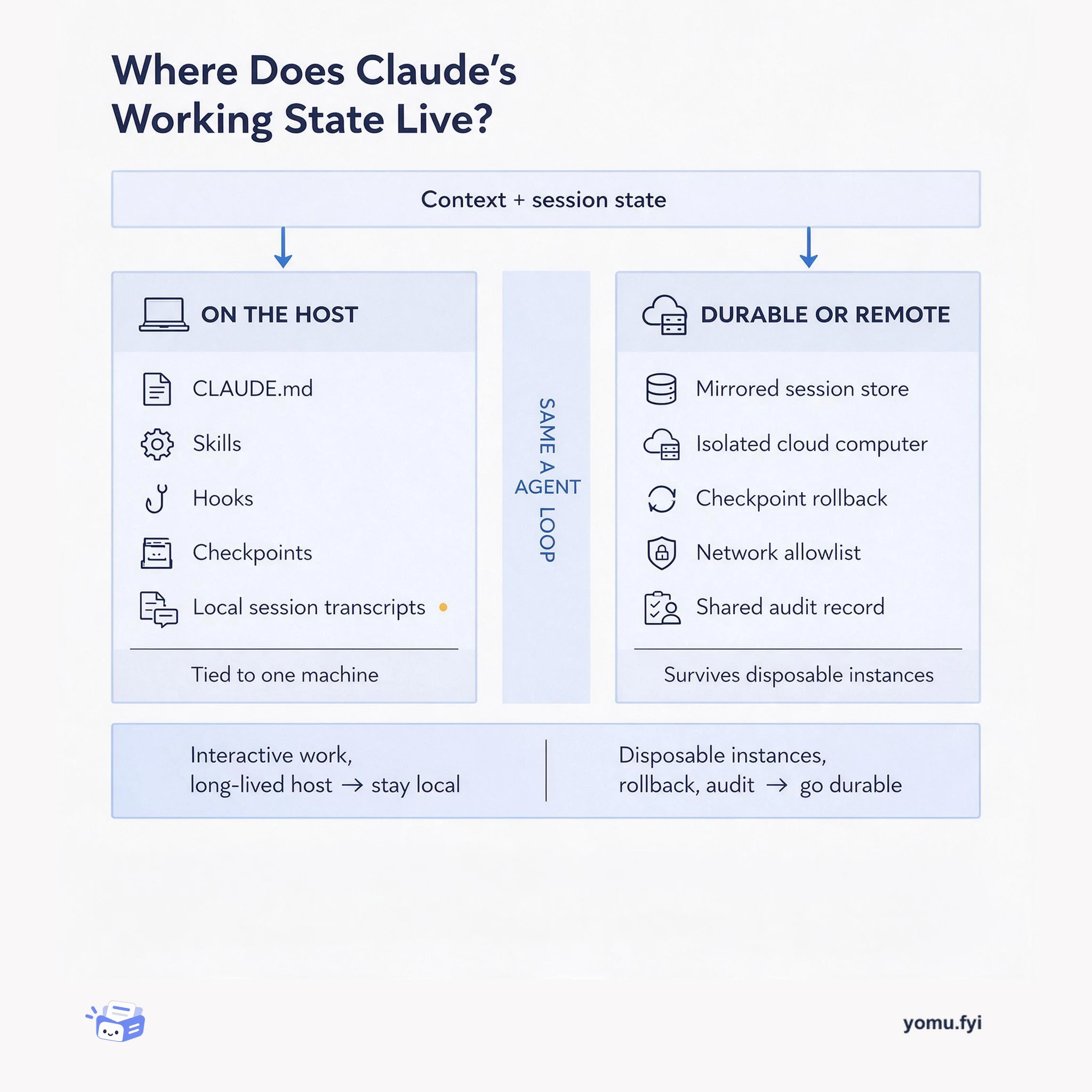
Compare two places to keep Claude's working state: curated files on your own machine versus a durable session store or isolated cloud computer, and learn which one fits your deployment.
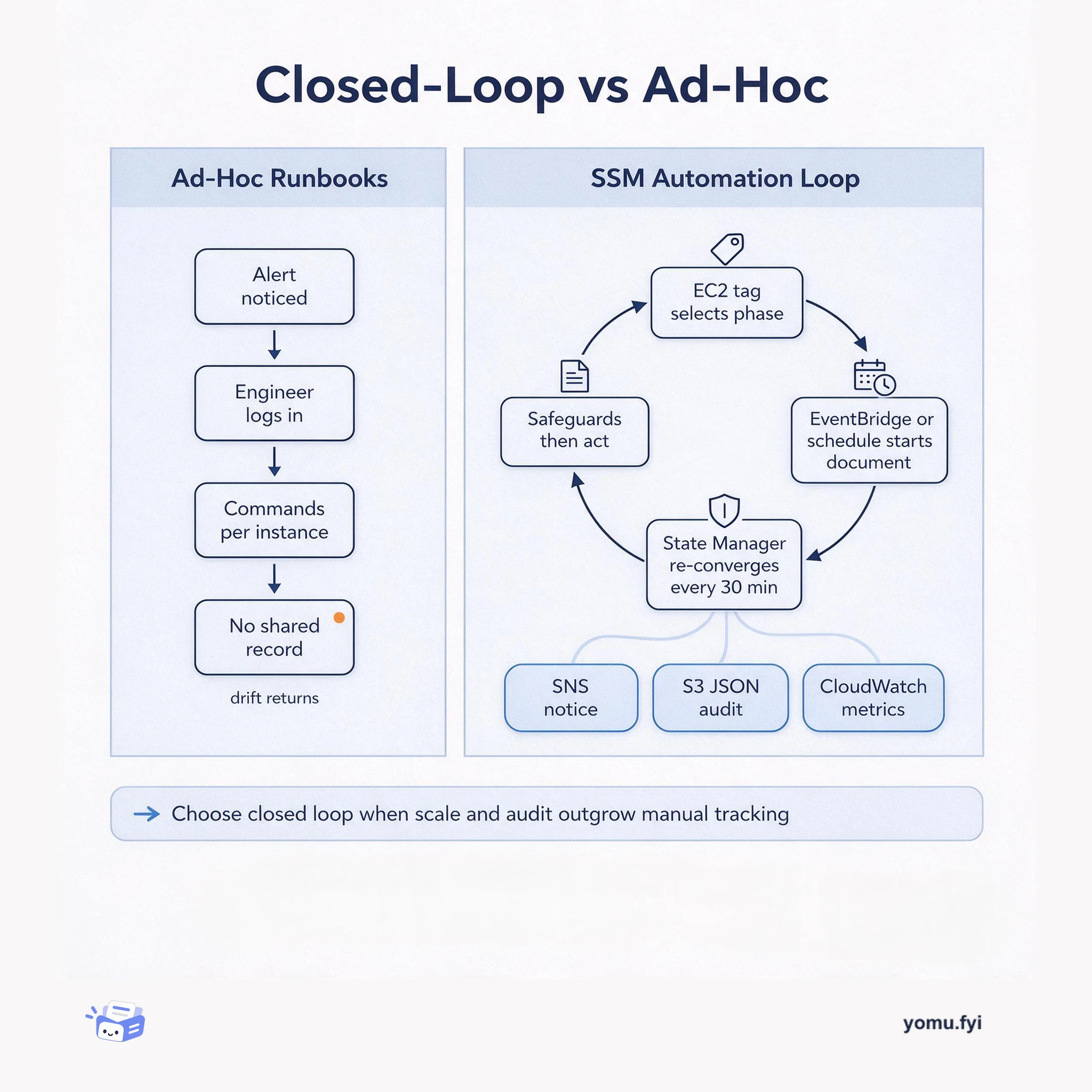
A side-by-side comparison of ad-hoc, human-run remediation and tag-driven AWS Systems Manager Automation, showing what each costs in audit trail, drift, and time to recover.
The Good Stuff
Paid picks we use ourselves. Links carry a referral code — a subscription through one earns us a commission at no extra cost to you.
One useful email. Unsubscribe anytime.