How to Give an Agent a Query Language Instead of a Code Interpreter
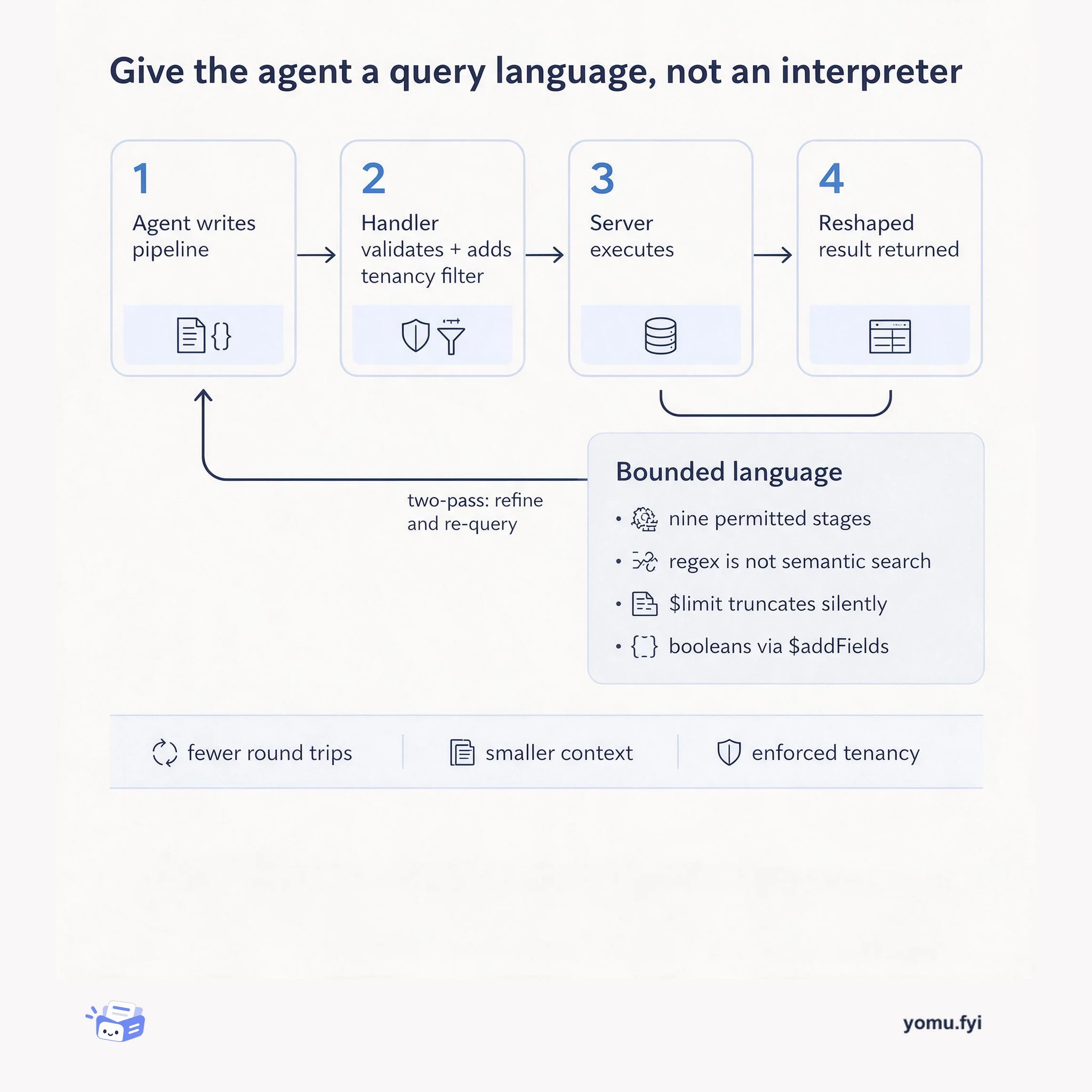
A four-step pattern for letting a document agent write validated aggregation pipelines instead of arbitrary code, so results come back shaped and tenancy stays enforced.
Loading…
Topic
542 posts about AI Agents. Every summary links to the original.
See the idea
A four-step pattern for letting a document agent write validated aggregation pipelines instead of arbitrary code, so results come back shaped and tenancy stays enforced.
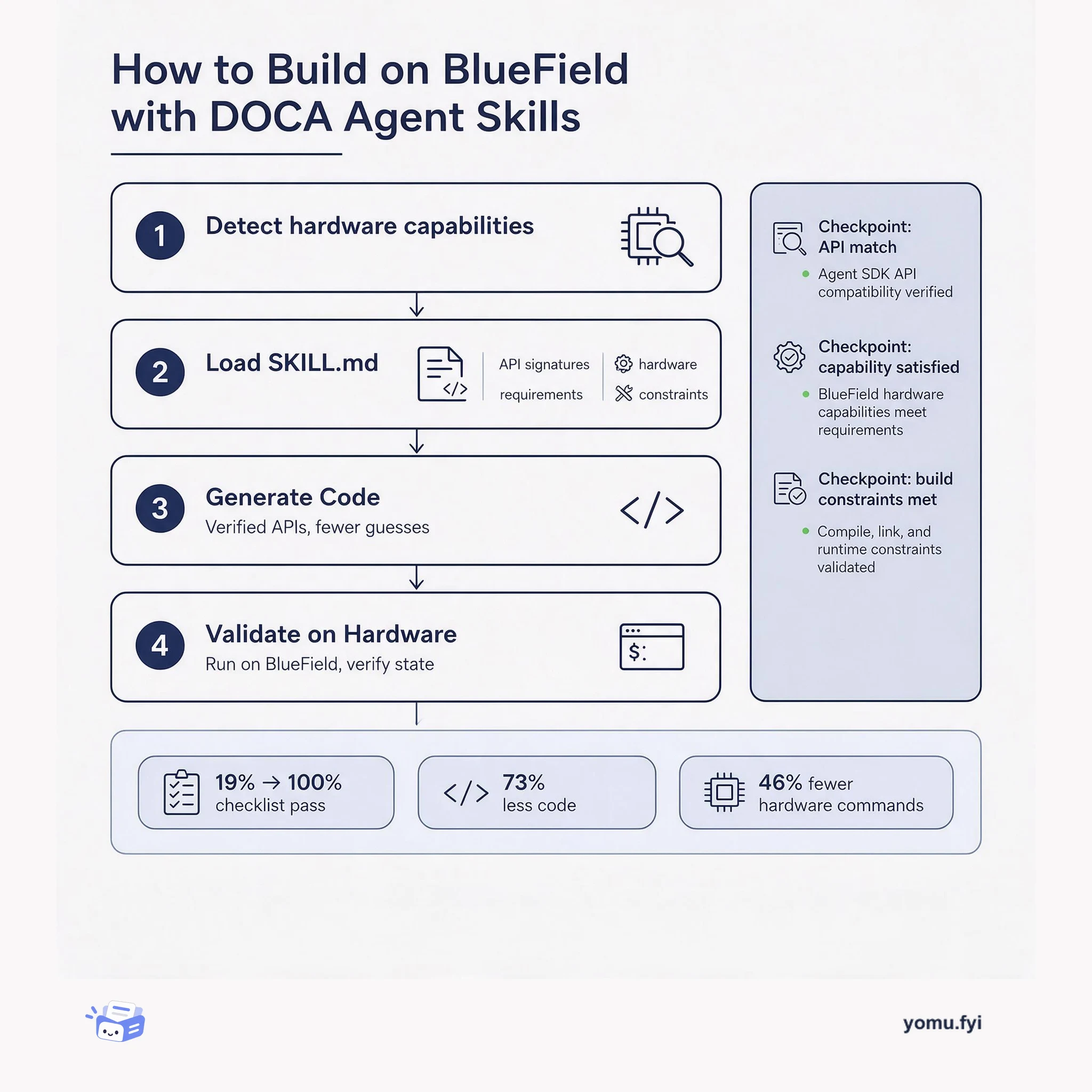
A practical how-to for using NVIDIA DOCA Agent Skills to generate BlueField code with verified APIs and hardware checks, reducing correction cycles and failed builds.
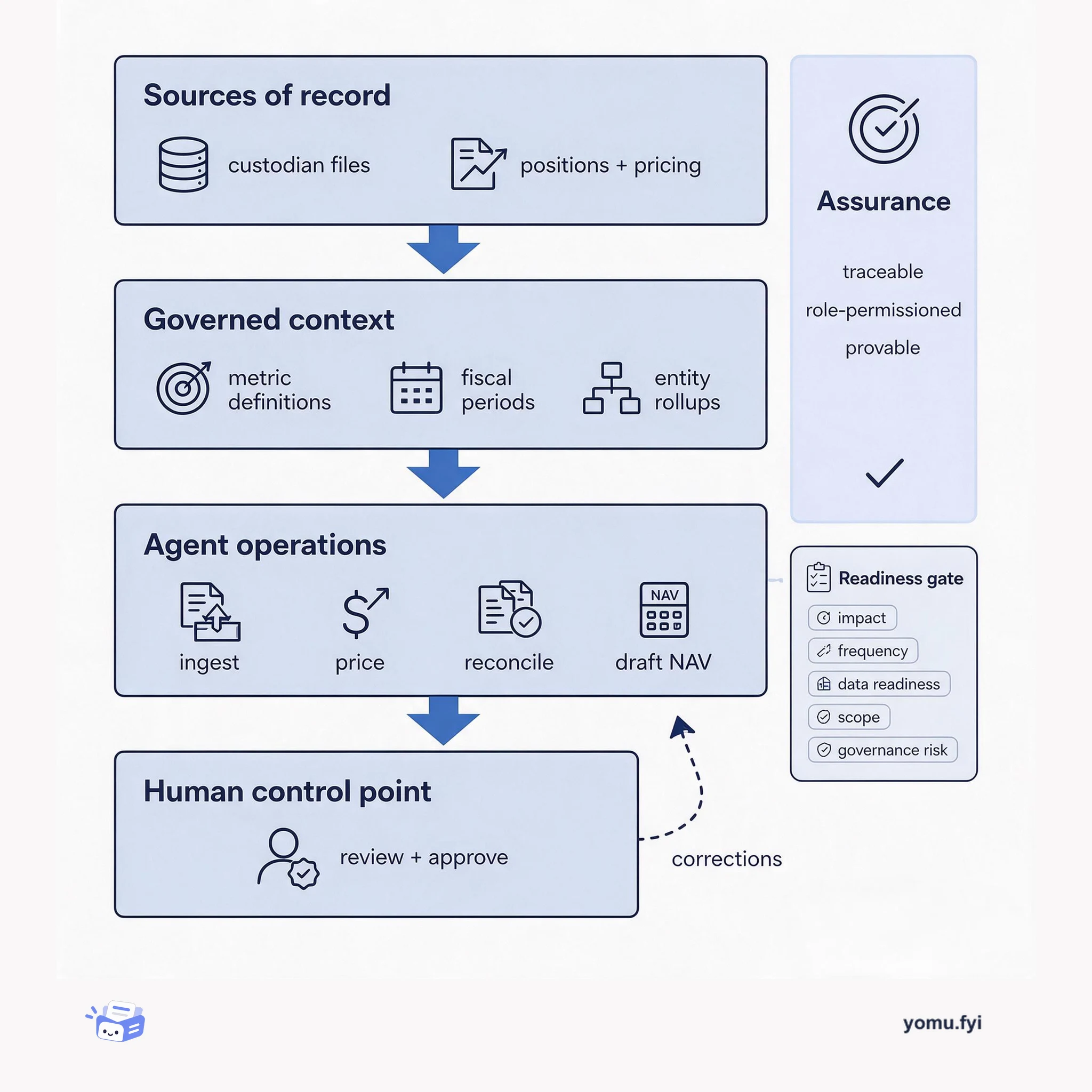
Asset management runs as a layered control plane: custodian and pricing data feed a governed context layer, agents run the overnight fund work, and a human signs off before anything is published.
The Good Stuff
Paid picks we use ourselves. Links carry a referral code — a subscription through one earns us a commission at no extra cost to you.
Newest first
The article outlines authentication trends expected to shape identity verification, fraud prevention, payments, and access in 2026, against a backdrop of deepfakes, synthetic identities, regulatory change, and increasingly online services. It describes identity orchestration that combines document checks, biometrics, device intelligence, and behavioral signals, while fraud systems assess behavior and may allow, challenge, delay, or block access. For AI agents, Know Your Agent links a bot to its enterprise and official communication channel, with document verification and Twilio Lookup presented as a combined onboarding approach. The recommended strategies add continuous anomaly monitoring, risk-based MFA, human-in-the-loop approvals, multichannel authorization, passkeys, digital IDs, and layered controls, while concluding that businesses and regulators should remain agile and use services such as Twilio Verify, Lookup API, and Verify Fraud Guard.
The post argues that the long-standing trade-off between security and seamless user experience is a false choice, especially as autonomous AI agents act across systems. High-friction measures such as passwords, CAPTCHAs, and one-time login checks can create insecure credential reuse and fail to govern over-permissioned agents or risks that emerge during a session. It proposes invisible, continuous risk evaluation using device, network, phone, email, communication, and behavioral signals, with event-triggered verification when an agent requests a consequential action. The approach also separates human authentication from agent identity and Know Your Agent (KYA), which define delegated authority, contextual rules, and time-bounded permissions while linking an agent to its deploying entity. Twilio is presented as a unified trust layer combining customer data, security intelligence, AI governance, and communication channels; the conclusion is that adaptive controls can protect users while making security largely invisible.
A 34% year-over-year increase in consumers using generative AI for online shopping, especially among Gen Z and Millennials, is motivating e-commerce teams to adopt AI shopping agents. This tutorial demonstrates building a chat-based shopping assistant on MongoDB Atlas with CrewAI that supports zero-click buying from product discovery to post-purchase follow-up. The agent interprets natural-language queries, retrieves semantically relevant products via MongoDB Vector Search with Voyage AI embeddings using price and inventory pre-filters before similarity ranking, and uses Change Streams for atomic inventory checkout. Atlas Triggers enable proactive order notifications, while Atlas Stream Processing detects delivery patterns by monitoring updates in two-minute tumbling windows, writing confirmed signals to agent_triggers when at least 10 orders per carrier-region are delayed by 45 minutes. MongoDB consolidates operational data, semantic search, and event-driven capabilities into a single platform, reducing latency and complexity.
Cursor’s release expands cloud agents and the Cursor harness for longer-running, event-driven software work. Cloud agents can subscribe to pull requests, Slack threads, or scheduled tasks, wake on events, keep goals until completion, and automatically address CI failures and bot comments on pull requests they create. Custom modes pin a selected skill in chat, while /goal supplies a long-lived objective that can be paired with a custom mode or /loop. Subagents can run on separate virtual machines with isolated project copies and clean context, supporting fresh testing or parallel fixes without collisions. Steering improvements let users send follow-ups that wait for the next tool call instead of interrupting an action.
Lore is an open-source, MIT-licensed tool from Notion for giving AI agents shared, persistent memory backed by Notion, addressing experiential knowledge, follow-up tasks, decision records, and procedures that can disappear between sessions. A Lore vault uses five related Notion databases—Projects, Topics, Memories, Entities, and Facts—with MCP tools for agents, Notion or a CLI for humans, and hooks intended to retrieve context and save information in the background. The design emphasizes memory maintenance: facts expire by default, relationships such as supersedes and conflicts_with clarify updates, and the CLI can identify orphaned or duplicated information. In a 500-query SkillRet retrieval evaluation, Lore achieved 84% success, while a paired model evaluation found seeded memory recovered about 46% of failures on tasks never solved without memory. The results indicate that relevant, well-maintained memory can improve agent performance, while stale or irrelevant content can harm it.
Six Indian organizations are using MongoDB Atlas to move AI projects from prototype to production at scale. Emergent Labs built a platform for non-programmers to create applications via natural language prompts, powering nearly 12 million apps. Zomato’s AI customer support platform Nugget improved human-agent efficiency by 40% within four months. Leena AI uses MongoDB Atlas to handle high-volume employee queries in real-time across 500 enterprises. Brahma AI relies on MongoDB as a unified data foundation for its enterprise content management and AI creation platform. These organizations cite MongoDB’s flexible document model, built-in search and vector capabilities, and scalability as key enablers for their AI workflows.
The post distinguishes agent state, the run-bound working data of a single execution, from agent memory, knowledge that outlives the run and is read across sessions. Context compaction, which decides what to keep when the window fills, is lossy by construction and sets both token cost and reliability; Chroma’s study found models become unreliable well before their advertised 200k-token window, and teams compact at 95% or proactively at 60%. System prompts and skills must be versioned, governed infrastructure, not text files, with prompt registries and the SKILL.md standard for procedural memory, and skills are executable so they require sandboxing. Enterprise data enters memory through pipelines like change data capture, not migrations, with chunking, embedding, and provenance stamps. The database choice caps filtered recall under selective scoping, the consistency window, and temporal modeling, setting the ceiling for later decisions.
Connecting an autonomous Agent Development Kit (ADK) agent to databases, internal APIs, and code execution turns model decisions into production-state changes that system prompts cannot securely constrain. The post presents an open-source Customer Support & Returns Agent built with ADK and Gemini, using an example where prompt injection could produce an unauthorized refund or leak environment secrets. Its zero-trust design combines hardware-backed signing for database mutations, gVisor isolation with no network egress and resource limits for generated Python, and deterministic semantic gateways for prompts, tool calls, and database updates. Local equivalents use HMAC keys, a database ingress verifier, a constrained Docker runner, and Python validation tests, while production mapping uses Cloud KMS, HSM, and VPC Service Controls. The conclusion is that infrastructure-enforced boundaries let the model reason dynamically within strict limits.
Ramp describes an approach to scaling integrations beyond what engineers can build and maintain by hand. Its agentic system lets customers describe a missing workflow integration, researches the provider’s API, requests credentials through a secure widget, writes and tests ordered API-call “recipes,” and generates a deterministic script that runs the integration after build time. An internal Integration Factory applies the same pattern to first-party connectors, producing evidence for review and opening pull requests; the post says 75 integrations have shipped this way, with work reduced from weeks or months to hours. Security controls include HTTPS and hostname allowlists, private-address rejection, isolated egress, bounded responses, business-scoped immutable recipes, and test credentials rather than customer data. The central design lesson is to use models during research and construction, keep them out of execution, and bound autonomy with verification artifacts.
Cursor announced that the Firetiger team is joining the company, bringing together coding agents with agents focused on software after it reaches production. Founded in 2024 by Rustam Lalkaka and Achille Roussel, Firetiger builds agents that monitor rollouts, catch regressions, investigate incidents, and pass findings back to coding agents. The stated motivation is to reduce operational toil and connect code generation with production feedback, so an agent can ship a change, observe its behavior, and respond when something goes wrong. Firetiger’s work is expected to appear across Cursor as the companies develop long-running, autonomous, context-aware agents for teams, alongside Cursor Origin and the forthcoming Change Monitors, which will watch deployed changes and flag problems as they appear.
Fin’s new Evals and Releases provide an evaluation and rollout system for testing changes before launch, controlling deployment, and assessing live conversations, alongside Monitors. Evals group multi-turn Simulations built from real conversations around a theme, then score them pass/fail using deterministic checks and an LLM judge against criteria such as required responses, Procedures, or data connector calls. Releases let teams edit content, Procedures, and Guidance away from live Fin, run Evals on proposed changes, collaborate, and publish to everyone, ramp traffic, A/B test, or roll back. Monitors evaluates every live conversation and can turn failures into new Simulations for subsequent testing. The combined workflow addresses probabilistic behavior, regression risk, and drift as support content and policies change, while Operator can draft changes, tests, and Releases for review and approval.
Cursor introduces builds for Cloud Agents, continuously prepared copies of development environments that replace just-in-time machine boot, repository cloning, dependency installation, and install-script execution. Builds run by default every hour; successful builds become the starting point for future agents, which fork warm live machines rather than restoring environments from disk. The post reports 10x faster internal environment boot times and 3x faster time to first token, while customers cite quick starts and uninterrupted automated runs when builds fail. If a dependency bump or Docker build breaks installation, the failed build stays inactive and sessions continue from the last successful version while debugging proceeds. The Cloud Agents dashboard exposes build status, logs, captured commit SHAs, and run-to-build links, while a git-state threshold and Cursor Cloud MCP support oversight; setup requires moving preparable work into install and reserving fresh services for start.
Cursor announces that it has earned AIUC-1 certification after an independent review of its organizational controls and agent behavior. AIUC-1 combines an organizational-controls audit with adversarial product testing, translating the NIST AI Risk Management Framework, MITRE ATLAS, and OWASP’s agentic threat taxonomy into requirements for live AI systems. Schellman reviewed documented controls and AI governance practices, while evaluators tested IDE and cloud agents in a representative enterprise configuration across several thousand scenarios and two rounds. Testing covered rules, hooks, Auto-review, model-level safeguards, secrets protection, secure code generation, MCP security, identity and permissions, and potentially destructive actions. Cursor says its safeguards held in benign and adversarial conditions, with certification requiring quarterly testing and an annual full audit as AIUC-1 evolves.
MongoDB has launched the Atlas Managed MCP Server, a fully hosted service that lets AI coding tools connect to Atlas data without manual infrastructure setup. The server uses OAuth 2.1 to replace shared service accounts with individual user delegation, so agents act with the developer’s own permissions and every action is auditable. Developers can connect via one-click OAuth consent in tools like Claude Code, Codex, Cursor, Grok Build, and Devin AI, with no connection strings or credentials to manage. Admins can enforce read-only mode, configure token lifetimes, and revoke access from the Atlas UI or Admin API. The announcement also includes Atlas App Connections, native connectors for frontier AI tools, and an integration with Vercel v0, aiming to close the gap between prototype and production.
McKinsey projects AI agents will generate $2.9 trillion annually; a WRITER survey finds 97% of executives have deployed agents, yet only 29% see significant ROI due to data accuracy issues. MongoDB announced capabilities embedding benchmark-leading retrieval directly into its operational database, closing the gap between agentic promise and impact. Automated Embedding in MongoDB Atlas powered by Voyage AI, now GA, uses the top-ranked Voyage 4 model family for accurate retrieval without separate pipelines, as demonstrated by MedINT. The Atlas Embedding and Reranking API and voyage-code-4 model, designed for agentic coding retrieval, extend accurate retrieval to any stack and coding agent workloads at low cost. $vectorSearch in Atlas Stream Processing enables agents to retrieve accurate data in motion, and a joint MongoDB-Temporal reference architecture provides a forkable starting point for durable execution on live data.
Cursor’s Cloud Agents now use Builds, ready-to-use copies of a development environment prepared in the background. These environments include cloned repositories, installed dependencies, and completed install commands, allowing agents to start without repeating setup each session. Cursor refreshes environments regularly, keeps warm copies, and activates only successful builds; internally, environments boot 10x faster and time to first token is 3x faster. If a commit or dependency update breaks a build, the last successful build remains active, while users receive a notification and can debug in the background. Builds can be inspected in the Cloud Agents dashboard, where logs, commit SHAs, statuses, and agent run associations are available, with tools for agents to inspect or manage them.
Grok 4.6, released with SpaceXAI, is presented as a model for long-running agents and ambitious interactive, visual, coding, and knowledge-work tasks. It builds on Grok 4.5 through a longer supplemental training run using curated model-generated reasoning and technical data, an improved optimizer and training recipe, regenerated SFT trajectories, model-based filtering, and agentic reinforcement-learning tasks across several environments. The release says Grok 4.6 matches GPT-5.6 Sol on the Artificial Analysis Intelligence Index and reports stronger first passes, sustained multi-step work, self-testing, and iterative refinement for working projects. It is available in Cursor, Grok Build, the SpaceXAI API, and through OpenRouter, Vercel, and Cloudflare, with pricing from $2 per million input tokens and $6 per million output tokens, while a fast variant costs twice as much.
AI-assisted software development shifts the human bottleneck from writing code to reviewing, verifying, and maintaining generated code, while people still define architecture, service boundaries, safety, and reliability. The post presents Go as a language designed for software engineering and argues that its end-to-end platform—built-in formatting, testing, dependency management, security tooling, and a comprehensive standard library—gives teams and AI agents a consistent foundation. Go’s readability, explicitness, standardized syntax through gofmt, static typing, and single-binary portability are described as guardrails that make generated code easier to inspect, validate, and operate. It also identifies gopls, the rebuilt go fix with modernizers, profiling, execution tracing, and profile-guided optimization as tools for maintaining and tuning systems over time. The conclusion is that Go’s consistency and production-oriented tooling can help humans absorb high-volume AI output without sacrificing reliability, maintainability, or system integrity.
Claude Sonnet 5 is introduced as an agentic Sonnet model that plans, uses browser and terminal tools, and operates autonomously. The post says it approaches Opus 4.8 performance at lower prices while improving on Sonnet 4.6 in reasoning, tool use, coding, and knowledge work. Comparisons on BrowseComp and OSWorld-Verified across effort levels show a wider cost-performance range, with higher-effort results matching Opus 4.8 on some tasks. Safety assessments found lower overall undesirable behavior, hallucination, and sycophancy rates than Sonnet 4.6, while default cyber safeguards address dangerous usage; the model is available across all plans and via the Claude API for $2 per million input tokens and $10 per million output tokens.
Agent Plugins 1.0.0 is an open, vendor-neutral specification for packaging Agent Skills and MCP servers into portable plugins, addressing incompatible wrappers that force authors to maintain client-specific copies. It defines a plugin as a directory with plugin.json, skills/ subdirectories, mcp.json, and client-owned reverse-domain extension namespaces. The manifest fixes component locations, requires explicit MCP server types for stdio, Streamable HTTP, or legacy HTTP+SSE, and lets skills continue loading when an MCP entry fails. Version 1 deliberately excludes installation, distribution, permissions, sandboxing, trust verification, and user experience, leaving those concerns to clients and related ecosystem layers such as discovery and catalogs. Google is joining the Core Maintainers and says Agents CLI and Data Agent Kit support the format, while more product integrations are expected.
The best engineering reads, once a week.