How to Give an Agent a Query Language Instead of a Code Interpreter
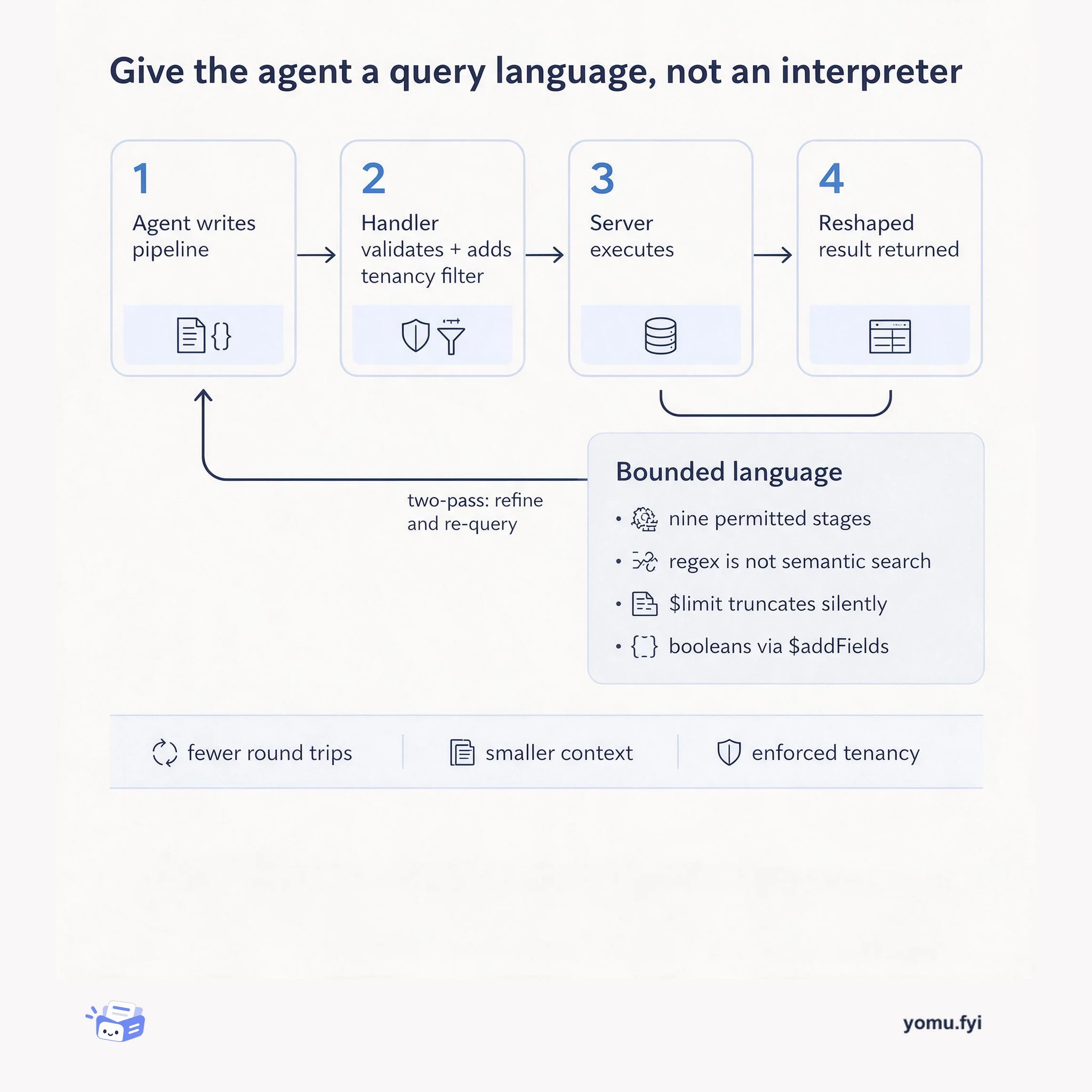
A four-step pattern for letting a document agent write validated aggregation pipelines instead of arbitrary code, so results come back shaped and tenancy stays enforced.
Loading…
Topic
542 posts about AI Agents. Every summary links to the original.
See the idea
A four-step pattern for letting a document agent write validated aggregation pipelines instead of arbitrary code, so results come back shaped and tenancy stays enforced.
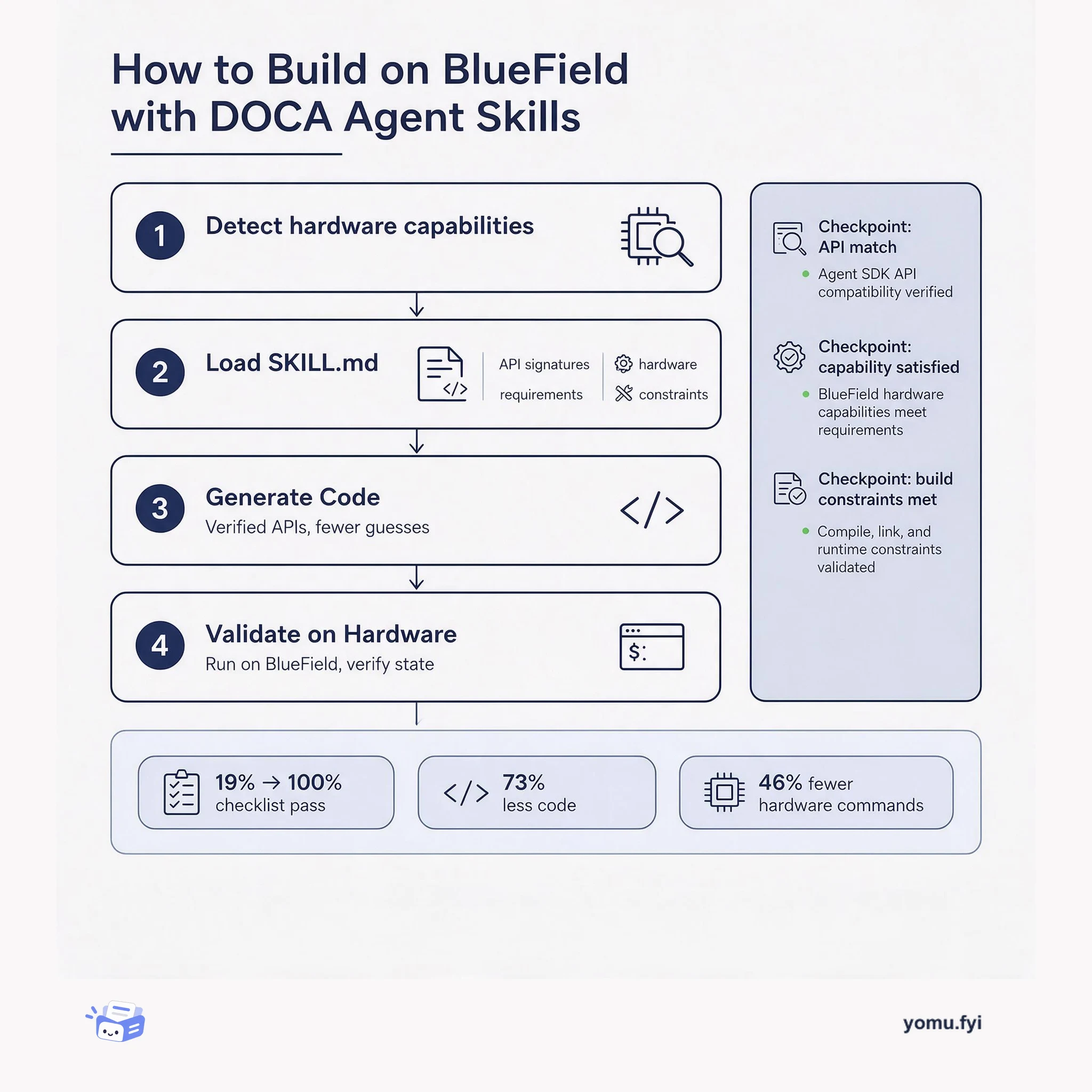
A practical how-to for using NVIDIA DOCA Agent Skills to generate BlueField code with verified APIs and hardware checks, reducing correction cycles and failed builds.
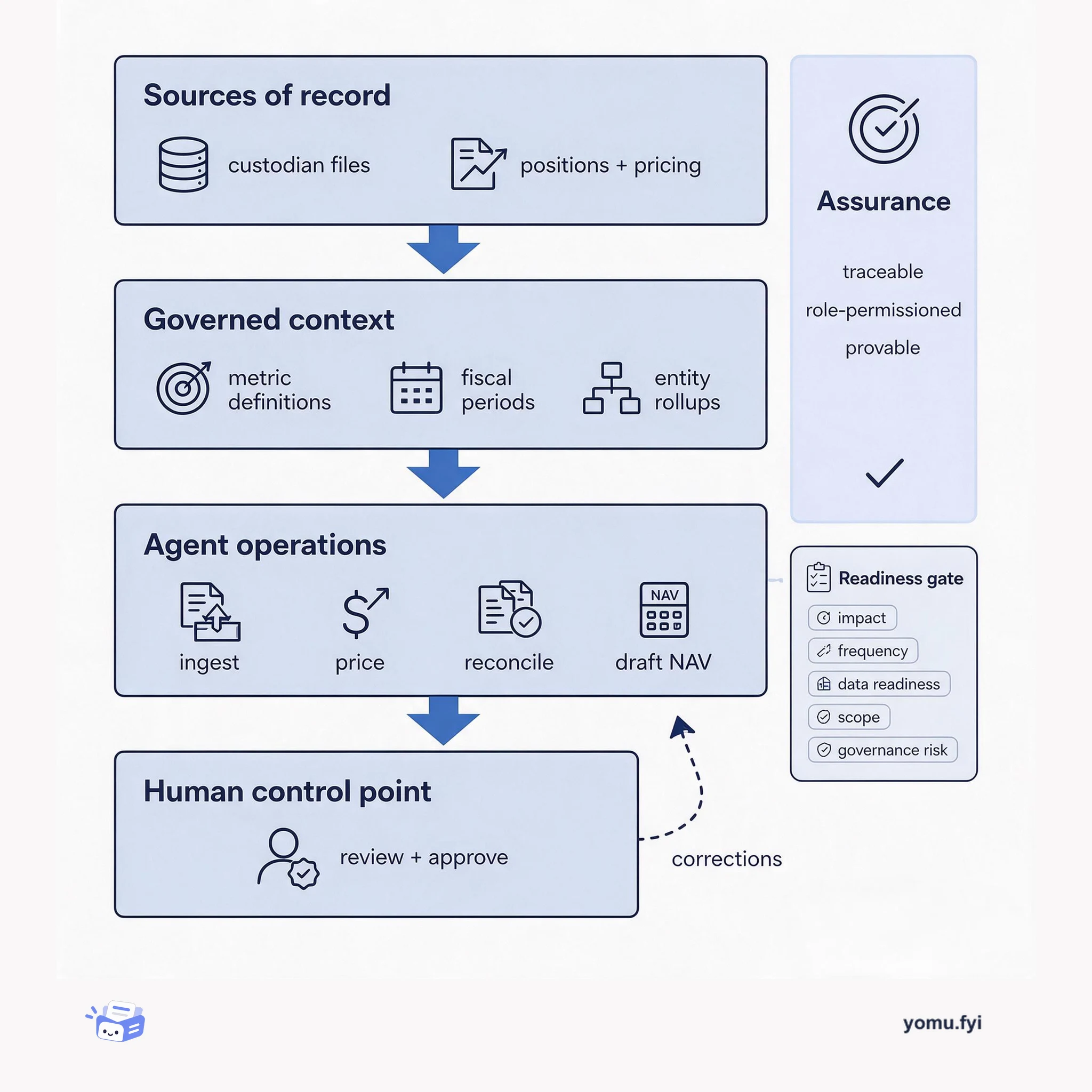
Asset management runs as a layered control plane: custodian and pricing data feed a governed context layer, agents run the overnight fund work, and a human signs off before anything is published.
The Good Stuff
Paid picks we use ourselves. Links carry a referral code — a subscription through one earns us a commission at no extra cost to you.
Newest first
Gartner named Cursor a Leader in the 2026 Magic Quadrant™ for Enterprise AI Coding Agents, with Cursor positioned furthest on Completeness of Vision. Cursor reports that more than 70% of the Fortune 500 use its platform to deploy and manage coding agents across the software development lifecycle, while its stated direction centers on developers orchestrating large teams of agents. The roadmap combines expanded in-house model training, including Composer 2.5 and a planned future model built with SpaceXAI, with automation through Bugbot, security agents, scheduled Automations, and the Cursor SDK. It also calls for deeper enterprise controls, admin integrations, analytics dashboards, and broader availability of self-hosted cloud agents for regulated industries and regions.
Uber describes its 2025 effort to give AI agents verifiable identities and preserve attribution as agents act for users across compositional, multi-step workflows. The problem is that conventional human and workload identities expose only generic service identities, dropping originating users and intermediate agents across hops and weakening audits, authorization, and incident response. The design extends Uber’s Zero Trust Architecture with an Agent Registry, an AI Agent Mesh, Security Token Service (STS), MCP Gateway, downstream systems, and an AI Gateway, while integrating identity and context propagation into the agent SDK. Workloads obtain cryptographically signed workload SVIDs from SPIRE, and STS issues short-lived, scoped JWTs for each hop; MCP Gateway authenticates and authorizes tool calls. Production metrics reported show P99 STS token-exchange latency consistently below 40 milliseconds, while the roadmap places dynamic access control and unified policy enforcement above the identity foundation.
Databricks presents a first cohort of partner-built industry solutions that use Genie to reduce the “Analyst Bottleneck,” where leaders wait for custom SQL or dashboard updates. Genie provides a conversational analytics layer grounded in Unity Catalog metadata and business semantics, using specialized AI agents to return governed, secure, traceable answers to natural-language questions. The featured accelerators span communications, media and entertainment, financial services, healthcare and life sciences, manufacturing and energy, public sector, and retail, with examples including churn prediction, next-best-action recommendations, billing anomaly investigation, KYC monitoring, actuarial analysis, and commercial insights. Across the examples, solutions combine domain expertise with Databricks platform capabilities such as machine learning, Agent Bricks, Lakebase, Serverless SQL, and auditable governance to support self-service analysis and operational decisions.
Databricks Genie makes descriptive analytics accessible in natural language, but predictive questions still require specialized data science workflows and carefully prepared datasets. This post presents a multi-agent supervisor deployed as a Databricks App, combining Genie, TabPFN, and Agent Bricks to turn business questions into predictions. The orchestrator asks Genie to use governed Lakehouse data, schemas, relationships, and semantics to generate labeled training data through SQL, then sends it to TabPFN, which predicts in a single forward pass without feature preprocessing, model selection, or hyperparameter tuning. The resulting conversational experience supports descriptive and predictive analytics with Unity Catalog lineage and access control, while an MLflow GenAI evaluation harness monitors reliability and regressions. Its central limitation is that predictions depend on Genie producing a meaningful dataset with a clear label, so missing signals, joins, outcomes, or agent omissions can make results unreliable.
Applied Compute, founded by former OpenAI Codex and o1 researchers, builds custom AI agents for enterprises through a post-training approach they call Specific Intelligence. Their core training mechanism is Reinforcement Learning, where agents repeatedly attempt tasks in replayable environments and are scored against reward functions to refine model weights. For clients like DoorDash and Cognition, this means training specialized agents for merchant onboarding and bug-catching that improve from continuous use. The company evaluated multiple infrastructure platforms before selecting Modal, which provides ephemeral sandboxes for complex environment simulation, sub-second cold starts to keep GPUs busy, and serverless fan-out for parallel grading. Modal’s primitives allow each phase of the RL loop—rollouts, evals, and inference—to operate with appropriate resources while sharing state efficiently.
Cursor Automations are now available in the Agents Window as well as the existing Automations interface, allowing users to create and manage them alongside agents in the same workspace. The release also lets an automation attach multiple repositories, so agents can use context across codebases to deliver, test, and verify tasks, or run with no repository when the work is not code-centered. For no-repo use cases, five Cursor Marketplace templates cover Slack digests, product analytics, FAQ drafting from Slack and documentation context, finance reporting from providers such as Stripe, and customer health monitoring across tools including Granola, Slack, and Databricks. Newly created automations receive a 50% discount on all agent runs for the next seven days, while the release directs users to the documentation for more information.
Databricks announces the Databricks Certified Context Engineer Associate, described as the industry’s first certification purpose-built for context-aware AI systems. It assesses whether practitioners can design, assemble, and govern the information AI agents receive at inference time, including system prompts, retrieval, memory, external tools, context-window management, and governance. Candidates work with Databricks technologies such as AI Search, Lakebase, MLflow, MCP, and Unity Catalog, while advanced coverage includes multi-agent systems, long-horizon workflows, and evaluation of context decisions. The beta exam will be available free to Data + AI Summit attendees, who may take it once; beta results are expected in 6–8 weeks.
Unity AI Gateway is expanding runtime governance for production AI agents, model calls, and MCP tool interactions as teams face rising costs, unclear behavior, and limited control. The Beta adds LLM-based guardrails, token-level cost attribution with per-user alerts and hard budget limits, payload logging, and MCP service policies. Guardrails use a model and prompt to evaluate inputs, outputs, or both in real time, while inference tables and Unity Catalog system tables centralize governed records of usage and interactions. For MCPs, administrators can define SQL policies as Unity Catalog functions using agent identity, user context, and request parameters to constrain tool access and sensitive actions. The capabilities are available in Beta, with payload logging and service policies offered through gated enrollment, and are intended to improve observability, compliance, and cost control.
MemEx addresses the context-window bottleneck in LLM agents, where large tool outputs persist in the shared prompt even when later steps need only a small portion. It gives the agent a persistent, typed Python kernel: tool results remain as objects in scope, code can filter, summarize, and compose them, and only printed values are materialized as context tokens. MemEx preserves existing Tool Calling schemas while adding typed submit(), persistent state, backend-agnostic execution, and asynchronous spawn_agent() sub-agents, enabling multi-step workflows and parallel trajectory analysis. Across nine-model evaluations on OfficeQA Pro and Enterprise Structured Retrieval, it was reported as better and cheaper than parallel structured Tool Calling; examples include roughly 10-point OfficeQA gains for some models and Qwen structured-retrieval accuracy rising from 18% to 36% and 20% to 38% at lower token cost.
Anthropic launched Claude Managed Agents, a suite of composable APIs that separate the agent loop from code execution for building cloud-hosted agents at scale. Modal has collaborated with Anthropic to provide a first-class integration allowing all tool calls to run in self-hosted Modal Sandboxes, which offer fast cold-starts, custom images, snapshotting techniques, and cost-efficient burst pricing. These sandboxes also provide network security through short-lived connect tokens and support upwards of 100,000 concurrent sandboxes per customer. DoorDash is exploring Managed Agents as an accelerator for its merchant intelligence system, while Blend uses the integration to enable secure, scalable agent-assisted triage across complex banking environments. The integration gives teams isolation, cost efficiency, and control over observability, failure handling, and scale while maintaining the convenience of Anthropic’s managed agent loop.
Agent evaluations often ask what an AI Agent can do, but the larger constraint may be whether an organization is structured to let it act. Across organizations in energy, healthcare, ecommerce, gaming, financial services, and property management, teams found that Agents could often perform actions technically, but stalled on unreliable identification, inaccessible live data, or unreachable vendor systems. The post describes five readiness types—content, scope, procedural, data, and execution—and says deeper automation depends on documented processes, trustworthy connected data, stable APIs, and clear ownership of risk. Teams that lacked these foundations often redesigned toward guiding users rather than executing changes, while teams with standardized operations could trigger tightly controlled actions. The unresolved question is how readiness develops, since the gaps may involve undocumented procedures, fragmented systems, missing APIs, or infrastructure and accountability investments beyond buying a more capable Agent.
Operator is a customer-operations Agent built to help teams understand, manage, and improve customer experience across workspaces. The post distinguishes a production Agent from a prototype that simply gives an LLM API access and a system prompt, describing more than 50 purpose-built tools and 10 skills for data retrieval, reporting, investigation, and operational tasks. Its intelligence layer combines semantic search tuned against millions of support conversations, workspace-specific attribute awareness, and encoded reasoning, while the action layer supports configuration and content changes through reviewable diffs requiring explicit approval. A hybrid conversational and graphical interface presents charts, dashboards, and structured proposals within the existing platform. The post argues that read-only custom tools can be built in weeks, but production reliability, safe actions, multi-tenant isolation, graceful degradation, and ongoing maintenance require substantially greater investment.
Operator is an agent for customer operations that works across Fin and the Intercom helpdesk, addressing the ongoing effort required to manage AI and human support work. It can analyze operational data and conversation samples, explain metric changes and root causes, maintain help-center content from briefs, and identify content gaps with localized drafts. Operator can also debug Fin conversations, propose configuration fixes, build Procedures and other automations, run simulation tests, and support incident response and rep management. Its purpose-built tools and proposal system present structured diffs for review, editing, and approval before changes go live; the announcement says more than 200 early users are trying it and that it is available in early access.
Electric utilities are facing rising demand, retiring generation, extreme weather, aging infrastructure, and fragmented operational data that manual processes cannot manage at scale. AI agents are presented as a human-centered alternative that synthesizes heterogeneous data, learns from outcomes, and progresses from human-approved recommendations to exception-based control and eventually autonomous operations within defined parameters. Hawaiian Electric used a Retrieval Augmented Generation proof-of-concept with Databricks AI Search, Unity Catalog, and Lakeflow Declarative Pipelines to query regulatory documents and provide page-specific citations. The system reduced response times from five minutes to five seconds and was implemented in two weeks, while the article describes broader potential for predictive maintenance, outage response, load forecasting, and customer service.
AI-powered inbound sales depends on knowledge management: accurate, current information about products, pricing, plans, qualification, and routing gives a Sales Agent the context to answer questions and guide buyers. The guide describes knowledge management as creating, organizing, sharing, and maintaining business knowledge, while emphasizing content such as product FAQs, pricing overviews, competitor battlecards, case studies, and internal sales materials. It recommends finding gaps through recurring questions, buyer objections, search data, and disengaged conversations; then writing machine-friendly content with simple language, consistent terminology, explanatory context, scannable formatting, and text accompanying images or video. Connecting the Agent to CRM and enrichment systems keeps data and context connected, while ongoing reviews help content evolve from conversation insights and reduce repetitive work for sales teams. It presents knowledge management as a continuous sales function whose cumulative improvements can support faster responses, better qualification, and more focused human selling.
Notion introduces a Developer Platform with Workers, data synchronization, custom agent tools, external agents and a CLI for extending its workspace beyond built-in capabilities. As teams connect agents to more workflows, the platform addresses gaps involving external data, custom logic and agents that cannot otherwise participate in Notion. Workers run custom code in a hosted secure sandbox, enabling database sync, agent tools and webhook triggers without user-managed servers; the CLI supports authentication, Notion actions and Worker deployment from a terminal or IDE. External Agents can work natively alongside teams and Custom Agents, while the External Agent API supports bringing internally built agents into the workspace. The CLI is available on all plans, Workers are in public beta for Business and Enterprise plans, and External Agents are offered through a private-beta waitlist.
This release introduces quality-of-life improvements to the Agents Window, centered on full-screen work areas and more compact agent conversations. Full screen expands files, changes, canvases, PRs, browsers, or terminals across the right panel, replaces chat with a floating prompt bar, and is available through the panel control, command palette, or Cmd/Ctrl+Shift+M. Compact chats offer Compact, Balanced, and Detailed tool-call density settings, ranging from concise results with minimal traces to near-complete step-by-step context. The release also improves PR review visibility, scrolling, streaming, context persistence, MCP authentication, model selection, search, and task status, while fixing reliability issues across PRs, background and cloud agents, MCP/OAuth, shortcuts, hooks, model routing, webhooks, and mirrored repositories.
Cloud agents need a laptop-like development environment with cloned repositories, installed dependencies, credentials, and build-system access to complete engineering tasks end-to-end. This release adds configurable multi-repo environments, Dockerfile-based configuration, and tools that let Cursor set up and maintain those environments. Build secrets remain scoped to build steps, while improved layer caching makes cache-hit builds run 70% faster; Cursor also asks setup questions, flags missing credentials, validates configuration, and falls back to a base image with warnings when setup fails. Version histories, admin-controlled rollback, audit logs, and environment-scoped egress and secrets provide governance and isolation across environments for teams running parallelized agents.
Intercom is changing its company name to Fin while retaining Intercom for its customer service software platform, including the recently launched Intercom 2 rebuild. The company says all 1,400 employees are now employed by Fin, named after its leading customer agent platform, which it says is about to become the largest part of the business. The change follows three years of promoting the service agent category under Fin, often with Intercom in the background, and reflects a belief that established brands carry baggage when repositioning. The CEO argues that newcomers benefited from having no prior market position to explain, despite Intercom’s claim of superior technology, and presents the renaming as part of a broader transformation spanning culture, pricing, products, and investment priorities.
The MCP Marketplace connects agentic applications with real-time external intelligence alongside enterprise data. The problem appears in use cases such as loan approval, where historical internal records omit market conditions, updated credit signals, property changes, and competitor activity, making manual research a bottleneck. Databricks Marketplace provides governed access to MCP servers from You.com, Moody’s, and Cotality, while Unity Catalog authenticates connections and tracks access and lineage; Lakebase stores state, decisions, and audit trails across multi-step workflows. Examples show agents combining internal data with web research, credit ratings and sector outlooks, or property-resolution and mortgage signals before surfacing decisions for human review, including a commercial-loan flow with recorded sources, timestamps, and approver.
The best engineering reads, once a week.