How to Give an Agent a Query Language Instead of a Code Interpreter
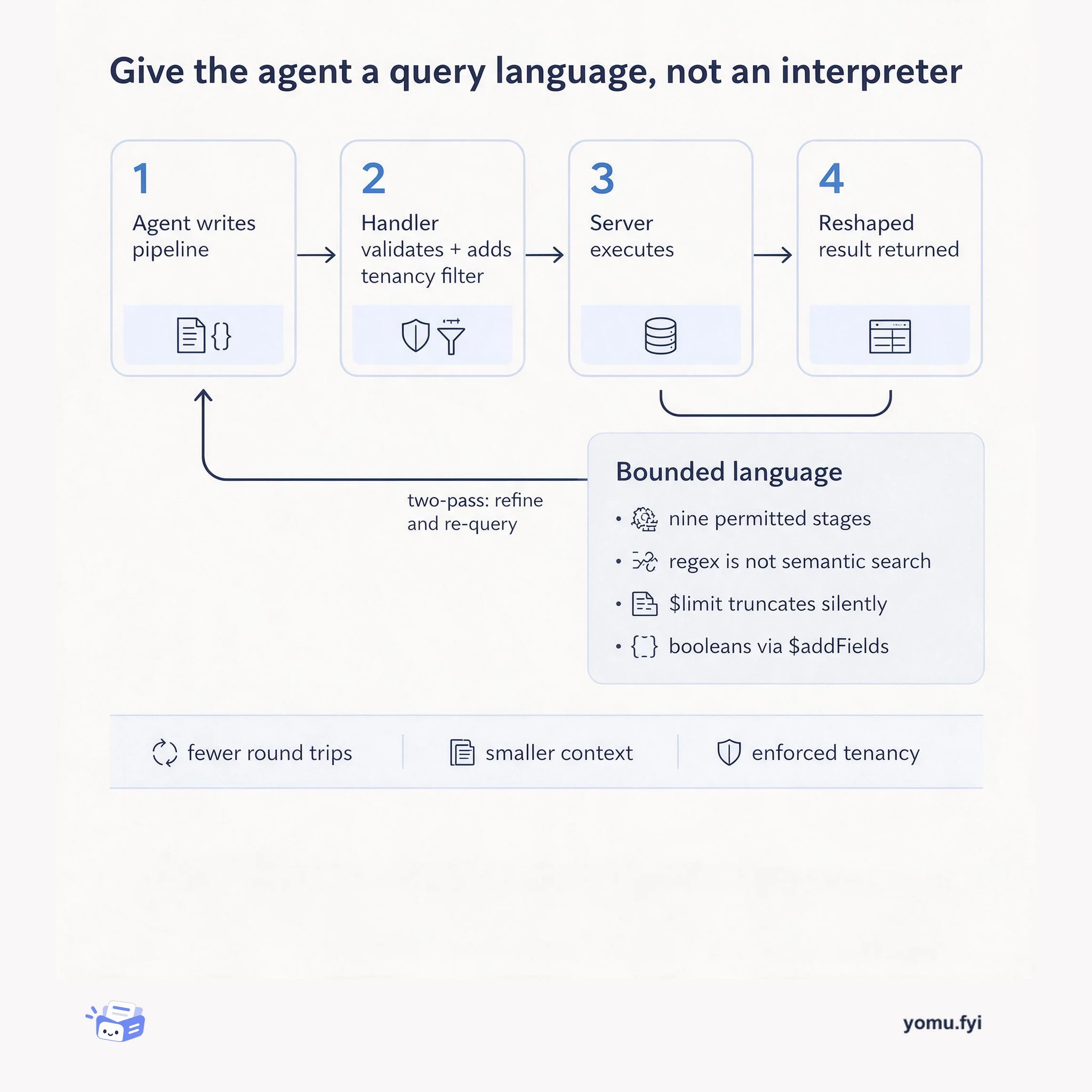
A four-step pattern for letting a document agent write validated aggregation pipelines instead of arbitrary code, so results come back shaped and tenancy stays enforced.
Loading…
Topic
542 posts about AI Agents. Every summary links to the original.
See the idea
A four-step pattern for letting a document agent write validated aggregation pipelines instead of arbitrary code, so results come back shaped and tenancy stays enforced.
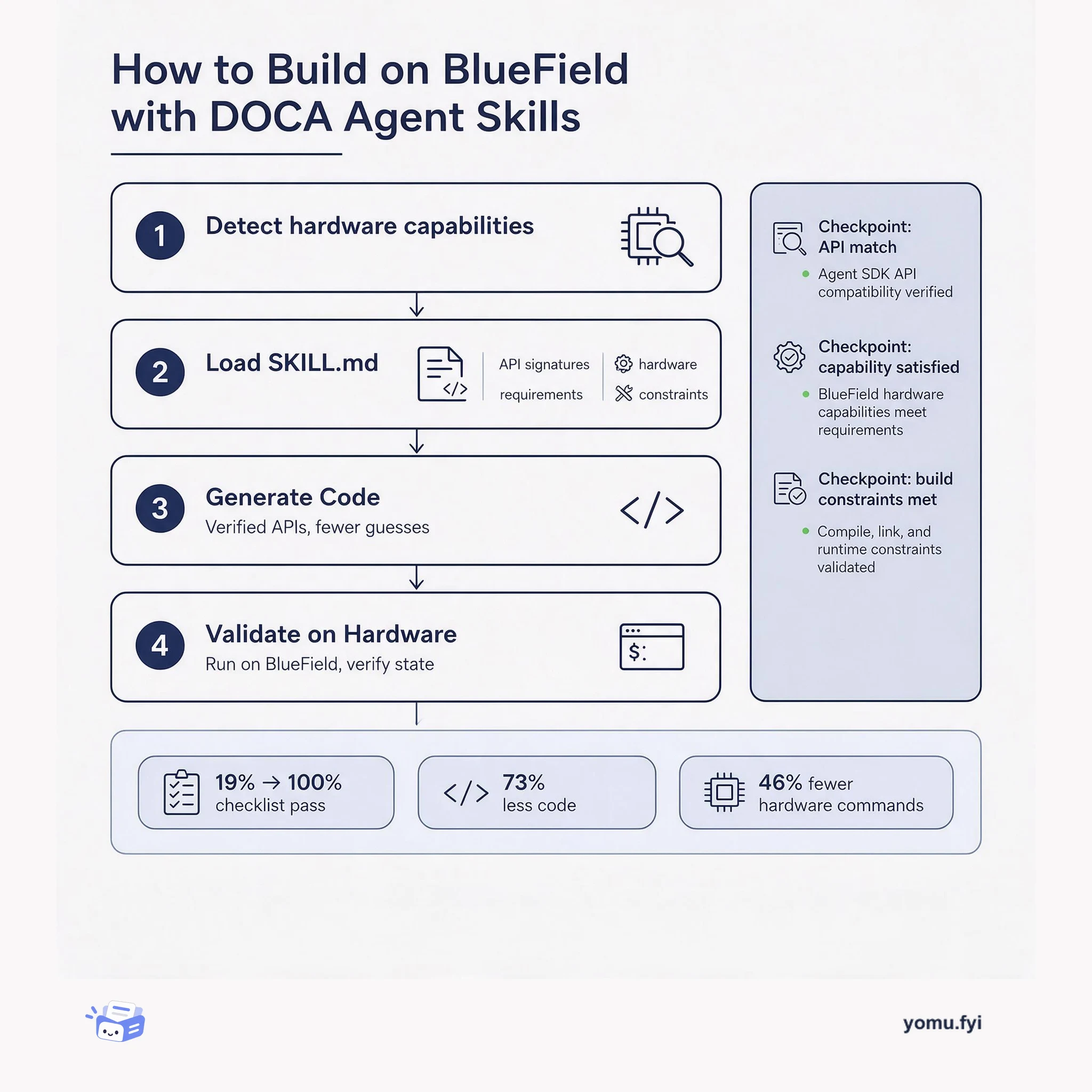
A practical how-to for using NVIDIA DOCA Agent Skills to generate BlueField code with verified APIs and hardware checks, reducing correction cycles and failed builds.
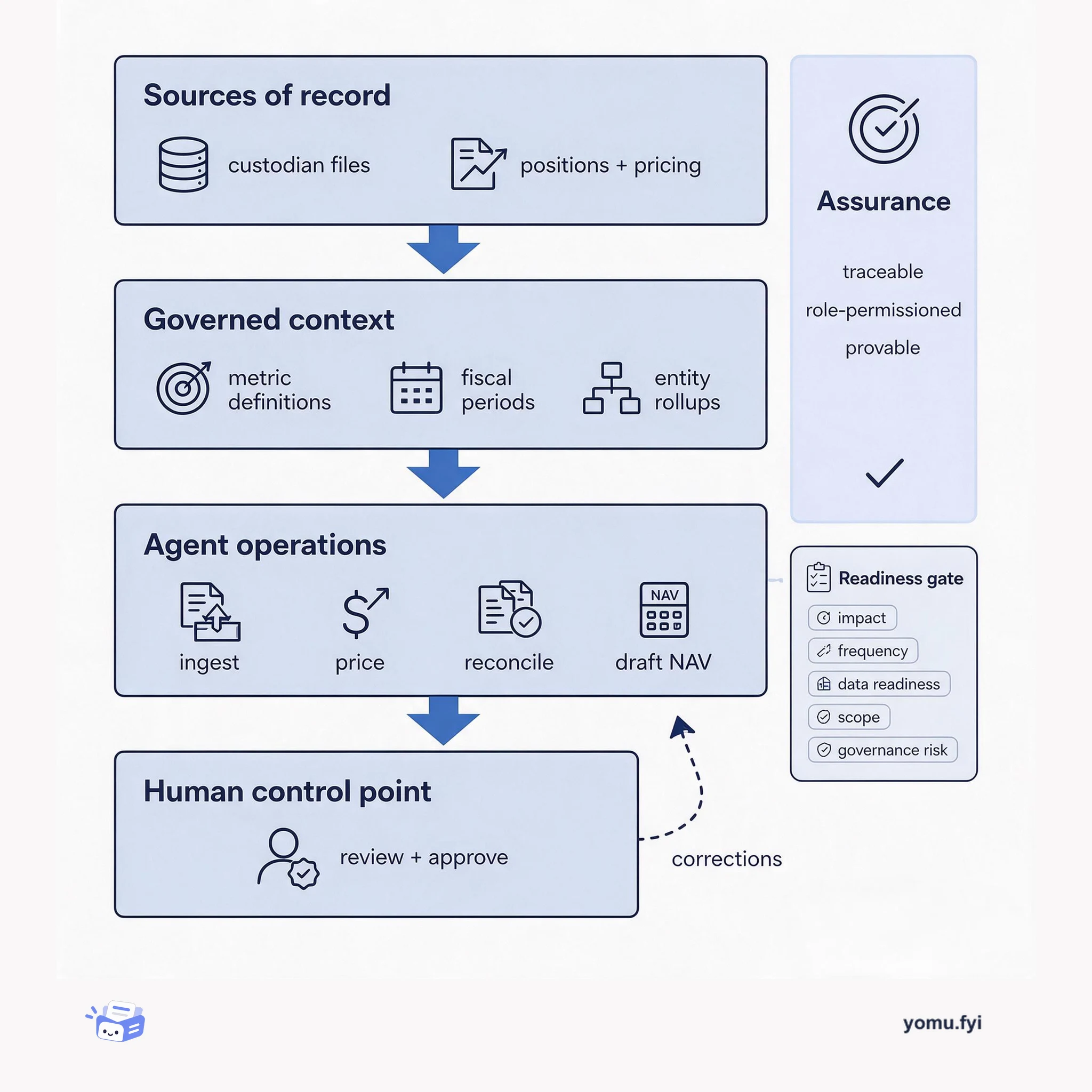
Asset management runs as a layered control plane: custodian and pricing data feed a governed context layer, agents run the overnight fund work, and a human signs off before anything is published.
The Good Stuff
Paid picks we use ourselves. Links carry a referral code — a subscription through one earns us a commission at no extra cost to you.
Newest first
Genie is Databricks’ data agent for complex questions across structured enterprise assets—tables, dashboards, and notebooks—and unstructured sources including workspace files, Google Drive, and Sharepoint. Unlike coding agents operating in static environments, it must discover relevant assets at enterprise scale, determine authoritative knowledge from potentially contradictory sources, and handle questions without verifiable tests or guaranteed answers. It combines specialized knowledge search using semantic context and metadata, parallel thinking across sampled trajectories, and Multi-LLM orchestration with optimized prompts for distinct sub-agents. On an internal benchmark of real-world data-analysis tasks, these techniques raised accuracy from 32% to over 90% against a leading coding agent while reducing cost and latency; specialized search alone improved table-discovery performance by up to 40%, while parallel thinking added latency and token costs before further optimization.
Fin for Sales uses outcome-based pricing built around qualified pipeline rather than activity: customers pay $10 per qualified lead, with qualification criteria defined by the customer. The model reflects Fin’s role in engaging prospects, gathering information, evaluating them against those criteria, and routing high-intent buyers to sales representatives. The team rejected revenue-share pricing because attribution would include factors outside Fin’s control, while measuring closed revenue would require deep CRM integrations and slow implementation. Disqualifications and support queries are priced at $1, matching the stated service pricing, while the higher qualified-lead price represents pipeline creation. The company says customer research across several pricing models favored outcome-aligned pricing, and cites early customer feedback reporting at least ten times the value.
Fin for Ecommerce is a new Customer Agent role for Shopify merchants, combining shopping assistance with ecommerce support before and after purchase. It helps shoppers discover products through conversational questions, live browsing context, catalog retrieval, comparisons, complementary recommendations, cart updates, and checkout guidance, while handling returns, refunds, exchanges, order changes, tracking, and shipping questions in the same conversation. The system uses Fin Apex 1.0 with an ecommerce retrieval engine and connects to Shopify to sync products, variants, content, order data, inventory, and APIs. Merchants can add Messenger and set Fin live in minutes without manual training; Shopify API integrations also let Fin use Procedures for complex requests, with drafts based on account data and company policies for review. The announcement positions Fin as a single Agent spanning discovery, purchase, and post-purchase support, with named ecommerce brands already using it.
Security operations centers measure MTTD, MTTR, false-positive rates, and analyst utilization, yet investigations often stall because analysts assemble evidence across fragmented systems. A single alert may require separate queries for logs, identity records, asset information, prior alerts, and cross-source timelines, making the analyst the integration layer and creating an MTTI bottleneck. The post presents Lakewatch with Databricks Genie as an agentic interface powered by Anthropic Claude models: analysts ask natural-language questions while autonomous agents hunt, summarize, correlate, and reconstruct timelines across security, IT, and business data. It argues that this architecture can reduce investigation work from manual, multi-system workflows to answers in seconds, while retaining analyst-level access controls and governed data access as exploit time has shrunk to 1.3 days.
RL training depends on runnable environments, because broken setup can consume tokens and compute without producing a reward signal or can make a task unsolvable. Composer autoinstall addresses this by using earlier Composer models to turn unconfigured repository checkouts into working mock environments. A Cursor agent first proposes 10 commands and expected outputs, while a separate Composer agent configures the checkout, mocks dependencies, and is evaluated against three selected commands. The process can create placeholder files, images, database tables, MinIO configurations, Docker containers, and startup scripts, restarting up to five times before discarding an environment. In a Celo monorepo experiment, the agent installed dependencies including Foundry and eventually mocked a user to run a minimal application; Composer 2 later scored 61.7% on Terminal-Bench versus 47.9% for Composer 1.5.
Ramp for Agents adds CLI and MCP interfaces through which AI agents can manage cards, bills, expenses, and approvals, creating a need to represent agents as accountable actors instead of handing them users’ session tokens or API keys. The initial identity model links a named Agent Key to a human sponsor and business, bounds scopes by the sponsor’s role, records agent attribution, and adds expiration and revocation. Ramp extends RBAC and its DenormalizedActor audit model with AgentContext, so logs, approvals, and webhooks can distinguish “Sarah (via Codex)” while reusing existing permissioning and rendering paths. OAuth2-PKCE exchanges the Agent Key for short-lived access and refresh tokens, with re-validation during refresh to limit leaked-credential exposure and preserve session traceability. The first release uses on-behalf-of-user agents because they fit current demand and keep a human accountable, while admins can oversee keys or disable agent access for roles and groups.
Notion’s Custom Agents launched in beta in February, and more than one million agents were created in two months before the feature moved out of beta. The post reports that teams scaled fastest when they treated agents as internal products, iterated with workflow experts, and shared operational knowledge rather than relying on engineers alone. Teams also redesigned end-to-end processes, such as Braintrust’s agent that scans competitor updates and Gong transcripts, updates a Notion sales one-pager, and flags relevant launches. Usage costs fell by up to 50%, partly through lighter models including Haiku 4.5 and GPT-5.4 Mini, which use up to 10× fewer credits, while new limits, dashboards, alerts, and pause controls support administration. From May 4, usage-based pricing applies through Notion credits at $10 per 1,000 credits for Business and Enterprise plans.
The guide maps AI applications for data scientists, machine learning engineers, and technical leaders, covering predictive AI, generative AI, conversational AI, and autonomous agents across consumer, developer, and enterprise settings. It distinguishes consumer-facing tools from developer platforms and describes production concerns including model lifecycle management, vector search, data lineage, deployment, monitoring, governance, and evaluation. Generative systems create text, images, code, audio, and video from prompts, while large language models and mixture-of-experts architectures are presented as important foundations for enterprise applications; open models offer control over weights, governance, and deployment. The guide recommends defining use cases, assessing data readiness, and building privacy, bias-auditing, and monitoring controls before production, while noting that agents coordinate multi-step workflows across tools, APIs, and databases.
Agentic AI and generative AI differ primarily in whether a system autonomously pursues a multi-step goal or produces content in response to a prompt. The post defines agentic systems through a perceive-plan-act cycle: agents maintain memory and state, decompose goals, call tools or sub-agents, evaluate conditions, and recover from errors, while generative AI typically performs bounded, reactive inference. It presents workflow examples such as sales follow-up and market-intelligence summarization, showing how APIs connect agents to CRMs, databases, communication platforms, and news services while LLMs provide text generation or reasoning at individual steps. RAG can ground generative outputs in external knowledge, but agentic deployments add operational concerns around repeated inference loops, human oversight, provenance logging, and access controls. The conclusion recommends choosing by task structure: generative AI for single-turn creation or summarization, agentic AI for autonomous coordination, and both together for complex enterprise workflows.
Databricks and Stitch are partnering to connect enterprise data infrastructure with marketing execution, addressing a gap that leaves campaigns dependent on stale segments, delayed data, and disconnected tools. The partnership positions Stitch as a marketing implementation layer that structures Databricks data for real-time segmentation, personalization, AI-driven decisioning, and self-service analytics while building applications and agents directly on the platform. Its work spans campaign-ready architecture, full-stack marketing applications, Genie-based access for nontechnical users, AI-powered campaign operations, and migrations from legacy platforms. Examples include real-time transaction data reaching customer marketing at a convenience-store brand, measurable campaign results within weeks for a medical testing company, and a global QSR rebuilding campaign workflows on Databricks as AI tools improve.
Ramp tested whether AI agents would relay a tracked referral incentive to people researching spend-management software. Across roughly 50 marketing pages, Cloudflare Workers served bot-specific variants—Markdown, stripped HTML, or schema-heavy content—while unique URLs and logs attributed downstream activity. Markdown surfaced most reliably, and bot classification proved difficult: major assistants were labeled “AI Assistants,” OpenAI SearchBot cached aggressively, and DeepSeek required TLS fingerprinting plus ASN detection. Over 32 days, agent relays rose from roughly 40 at 2.5 weeks to nearly 10 times that total, with Claude responsible for most matches; Perplexity moved from vague references to one specific branded mention, while ChatGPT remained at zero. The experiment concludes that agents can relay offers, but model-specific content strategies, citation-aware page selection, and better attribution are still needed.
Enterprise security operations centers may receive tens of thousands of alerts daily, making prioritization necessary and leaving lower-priority signals uninvestigated. Alert fatigue is presented as a data architecture problem: fragmented endpoint, network, identity, and cloud telemetry, combined with proprietary SIEM collection-and-discard practices, limits correlation and overwhelms analysts. Lakewatch proposes an open lakehouse foundation that unifies security, IT, and business telemetry, applies automated OCSF normalization, and uses Agent Bricks for data wrangling and alert triage. Databricks Genie is positioned as a natural-language AI security agent whose autonomous agents can hunt, summarize, and neutralize threats, while Unity Catalog logs queries and actions for audit and forensic purposes. Lakewatch is currently available in Private Preview.
Cursor describes its agent harness as an iterative product process: vision-driven hypotheses are tested through offline evals, real-world A/B experiments, and instrumentation. Its context strategy has shifted from static codebase context and guardrails toward dynamic retrieval as models improve, while model-specific prompts and tools match training conventions. Quality measurement combines CursorBench with latency, token efficiency, tool-call errors, cache behavior, code Keep Rate, and language-model analysis of user responses. The team classifies expected and unknown tool errors, uses per-tool and per-model anomaly baselines, and automates log investigations and backlog tickets; one sprint reduced unexpected tool-call errors by an order of magnitude. The harness also supports model switching and subagents, although switching can cause cache misses and summary information loss, and the post argues that multi-agent orchestration will make harness engineering increasingly central.
The post announces Databricks as a launch partner for Stripe Projects, an agent-first CLI that lets AI agents discover, provision, and pay for Neon databases without human interaction. It addresses the manual work still required to provision services, navigate interfaces, configure accounts, and enter payment details, which can slow autonomous app development. With Lakebase architecture, Neon can provide production-ready Postgres in under 350ms, while decoupled compute and storage support rapid creation and teardown of OLTP databases. Serverless scaling adjusts compute to traffic and can scale to zero, while zero-copy branching creates isolated production-data branches for testing, migrations, and prompt experiments without risking the primary environment. The post also notes Databricks’ Stripe Data Pipeline is available in the Databricks Marketplace for analyzing Stripe data without ETL.
Enterprise AI initiatives often produce activity rather than value because organizations start with technology instead of a defined outcome and overlook data architecture, governance, and semantic context. Agentic systems add risk when they can send messages, update records, place orders, or delete records, making permissions and situational controls essential. The discussion argues that dashboards and batch pipelines are poorly matched to low-latency, high-scale agent workloads, which require transactional infrastructure alongside existing analytics. Lakebase is presented as that transactional foundation, while AgentBricks, Databricks Apps, and Genie provide agent development and monitoring, application delivery, and conversational data access. The recommended path is to define success first, isolate a focused pilot, learn what works, and redesign underlying processes rather than merely add AI to them.
Cursor’s SDK is now in public beta, letting developers build programmatic coding agents with the runtime, harness, and models used by Cursor’s desktop app, CLI, and web app through TypeScript. Agents can run locally, on Cursor’s cloud in dedicated VMs, or on self-hosted workers; cloud sessions include a repository clone, configured development environment, streaming, reconnection, and options to push branches or open pull requests. The SDK also provides codebase indexing, semantic search, grep, MCP servers, repository skills, hooks, and named subagents, while supporting every model available in Cursor, including Composer 2.5. Described uses include CI/CD automations, custom internal platforms, and customer-facing agent experiences, with starter projects for quickstarts, prototyping, kanban workflows, and a CLI; the SDK uses standard token-based consumption pricing.
Sales leaders have treated pipeline growth as constrained by headcount, making a 30% increase appear to require 30% more people. The post presents Intercom’s use of Fin, its Customer Agent, for inbound sales as a separate pipeline source rather than merely an efficiency layer for SDRs, with its own metrics, targets, and owner. Fin engages inbound prospects instantly, qualifies and routes high-intent visitors, and keeps lower-intent prospects warm, while SDRs focus on phone qualification, relationship-building, and helping trial users realize value. Drawing on customer-service implementation, the operating model includes dedicated AI ownership and continuous optimization against meetings, pipeline, and revenue. The conclusion is that AI can raise the pipeline ceiling above current headcount capacity, although the constraint shifts to how well the Agent understands the product, customers, and demand qualification.
The post argues that AI-native applications face a “builder’s tax” because operational databases and lakehouse analytics are separated by CDC, ETL/ELT, and reverse ETL pipelines. This architecture can leave AI systems with stale data while duplicating governance and shifting engineering effort toward orchestration and failure management. It presents Lakebase, a fully managed serverless Postgres engine integrated with the Databricks Data + AI Platform, as a shared operational foundation where applications, agents, analytics, and governance use the same data. The proposed pattern combines a lakehouse intelligence layer, a low-latency Lakebase execution layer, and a continuous learning loop, with pgvector supporting agent memory and semantic search. Reported customer examples include faster feature onboarding, reduced on-call disruption, higher agent throughput, and consolidated data estates, though the results vary by organization.
LangGuard is presented as a runtime enforcement layer for enterprise agentic workflows, monitoring actions, decisions, tools, credentials, and intent across connected systems. Its GRAIL data fabric records multidimensional trace data, builds a live knowledge graph, and evaluates allow/deny/modify decisions against policy before tools, datasets, or models are accessed. The deployment uses Databricks Lakebase as the operational system of record, relying on PostgreSQL, serverless autoscaling, scale-to-zero, compute-storage disaggregation, hot-data caching, and copy-on-write branching for policy testing. LangGuard chose this architecture to handle bursty trace writes and low-latency enforcement reads without provisioning for peak demand, while keeping operational data available to Databricks analytics and AI capabilities without additional ETL. The stated next step is predictive governance: training behavioral models on historical traces to flag anomalous agent behavior before a policy violation.
Databricks announces a partnership with OpenAI around GPT-5.5, described as OpenAI’s strongest frontier model for enterprise agentic work, complex document reasoning, and long-horizon coding agents. The model powers Codex and is presented as able to research, analyze data, create documents and spreadsheets, operate software, use tools, check outputs, recover from ambiguity, and continue through multi-part tasks. Databricks evaluated it on OfficeQA, a benchmark built from 89,000 pages of U.S. Treasury Bulletins that tests document retrieval, table interpretation, and precise calculation. With retrieval handled, GPT-5.5 scored 64.66% versus GPT-5.4’s 57.14%; in the full-agent OfficeQA Pro Agent Harness, it scored 52.63% versus 36.10%, representing reported improvements of roughly 13% and a 46% reduction in errors.
The best engineering reads, once a week.