How to Give an Agent a Query Language Instead of a Code Interpreter
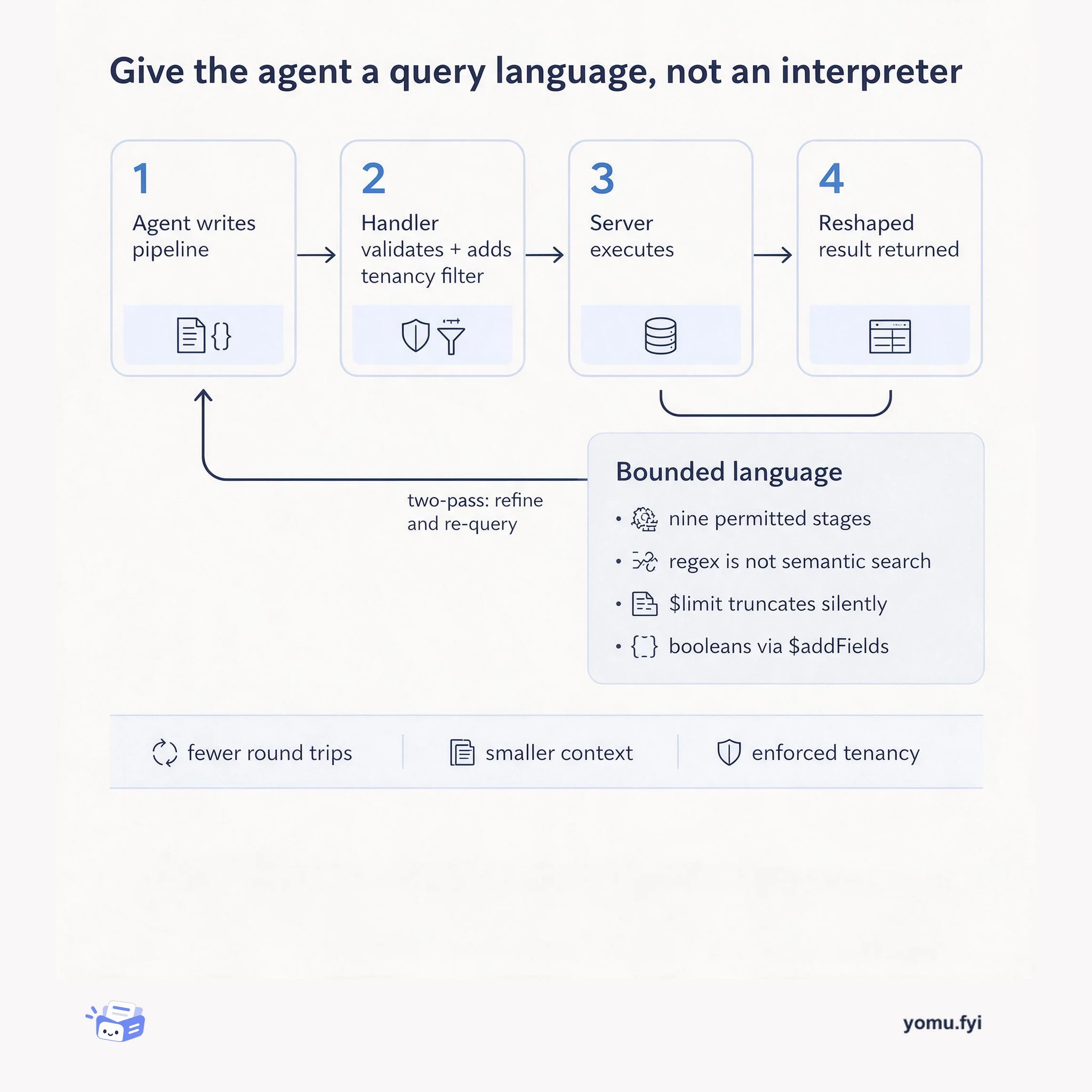
A four-step pattern for letting a document agent write validated aggregation pipelines instead of arbitrary code, so results come back shaped and tenancy stays enforced.
Loading…
Topic
542 posts about AI Agents. Every summary links to the original.
See the idea
A four-step pattern for letting a document agent write validated aggregation pipelines instead of arbitrary code, so results come back shaped and tenancy stays enforced.
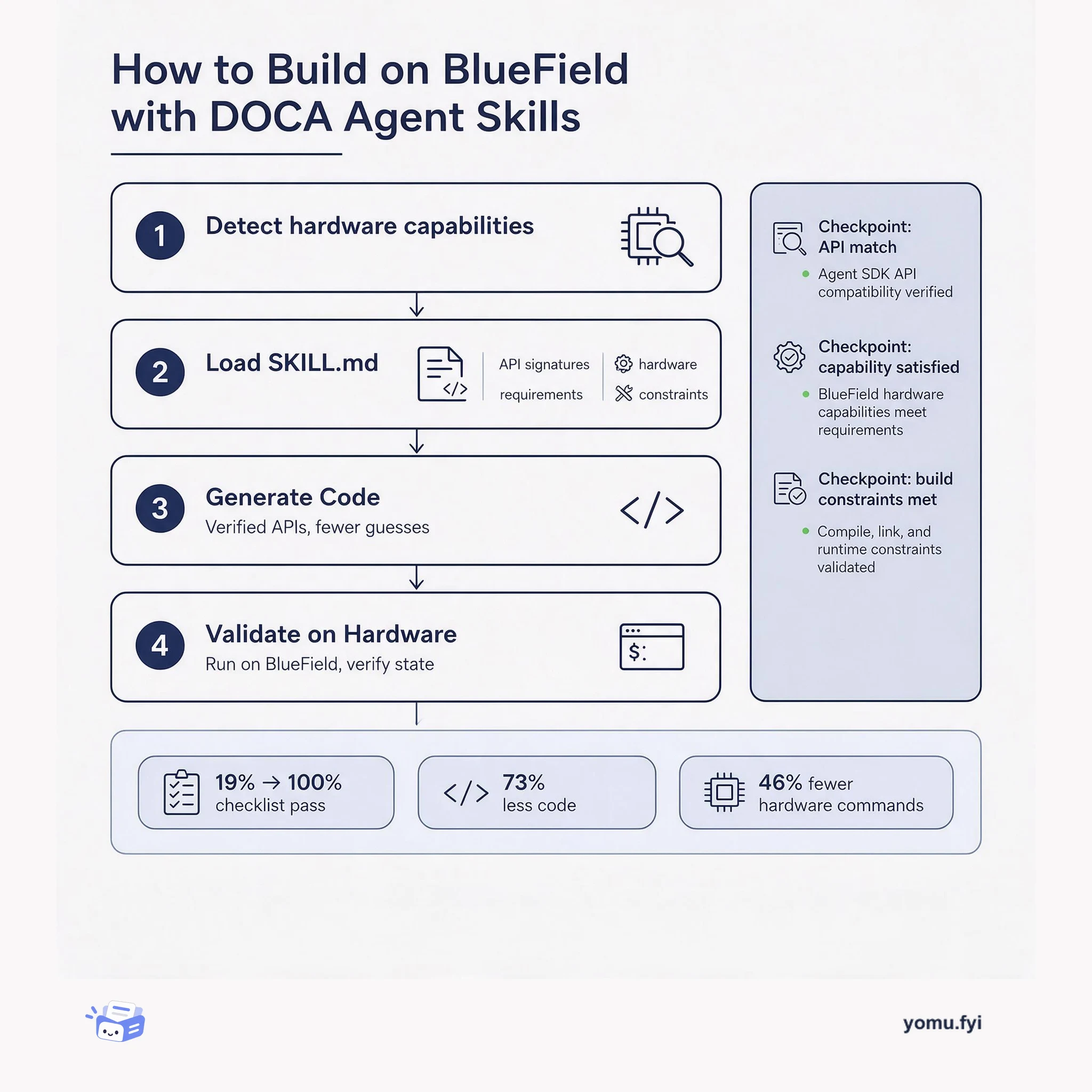
A practical how-to for using NVIDIA DOCA Agent Skills to generate BlueField code with verified APIs and hardware checks, reducing correction cycles and failed builds.
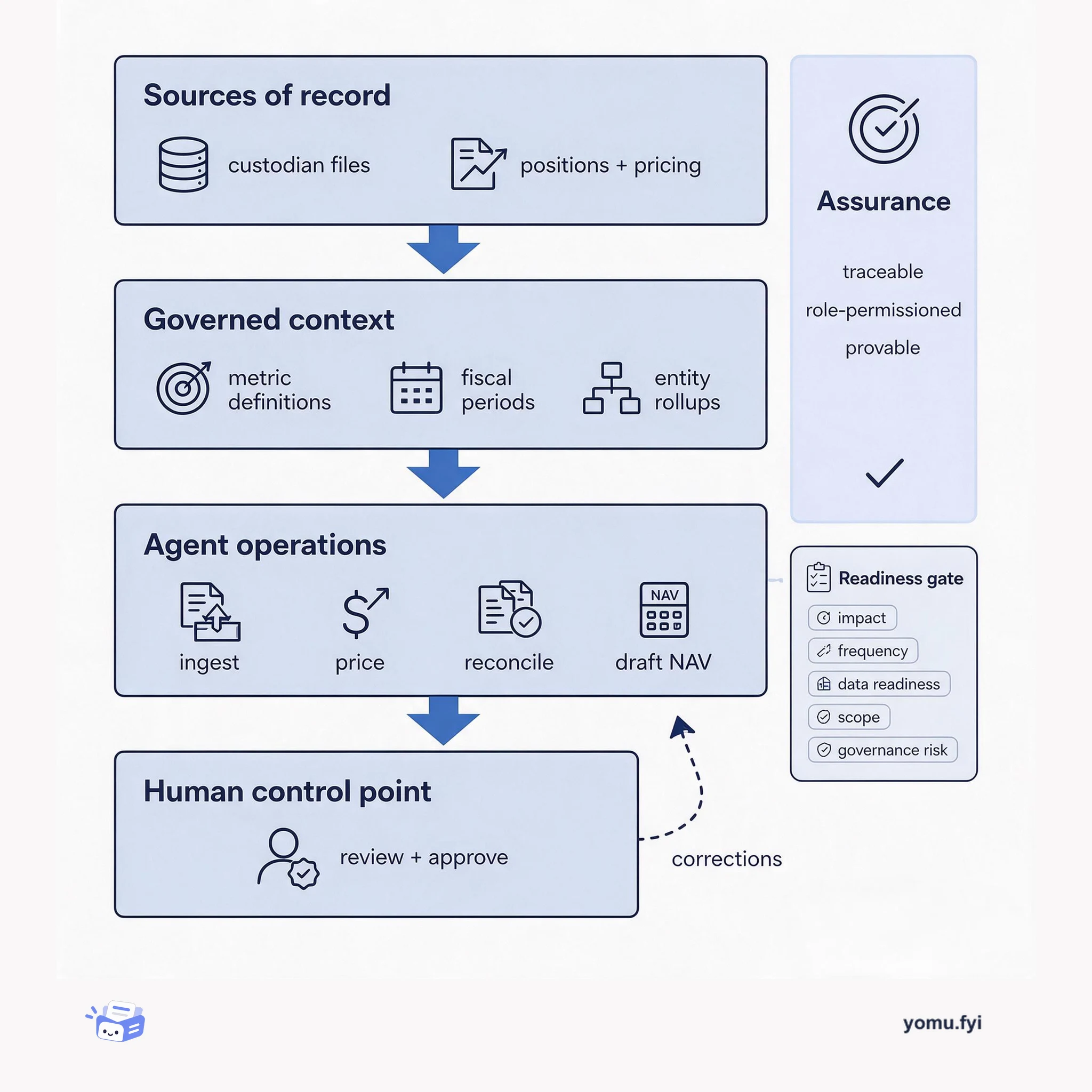
Asset management runs as a layered control plane: custodian and pricing data feed a governed context layer, agents run the overnight fund work, and a human signs off before anything is published.
The Good Stuff
Paid picks we use ourselves. Links carry a referral code — a subscription through one earns us a commission at no extra cost to you.
Newest first
The Sales Agent Blueprint is a newly announced guide for sales, revenue, and AI transformation leaders seeking to launch and scale AI for inbound sales. It addresses manual inbound workflows in which leads wait in queues, making outcomes depend on team timing and capacity rather than buyer intent, and describes agents that engage buyers, qualify leads, and route high-intent opportunities in real time. The first available track, “Launch it,” covers understanding Sales Agents, building a business case, deciding whether to buy or build, evaluating performance with a five-step framework, planning deployment, and continuously training, testing, deploying, and optimizing the system. A second track, “Scale it,” is coming soon and will focus on redesigning the buyer journey, AI-first systems and ownership models, and pipeline generation and scaling.
Fin for Sales is a new role for Fin Customer Agent that handles inbound sales from initial engagement through qualification, routing, and conversion. It starts conversations across messenger and email, uses page context and smart suggestions, and applies playbooks, knowledge, enrichment, and memory to answer questions, handle objections, and personalize discovery. Fin qualifies prospects in real time by collecting details about use case, budget, fit, and timing, syncing structured context and conversation history to a CRM, and directing leads to sales teams or self-serve paths. It can book meetings through Chili Piper or Calendly, initiate trials or subscriptions, and hand off an AI-generated summary to representatives. The announcement reports early results including Fellow booking 18 previously unreachable meetings in January at around 48% conversion, while positioning Fin for Sales as part of a shared Customer Agent platform.
Intercom describes how it uses an AI PR review Agent to approve some pull requests amid a workflow where more than 93% are Agent-driven and engineers deploy hundreds of times daily. The system decomposes review into specialist sub-Agents that assess problem descriptions, intent alignment, safety, logic, best practices, and execution paths, while applying Intercom-specific guidance and enforcing smaller changes. In a pilot of more than 100 PRs, AI-approved changes had zero reverts and approval time improved 6–16 times at the 75th percentile; in four rollout weeks, 497 PRs went fully autonomous. Reported revert rates were lower for AI-authored than human-authored code in both backend and frontend comparisons, though the source says zero reverts will not necessarily persist. The process remains auditable, allows human review requests, and keeps the shipping engineer accountable for production behavior and rollback.
Real-time decisioning for AI agents depends on more than customer records: it requires a customer context layer that captures what people are doing now and connects that behavior to identity. The post positions the data platform as the center of a composable martech architecture, with agents and applications operating on shared data in open formats such as Apache Iceberg and Delta Lake. Snowplow’s described approach places structured event collection, schema validation, enrichment, and identity resolution before data reaches the platform, while operating in the customer’s cloud environment. It distinguishes historical profiles from granular behavioral event streams and argues that agent interaction outcomes should return to the foundation as first-class events. The resulting four-stage loop—collect, resolve and enrich, serve, and learn—supports simultaneous real-time and historical context, with decision quality dependent on source data coherence.
LLM applications are presented as production systems that extend beyond chatbots by connecting foundation models to external data, tools, APIs, memory and workflows. Modern categories include assistants and copilots, retrieval-augmented generation (RAG), autonomous agents, multi-agent systems and local or on-device inference, each with distinct capabilities and trade-offs. A typical RAG pipeline uses vector search over a curated knowledge base, then supplies retrieved passages to the model; chunking, source freshness and retrieval accuracy affect results. Production systems also require orchestration, evaluation, observability, governance, guardrails, audit trails and human-in-the-loop checkpoints, especially when agents can call tools or execute workflows. The source distinguishes prompt engineering, which guides behavior without changing model weights, from fine-tuning, which adapts models to domain-specific tasks, and describes a unified path combining data, models, retrieval, orchestration, evaluation and governance for production deployment.
Databricks and Adobe announce three partnership milestones aimed at connecting governed Lakehouse data with marketing activation in Adobe Experience Platform. The changes include Delta Sharing support for zero-copy access, a Databricks Genie connection to Adobe Marketing Agent through Model Context Protocol (MCP), and an upcoming Adobe Marketing Agent beta for the Databricks Marketplace. Using Unity Catalog as the source, Experience Platform can access shared tables and views as virtual tables, while Adobe Data Distiller queries live Databricks data without copying underlying records. Through MCP, agents in both platforms can use governed datasets, metadata, models, campaign metrics, SQL Warehouses, and Model Serving endpoints with natural-language interactions. The stated outcome is a shared, real-time context for audience creation, campaign analysis, closed-loop attribution, and model improvement, while reducing data movement, duplication, latency, egress, and governance overhead.
Data + AI Summit returns to San Francisco from June 14 through June 18, 2026, with Databricks Training and Certification offering more than 20 hands-on courses across AI agents, vibe coding, data engineering, and Lakebase. Training-exclusive days on Sunday and Monday are designed to provide dedicated learning time, while sessions continue during the conference week. New courses cover agentic development with Genie Code, Claude Code, Cursor, MCP servers, and structured prompting; production agent deployment with MLflow’s ResponsesAgent framework and tracing; Lakeflow Spark Declarative Pipelines; and AI/BI dashboards and Genie Spaces. Onsite certification exams cost $100 plus taxes, a 50% discount, and seven listed exams are available. The Learning Hub adds labs, skills assessments, customized learning plans, and community access.
Databricks introduces Agent mode in Genie spaces, an agentic process that plans, explores, and reasons over data to answer business questions. For each question, Genie can confirm an issue, test potential contributors through multiple queries, reflect on results, and decide what to investigate next, using Unity Catalog metadata and author-defined semantics from the Genie space. It produces a findings report with quantified results, identified contributors, visualizations, and references to the underlying SQL, and may include actionable recommendations. The agent scales its reasoning to task complexity, using validation for straightforward questions and more planning for multi-step investigations; in AI/BI Dashboards, Genie uses Agent mode by default. Workspace admins enable the feature in Workspace Previews, after which users turn on the Agent toggle in Genie spaces; API support and unstructured document analysis are planned additions.
Databricks introduces coding agent support in Unity AI Gateway to address security, cost, and visibility challenges created by organizations using multiple coding tools. The gateway provides a unified governance hub for Codex, Cursor, and Gemini CLI, combining access controls, usage statistics, operational observability, cost management, guardrails, and inference capacity. Agent access can be governed centrally, with audit logs in Unity Catalog, MCP servers managed in Databricks, MLflow tracing, shared cost limits, and coding metrics and traces ingested into Unity Catalog-managed Delta tables through OpenTelemetry. The announcement says developers can authenticate with Databricks credentials across connected services, use centralized budgets and model capacity, and let organizations analyze adoption, developer velocity, and rate-limit pressure in the lakehouse; support for Cursor, Gemini CLI, and Codex CLI is available to all Databricks customers.
Enterprise agents often reason well over clean text but struggle with scanned PDFs, inconsistent layouts, nested tables, images, and handwriting, making document processing an accuracy ceiling for business workflows. The post announces Document Intelligence, a pipeline of chainable AI Functions: ai_parse_document converts scans into layout-enriched structured text, while ai_classify and ai_extract support routing and entity extraction. On OfficeQA treasury-bond documents, preprocessing with ai_parse_document produced a 16% average performance gain across tested agent frameworks without changing their reasoning harness. Across invoice, contract, medical-note, and financial-filing extraction tasks, it reportedly delivered the highest accuracy at 5–7x lower cost than comparable pipelines, with serverless batch infrastructure scaling the same SQL call from 100 to 100,000. Databricks integrates ingestion, orchestration, governance, and agent building through Lakeflow Connect, Lakeflow Jobs or Spark Declarative Pipelines, Unity Catalog, and Agent Bricks, aiming to replace fragmented services with reusable workflows.
Amplitude’s engineering team built toward an autonomous development pipeline that moves software from idea to production with minimal developer intervention, using Cursor to connect customer feedback, observability, code reviews, and other lifecycle context to agents. Cloud agents run in isolated, scalable VMs with complete development environments, enabling parallel, long-running, self-testing work that local machines could not support at the same scale. Automations now turn Slack bug reports and feature requests into Linear tickets and pull requests, perform hourly legacy migrations, and classify pull-request risk, while Bugbot reviews and autofixes low-risk changes. Since adopting cloud agents, Amplitude reports a threefold increase in weekly production commits, more than 1,000 unprompted agent runs per week, and Cursor as a top-three contributor by commit volume. About 60–70% of low-risk pull requests merge without additional developer work, while high-risk changes are routed to appropriate reviewers; the next goal is automating CI/CD, build validation, and deployment.
The post walks through constructing a custom agent harness with the OpenAI Agents SDK and Modal Sandboxes, starting from a minimal coding agent that executes shell commands directly on the host. To improve safety, the agent is moved into isolated Modal Sandboxes, which are secure Linux environments that can be equipped with GPUs for compute-intensive tasks like training models. Memory is added via Sessions to accumulate context across turns, and subagents are introduced to handle focused subtasks with fresh context windows, preventing context bloat in the orchestrator while allowing long-horizon work. An async subagent pool enables parallel execution, with quotas to limit GPU spend, and filesystem snapshots allow checkpointing and deduplication of setup work across subagents, saving time and offloading memory. The harness is applied to the Parameter Golf challenge, where an orchestrator delegates parallel training experiments across different ML frameworks on GPUs, demonstrating autonomous research capabilities with composable skills.
Resend CLI 2.0 gives terminal-based access to the full Resend API and adds four features: sending emails from local React (.tsx/.jsx) files, managing automations and events, one-command webhook listening with automatic tunneling, and Agent Skills for autonomous API interaction. Users can now create automation runs, inspect results, and build multi-step workflows directly from the command line. The webhook listener automatically sets up a tunnel and forwards all event types to a local server, eliminating the need for separate tunneling tools. Agent Skills provide a structured interface enabling AI agents to independently manage their own inbox, sign up for accounts, receive confirmation emails, process attachments, and respond without manual intervention. Other improvements include programmatic log retrieval, enhanced API key storage via the system keychain (macOS Keychain, Linux Secret Storage, Windows Credential Manager), and the deprecation of the team command in favor of auth.
Cursor introduces canvases, allowing agents to represent information through interactive visual interfaces instead of chat text or markdown. In the Agents Window, these durable artifacts sit alongside tools including the terminal, browser, and source control, and agents can build dashboards, PR review interfaces, architecture diagrams, and eval-failure investigations. Canvases use a React-based UI library with first-party tables, boxes, diagrams, and charts, plus existing Cursor components such as diffs and to-do lists; skills can teach agents to create specific canvas types. Cursor reports that combining observability data from Datadog, Databricks, and Sentry MCPs with local debug files makes time-series analysis easier, while eval skills group rollout failures to expose hidden harness bugs. The company is also using canvases to visualize autoresearch progress and current hypotheses during client-performance experiments.
Enterprise questions that connect structured records with unstructured text are difficult for single-turn retrieval systems to answer reliably. The post evaluates Databricks Agent Bricks Supervisor Agent (SA), a declarative agent builder built on the internal aroll framework, across STaRK’s Amazon, MAG, and Prime domains and six KARLBench tasks. SA decomposes questions, routes sub-questions to Genie or Knowledge Assistant, combines results, and can reformulate queries or use SQL JOINs when initial retrieval is incomplete. It outperforms rerun SoTA baselines by 4% on STaRK-Amazon, 21% on MAG, and 38% on Prime, while delivering a 23% improvement on FinanceBench and consistent gains across KARLBench; the authors attribute the results to multi-step tool selection, reflection, and precise instructions rather than custom code.
Agent Bricks is presented as Databricks’ enterprise platform for building, deploying, and governing agents that operate on business data under real identities, permissions, and operational constraints. The platform combines multi-model and framework support, execution, routing, fallback, cost optimization, and unified governance through Unity Catalog and AI Gateway, including on-behalf-of token passing and observability across data, models, MCPs, and APIs. Its context layer uses metadata such as schemas, business definitions, lineage, permissions, and data-quality signals, while Genie Spaces, Document Intelligence, Knowledge Assistant, and Agent Mode address structured and unstructured business information. The announcement includes general availability for Document Intelligence, Custom Agents on Apps, and Supervisor Agent, plus AI Gateway guardrails, managed OAuth MCP Connectors, web search, and MLflow’s CLEARS evaluation framework; the post reports 70% higher accuracy than standard RAG and a 30% improvement in multi-step workflows.
Complex customer-support queries are relatively infrequent but consume disproportionate handling time and shape customers’ memories of service, especially when they require action across systems. The post distinguishes informational, personalized, and action-led queries, then positions Fin Procedures as a way to automate complex cases through configurable multi-step processes using natural-language SOPs, branching logic, data connectors, and AI-powered simulations. Since managed-availability launch, Procedures has handled more than 1.5 million conversations across hundreds of apps, with volume doubling month over month; a randomized 5% holdout found CSAT 28.93% higher when Procedures ran. The product is available to all 8,000+ Fin customers and adds review, failure reporting, rollback, connector monitoring, email simulation, and Agent in the Loop checkpoints for human approval or missing integrations.
The post reports a three-week experiment in which a multi-agent system optimized 235 CUDA kernel problems generated from workloads spanning more than 124 production open-source models. Using SOL-ExecBench on 27 NVIDIA Blackwell 200 GPUs, the system used a planner to distribute and rebalance work, while autonomous workers benchmarked, debugged, and refined kernels without developer intervention. It ran separate CUDA C with inline PTX and CuTe DSL runs, reaching assembly-level optimization and learning a documented higher-level API. Against a single-agent optimized PyTorch baseline, it outperformed 149 of 235 problems, achieving a 1.38x geometric mean ratio, while 45 solutions exceeded 2x. The highlighted cases included an 84% geomean gain over a human FlashInfer baseline for paged-prefill attention, a 39% gain for NVFP4 MoE linear, and a GEMM reaching 86% of a tuned cuBLAS baseline; median SOL was 0.56, leaving room for improvement.
The Google Cloud AI Agent Bake-Off is presented as a test of building autonomous agents under severe time constraints for e-commerce, banking modernization, and startup go-to-market problems. Its five patterns recommend decomposing monolithic prompts into specialized sub-agents under a supervisor, designing modularly because model capabilities can quickly replace custom harnesses, and treating multimodality as native. It also advocates open protocols—including MCP, A2A, UCP, AP2, A2UI, and AG-UI—for agent and tool connections instead of bespoke wrappers. Finally, it separates probabilistic reasoning from execution: strict JSON schemas such as Pydantic validate LLM outputs before deterministic Python functions or SQL perform calculations and writes. The stated conclusion is that reliable production agents depend on rigorous software architecture rather than elaborate prompts or flashy single-shot demos.
Brainlabs CEO Dan Gilbert describes “execution tax” as the gap between a decision and its outcome, where meeting action items are recorded, chased, or lost. He argues that AI has improved engineering productivity while leaving strategists, account managers, and operators with fragmented context and a wide gap between thinking and doing. Brainlabs chose Notion as a company-wide context layer and built “Get Stuff Done,” a factory of Notion Custom Agents that captures action items, assigns owners, and executes suitable work. Its automation uses Notion Custom Agents for native tasks, Notion Workers for external integrations, company-specific Skills and selected LLMs for complex tasks, and human-in-the-loop workflows when judgment remains necessary; Gilbert says some decisions now become completed work in minutes rather than weeks.
The best engineering reads, once a week.