How to Give an Agent a Query Language Instead of a Code Interpreter
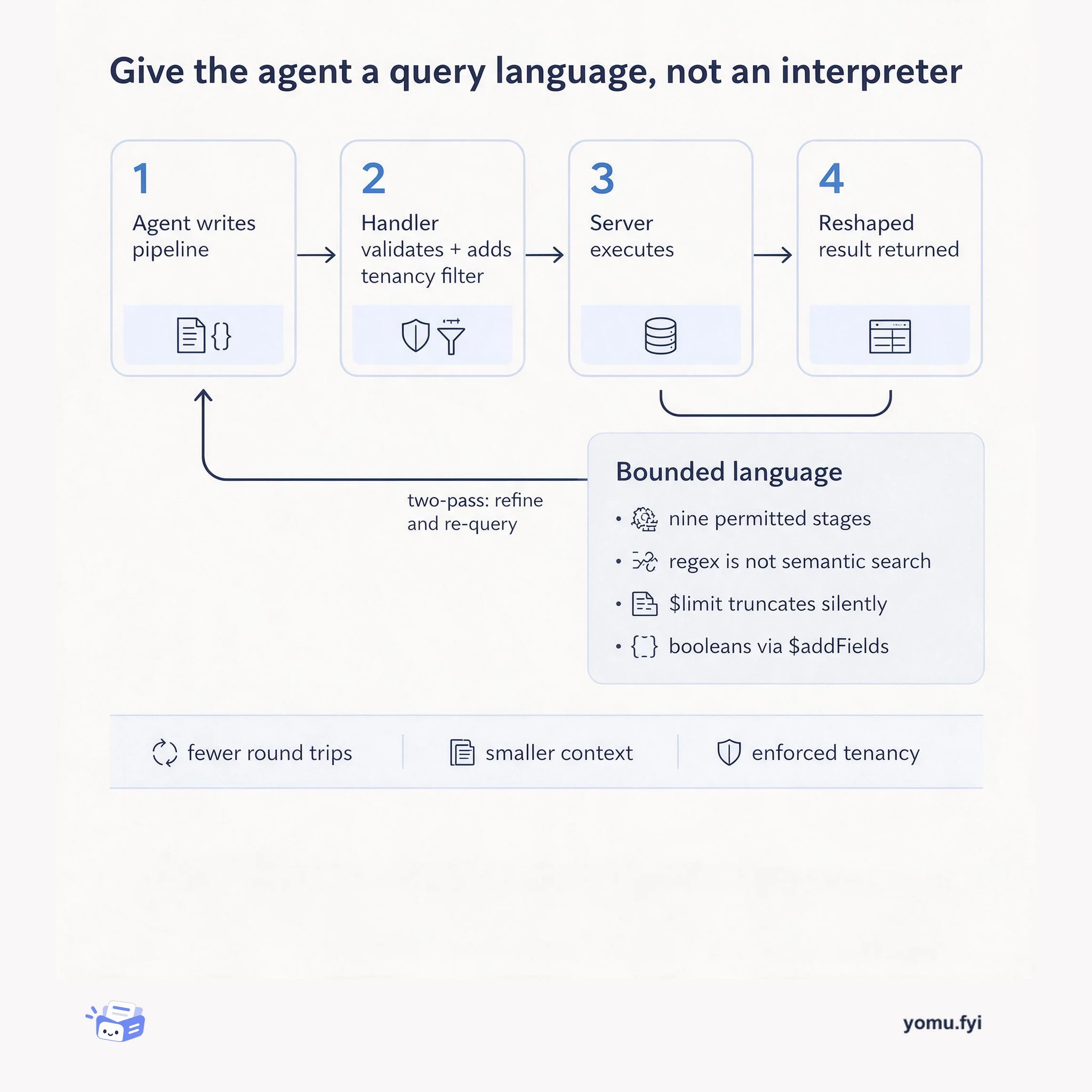
A four-step pattern for letting a document agent write validated aggregation pipelines instead of arbitrary code, so results come back shaped and tenancy stays enforced.
Loading…
Topic
542 posts about AI Agents. Every summary links to the original.
See the idea
A four-step pattern for letting a document agent write validated aggregation pipelines instead of arbitrary code, so results come back shaped and tenancy stays enforced.
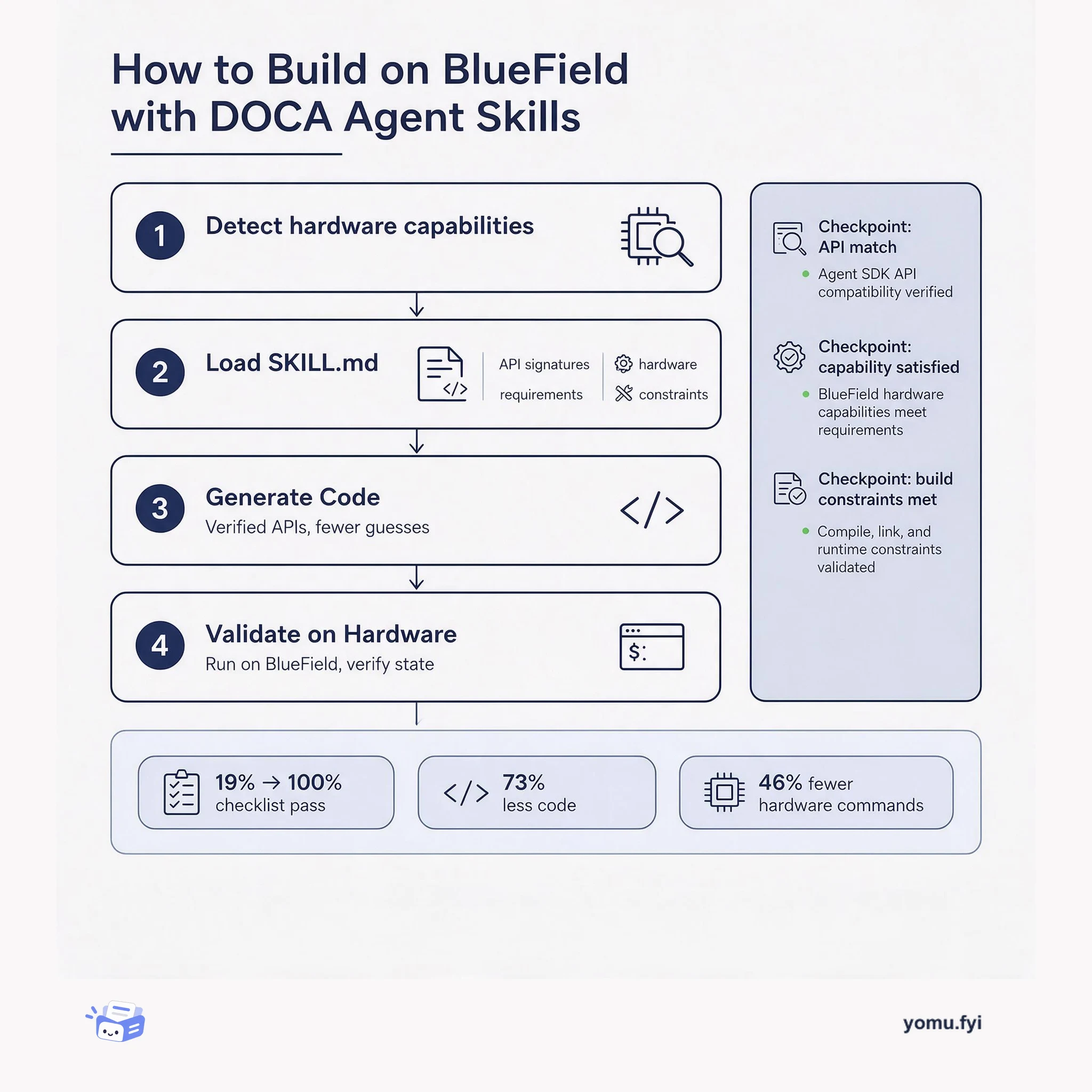
A practical how-to for using NVIDIA DOCA Agent Skills to generate BlueField code with verified APIs and hardware checks, reducing correction cycles and failed builds.
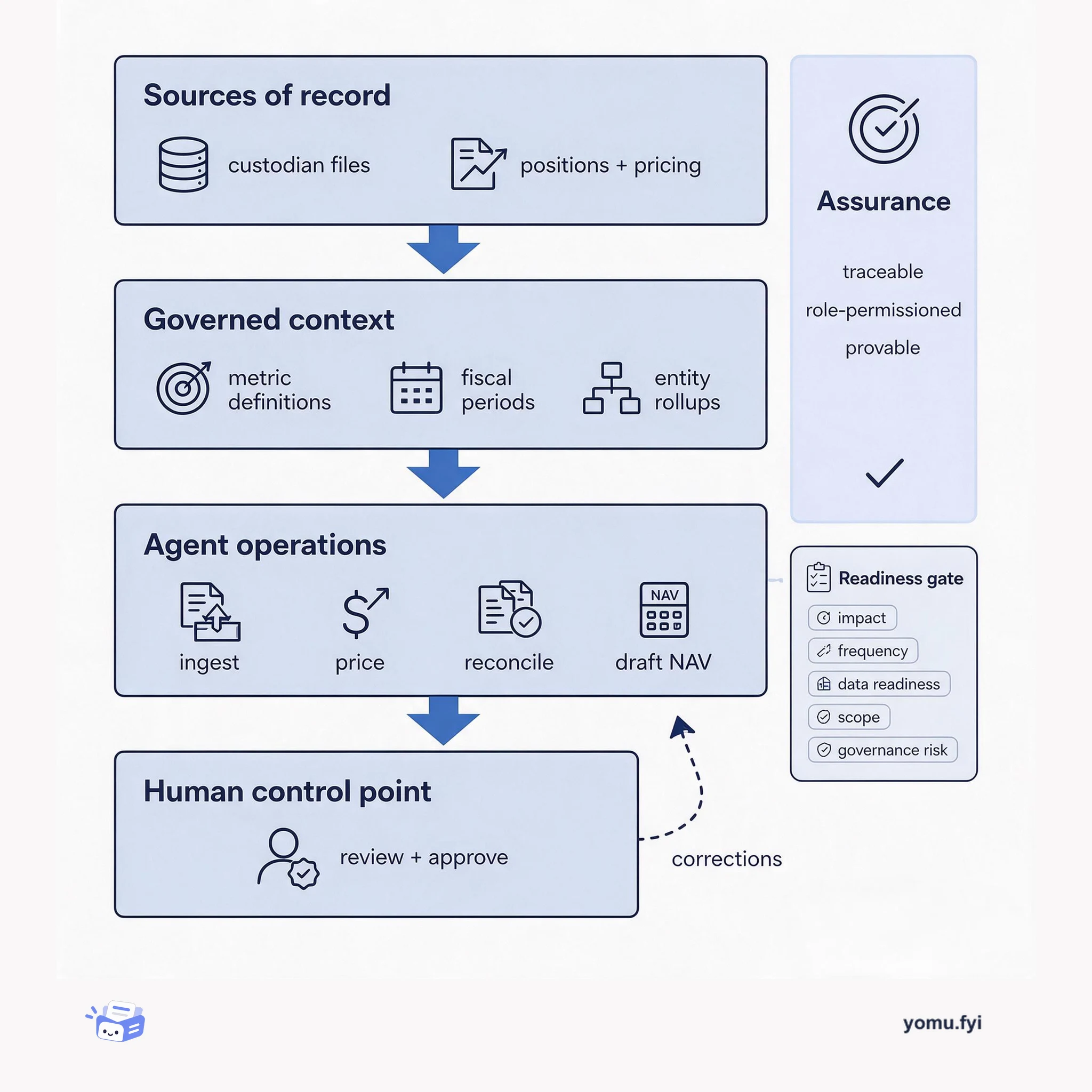
Asset management runs as a layered control plane: custodian and pricing data feed a governed context layer, agents run the overnight fund work, and a human signs off before anything is published.
The Good Stuff
Paid picks we use ourselves. Links carry a referral code — a subscription through one earns us a commission at no extra cost to you.
Newest first
Fin API platform launch makes the models powering its customer-agent system available through APIs, with contracts starting at $250k annually. It says Fin currently resolves over 2M customer issues weekly across brands and runs on models trained by its AI group. Last week’s Apex announcement is described as a specialized customer-service LLM that beat frontier models from Anthropic and OpenAI in six-month production tests on resolution rate, latency, hallucination rate, and cost. Customers can choose the Fin Agent Platform, Fin Agent API, or direct access to Apex and related models for bespoke, specialized agents. The rationale is customer demand and a broader expectation that software differentiation will shift from features and interfaces toward agents built on differentiated AI.
Cursor 3 is a unified workspace for building software with agents, introduced as Cursor moves toward a third era in which fleets of agents work autonomously to ship improvements. Built from scratch around agents rather than as an extension, its multi-workspace interface brings local and cloud agents into one sidebar across multiple repositories and supports parallel work. Sessions can move from cloud to local for desktop editing and testing, or from local to cloud for offline and longer-running work; cloud agents also produce demos and screenshots for verification. The new diffs view streamlines editing and review through staging, committing, and PR management, while files with full LSPs, an integrated browser, and Marketplace plugins retain IDE capabilities; users can switch back to the Cursor IDE. Cursor says these foundational pieces—model, product, and runtime—are in place for more autonomous agents and team collaboration, while IDE investment continues until codebases are self-driving.
Composer 2 is a coding model for agentic software engineering, and its technical report describes training from continued pretraining of the open Kimi K2.5 base model through large-scale reinforcement learning. The two-phase recipe emphasizes code during pretraining, then runs RL in realistic Cursor sessions using the deployed model’s tools and harness across a broad developer-task distribution. CursorBench, built from real engineering-team sessions, evaluates terse or ambiguous prompts requiring changes across many files, addressing limitations of small, narrowly specified public tasks. Composer 2 scores 61.3 on CursorBench, 37% above Composer 1.5, plus 73.7 on SWE-bench Multilingual and 61.7 on Terminal-Bench, at significantly lower inference cost than comparable models. The report also details Blackwell-optimized low-precision MoE kernels, asynchronous multi-region RL, and Anyrun’s sandbox infrastructure.
Intercom announced Monitors, a new Fin product area intended to complete its observability suite alongside Insights and Recommendations. It addresses the limits of random sampling, CSAT, and spreadsheet-driven quality assurance by letting teams select conversations with filters or natural-language criteria, including risk signals, and maintain repeatable samples. Custom Scorecards then define business-specific evaluation criteria, weighting, and critical failures, with scoring performed by AI, humans, or both to produce an overall quality score. Flagged conversations enter a Review Queue for assignment, notes, status tracking, and follow-up fixes, while reporting compares scores with CX Score, resolution rate, Monitors, and Scorecards over time. Monitors for Fin conversations is live, with human-agent QA, real-time alerts, and knowledge-base evaluation identified as planned additions.
AI is shifting support from reactive backlog management toward proactive experience design, as teams gain capacity through faster, more efficient service across languages and time zones. The report says 58% rank experience and satisfaction as their top 2026 priority, up from 28%, while mature deployment triples the share able to always meet expectations from 9%. Intercom’s support team expanded access, improved first-response rates, and added onboarding sessions while absorbing a 300% demand increase without expanding headcount, enabled by deep integration of Fin. Clay uses Fin across Slack, email, and in-app chat, where it handles half of roughly 7,000 monthly queries and participates in 90% of all queries. The recommended model treats support as a product, combines AI with human handoffs, anticipates needs, builds trust, and personalizes interactions.
Customer service teams often see early AI gains in response speed and efficiency, but deeper operational integration produces larger returns and makes value easier to measure. Research cited in the 2026 Customer Service Transformation Report says 62% of support teams have improved metrics after implementing AI, rising to 87% among teams at mature deployment; the share able to measure ROI rises from 35% to 70%. As deployment matures, teams shift from measuring time and cost savings to tracking how freed capacity supports higher-value customer work and revenue-generating activity. The proposed AI-first economic model treats AI as a workforce capability that improves human productivity, system improvement, revenue influence, and organizational agility. Intercom’s Fin illustrates the model: it is involved in 97% of customer conversations, resolves 83.5% end-to-end, and helped absorb more than 300% demand growth without scaling headcount.
AI adoption is widespread in customer service, but the report identifies a deployment gap between organizations experimenting with the technology and those integrating it deeply into operations. Based on a survey of 2,470 global support professionals, it finds that 82% of senior leaders invested in AI in the past year and 87% plan to invest in 2026, while only 10% report mature deployment. Mature teams put AI at the core of workflows, give it meaningful responsibility, and use continuous improvement to achieve higher-quality, more consistent support; 43% report that outcome, nearly double the rate for teams at initial deployment. Lightspeed illustrates the approach by combining tailored training, executive alignment, content investment, and AI operations discipline, reaching 72% Fin resolution without human intervention across 43,000-plus monthly requests and 12-plus languages.
The post presents Kaizen as a structured approach to continuous improvement, centered on small changes, immediate iteration, and participation from people closest to the work. At Fin, this philosophy is applied to Agent Fin through the Fin Flywheel: teams train it on complex queries, test simulated conversations, deploy it across channels, and analyze performance with AI-powered insights. Each interaction feeds a repeatable loop rather than a one-time launch, while Human Support representatives examine escalations, ask why Fin could not resolve them, and identify content, process, or tooling fixes. A lightweight AI-powered logging process captures suggestions in the moment, enabling subject matter experts or frontline teams to implement changes quickly; together, the two systems make continuous learning an ingrained capability and are presented as a source of competitive advantage.
Grab’s Analytics Data Warehouse team supports more than 1,000 monthly users and 15,000 tables, but repetitive questions about definitions, lineage, quality, and basic enhancements consumed about 40% of engineering time. It deployed a multi-agent AI system that routes Slack requests into enhancement or investigation pathways, using FastAPI and LangGraph for stateful, cyclical collaboration, Redis for caching and sessions, and PostgreSQL for persistent memory. Specialized agents query Trino, Hive, or Delta Lake, inspect GitLab code, check incidents and pipeline health, or prepare semi-automated code changes, while human reviewers approve production modifications. The system autonomously resolves most standard inquiries and some common enhancements, reducing resolution time by an order of magnitude and bringing simple answers to users within minutes. The resulting capacity shift reclaimed several FTEs worth of engineering bandwidth and moved hundreds of hours from reactive support to roadmap work.
Money Forward expanded Cursor coding agents beyond engineering to product, design, and quality assurance after developers began saving an estimated 15–20 hours per week. Adoption among engineers rose 30% within a week, and the company now reports more than 1,000 daily users; engineering examples include Rails optimization, Terraform deployments, and Vue-to-React migrations. For the company-wide rollout, its MEPAR department chose Cursor for minimal setup, visual browser capabilities, a unified workspace, model-agnostic asynchronous cloud agents, and context retrieval across complex codebases. QA uses MCP-connected Jira and Notion materials to generate test cases and Playwright scripts, reducing test-generation time by 70%, while product managers inspect repositories for requirements and designers prototype against live frontends and product analytics.
Composer is trained for long-horizon coding tasks using self-summarization, allowing reinforcement-learning trajectories to exceed the model’s context window. When a fixed token trigger is reached, Composer receives a synthetic summarization query, uses scratch space to produce a condensed context, and resumes with the summary plus conversation state; training rewards every token in the chained rollout with the final outcome. Against a tuned prompt-based compaction baseline, self-summary reduced compaction-related error by 50% on CursorBench at both 80k and 40k triggers, while summaries averaged about 1,000 tokens instead of more than 5,000 and reused the KV cache. An early Composer checkpoint solved Terminal-Bench 2.0’s make-doom-for-mips after 170 turns, summarizing more than 100,000 tokens into roughly 1,000 tokens of retained information.
An Android team at Medium describes how it encoded its project conventions so AI assistants generate code aligned with Clean Architecture, Kotlin, Jetpack Compose, Hilt, Apollo GraphQL, and feature modules. An AGENTS.md file provides persistent context about module structure, dependency injection, state management, navigation, testing, and commands, while Markdown skills in .agents/skills/ provide ordered runbooks for specific tasks. Examples cover scaffolding screens and feature modules, migrating Material 2 to Material 3, enforcing ViewModel feature-flag handling, and adding deeplinks, analytics, translations, and tests. Detailed patterns include ViewModel-injecting and @VisibleForTesting composables, assisted injection, StateFlow, Result, MockK, Turbine, and Robolectric. The team iterates skills from review feedback, keeps them version-controlled, and plans file-aware rules plus commands for release diffs and reporting.
After a fivefold increase in pull-request velocity over nine months, the team found static analysis and rigid code ownership insufficient for security at scale. It built a fleet of Cursor Automations powered by cloud agents, webhook and GitHub integrations, and a security MCP deployed as a just-in-time serverless Lambda function. The MCP provides persistent data, semantic deduplication using Gemini Flash 2.5, and consistently formatted reporting and follow-up actions, while Terraform standardizes review and deployment. Four templates cover PR review, segmented vulnerability hunting, dependency patching with reachability analysis and tests, and daily invariant-drift monitoring. Agentic Security Review has run on thousands of PRs in two months and prevented hundreds of issues from reaching production; the team says more automations are planned.
Fin is changing its pricing metric from “resolutions” to “outcomes” as its capabilities extend beyond fully autonomous support conversations. Historically, a resolution meant Fin solved an issue end to end without human involvement; the model gave teams a clear ROI comparison, and Fin’s average customer resolution rate now stands at 76% across more than 7,000 teams. Customers increasingly deploy Fin on complex, multi-step work involving external systems, policy constraints, and human oversight, where Fin may gather context and act before handing off for confirmation. An outcome counts when Fin successfully completes the action it was configured to perform, including a full resolution or a Procedure. The change keeps pricing simple while recognizing collaborative workflows, supporting compliance, and providing a metric that can scale as Fin takes on more roles beyond service.
Cursor describes a hybrid online-offline process for comparing coding-agent quality as developer tasks become longer, more complex, and multi-file. Its offline CursorBench suite uses tasks derived from real Cursor sessions, paired with ground-truth solutions through Cursor Blame, and evaluates correctness alongside code quality, efficiency, and interaction behavior; the post focuses on correctness. Tasks are intentionally short and underspecified, span larger codebases and multi-workspace environments, and are scored with agentic graders, while correctness is plotted against median completion tokens to show the compute/latency trade-off. Controlled live-traffic experiments supplement the suite, catching regressions that offline grading misses, and the post reports that CursorBench separates frontier models more clearly and its rankings track developer experience more closely than public benchmarks.
Cursor is adding more than 30 plugins to its Marketplace, including integrations from Atlassian, Datadog, GitLab, Glean, Hugging Face, monday.com, and PlanetScale. The plugins extend Cursor across infrastructure and productivity workflows: users can query observability data, manage GitLab repositories and pipelines, work with PlanetScale schemas and queries, handle Atlassian issues and backlogs, search company knowledge in Glean, and manage monday.com boards and tasks. Each plugin bundles capabilities such as MCPs with skills that instruct an agent how to use them, and those tools can support manually started or automatically invoked cloud agents. Cursor also supports community-built plugins, while Teams and Enterprise admins can create private team marketplaces. Automations can run agents on schedules or events with custom instructions.
February updates for Fin address constraints in complex automation, voice quality, Shopify deployment, and helpdesk operations. Procedures can be drafted from existing source material, edited in natural language with hooks for live data, business logic, and deterministic code, then tested step by step in simulations using conversation data and defined criteria. Voice changes add pronunciation rules, 11 new voices, and automatic background-noise reduction, while Shopify setup connects a store, installs Messenger without code, and deploys Fin in under two minutes. Helpdesk additions include 11 call metrics and automatic public-holiday office hours; the post says 19 improvements shipped in 2026, and concludes that all featured updates are live and available now.
The post describes how businesses are extending AI beyond customer support across the customer lifecycle, with support teams increasingly positioned to lead that work. Research cited in the 2026 Customer Service Transformation Report says 52% of respondents plan to scale AI to other departments in 2026, while 32% say customer service teams lead their AI transformation strategy. WHOOP deployed Fin on its Join page after prospective buyers faced waits of more than 10 hours; Fin resolved 84% of inbound questions and helped drive a 130% increase in attributable sales. The post warns that isolated departmental agents can fragment experiences, and presents a unified Customer Agent with shared memory and business knowledge as the intended direction. It argues support can provide shared standards, guardrails, operating practices, and implementation expertise as AI expands into sales and other functions.
Cursor Automations introduces always-on agents that run on schedules or react to events from Slack, Linear, GitHub, PagerDuty, or custom webhooks. Each invocation spins up a cloud sandbox, uses configured models and MCPs, verifies its output, and can draw on memory from past runs. The product supports review and monitoring workflows, including security audits on pushes to main, risk-based codeowner assignment, and PagerDuty-driven incident investigation that proposes fixes. Other automations generate weekly repository digests, add tests after merged code, triage Slack bug reports through Linear, and assemble cross-tool dashboards. Examples from Cursor and Rippling report faster incident response and reduced repetitive work, while Runlayer describes a software factory built with Runlayer MCP and plugins.
Cursor is now available in IntelliJ IDEA, PyCharm, WebStorm, and other JetBrains IDEs through the Agent Client Protocol (ACP), extending its agent-driven development experience to developers using those environments. The integration lets users choose frontier models from OpenAI, Anthropic, Google, and Cursor, while Cursor provides a custom-built agent harness for each model. Cursor's secure codebase indexing and semantic search are combined with JetBrains IDE code intelligence and tooling to support work on large enterprise codebases. Users install Cursor ACP from the ACP Registry and authenticate with an existing Cursor account; it is free for users on paid plans, and the release is described as a foundation for deeper JetBrains integrations.
The best engineering reads, once a week.