How to Run an Agent Loop That Actually Converges
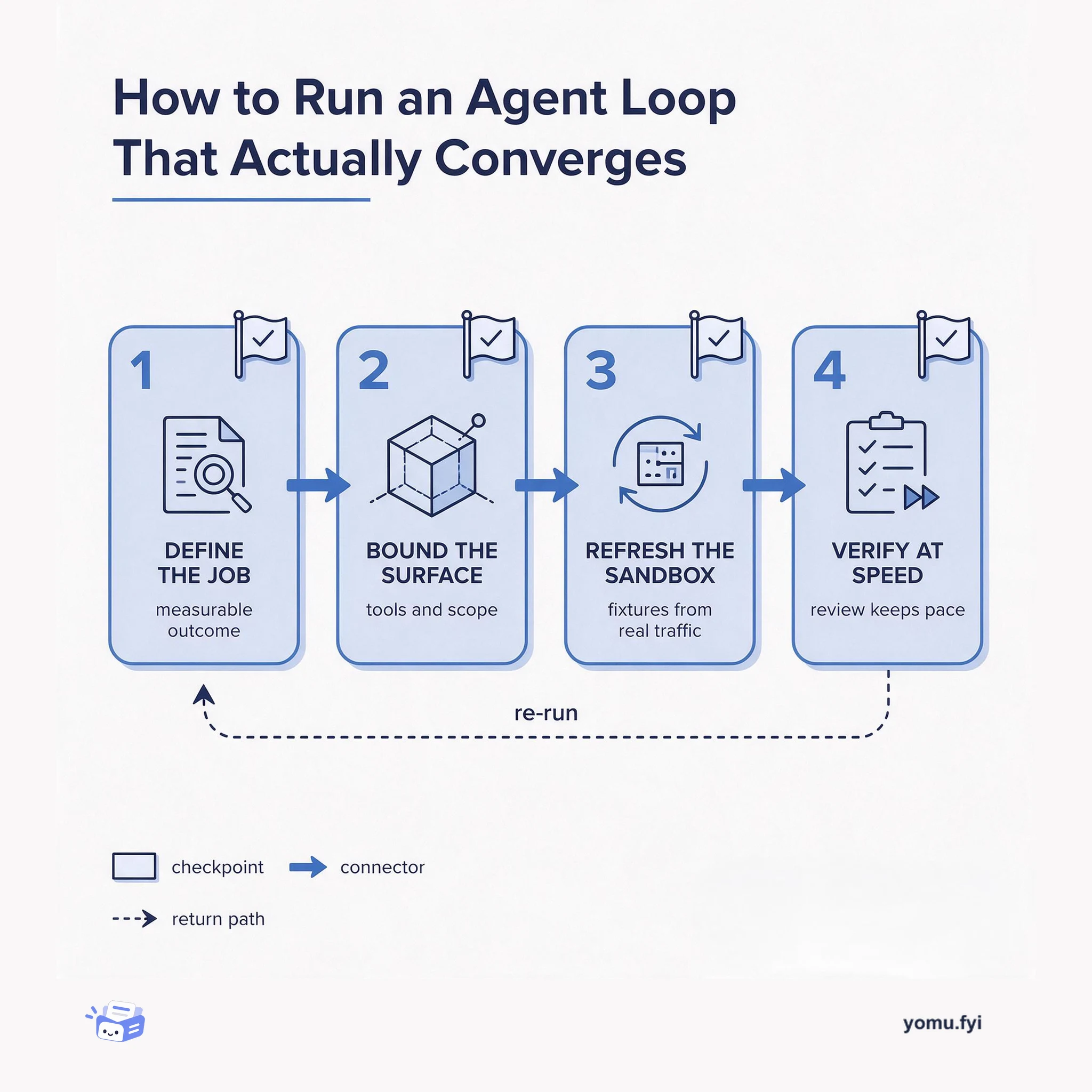
A four-checkpoint how-to for agent loops: name a measurable job, bound the tool surface, refresh sandbox fixtures from real traffic, and verify at agent speed.
Loading…
Topic
564 posts about AI Agents. Every summary links to the original.
See the idea
A four-checkpoint how-to for agent loops: name a measurable job, bound the tool surface, refresh sandbox fixtures from real traffic, and verify at agent speed.
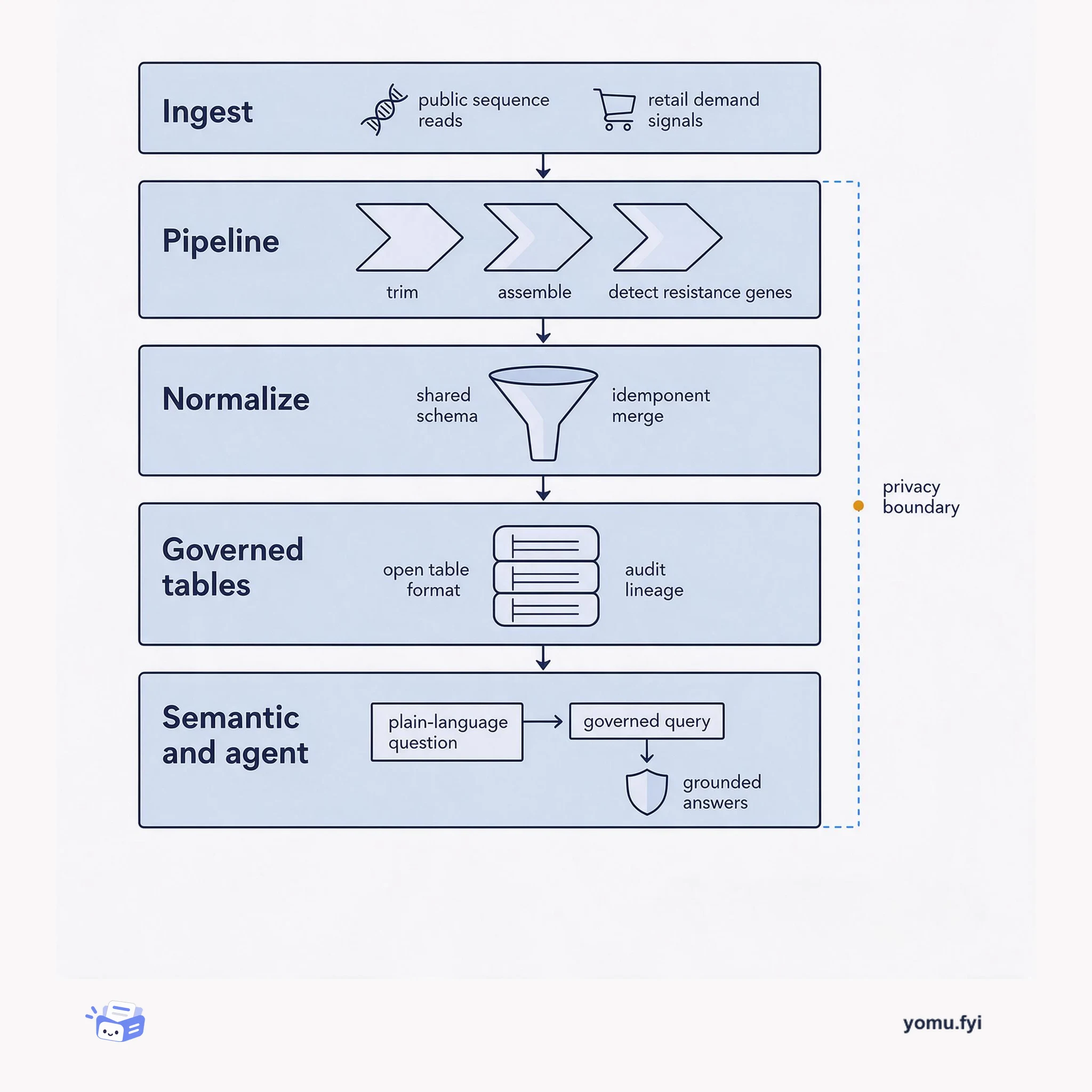
Antimicrobial resistance surveillance is a layered data architecture: raw reads and demand signals flow in, get normalized into governed tables, and answer plain-language queries. The diagram maps each boundary.
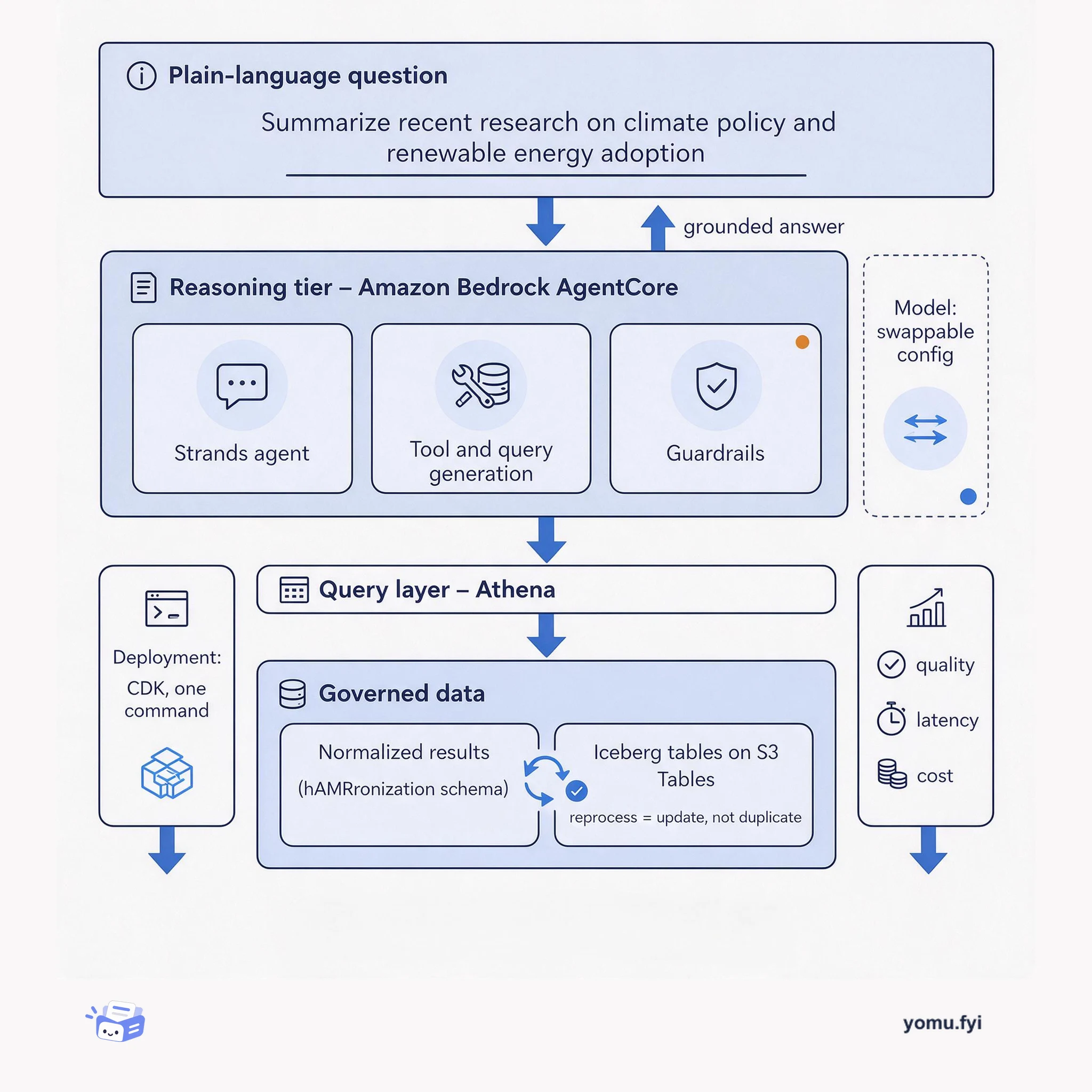
Amazon Bedrock is the managed reasoning tier in an agent architecture, not the whole system. This layered view shows the pipelines, governed tables, query layer, and guardrails around it.
The Good Stuff
Paid picks we use ourselves. Links carry a referral code — a subscription through one earns us a commission at no extra cost to you.
Newest first
Agent sprawl arises when many AI agents on Red Hat OpenShift become redundant, insecure, and untraceable, using static API keys over HTTP and lacking visibility into reasoning failures. Rossoctl, a Kubernetes-native controller, automates discovery by declaring AgentRuntime resources that fetch metadata to create AgentCard custom resources, and uses a two-phase Helm deployment to resolve the URL dependency between routes and AgentCards. It adopts the A2A protocol, which standardizes agent interaction through a machine-readable AgentCard at /.well-known/agent-card.json and a JSON-RPC interface for consistent payloads. Security follows a six-layer zero-trust model: SPIRE issues short-lived certificates, Istio enforces mTLS, AgentCards are signed with JWS, and AuthBridge provides scoped OAuth2 tokens. Observability uses opt-in MLflow tracing that captures orchestration flow, tool calls, and model latency, enabling diagnosis of semantic failures such as hallucinations or data leaks that standard metrics miss.
JetBrains Research, in collaboration with Lund University, studied how to review AI-generated code as AI agents produce thousands of lines across multiple files quickly. The core problem identified is trust calibration: developers cannot gauge an LLM’s confidence per line, making line-by-line review unscalable. The study proposes a three-level conceptual framework: overview for high-level hypotheses, file-level risk stratification, and code snippet-level chunk decomposition with chain-of-thought linkage. This framework was developed through participatory design with 17 practitioners and a follow-up survey of 43 professionals, and will be presented at ESEIW 2026. The paper argues that current diff viewers are inadequate for AI-generated code and that tools must surface risk and confidence signals at the granularity where developers allocate attention.
Most conversation design guidance focuses on voice and tone, but consumers prioritize immediate issue resolution (40%), speed (40%), accuracy (38%), and 24/7 availability (38%) over rapport. The post recommends opening with capability, loading context before the first turn using persistent profiles, and designing a second option when the first fails. Escalation should be triggered by conversation rules like a second failed attempt or explicit request, not treated as an error condition. Confirmation turns should be cut except for irreversible actions, and agents should clearly state what they cannot do. An agent with customer history, a backup path, and a clean exit is more helpful than one with a carefully written persona but lacking those features.
Training a single LLM agent jointly across diverse interactive environments is challenged by scalar rewards that provide limited information about cross-environment relationships and no within-group reward contrast when rewards are identical. RISED addresses this by using rubrics—textual descriptions of rollout behaviors—to guide both online data selection and policy supervision. An LLM judge tags each rollout with a predefined rubric vocabulary shared across environments, and these profiles select data aligned with the batch’s behavioral composition while limiting overlap with already-selected data. Positive rubrics supply token-level supervision via an on-policy self-distillation teacher, while negative rubrics steer subsequent rollouts away from recurring failure modes. Across model backbones, RISED achieves the highest mean pass rate across environments and ranks first or second in every individual environment.
Enterprise AI agents without persistent memory suffer from the “Groundhog Day” problem, repeatedly asking users to re-explain themselves. Agentforce Memory addresses this by giving agents persistent memory that retains user preferences, conversation history, and context across sessions. The team first established a shared terminology document to define concepts like semantic and episodic memory before architectural discussions could proceed. The architecture evolved incrementally, starting with conversation history injection and later adding semantic retrieval to find relevant past information regardless of recency. Memory retrieval uses keyword search during pre-orchestration to balance context quality with low latency, and moving memory into the Reasoner simplified configuration for administrators. Privacy and user trust were treated as architectural requirements from the start, enabling individual user controls over memory creation and management.
General-purpose AI agents fail on business questions because they lack enterprise context such as authoritative tables, business rules, and trusted experts; the missing institutional knowledge is scattered across dashboards, documents, and people. Databricks’ Genie Ontology addresses this by continuously updating institutional knowledge from certified Unity Catalog concepts and automatically learned snippets from dashboards, notebooks, SQL queries, and connected apps. OntoRank ranks sources by authority using certification, usage, and authorship signals, so Genie grounds answers in the most trusted and relevant data. In a weekly adoption review, a product manager prompts Genie, which uses MCP to search Google Docs and Jira while running live SQL for fresh analysis. The resulting report includes citations, forecasting, scheduling, and even conversion into a shareable Genie Agent, all within permission boundaries.
Intercom’s Chief Product Officer and Co-founder discuss how generative AI reshaped their strategy, product development, and internal rituals. They describe moving from isolated AI tasks to AI-native products built from the ground up with AI at their core. A key move was launching Fin, their AI agent, as a standalone product on competitor platforms like Zendesk, prioritizing AI leadership over platform exclusivity. They draw parallels to Facebook’s mobile pivot and the iPhone’s initial skepticism, arguing generative AI will face similar resistance but have profound disruptive potential. The conversation emphasizes that second- and third-order effects of AI will create entirely new workflows and behaviors, making full impact hard to predict.
LangGraph agents can call tools and follow prompts but lack safety guardrails, risking unsafe responses like explaining fraud. NeMo Guardrails acts as a transparent proxy between the agent and LLM, inspecting every request and response without requiring agent code changes. On Red Hat OpenShift AI, the guardrails service is deployed via a NemoGuardrails custom resource managed by the TrustyAI Operator, and the agent’s BASE_URL points to this service instead of the model endpoint. The example demonstrates three rail types: regex filtering for jailbreak patterns, content safety classification against S1-S13 categories, and topic safety to keep the agent within a banking domain, with optional tracing using MLflow and OpenTelemetry. Rails execute sequentially, with the first failure short-circuiting the chain, and the separation lets safety policy be owned by guardrails while the agent handles reasoning and tools.
Cloudflare marked its 16th Birthday Week with 46 announcements spanning open source, application security, AI agent economics, and developer platform upgrades. The week began with a new agentic CLI called cf, an open-source generation pipeline called Forge, and EmDash, a serverless CMS with sandboxed plugins. Tuesday focused on Cloudflare’s intention to become a public certificate authority and post-quantum security tools. Wednesday introduced Pay Per Use and the Monetization Gateway, creating an economic model for AI agents to pay creators when using their content. The week closed with features for faster connectivity and broader accessibility.
Grab built sim-rs, a self-contained simulator that models its fulfillment marketplace to enable rapid experimentation with dispatch strategies. The simulator processes a city-day of marketplace activity in tens of minutes, using historical data and configurable components for batching, allocation, and cancellation. Agents connected through an autoresearch loop propose changes, run reproducible experiments, and receive computed verdicts, with safeguards against specification gaming such as immutable core data and scoped changes. The simulator also supports A/B/n comparisons within a single run, exposing all arms to the same demand and dynamics to improve translation to production. By making each attempt take minutes instead of weeks, sim-rs allows agents to test thousands of ideas cheaply and receive honest feedback, accelerating research while keeping the simulator faithful through automated translation of production logic and behavioral modeling.
ThinkingBox, a benchmark from Microsoft and Hugging Face, grades AI agents on the database state and side effects they leave behind rather than on tool calls or final responses. In a common-set ablation covering 121,680 valid trials across 12 LLM models, 79,853 attempts failed executable checks, and 67.24% of those failures still terminated cleanly and invoked a state-changing tool without error, with wrong field values in 77.61% of them. The benchmark runs every task 20 independent times from identical clean backends, reporting pass@1, pass@20, and observed 20/20 consistency to separate capability from reliability. For example, Kimi-K3 solved 93.89% of tasks at least once but only 13.41% consistently, while Claude Opus 5 completed 47.53% of tasks on every attempt, and Claude Opus 5.5 gained no additional dependability over its predecessor despite higher pass@1. ThinkingBox is available through Hugging Face’s OpenEnv with MIT-licensed code and CDLA-Permissive-2.0 benchmark data.
Buy-side asset management finance departments face growing complexity from AI agents influencing valuation, redemption, and reconciliation workflows, while protecting net fee margin and NAV integrity remains their core mission. Databricks Genie One is presented as a data-smart AI coworker grounded in Genie Ontology, which captures business meaning and keeps definitions current as strategies and fee arrangements shift. Behind the assistant, Genie Agents automate overnight fund operations: ingesting custodian files, pricing positions, reconciling records, and producing a preliminary NAV for review. Every figure is traceable to its source, permissioned by role, and provable to investors or regulators, enabling finance teams to see forming risks early. The system does not make investment or valuation decisions; a human remains in the loop for every action.
Supabase announced a code-first approach at its Select 2026 event, enabling developers to store schema and configuration in code so coding agents can set up and modify projects end to end. Local Supabase now runs as native processes without Docker, allowing multiple instances per directory and compatibility with sandboxes like Claude Code. A new MCP server lets application users connect their own agents, authenticating through existing Auth flows and enforcing row-level security on every tool call. Operational tools include Health Check Advisors for error rates, Database Connections for session management, Explorer notebooks for unified SQL and log queries, and query_logs for agent monitoring. Scaling features encompass Multigres for multi-node Postgres high availability, OrioleDB to avoid table bloat and VACUUM, Supabase Pipelines for near real-time data streaming to analytics platforms, and dbarena for transparent benchmarks.
At Supabase Select, Supabase announced tools that let coding agents find production problems, test fixes, and report back, with controls for access and permission. A new MCP tool gives agents raw SQL access to project logs, advisor checks now include health signals for error rates across Data API, Auth, Storage, and Edge Functions, and the database connections view shows sessions, long queries, idle-in-transaction, blocked, and lock holders. Notebooks combine saved database or log queries with markdown notes, can be created in the dashboard via the Assistant, pulled locally with supabase notebooks pull, and pushed with supabase notebooks push, and are found in the new Explorer rolling out through October 12. Updated Skills provide a living document of common health, security, performance, and resource signals for agents to watch for and how to monitor them. Supabase Pipelines, available on paid plans, allow replicating data to BigQuery, ClickHouse, DuckLake, or Snowflake.
Supabase announced tools at Supabase Select that let coding agents manage backend configuration and deployment from code, eliminating the need for dashboard-only changes. Declarative Schemas 2.0 allows agents to edit SQL files as the source of truth, with pg-delta generating migrations, while config.toml holds settings like auth providers that can be pulled back from the dashboard. Local development now runs as native processes without Docker, supporting multiple instances per directory and working in environments like Claude Code’s sandbox, currently in alpha off by default. Supabase Compute provides long-running services in any language alongside the database, with configurable memory and CPU, public or private HTTP endpoints, and deployment via CLI or Management API. The new MCP server lets user agents interact with an app as the signed-in user, respecting existing RLS policies, built on @supabase/server and Supabase Middleware, with a headless app template available.
Supabase is acquiring Turso to evolve database infrastructure for the massive scale of AI agent-created databases. Supabase already launches over one million databases per week and expects demand to outpace capacity as agents build more software. Turso rebuilt SQLite in Rust, creating a cloud platform where a single server manages millions of databases, loading them on demand and suspending them when idle, avoiding dedicated machines for small workloads. This architecture suits agent workloads needing cheap, on-demand databases, while Postgres remains the path for scaling to production; Turso will continue operating independently with a clear path into Supabase’s ecosystem, and for existing users nothing changes. Glauber Costa will lead the agentic infrastructure effort, and the combined mission is to store the world’s data as agents create more of it.
Cloudflare launched a Web Search API via AI Gateway, partnering with Ceramic.ai, Exa, and Linkup, to provide grounded intelligence by letting AI agents search the web instead of guessing URLs that return 404 errors. The API injects live, structured snippets into inference pipelines, giving models access to information beyond their training cutoff, such as new Birthday Week releases, and grounding agent responses with real-time data. Developers can integrate via AI Gateway credits, a direct REST endpoint with curl, or Workers bindings with one line of code. Partners commit to Cloudflare’s verified bot standards, including identifying crawlers, respecting robots.txt, and providing source links for transparency. Web search calls are logged in AI Gateway observability, billed at list pricing without markup, support Bring-Your-Own-Key and Zero Data Retention, with native server tools coming soon.
Cloudflare’s Quick Tunnels now support email-based access control via the –allowed-mail flag, requiring no account on either side. The feature addresses the risk of exposing sensitive work, especially as AI coding agents increasingly use tunnels to share previews. Cloudflare Access verifies the visitor’s email with a one-time PIN, while cloudflared on the developer’s machine authorizes the request against a local rule list. The guest list never leaves the developer’s machine, and the tunnel remains accountless and free. The feature was built and shipped by two interns, Hugo Vicente and Alessandro Frigerio.
AutoSynthData, built by ServiceNow CoreAI, generates training data for enterprise agents by targeting capability gaps from evaluation, using a stronger teacher such as Qwen3.8-27B to demonstrate successes. It uses a target model’s failures and a stronger teacher’s successes to decide what to learn next. The system produces tasks composing a system specification, user prompt, and verifier, ensuring feasibility, realism, and difficulty against the target environment. After sample-level checks and batch-level review, the dataset grows via target and multiply phases, generating 2,000 samples in 18 hours for the Hybrid domain. In EnterpriseOps Gym, synthetic SFT on Gemma-4-26B-A4B-it improved mean Pass@1 by 7.2 points (35% relative) in Hybrid and from 18.77% to 27.18% in ITSM, showing the approach works across domains.
Seer is Sentry’s agent debugger that reasons across errors, traces, logs, profiles, and linked repositories to identify root causes, not just surface-level stack traces. The Sentry MCP, set up via the agent plugin with a single command, bridges Sentry’s data into coding agents like Claude Code and Cursor, enabling them to invoke Seer’s full analysis. The new Sentry CLI provides natural-language access to Seer’s diagnosis and issue management directly from the terminal, using selectors like @latest and @most_frequent. These tools are complementary: Seer provides deep diagnosis, while the MCP and CLI deliver that context into the environments developers already use. Teams can automate the entire workflow so Seer diagnoses, an agent fixes, and a draft PR awaits review without human involvement until approval, with Seer triggering on issues meeting event count and fixability thresholds.
The best engineering reads, once a week.