How to Run an Agent Loop That Actually Converges
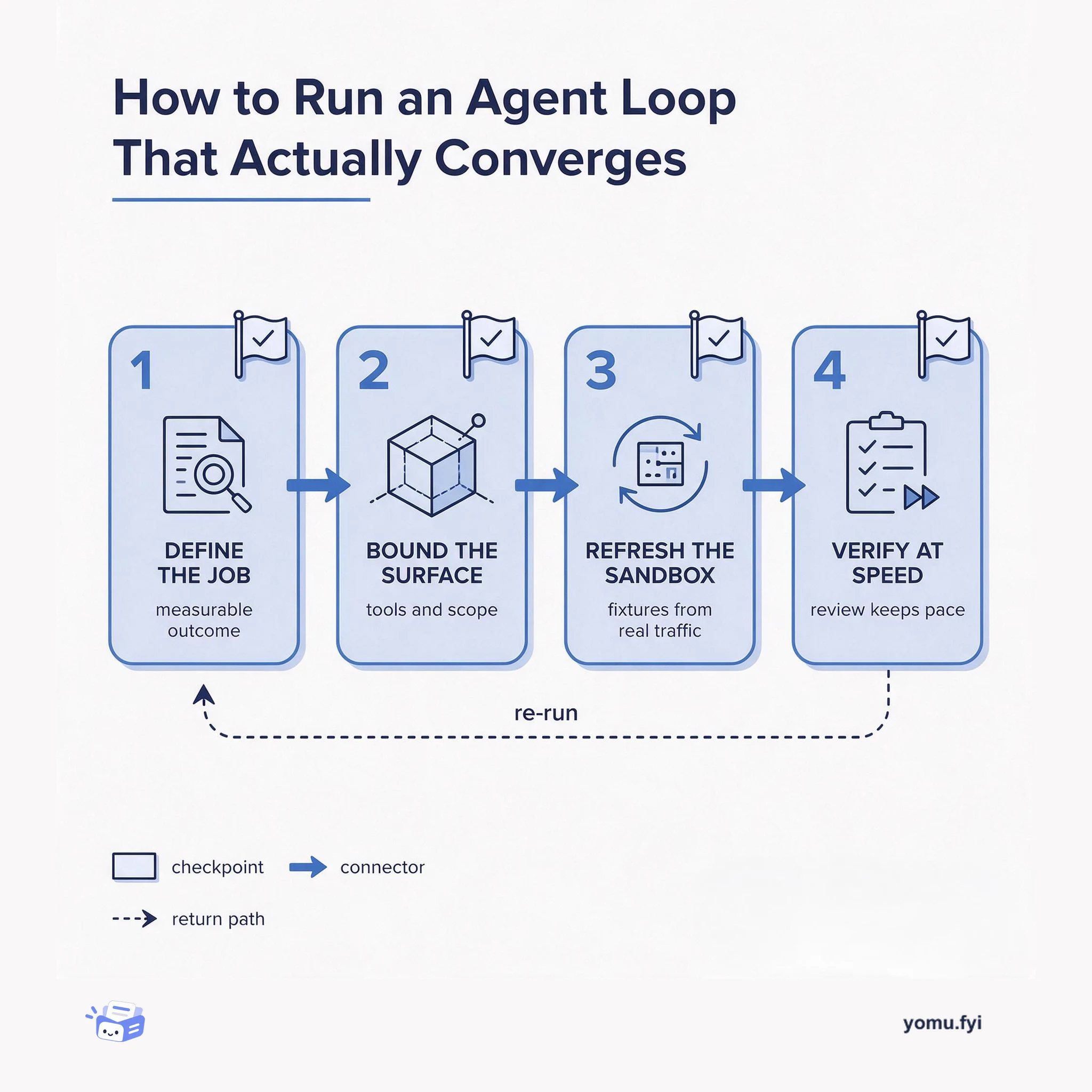
A four-checkpoint how-to for agent loops: name a measurable job, bound the tool surface, refresh sandbox fixtures from real traffic, and verify at agent speed.
Loading…
Topic
549 posts about AI Agents. Every summary links to the original.
See the idea
A four-checkpoint how-to for agent loops: name a measurable job, bound the tool surface, refresh sandbox fixtures from real traffic, and verify at agent speed.
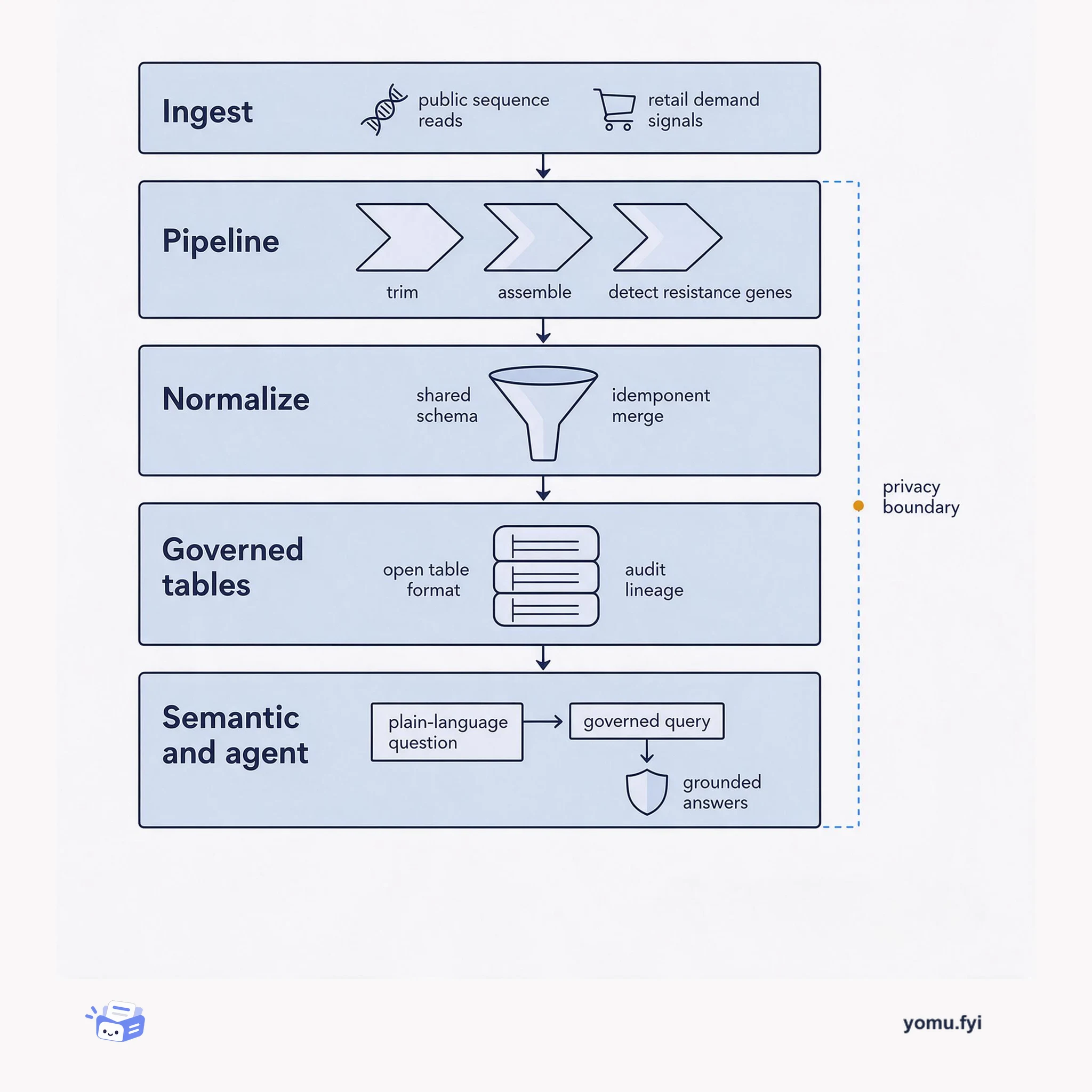
Antimicrobial resistance surveillance is a layered data architecture: raw reads and demand signals flow in, get normalized into governed tables, and answer plain-language queries. The diagram maps each boundary.
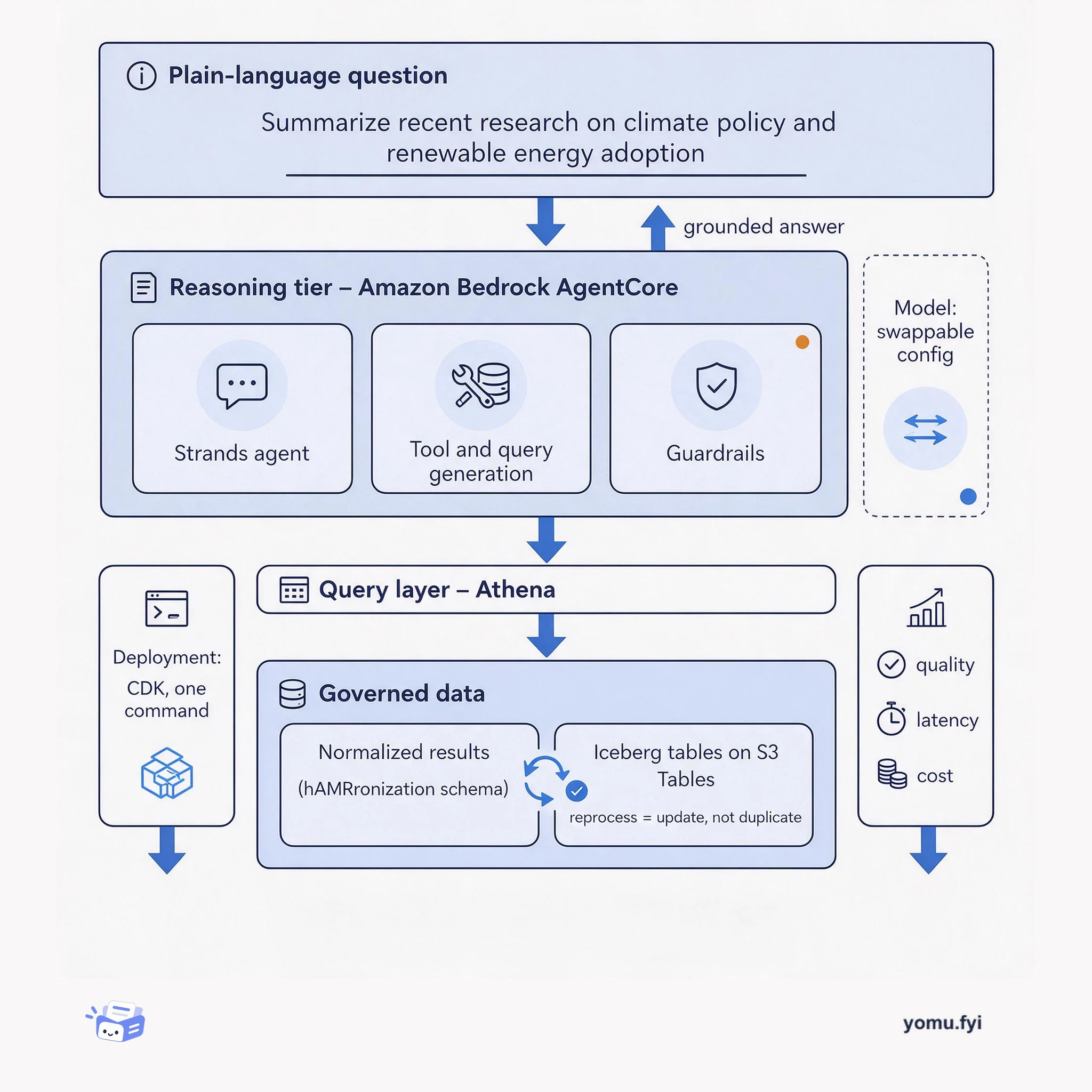
Amazon Bedrock is the managed reasoning tier in an agent architecture, not the whole system. This layered view shows the pipelines, governed tables, query layer, and guardrails around it.
The Good Stuff
Paid picks we use ourselves. Links carry a referral code — a subscription through one earns us a commission at no extra cost to you.
Newest first
Cloudflare Registrar introduced a redesigned domain search that shows every supported extension and responds progressively as the user types. The search gathers availability evidence from prepared datasets, DNS, and live registry checks, updating only changed results via WebSocket deltas. The system uses Workers, Durable Objects, and Workers KV on Cloudflare’s developer platform to coordinate more than 420 extension checks per query. The Registrar API beta now includes a sandbox for testing, transfer support, and an extensions endpoint with registry requirements. Agents can search, register, or transfer domains through the MCP or the newly launched cf CLI with natural-language prompts.
Cloudflare announced the Monetization Gateway closed beta, enabling domain owners to charge AI agents per request for websites, APIs, MCP tools, or datasets. The gateway uses the HTTP 402 Payment Required status code to allow inline payment without redirects or separate payment APIs. Sellers define pricing rules matching request parts and choose from several schemes, with settlement on the Base blockchain using USDC via Coinbase’s x402 Facilitator. Customer use cases include Cloudflare AI Gateway for inference, Ceramic.ai for web search, Stocktwits for stock signals, and API2PDF for document conversion. The beta is available to eligible U.S.-based sellers and buyers, with plans to support additional geographies and payment rails over time.
Cloudflare Containers have been rebuilt to meet the needs of agent sandboxes, which require on-demand creation, fast startup, and the ability to pause and resume. The new durable_object scheduling policy lets application code choose each sandbox’s image and instance type at runtime, replacing the previous deploy-time configuration. A redesigned runtime reduces median container startup from over four seconds to 648 milliseconds, and filesystem snapshots are available in public beta for saving and restoring workspaces. Each container retains its Durable Object as a persistent, programmable controller that manages its lifecycle and outbound traffic. These changes make Containers a more flexible complement to Workers and Durable Objects for agents needing a full Linux workspace.
More than half of Internet traffic is now automated, and AI agents are the fastest-growing part of it, with daily requests on Cloudflare’s network growing by more than 1,700% over the past year. This second audience consumes bandwidth without generating ad impressions or subscriptions, causing revenue per request to fall while costs rise. Cloudflare is giving site owners tools to see who is visiting, set terms per bot type, and charge for access. These include AI Crawl Control, Web Bot Auth for cryptographically verified agents, Disallow AI Training to block training without losing search indexing, and Pay Per Use to pay publishers when content is actually used. The goal is to build open standards so any site can set its terms and get paid, rather than a few companies controlling discovery and payment.
Stripe offers over 125 different payment methods globally, each requiring integrations that previously took up to six months because teams started from scratch. They hypothesized that reusable prompts with hardening could reduce effort, and a bake-off showed vanilla Claude Code took 20 days versus 4 days with their prompts. The resulting factory has created three new payment method integrations and migrated ten existing ones to a modern stack, reducing timelines from six months to two to six weeks. The factory also uses code-based orchestration, continuous knowledge loops where agents suggest prompt improvements, and agents testing their own code against sandbox environments. The factory’s approach has since been extended to Stripe’s tax and verification teams for building their own connectors.
MongoDB announced the public preview of Atlas Agent Engine, a secure platform for building, deploying, and governing AI agents with built-in memory, retrieval, and open flexibility to choose any LLM or framework. The company validated the platform internally with Holly, a unified agentic workspace that replaces seven disconnected tools for sales reps and is powered by Atlas Agent Engine’s runtime, orchestration, and governance. Compared to manually hopping between tools, Holly cuts the time to research and build an outbound prospecting list by roughly 95%, reducing account prep from hours to minutes. Atlas Agent Engine enforces centralized controls and governance while granting developer autonomy, addressing CIO fears about agents running amok in enterprise systems. It is part of a trio of launches alongside MongoDB 9.0 and Atlas Infinite, giving builders a governed platform to run agents grounded in real-time operational data.
At MongoDB.local NYC, MongoDB launched Atlas Agent Engine in Public Preview, providing a single foundation for building, deploying, and governing AI agents. Six global systems integrators—Accenture, Capgemini, Cognizant, Infosys, TCS, and Tech Mahindra—are launch partners, integrating the engine into their AI offerings. The platform is model- and framework-neutral, with partners like Arize AI offering trace monitoring for production reliability. MongoDB also announced Devin for MongoDB Modernizations, leveraging Cognition’s AI software engineer to automate legacy code migration while AMP handles data movement. New partnerships with Emergent, Monk.io, and Retool extend MongoDB’s reach into AI application development and internal tools, reinforcing that the agentic era requires an ecosystem of partners with industry expertise.
AI agents require precise context retrieval, not larger windows, and MongoDB’s new Rerank-3 and Rerank-3-lite models outperform Cohere Rerank v4.0 Pro by 2.14% and Qwen3-Reranker-8B by 3.31% overall, with greatest improvements on long documents and code. The $rerank native aggregation stage rescores candidate sets index-free within MongoDB, while Automated Embedding generates and refreshes vectors near-real-time to prevent model version drift. This unified platform eliminates separate vendors and external API calls, supporting lexical, vector, and hybrid search directly against operational data without moving or syncing. The result is simpler retrieval architecture that improved Gravity’s accuracy and cut latency by roughly 50% by better discriminating between strong and weak matches. Retrieval quality forms one layer of MongoDB’s broader agent platform, which also includes performance scaling with Atlas Infinite and agent memory with Atlas Agent Engine.
Notion built a Custom Agent workflow in Notion to keep Academy content current as product changes ship. The system uses two databases: an Academy library mapping the curriculum and a maintenance-tasks database tracking work from each product change. Two Custom Agents handle the work: the Academy Drift Agent compares launch docs against the library and flags affected lessons, while the Academy Drafting Agent drafts approved updates using editorial guidance. MCP connects the workflow to Parta, the e-learning platform, so approved content moves into final QA without manual hand-off. The loop includes human review checkpoints before scope approval and before content moves into Parta, reducing content drift and giving the team hours back each week.
Vision-language models enable production-scale video understanding, but building maintainable systems that combine ingestion, stream processing, event detection, retrieval, summarization, and reporting with services like Kafka, Redis, and Elasticsearch is challenging. The NVIDIA VSS Blueprint 3.3 introduces the Build Vision Agent skill, which composes multi-workflow applications from a single natural-language prompt using one of four Foundation profiles. It also adds Adaptive EVS, which prunes unchanged video patches via cosine similarity before VLM processing and batches tokens around events. Adaptive EVS cuts alert latency by 17%, delivers 80% fewer VLM input tokens for a 60-minute summary, and enables 46% more concurrent streams on the same GPU. These updates reduce development effort, infrastructure duplication, and operating costs, allowing a single prompt to build a bottling-line agent in under 30 minutes.
MCP agents can produce claims that are factually true but attributed to the wrong source, a failure known as cross-source conflation that source-blind checkers miss. ProvenanceGuard preserves source identity by decomposing answers into claims, routing each to its relevant tool output, and checking support and attribution separately, using local models like MiniLM and DeBERTa. On medical agent traces with 281 interactions, it caught 138 of 139 claims experts flagged, scoring 0.802 F1 on blocking decisions and correct source 86% of the time. It flagged 67 supported claims for review under a cautious policy and added roughly half a second per answer in local tests. Blocked answers can be fixed through a repair loop for rewriting or fallback, avoiding unverifiable responses while keeping sensitive traces in a controlled environment.
Cloudflare introduced Threat Signals, a free agentic skill layer for open-source threat intelligence available to every account. The product targets the unstructured-reporting problem: converting research posts into indicators that security tools can consume while preserving the context that explains their relevance. A skill encodes detailed instructions that capture how an experienced analyst handles one part of the job, and it runs identically on every report. The agentic skills summarize reports, surface key context, extract and normalize indicators of compromise, and apply tags within a private, account-scoped dataset. This approach standardizes analyst expertise into repeatable, context-preserving processing for threat reports.
The ClickHouse workload for Microsoft Fabric brings ClickHouse as a native acceleration layer for OneLake, now in public preview. It provisions dedicated ClickHouse Cloud services on Azure via the Fabric Extensibility Toolkit, using a ClickHouse item in the workspace. Users sync OneLake tables through ClickPipes as point-in-time snapshots with no ingestion charges. The embedded SQL console and external tools (Power BI, Copilot Studio, GitHub Copilot) can then query billions of rows with sub-second response times at high concurrency. Planned future features include write-back to OneLake, continuous sync, permission sync, and deeper Power BI integration.
Seer Agent, Sentry’s AI debugging assistant, now performs write actions through the Sentry API, such as setting up custom dashboards, creating monitors and alerts, and assigning, resolving, and archiving issues. It defaults to the user’s permission level and explicitly requests permission for tasks outside its write scope, with permissions not persisting beyond a single chat. The agent can also incorporate infrastructure data from external monitoring platforms like Datadog and Google Cloud Platform via Seer Connectors, using API keys instead of OAuth. This allows Seer Agent to diagnose issues by connecting front-end and back-end data beyond Sentry’s native scope. These updates evolve Seer Agent from a conversational rubber duck into a proactive debugging assistant that can act on behalf of users.
A Twilio research report identifies a 35-point satisfaction gap: 86% of brands believe their AI customer service satisfies customers, but only 51% of consumers agree. The discrepancy arises because companies measure metrics such as conversation completion surveys and containment rates, which systematically exclude abandoned or unresolved interactions. 71% of consumers abandon a conversation when the AI fails to recognize them, yet those exits rarely appear in satisfaction data. 49% of consumers say AI never resolved their issue. To close the gap, Twilio recommends tracking abandonment by conversation stage, resolution of the underlying issue across sessions, repeat contact within seven days, containment split by outcome, and escalation quality.
MongoDB announced the largest platform expansion yet, including MongoDB 9.0, Atlas Infinite, and Atlas Agent Engine. MongoDB 9.0 delivers up to 2x higher throughput, 35% faster reads, and 30% faster updates over version 8.0. Atlas Infinite is a new deployment option that allows storage and compute to scale independently, with time to scale more than 96% faster and each shard holding 10x more storage. Atlas Agent Engine provides built-in memory, retrieval, identity, and governance for production agents, operating on the same data platform as operational data. The company argues that as AI moves from generating answers to taking actions, the data layer must provide live, fresh, and retrievable operational data rather than separate AI infrastructure.
Agentic AI transforms the database from a passive record store into an active control point that serves real-time context and enforces policy at the moment an agent acts. According to IDC’s April 2026 survey of 715 organizations, 30% already run agentic AI in production and another 50% have established spending plans. Real-time data delivery is now baseline: 64.6% of enterprise use cases require real-time or near-real-time delivery, and 91.2% of streaming scenarios need end-to-end latency under 200 milliseconds. IDC identifies four requirements for agentic AI: a real-time operational foundation for unstructured data, elastic scale for bursty agent traffic, accurate always-current retrieval via integrated vector databases, and a governed runtime with durable memory and identity-bound policy. By 2029, IDC predicts 60% of enterprise data platforms will unify transactional and analytical workloads in hybrid processing architectures to power agentic AI.
Traditional OLTP systems like Postgres face challenges meeting the low-latency, high-accuracy search demands of AI agents, often requiring standalone search engines with ETL pipelines. Lakebase introduces lakebase_vector and lakebase_text, two extensions that bring scalable approximate nearest neighbor search and BM25 full-text search directly into Lakebase Postgres. lakebase_vector overcomes pgvector’s memory-bound HNSW index by using hierarchical IVF clustering and binary quantization, achieving 71-millisecond P99 latency at 97 percent recall on the 100-million-vector LAION benchmark. The extensions decouple storage from compute for pay-per-use scaling, enable fast parallel index builds, and support native hybrid search that fuses vector similarity with keyword relevance in a single SQL query. Early adopters like Conexiom reduced infrastructure costs by three times while achieving five times higher throughput, and the service is generally available on AWS and Azure.
Salesforce Marketing Cloud’s AI Delivery Lead Sohini Arya and team built Agent Designer, a system that automates the creation and testing of multi-agent AI teams. The orchestrator cannot write agent files itself; instead, seven specialist agents analyze architecture, failure modes, and compliance before the orchestrator synthesizes findings for human review. The system transforms an engineer’s request into a tested multi-agent team in 15-30 minutes, down from 2-4 hours manually, and helped approximately 200 engineers adopt the manager-of-agents model. Governance challenges included enforcing write-scope boundaries via prompts, reconciling independently produced design conflicts, and applying topology-specific budget formulas that account for flat, swarm, or team structures. Verifier agents return structured PASS/WARN/FAIL blocks, and self-healing is limited to two fix attempts and a $3 ceiling to prevent runaway repairs, with the orchestrator’s 500-turn budget divided across analysis, approval, generation, testing, and retries.
Cloudflare introduced cf, a new CLI that provides access to the entire Cloudflare API surface of over 3,000 operations, far exceeding Wrangler’s roughly 280 commands. Cf is designed primarily for AI coding agents, which account for nearly half of Wrangler usage, and defaults to JSON output with condensed formatting to minimize token consumption. The CLI includes a natural language search command, cf cli search, that helps agents discover the right operation without bloating context, and uses TypeScript-based configuration via cloudflare.config.ts for type safety. Cf is generated by Forge, Cloudflare’s internal pipeline that produces CLI commands from OpenAPI schema annotations, enabling consistent and comprehensive API coverage. The open beta is available globally via npm, and cf adopts Vite as its default local development server, with a migration path from Wrangler and maintenance support for 18 months after beta ends.
The best engineering reads, once a week.