How to Build an ASL Gloss Workflow That Keeps Context
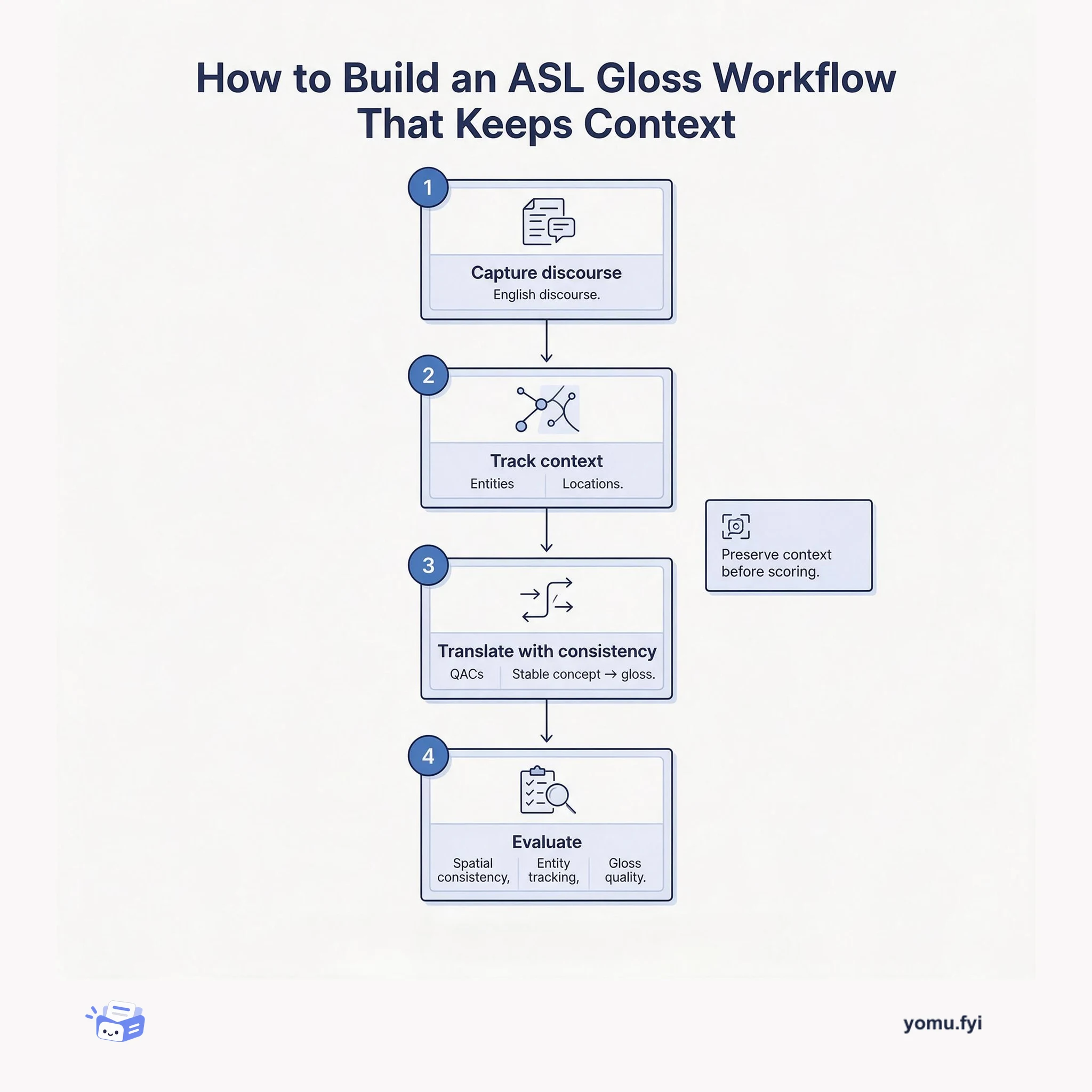
Learn a practical workflow for translating English discourse into ASL gloss while preserving spatial references, question-answer structure, and consistent concept-to-gloss mappings.
Loading…
Topic
465 posts about AI. Every summary links to the original.
See the idea
Learn a practical workflow for translating English discourse into ASL gloss while preserving spatial references, question-answer structure, and consistent concept-to-gloss mappings.
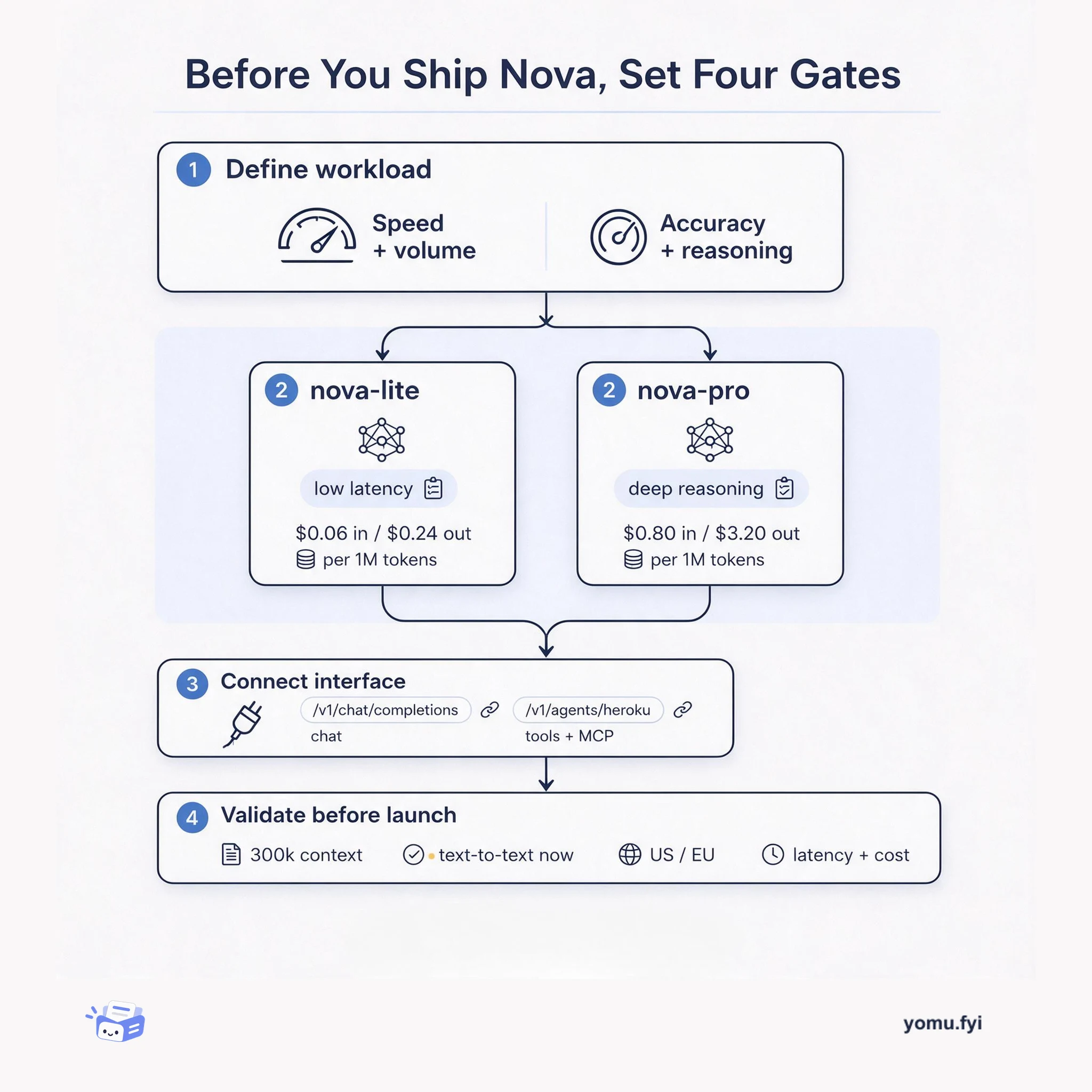
A practical checklist for putting Amazon Nova into an application: choose nova-lite or nova-pro by workload, expose tools, and verify context, modality, region, and cost constraints.
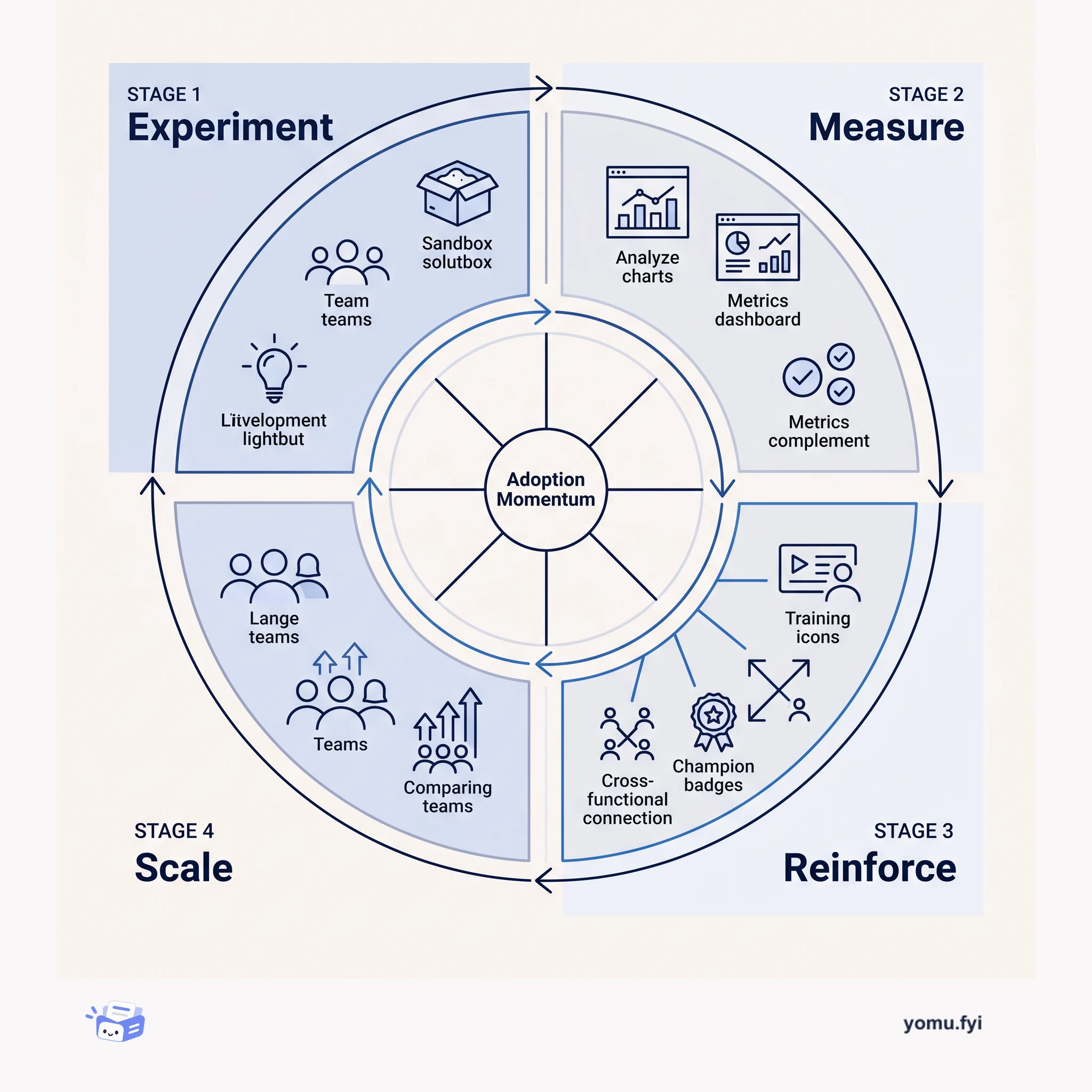
Adoption moves through experimentation, measurement, and reinforcement loops. Learn how leading companies build momentum from pilot programs into enterprise-wide habits and measurable business impact.
The Good Stuff
Paid picks we use ourselves. Links carry a referral code — a subscription through one earns us a commission at no extra cost to you.
Newest first
SK Telecom (SKT), Korea’s largest mobile operator, has become a commercial partner and strategic investor in Anthropic. The companies will develop a multilingual large language model customized for telecommunications applications such as customer service, marketing, sales, and interactive consumer experiences, with support planned for Korean, English, Japanese, Spanish, and more. Anthropic will fine-tune Claude using SKT’s telecommunications expertise: SKT experts will provide feedback on responses, and that feedback will help train industry-specific solutions. SKT has invested an additional $100 million in Anthropic, following an earlier investment by SK Telecom Venture Capital, while the companies describe the partnership as a way to promote AI innovation and develop safer, more reliable technology for telcos worldwide.
Anthropic announces a partnership with Zoom under which Zoom will use Claude, Anthropic’s AI assistant built with Constitutional AI, to develop customer-facing products centered on reliability, productivity, and safety. Zoom’s federated approach will combine its own technology with models including Claude to address diverse customer needs, with the first Claude integration planned for the Zoom Contact Center portfolio. There, Claude is intended to improve the end-user experience and support contact-center agent performance. Zoom Ventures has also invested in Anthropic, aligning the companies around customer-centric AI products grounded in trust and security and designed for real-world use. The announcement presents the collaboration as a way to bring robust, steerable AI into workplace applications.
Published in August 2026, this guide compares eight conversational AI platforms amid rapid market consolidation and acquisitions including NiCE’s roughly $955 million purchase of Cognigy. It defines the category as software for building, deploying, and operating agents across voice and messaging, then distinguishes vendor-managed services that own reasoning from infrastructure providers that carry conversations while teams own the reasoning. The evaluation criteria include model flexibility, voice and messaging parity, deployment control, cross-channel context, human handoff, pricing, and integration depth. Twilio is presented as an infrastructure layer for teams choosing their own models, with ConversationRelay, Agent Connect, Conversation Orchestrator, Conversation Memory, and Flex supporting channels, continuity, and escalation; other entries include Google Conversational Agents, Kore.ai, and NiCE Cognigy. The guide argues that portable models and conversation data will matter as the conversation layer separates from agent reasoning.
A $5 million grant program will fund independent research into how AI affects user wellbeing, offering direct funding, model access, and technical support for open-source evaluations. The initiative addresses the difficulty of judging wellbeing-related behavior, where risks may emerge only across long, shifting conversations and where otherwise reasonable advice can become harmful in a different context, such as disordered eating. Grantees will work independently and publish reusable evaluations or benchmarks, with guidance asking projects to define pass/fail criteria, involve clinical and subject-matter experts, test overcompliance and overrefusal, model realistic multi-turn scenarios, and validate graders against experts. Applications are due September 21, with selected full-proposal applicants notified by October 5.
Anthropic introduced the Anthropic Economic Index to track how AI is used in work and to study its effects on labor markets over time. Its first report analyzes approximately one million anonymized Free and Pro Claude.ai conversations, using Clio to match them with occupational tasks from the U.S. Department of Labor’s O*NET database. Usage concentrated in computer and mathematical work, which represented 37.2% of queries, while 36% of occupations showed AI use in at least a quarter of associated tasks and about 4% reached three-quarters. The report found 57% augmentation versus 43% automation, lower use in both low- and very-high-wage occupations, and plans for open data and repeated analyses, while noting possible classification errors and coding overrepresentation.
Anthropic is expanding its Economic Futures Programme to the UK and Europe to support research and policy discussions about AI’s effects on labor, productivity, and growth. The expansion begins with an Economic Futures Symposium at the London School of Economics and Political Science, where more than 100 experts and selected researchers will discuss policy proposals. Planned support includes research grants, API credits for UK and EU researchers, forums for evidence-based policy, and more granular data on European AI use. The Anthropic Economic Index reports that coding is Claude’s most common use across Europe, while UK usage most often supports academic research, writing, and educational content; Germany shows high per-capita use for manufacturing equipment, and France records four times the global average for dining, shopping, and nightlife information. Regular public releases will track adoption across European industries and regions as the programme seeks to inform decisions about the workforce transition.
The Anthropic Economic Futures Research Fund commits $200 million to external research on interventions that could help society prepare for AI’s economic impacts. It prioritizes five areas: workplace integration, support for AI-driven transitions, income support for displacement, worker stakes in AI-driven growth, and evidence on public investments. The fund will favor large-scale randomized controlled trials, ambitious pilots, and program evaluations, with particular interest in projects that share findings at key milestones and can scale rapidly if promising; typical awards will be $5 million to $30 million, with nothing below $1 million funded directly. Eligible applicants include accredited degree-granting institutions, independent research and policy organizations, and nonprofits with experience running field experiments at scale, while the fund remains global despite US-centric examples.
Anthropic’s second Economic Index report examines how Claude.ai usage changed after Claude 3.7 Sonnet launched, using 1 million anonymized Free and Pro conversations from the following 11 days. Clio maps conversations to 17,000 tasks in the U.S. Department of Labor’s O*NET database, enabling comparisons across occupations and interaction modes, while the report also introduces a 630-category bottom-up taxonomy. Coding, education, and science usage increased modestly, and extended thinking appeared most often in technical and creative work, including computer science research, software development, multimedia art, and video game design. Augmentation remained 57% of usage, learning interactions rose from about 23% to 28%, and the report releases task- and occupation-level datasets covering thinking mode and augmentation-versus-automation patterns.
The Anthropic Economic Index connector for Claude makes the Index’s data available for direct question-and-answer exploration. The Index measures how AI is used in the economy, including occupations, geographic usage, and the tasks people perform or automate with Claude. Users enable the connector from the claude.ai connectors directory, without installing anything, then can ask broad or specific questions and request the underlying data behind an answer. Responses are grounded in Index data, but the source cautions that it reflects Claude usage patterns rather than the labor market as a whole; the full datasets remain freely available on the website for further exploration.
Meta has designed MetaRoCE, a clean-sheet RDMA transport for AI workloads running on commodity Ethernet, targeting clusters that can reach million-GPU scale. Unlike standard RoCE, it treats packet loss and out-of-order delivery as normal: packets are sprayed across NIC-managed paths, written directly to their destinations, and retransmitted selectively without PFC or reorder buffers. It combines per-path telemetry and congestion windows with ECN-based sender control and receiver-driven fair-share hints, while a single connection supports multiple ordered streams and paths. On a 64-node AMD GPU cluster using RCCL collectives, Meta reports higher throughput and lower flow-completion times than RoCEv2, about 86% throughput at 1% packet loss, linear scaling across four- and eight-plane topologies, and autonomous recovery from plane failures. Meta is contributing the specification, reference implementation, and compliance suite to OCP, with a broader release planned for October at the 2026 OCP Global Summit.
MTIA 300 is Meta’s first in-house training and inference accelerator optimized for ranking and recommendation models. These workloads require frequent AllReduce, AllToAll, and AllGather operations because embedding tables can contain over 99% of model parameters, making communication a bottleneck that competes with computation on GPUs. Its package-integrated network uses two chiplets with twelve custom 800 Gbps RDMA NICs, while 16 message engines and near-memory compute handle collectives independently of the 12×6 processing-element grid. Co-designed HCCL compiles collectives into dependency-aware subgraphs for autonomous execution, with topology-aware algorithms spanning scale-up and scale-out links. In production, HCCL reaches up to 940 GB/s within a rack, and a 150-billion-parameter model across 40 accelerators completed communication 3.9 times faster than an equivalent GPU cluster; concurrent GEMMs degraded less than 0.5%.
Claude Fable 5’s biology safeguards have been updated to reduce false positives that reroute biology-related requests to Opus 5. In testing, the change reduced biology-related fallbacks by about 85% across product surfaces, expanding support for everyday health and educational questions and some clinical tasks. The update followed a rewrite of the classifier’s constitution, feedback from internal and external experts, new training data, and retraining, with verification that harmful and dual-use biology content would still trigger it. Fable 5 still blocks dual-use professional biology and drug-development queries, including virology, toxicology, and molecular design, while trusted access pathways are being developed for frontier research.
AWS released ExtendDB, an open source adapter that lets DynamoDB workloads use pluggable storage backends, enabling them to run outside AWS. MongoDB built a storage backend for ExtendDB, allowing DynamoDB workloads to run on MongoDB anywhere, including on-premises and air-gapped environments, without changing application code. The backend maps DynamoDB concepts like partition keys, secondary indexes, transactions, and streams to MongoDB primitives, with tradeoffs such as handling numeric precision differences in the Rust layer. The project began as a hackathon experiment where an engineer used Claude Code to prototype the backend, which quickly produced a working component, then required several weeks of partnering with AWS to merge. The post emphasizes that AI changed the economics of such experiments, enabling the idea to move from thought to implementation quickly, and the backend is now available as open source.
This webinar addresses the gap between impressive voice AI demos and reliable production deployments, focusing on global rollout barriers such as spam-flagged outbound calls, legal delays, latency, and custom integration work. It presents Twilio Voice and AI through the Guinness Price Index case, alongside reported examples from Docplanner and audibene, whose use of the Twilio platform is said to halve costs, double booking efficiency, and improve inbound reachability by 30 percent. A developer demonstration shows how Twilio Skills and an AI coding agent configure an initial setup, while an open-standard Model Context Protocol (MCP) Server and Twilio Agent Connect SDK replace growing custom glue code. It also covers Conversation Relay for real-time audio, Conversation Memory and Conversation Orchestrator for AI-to-human handoffs, and connections to privately hosted models to retain cloud and roadmap control. The session frames compliance, privacy, personalisation, and vendor lock-in as operational concerns in scaling voice AI.
Banks face a merchant identity gap: transaction descriptors from acquirers (e.g., SBUX) often don’t match customer search terms (e.g., “Starbucks” or “星巴克”) due to script differences, colloquial aliases, and cross-subsidiary naming inconsistencies. This gap inflates support costs, degrades spend categorization, and undermines personalized financial management and AI advisors. The solution uses a semantic resolution architecture on MongoDB storing a master merchant catalog with canonical names, aliases, and vector embeddings. An escalating pipeline applies fuzzy matching, semantic vector search with Voyage AI embeddings and MongoDB Vector Search, and gen AI write-back to resolve unknown descriptors and enrich the catalog. With canonical identities indexed, customers search in their own language, and institutions power conversational AI that accurately answers queries like “How much did I spend at Starbucks last month?” across markets.
Six Indian organizations are using MongoDB Atlas to move AI projects from prototype to production at scale. Emergent Labs built a platform for non-programmers to create applications via natural language prompts, powering nearly 12 million apps. Zomato’s AI customer support platform Nugget improved human-agent efficiency by 40% within four months. Leena AI uses MongoDB Atlas to handle high-volume employee queries in real-time across 500 enterprises. Brahma AI relies on MongoDB as a unified data foundation for its enterprise content management and AI creation platform. These organizations cite MongoDB’s flexible document model, built-in search and vector capabilities, and scalability as key enablers for their AI workflows.
DeepSeek V4 Pro 0813 costs $0.24 per rollout and achieves 62.8% pass@1 on DeepSWE, while GPT-5.6 Sol reaches 72.7% pass@1 at $8.37 per rollout—a 35x price gap. At four attempts, DeepSeek V4 Pro 0813 surpasses Sol, with 88.5% pass@4 versus 85.8%. Sol is faster and more reliable, completing a rollout in 17 minutes and 53 steps, and breaking tests in only 11% of its failures. A cascade strategy—running DeepSeek V4 Pro 0813 first and escalating to Sol on test failure—solves 83.0% of tasks at $3.35 each, outperforming either model alone. Per $100, DeepSeek V4 Pro 0813 solves 260 tasks versus Sol’s 9, making it the value leader for budget-constrained workloads.
The tutorial addresses wasted patient time in telehealth waiting rooms by adding an AI voice assistant to a Twilio Video room for intake collection. It combines Twilio Programmable Video, Conversation Relay, and an LLM, with the assistant joining as an audio-only participant and handling questions about visit reasons, symptoms, and medications. A two-leg Voice call bridges the room to Conversation Relay: one leg participates in the room, while the other sends transcribed audio to a WebSocket server and returns spoken LLM responses. The tutorial uses Node.js, Express, the Twilio helper library, OpenAI, ws, dotenv, and ngrok, and explains setup, browser interaction, and troubleshooting. Its stated result is a working application in which a patient converses naturally with the AI before a provider joins, with GPT-4o-mini processing speech.
Enterprise intelligence requires more than the plausible answers produced by general-purpose LLMs: it needs accurate insights from vast real-world brand data, supported by statistics, governance, and domain expertise. LLMs can hallucinate, miss context, produce inconsistent answers, and rely on limited, non-randomly sampled sources, making them unsuitable as the sole basis for high-stakes decisions. The article argues for matching technologies to tasks, using statistical models for quantitative problems such as social and online-news Reach, specialized classifiers for other tasks, and generative AI to synthesize model outputs. At enterprise scale, crisis and reputation use cases also demand near-real-time speed, consistency, predictability, explainability, auditability, monitoring, and bias testing. LLMs still have a role, including as orchestrators grounded in high-quality data, workflows, specialized models, and rigorous evaluation; the proposed future combines varied models rather than choosing between LLMs and traditional AI.
Grok 4.6, released with SpaceXAI, is presented as a model for long-running agents and ambitious interactive, visual, coding, and knowledge-work tasks. It builds on Grok 4.5 through a longer supplemental training run using curated model-generated reasoning and technical data, an improved optimizer and training recipe, regenerated SFT trajectories, model-based filtering, and agentic reinforcement-learning tasks across several environments. The release says Grok 4.6 matches GPT-5.6 Sol on the Artificial Analysis Intelligence Index and reports stronger first passes, sustained multi-step work, self-testing, and iterative refinement for working projects. It is available in Cursor, Grok Build, the SpaceXAI API, and through OpenRouter, Vercel, and Cloudflare, with pricing from $2 per million input tokens and $6 per million output tokens, while a fast variant costs twice as much.
The best engineering reads, once a week.