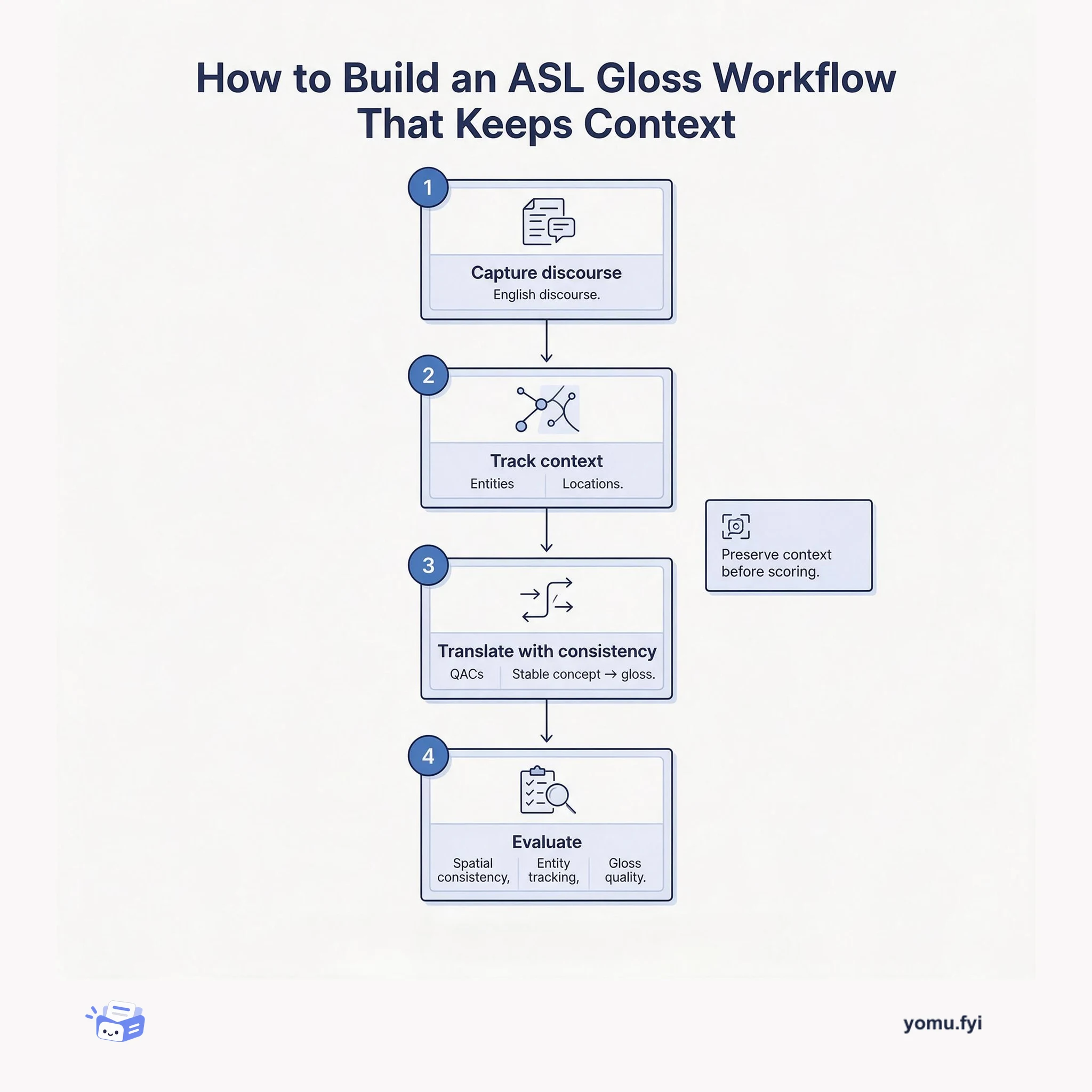
How to Build an ASL Gloss Workflow That Keeps Context
Learn a practical workflow for translating English discourse into ASL gloss while preserving spatial references, question-answer structure, and consistent concept-to-gloss mappings.
Loading…
Topic
470 posts about AI. Every summary links to the original.
See the idea
Learn a practical workflow for translating English discourse into ASL gloss while preserving spatial references, question-answer structure, and consistent concept-to-gloss mappings.
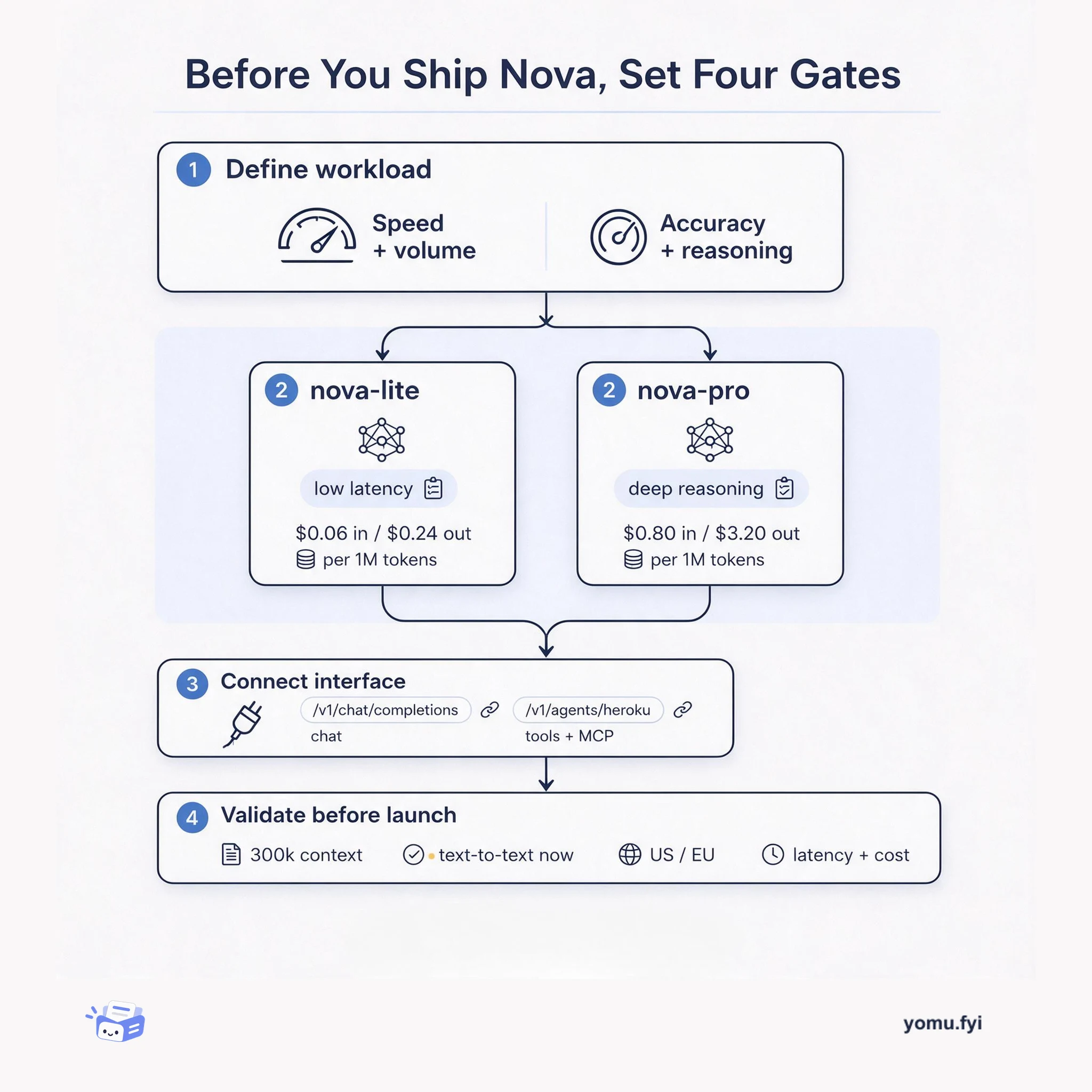
A practical checklist for putting Amazon Nova into an application: choose nova-lite or nova-pro by workload, expose tools, and verify context, modality, region, and cost constraints.
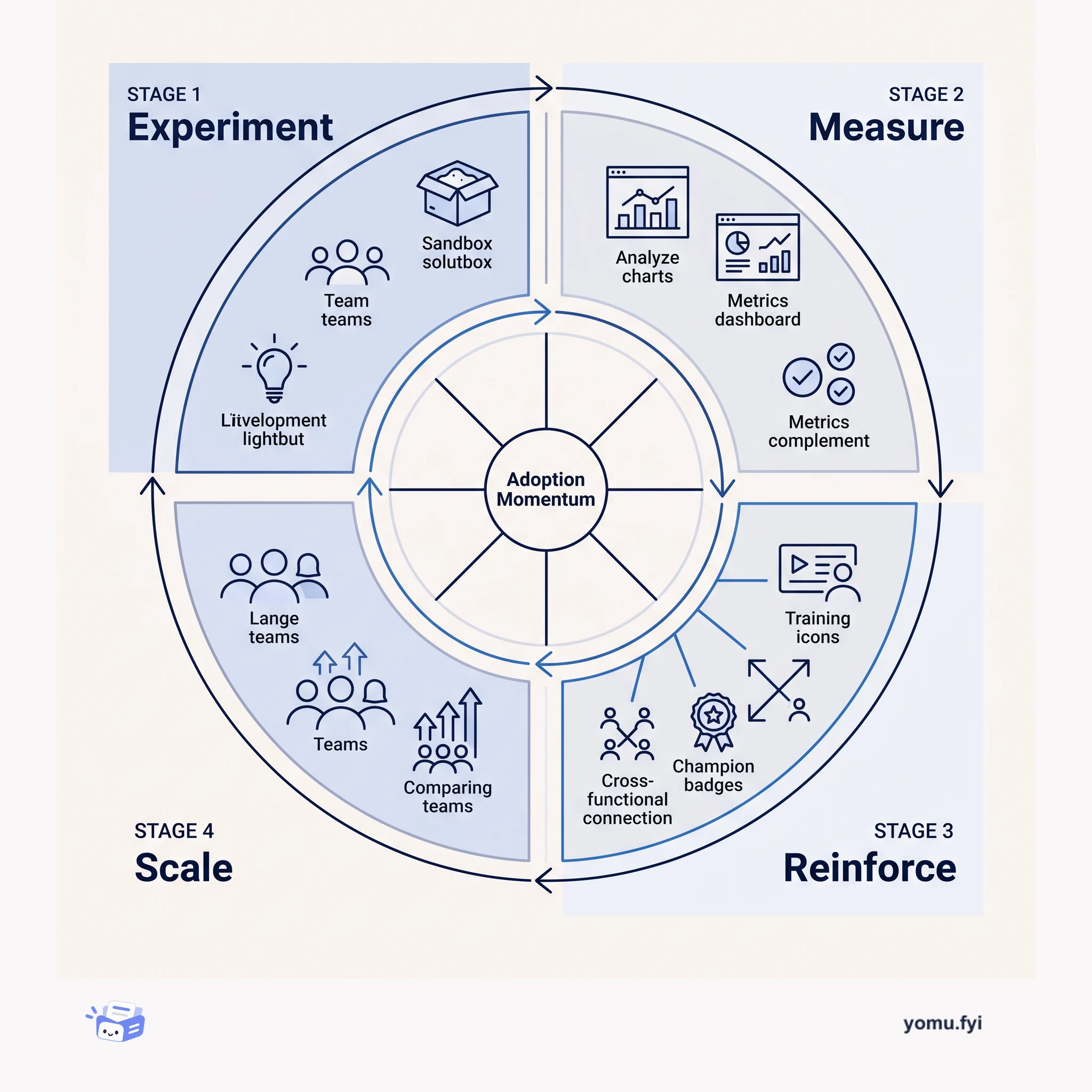
Adoption moves through experimentation, measurement, and reinforcement loops. Learn how leading companies build momentum from pilot programs into enterprise-wide habits and measurable business impact.
The Good Stuff
Paid picks we use ourselves. Links carry a referral code — a subscription through one earns us a commission at no extra cost to you.
Newest first
Six Indian organizations are using MongoDB Atlas to move AI projects from prototype to production at scale. Emergent Labs built a platform for non-programmers to create applications via natural language prompts, powering nearly 12 million apps. Zomato’s AI customer support platform Nugget improved human-agent efficiency by 40% within four months. Leena AI uses MongoDB Atlas to handle high-volume employee queries in real-time across 500 enterprises. Brahma AI relies on MongoDB as a unified data foundation for its enterprise content management and AI creation platform. These organizations cite MongoDB’s flexible document model, built-in search and vector capabilities, and scalability as key enablers for their AI workflows.
DeepSeek V4 Pro 0813 costs $0.24 per rollout and achieves 62.8% pass@1 on DeepSWE, while GPT-5.6 Sol reaches 72.7% pass@1 at $8.37 per rollout—a 35x price gap. At four attempts, DeepSeek V4 Pro 0813 surpasses Sol, with 88.5% pass@4 versus 85.8%. Sol is faster and more reliable, completing a rollout in 17 minutes and 53 steps, and breaking tests in only 11% of its failures. A cascade strategy—running DeepSeek V4 Pro 0813 first and escalating to Sol on test failure—solves 83.0% of tasks at $3.35 each, outperforming either model alone. Per $100, DeepSeek V4 Pro 0813 solves 260 tasks versus Sol’s 9, making it the value leader for budget-constrained workloads.
The tutorial addresses wasted patient time in telehealth waiting rooms by adding an AI voice assistant to a Twilio Video room for intake collection. It combines Twilio Programmable Video, Conversation Relay, and an LLM, with the assistant joining as an audio-only participant and handling questions about visit reasons, symptoms, and medications. A two-leg Voice call bridges the room to Conversation Relay: one leg participates in the room, while the other sends transcribed audio to a WebSocket server and returns spoken LLM responses. The tutorial uses Node.js, Express, the Twilio helper library, OpenAI, ws, dotenv, and ngrok, and explains setup, browser interaction, and troubleshooting. Its stated result is a working application in which a patient converses naturally with the AI before a provider joins, with GPT-4o-mini processing speech.
Enterprise intelligence requires more than the plausible answers produced by general-purpose LLMs: it needs accurate insights from vast real-world brand data, supported by statistics, governance, and domain expertise. LLMs can hallucinate, miss context, produce inconsistent answers, and rely on limited, non-randomly sampled sources, making them unsuitable as the sole basis for high-stakes decisions. The article argues for matching technologies to tasks, using statistical models for quantitative problems such as social and online-news Reach, specialized classifiers for other tasks, and generative AI to synthesize model outputs. At enterprise scale, crisis and reputation use cases also demand near-real-time speed, consistency, predictability, explainability, auditability, monitoring, and bias testing. LLMs still have a role, including as orchestrators grounded in high-quality data, workflows, specialized models, and rigorous evaluation; the proposed future combines varied models rather than choosing between LLMs and traditional AI.
Grok 4.6, released with SpaceXAI, is presented as a model for long-running agents and ambitious interactive, visual, coding, and knowledge-work tasks. It builds on Grok 4.5 through a longer supplemental training run using curated model-generated reasoning and technical data, an improved optimizer and training recipe, regenerated SFT trajectories, model-based filtering, and agentic reinforcement-learning tasks across several environments. The release says Grok 4.6 matches GPT-5.6 Sol on the Artificial Analysis Intelligence Index and reports stronger first passes, sustained multi-step work, self-testing, and iterative refinement for working projects. It is available in Cursor, Grok Build, the SpaceXAI API, and through OpenRouter, Vercel, and Cloudflare, with pricing from $2 per million input tokens and $6 per million output tokens, while a fast variant costs twice as much.
Grab Bench is a configurable evaluation harness for assessing AI systems on production-shaped work where plausible outputs can violate metric definitions, tool contracts, evidence boundaries, or hidden code invariants. It uses YAML configuration, task plugins, provider and modality checks, row-level records, model summaries, and deterministic scorers or LLM judges according to each task. Synthetic or redacted cases preserve production-relevant difficulty while protecting live data; profile reasoning requires ontology-valid JSON claims and faithful evidence IDs, while coding tasks exercise hidden tests and anti-gaming checks. The harness also records tokens, latency, skip reasons, configurations, and failure tags so teams can diagnose whether errors reflect unsupported claims, parameter drift, hidden invariants, cost, or capability gaps. It concludes that synthetic evaluations test contract adherence under controlled pressure but do not establish production uplift.
Cursor Router selects models for developer turns using production behavior rather than benchmark scores, balancing user satisfaction and cost. Its routing system first uses Compass, a continuous 0-to-1 complexity predictor trained on follow-up behavior, to keep simple turns on a price-efficient model or upgrade complex ones. Then a taxonomy of domains, tasks, and modifiers compares frontier-model strengths, while an optimizer applies a one-sided 75% uplift threshold and each mode's cost budget. The dataset contains hundreds of thousands of live Cursor turns, preserving conversation signals, model-switching effects, inferred performance from subsequent user actions, and token-based costs including cache misses. Current results report Auto Intelligence at above Fable-level satisfaction with 68% lower cost, and Auto Balance outperforming Opus 4.8 at 41% lower cost while raising satisfaction by 3%.
On the DeepSWE coding benchmark, GPT-5.6 Luna achieves 67.2% pass@1 versus DeepSeek-V4 Flash’s 53.3%, a 14-point gap. DeepSeek costs $0.10 per task, roughly six times less than Luna’s $0.61, delivering 532 solves per $100 versus Luna’s 110. A cascade that runs DeepSeek first and escalates only on failure solves 78.9% of tasks at $0.385 each, beating Luna’s solo accuracy and cutting cost by 37%. DeepSeek fails more gracefully (9% broken tests vs 15%) but is slower and dramatically weaker on JavaScript (35% vs 60%). Luna dominates seven of eight task domains, while DeepSeek leads only on query and config languages, illustrating how inexpensive models can combine with flagships for superior price-performance.
Mariano-Florentino (Tino) Cuéllar will join Anthropic as its first Chief Global Affairs Officer, leading policy, strategic international engagement, and government relationships worldwide. He brings experience spanning law, technology, international security, and public institutions, including the presidency of Carnegie Endowment, a California Supreme Court justice role, Stanford leadership, and service on federal advisory boards. Cuéllar has also co-led California’s Frontier AI Working Group and organized artificial intelligence classes at Stanford Law School nearly a decade ago. He stepped down as a Trustee of Anthropic’s Long-Term Benefit Trust, a position he held since January 2026, to join the company; Anthropic says he will help engage governments, civil society, and communities on AI’s risks, opportunities, and democratic governance.
Early-stage startups face a crowded software market and limited budgets, making technology selection a question of leverage rather than completeness. The guide proposes three selection principles: choose tools that scale with usage, integrate with the existing stack, and solve a clearly defined problem. It then recommends Stripe for payments, Slack for collaboration, Granola for meeting notes, Fin and Intercom for customer service, Linear for planning, Datadog for observability, MongoDB for data, Rippling for workforce administration, and Apollo for outbound sales and CRM. The examples emphasize operational coverage, from Stripe’s subscriptions and MongoDB’s flexible schema to Fin’s stated ability to resolve up to 76% of support conversations. The Fin Startup Pack is presented as a way to reduce adoption costs through partner credits and discounts, including more than $500,000 in credits and specified offers for each recommended tool.
Claude for Nonprofits launches with GivingTuesday to help nonprofit organizations address limited resources while fitting AI into existing workflows and meeting community privacy expectations. The program offers discounts of up to 75% on Team and Enterprise plans, including Claude Opus 4.6, Sonnet 4.5, and Haiku 4.5, with plan capabilities and intended organization sizes described in the announcement. It also adds open-source connectors for Benevity, Blackbaud, and Candid, linking Claude to nonprofit and fundraising data and searches. A free, no-background course, AI Fluency for Nonprofits, offers instruction on grant writing, program evaluation, donor engagement, and efficiency. Pilot partnerships with more than 60 grantee organizations and customer examples are being used to learn how nonprofits can apply Claude to impact analysis, fundraising, documentation, and operational work.
Together AI announces a strategic partnership with Moonshot AI to serve Kimi models as a launch platform, beginning with Kimi K3 and extending to future open-weights releases. Kimi K3 is described as a 2.8-trillion-parameter sparse Mixture-of-Experts model with native vision and a 1M-token context window, using Kimi Delta Attention, Attention Residuals, per-head Muon, and quantile-based expert load balancing. Together says developers can access the models through Serverless, Provisioned Throughput, and Dedicated Inference, with US-hosted infrastructure, zero data retention, autoscaling, and a 99% uptime SLA for Provisioned Throughput. The partnership also supports post-training through full-weight and LoRA reinforcement learning and supervised fine-tuning, with checkpoints deployable directly to inference; Kimi K3 is available at launch, while future Moonshot releases are planned for the same platform.
Anthropic CEO Dario Amodei states that Anthropic has never advocated banning open-weights models, while distinguishing models without dangerous capabilities as a public good from risks associated with sufficiently capable systems. The post identifies two concerns: authoritarian governments gaining military superiority or enabling repression, and powerful models being misused for cyberattacks, biological attacks, or serious alignment problems. It argues open weights can increase misuse risk because guardrails and monitoring are difficult after release, but says banning their use by US businesses would not address bad actors. Instead, Amodei supports restricting powerful chips and chipmaking equipment exports to China, disrupting industrial-scale distillation, and requiring global pre-release safety testing for sufficiently capable open and closed models. He agrees open weights can expand access, competition, and customer control, but says claims about safeguards should be tested empirically.
Anthropic is expanding its partnership with Cognizant, a technology services company, to deploy Claude more broadly across enterprise work. Cognizant is embedding Claude in its business and engineering platforms, scaling a Claude-certified workforce through its Frontier Certified model, and becoming a Global Premier Partner in the Claude Partner Network. Its Flowsource platform runs Claude Code alongside engineers in a Spec-Driven Development module, directing outputs with project specifications, coding standards, and architectural blueprints before evaluating them for production. The company reports more than 30,000 associates have completed Claude training and describes client deployments including a contract-intelligence system that cut review time by up to 40% and raised extraction accuracy above 88%, plus a risk-navigation tool that saves underwriters roughly eight hours a week. The collaboration combines Cognizant’s industry context, engineering scale, and delivery capabilities with Claude for production enterprise use.
Claude Opus 5 is available as a new model positioned near the frontier intelligence of Claude Fable 5, at half its price, while remaining behind Mythos 5 on cybersecurity tasks. Reported results show state-of-the-art performance on coding and knowledge-work evaluations, including Frontier-Bench, alongside strong results on ARC-AGI 3, Zapier AutomationBench, and OSWorld 2.0. The model uses configurable effort settings to trade intelligence for token use, speed, and cost, and is described as stronger at verifying work, iterating, and handling long agentic tasks. It costs $5 per million input tokens and $25 per million output tokens, with Fast mode running about 2.5 times faster at twice the base price. Safeguards allow vulnerability finding while blocking binary-based scanning, penetration testing, and exploit generation, with flagged requests able to fall back to Opus 4.8.
Claude Opus 4.7 is generally available as an upgrade to Opus 4.6, with stated gains in advanced software engineering, difficult long-running tasks, instruction following, self-verification, and higher-resolution vision. The announcement reports benchmark and tester results including a 13% resolution increase on a 93-task coding benchmark, a 0.715 tie for top score across six research-agent modules, and 90.9% on BigLaw Bench at high effort. It also describes safeguards that detect and block prohibited or high-risk cybersecurity requests, while legitimate security professionals can apply to the Cyber Verification Program. The model is offered across Claude products, its API, Amazon Bedrock, Vertex AI, and Microsoft Foundry at $5 per million input tokens and $25 per million output tokens. New controls include xhigh effort, task budgets, Claude Code’s /ultrareview, and auto mode, while migration may increase token counts because of tokenizer and reasoning changes.
Claude Haiku 4.5, the latest small model, is available to all users, offering a new option for near-frontier performance with lower cost and greater speed. Compared with Claude Sonnet 4, it delivers similar coding performance at one-third the cost and more than twice the speed, while surpassing Sonnet 4 on some computer-use tasks. Priced at $1/$5 per million input and output tokens, the model targets real-time assistants, customer service agents, pair programming, Claude Code workflows, and sub-agent orchestration, where Sonnet 4.5 can plan and delegate parallel subtasks to multiple Haiku 4.5 instances. Safety evaluations found low rates of concerning behavior and greater alignment than Haiku 3.5; the model is released under ASL-2 and is available through Claude apps and Code, the API, Amazon Bedrock, and Google Cloud’s Vertex AI.
Cursor is launching Cursor Router, a model-routing system for Teams and Enterprise plans that automatically selects a model for each coding request to target frontier-quality results at lower cost. It classifies requests using query, context, task complexity, domain, and model behavior, trained on more than 600,000 live requests and optimized for user satisfaction (AFC); the classifier is cache-aware and designed for frequent model updates. In online A/B testing across millions of requests, the company reports frontier-quality performance at 60% savings, while early-access accounts saved 30%–50% versus routing all traffic at Opus 4.8 API rates without a quality decrease. Three modes—Intelligence, Balance, and Cost—let teams choose a cost-intelligence tradeoff, with administrators controlling defaults, availability, and allowed models across supported Cursor clients.
Anthropic’s AI for Science program is accepting applications for a rare genetic disease research call, offering accepted applicants up to $50,000 in Claude credits over six months across two tracks: basic science and early-stage biotechnology. The basic-science track focuses on collaboration and mechanism discovery, including work with the Monarch Initiative’s Mondo Disease Ontology, Monarch Knowledge Graph, and agent-friendly DisMech library. The biotech track targets faster therapeutic development through regulatory documentation, modality and target analysis, biomarker discovery, and potential basket-trial strategies. Applications are open through August 2, 2026, at 11:59 PM PST, and projects may use Claude Opus or other approved generally available biology models.
Anthropic is committing $10 million CAD to Canadian research institutions to support beneficial and responsible AI applications, building on Canada’s contributions to neural networks, deep learning, and reinforcement learning. The announcement names partnerships with Amii, Mila, Vector, CHEO, CAMH, Université Laval, University of Toronto, and the University of Saskatchewan, with Claude credits supporting work spanning trust and safety, health, scientific discovery, mental health, robotics, sustainability, and public services. Amii, Mila, and Vector will also join Anthropic’s for Startups program, providing affiliated Canadian startups with at least $5,000 USD each in API credits. A Canadian country brief based on the March 2026 Anthropic Economic Index reports that Canada ranks eighth in Claude.ai use, accounts for 2.6% of global consumer use, and ranks second by per-capita adoption; usage is highest in British Columbia and closely follows professional, scientific, and technical employment.
The best engineering reads, once a week.