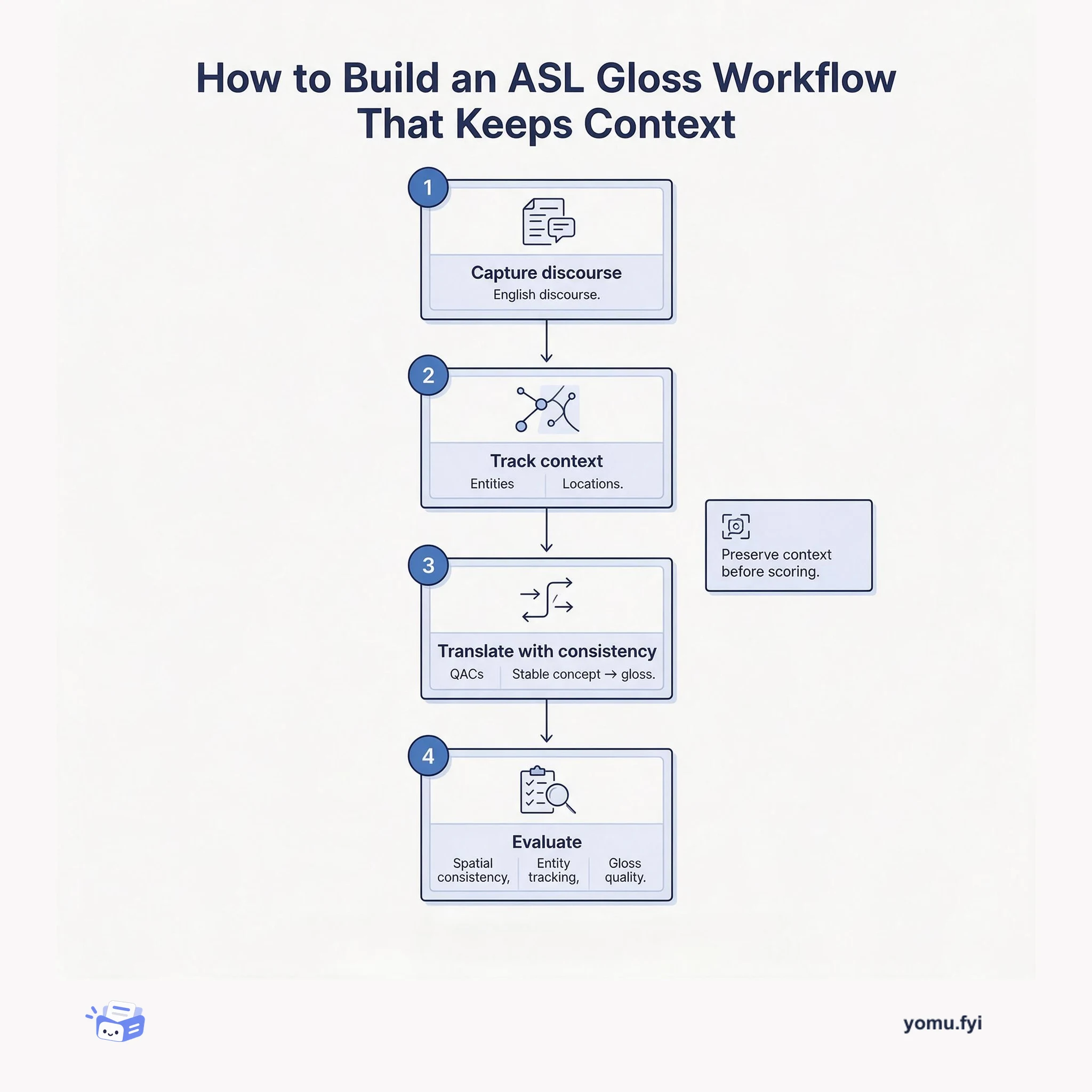
How to Build an ASL Gloss Workflow That Keeps Context
Learn a practical workflow for translating English discourse into ASL gloss while preserving spatial references, question-answer structure, and consistent concept-to-gloss mappings.
Loading…
Topic
483 posts about AI. Every summary links to the original.
See the idea
Learn a practical workflow for translating English discourse into ASL gloss while preserving spatial references, question-answer structure, and consistent concept-to-gloss mappings.
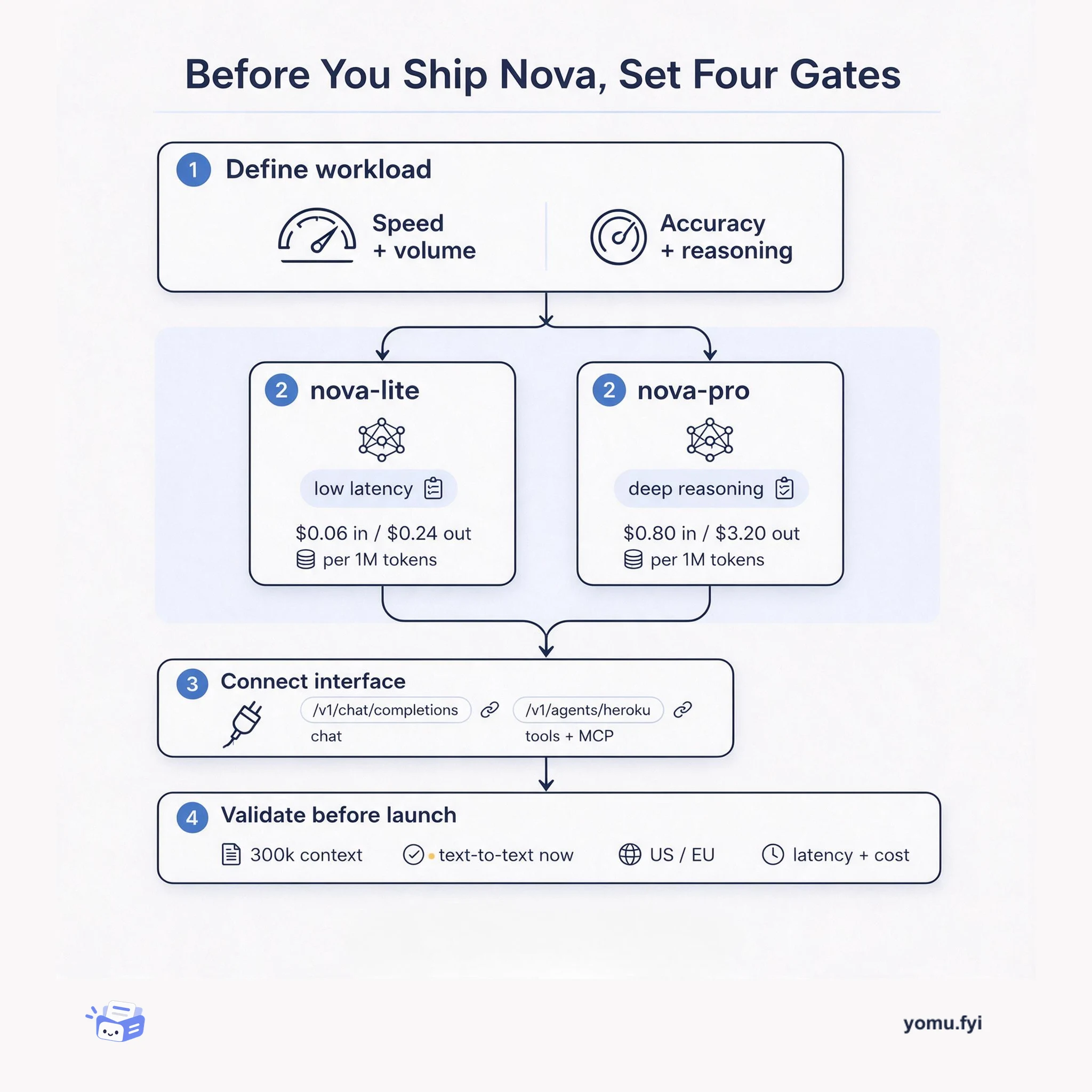
A practical checklist for putting Amazon Nova into an application: choose nova-lite or nova-pro by workload, expose tools, and verify context, modality, region, and cost constraints.
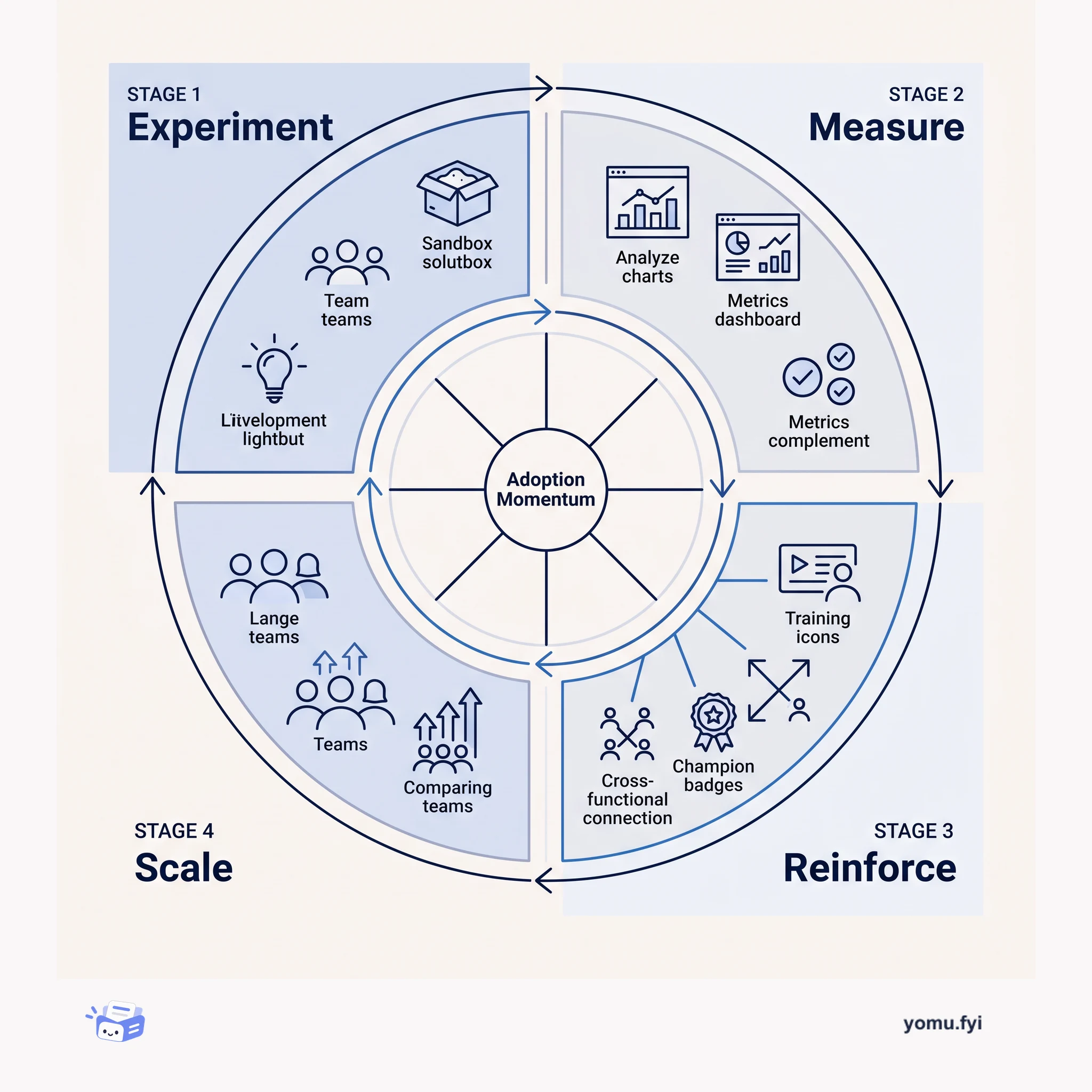
Adoption moves through experimentation, measurement, and reinforcement loops. Learn how leading companies build momentum from pilot programs into enterprise-wide habits and measurable business impact.
The Good Stuff
Paid picks we use ourselves. Links carry a referral code — a subscription through one earns us a commission at no extra cost to you.
Newest first
AI factories combine GPUs, CPUs, switches, DPUs, and SuperNICs with schedulers and security controls, making validation before hardware arrival critical. NVIDIA DSX Air provides a node-based digital twin that models hardware topology and software stack, allowing teams to validate supported configurations in a safe environment before production. AI agents interrogate the twin, run supported configuration and security checks, compare results with organizational policy, and produce evidence-based reports. The simulation supports Day 0 through Day 2 operations and integrates with NVIDIA Brev for on-demand GPU compute to run AI services like Video Search and Summarization. This governed automation model uses human-in-the-loop gates to ensure agents explore in the sandbox while production changes require approval, enabling continuous improvement.
The Technology Innovation Institute in Abu Dhabi released Falcon-ASR, a 1.6 billion parameter speech recognition model focused on Arabic, especially the Emirati dialect, while also supporting English, French, Spanish, and Portuguese. On the Open Universal Arabic ASR Leaderboard, Falcon-ASR achieved a 20.92% average word error rate across six test sets, outperforming the best published average of 23.17% in the reference snapshot. The model recorded a 22.73% word error rate and 10.19% character error rate on an internal Emirati evaluation, 4.07% better in word error rate than the next best system compared. Training data included background noise, overlapping speech, music, reverberation, telephony effects, speed, and pitch variations to handle diverse recording conditions. Falcon-ASR builds on the Falcon3-Audio architecture and provides word-level timestamps linking transcribed words to audio positions.
Red Hat’s emerging technologies team built IdeaBot, an AI-enabled SaaS platform on OpenShift that automates innovation workflows from initial concept to a standardized idea report. The platform guides users through four stages—discovery, research, refinement, and synthesis—using conversational interviews, automated research across internal and external sources, a curation board with confidence scoring, and a synthesis view that compiles deliverables like executive summaries and market analysis. Security enforces session isolation in dedicated pods, credential isolation through an auth proxy and token service that injects short-lived tokens, and stateless compute with PostgreSQL persistence and a warm pod pool to reduce cold starts. Development uses EARS syntax and Gherkin feature files to drive behavior-driven development, enabling automated test generation and reproducible builds. Red Hat plans to extend IdeaBot toward fully autonomous, reproducible agentic SDLC pipelines using factory patterns.
LLM-native IDEs (LIDEs) that allow AI agents to read repositories, execute commands, and modify code introduce significant security and privacy risks, as developers report incidents like leaked API secrets and file deletions. The authors analyzed 15.4 million Reddit posts from 46 subreddits using a three-stage pipeline, manually verifying 446 relevant posts and 6,280 comments for qualitative coding. They developed a taxonomy of 32 issues across 10 categories, with unauthorized file operations being the most frequent security problem (43.1%) and lack of transparency the top privacy concern (45.9%). Seven of the ten issue categories stem from system-level design choices rather than the underlying LLM’s reasoning. Developers commonly use self-devised workarounds such as configuration management (33%) and code governance (31%), indicating a trust gap between expectations and actual LIDE guarantees.
Anthropic is expanding its Cyber Verification Program (CVP) to make advanced AI models with reduced safeguards available to qualifying security professionals. The program now offers three access tiers—Defense Access, Red Team Access, and Specialized Access—each with different verification requirements and security controls. Defense Access allows defensive work like incident response and vulnerability analysis, while Red Team Access adds authorized penetration testing. Specialized Access, with the fewest cyber blocks, is reserved for organizations testing high-risk safety systems and is reviewed in collaboration with the US government. Evaluations on CyScenarioBench showed that the Red Team Access tier did not block any tasks and achieved a 68% success rate, equivalent to no safeguards, while the Defense Access tier blocked 46 of 50 tasks.
GPU-accelerated Kubernetes clusters depend on compatible versions across host kernels, GPU drivers, container runtimes, networking, storage, operators, and workload frameworks, each on its own release cycle. A configuration that works for one service, GPU generation, and Kubernetes release may silently fail for another, and tracing version conflicts after deployment is slow. NVIDIA AI Cluster Runtime (AICR) v1.0 addresses this with version-locked, validated recipes that pin component combinations, render deployment artifacts for Helm, Argo CD, Flux, or Helmfile, and carry signed validation evidence from tested hardware. The release establishes a stable compatibility contract across its CLI, REST API, Go SDK, bundle layout, and artifact schemas, with merge-blocking checks on public interfaces. AICR now has over 100 contributors, with almost half from outside NVIDIA, and integrations from Pulumi Labs and Mirantis demonstrate consuming the same configuration through different tools.
The 2026 Developer Survey gathered responses from over 30,000 developers over seven weeks, covering work patterns, technology usage, and AI adoption. Only 18% of developers work in an office daily, and the share of solo developers rose from 4% to 10%, possibly reflecting AI-enabled solopreneurship. In technology rankings, SQL surpassed HTML/CSS for the second spot, while Rust climbed to 12th most used language, potentially influenced by memory safety advocacy. AI usage is widespread: 73% of AI tool users employ them daily, with Claude Code (66%) and GitHub Copilot (59%) as leading agents, primarily for code generation (67%) and debugging (61%). Developers prioritize quality over cost (75% vs 38%) when using AI, and organizations implement cost controls like usage limits (38%) and model routing (27%), though 21% report increased spending.
JetBrains Research, in collaboration with Lund University, studied how to review AI-generated code as AI agents produce thousands of lines across multiple files quickly. The core problem identified is trust calibration: developers cannot gauge an LLM’s confidence per line, making line-by-line review unscalable. The study proposes a three-level conceptual framework: overview for high-level hypotheses, file-level risk stratification, and code snippet-level chunk decomposition with chain-of-thought linkage. This framework was developed through participatory design with 17 practitioners and a follow-up survey of 43 professionals, and will be presented at ESEIW 2026. The paper argues that current diff viewers are inadequate for AI-generated code and that tools must surface risk and confidence signals at the granularity where developers allocate attention.
JetBrains has joined the Open Source Security Foundation (OpenSSF) as a general member. OpenSSF is a cross-industry Linux Foundation initiative that works to secure the software supply chain, hosting projects like Sigstore for signing and SLSA for supply chain integrity, and its AI/ML Security Working Group publishes guidance on signing ML models and safe instructions for AI code assistants. The foundation announced the membership at OpenSSF Community Day Europe in Prague. JetBrains cites the rise of coding agents and AI as creating new security challenges, making it more important for developers to understand and verify code and dependencies, and notes that its own product JetBrains Air addresses these questions. The company aims to collaborate with the industry through OpenSSF to help shape the future of secure software development, as stated by Katherine Druckman, Head of Community and Partnership Engagement.
Together AI is collaborating with IBM and NVIDIA to scale enterprise-grade AI inference using a dedicated cluster of NVIDIA B300 GPUs on IBM Cloud with NVIDIA Spectrum-X Ethernet networking. This is the first large-scale inference cluster of its kind on IBM Cloud, and Together AI is the first customer running on it. Together AI operates the inference layer, IBM provides the cloud, and NVIDIA delivers the silicon and networking. The company serves hundreds of trillions of tokens per month to over a million developers, and demand continues to climb. Enterprises choose open models to keep their data sovereign and achieve frontier-level performance at a fraction of closed-model cost.
Google DeepMind launched EmbeddingGemma 2, an open-weight multimodal embedding model that maps text, images, video frames, and audio into a single vector space. Designed for local, privacy-first applications, it runs on as little as ~191MB active RAM for text-only weights and ~567MB for the full multimodal model on a Google Pixel 11 Pro. The model powers two new interactive showcases in Google AI Edge Gallery: Instant Media Search, which retrieves local images and videos via natural language or example images, and Video Moments Finder, which locates specific visual moments in local video files without transcribing audio. Google AI Edge Foresight for Mac uses EmbeddingGemma 2 alongside Gemma 4 for local meeting note-taking, cross-modal retrieval, and live question answering. Optimizations include modular encoders, quantization-aware training to INT4/INT8, and Matryoshka Representation Learning slicing to reduce storage footprints by up to 8x.
Intercom’s Chief Product Officer and Co-founder discuss how generative AI reshaped their strategy, product development, and internal rituals. They describe moving from isolated AI tasks to AI-native products built from the ground up with AI at their core. A key move was launching Fin, their AI agent, as a standalone product on competitor platforms like Zendesk, prioritizing AI leadership over platform exclusivity. They draw parallels to Facebook’s mobile pivot and the iPhone’s initial skepticism, arguing generative AI will face similar resistance but have profound disruptive potential. The conversation emphasizes that second- and third-order effects of AI will create entirely new workflows and behaviors, making full impact hard to predict.
The talk traces the tech industry’s journey from the late stages of SaaS in 2019, through pandemic virtual offices and NFTs, to the 2022 downturn and ChatGPT’s launch in November 2022. 2023 was a year of prototypes and ‘thin wrappers’ on ChatGPT, but also real learning about building with LLMs, including non-deterministic approaches. The author argues the AI transformation is now real, moving beyond superficial features to fundamentally rethinking products, exemplified by the shift from ‘Software as a Service’ to ‘Service as Software.’ The future of customer service includes proactive, personalized bots, video and voice bots, and the ability to analyze all conversations to deeply understand customers. The author cites Bloom’s 2 sigma effect as an example of AI’s potential in education and urges optimism, noting that learners will inherit the earth.
Customer expectations have never been higher, and the experience a business delivers can determine whether it wins or loses customers. Stacy Sherman, a CX author and speaker, joined The Ticket podcast to discuss her Doing CX Right framework for designing standout customer experiences. She emphasizes that companies must move from merely planning to taking action, and that walking in customers’ shoes to get the basics right is essential. Sherman advises validating every approach with real customers and ensuring internal teams feel valued to create a culture of customer excellence. She also recommends mapping the customer journey to identify where AI can enhance interactions and where the human touch should be preserved.
The performance of an AI-driven customer support engine depends directly on the quality of the knowledge that feeds it, as accurate, up-to-date content is critical for giving customers instant and trustworthy answers. Investing time and care into help content can significantly boost automated resolution rates, as Intercom has experienced firsthand. Many busy support teams struggle to prioritize maintaining their help centers due to limited resources, but filling content gaps and updating content after launching new products is essential for AI success. Knowledge content compounds in value over time; Intercom’s transition from its Resolution Bot to the Fin AI chatbot resulted in resolution rates skyrocketing from the start. Knowledge management should be cultivated as a company-wide responsibility, with input from product, engineering, sales, and marketing teams, and in the near future, internal knowledge will also be fed to AI to help agents answer complex queries.
Product management is at a critical juncture as generative AI reshapes how products are conceived, built, and used. Indiscriminately adding AI is risky; product managers must ensure the technology solves real user problems rather than being an end in itself. Curiosity is essential for driving exploration of generative AI’s new possibilities. A foundational understanding of AI is important, but the ability to collaborate with AI and ML experts is even more critical for bridging technical possibilities with customer needs. The future of product management will be shaped by those willing to learn, adapt, and explore the art of the possible.
Customer service tech stacks have become fragmented and outdated, comprising many disconnected point solutions that slow teams and prevent fast, personal experiences. Recent advances in AI now enable a consolidated AI-first platform with AI at the core, empowering teams to analyze conversation data, spot trends, and deliver personalized support at scale using business and customer data. AI bots can first resolve repetitive queries 24/7, then build contextual experiences from historical data, and eventually take actions like setting up capabilities for customers. AI makes proactive engagement possible by detecting customer actions to preemptively unblock pain points, onboard users, and prevent friction. This shift improves metrics like customer satisfaction and operational efficiency and supports data-driven programs like Intercom’s Beyond CSAT to measure success.
On The Ticket podcast, Intercom’s Declan Ivory interviews Amplitude’s Jenna Elliott about navigating AI-driven customer experience. Elliott argues a data-driven culture requires both qualitative and quantitative data to gauge team efficacy and identify areas for improvement, enabling targeted strategies that drive quicker value for customers. She highlights the balance between operational excellence and customer centricity, requiring a focus on KPIs and OKR frameworks as well as agile responsiveness to customer needs. AI should be implemented thoughtfully to complement rather than replace human interaction, boosting productivity and creating real value when integrated intentionally into the customer journey. New roles such as technical writers, customer journey designers, and strategists will emerge to ensure data is used in the right way to inform the customer journey.
Intercom’s VP of Design Emmet Connolly and Staff Product Designer Molly Mahar discuss how product designers must adapt their methods for AI, drawing from their experiences building Intercom’s products. They explain that designing for AI means moving from deterministic to probabilistic systems, where unpredictability is the norm and designers must design flexibly around surprises. Data quality is foundational for reliable AI, so designers should prioritize it; realistic prototyping using actual data helps capture essential user feedback and evaluate output effectiveness. Extensive testing is necessary to anticipate possible system failures; if live versions catch designers off guard, testing must be more robust. Building user trust requires consistent positive experiences and transparency about how the system works and its data, enabling designers to create AI experiences that make users feel comfortable and confident.
Intercom’s 2024 Customer Service Trends Report surveyed over 2,000 professionals, and in a podcast episode of The Ticket, three Intercom support leaders discussed the findings. The report found that customer expectations have hit an all-time high, with 87% of support teams reporting increased demands, driven by the availability of high-quality AI chatbots. AI adoption is accelerating: almost half of support teams already use AI, and 70% of C-level executives plan to invest further in 2024. Support roles are evolving, with new positions such as conversation designers and analysts emerging, as humans complement AI for complex issues. The report also reveals that only 18% of professionals believe their existing tech stack covers all needs, leading to demand for integrated AI-centric platforms and a shift in metrics like average handle time.
The best engineering reads, once a week.