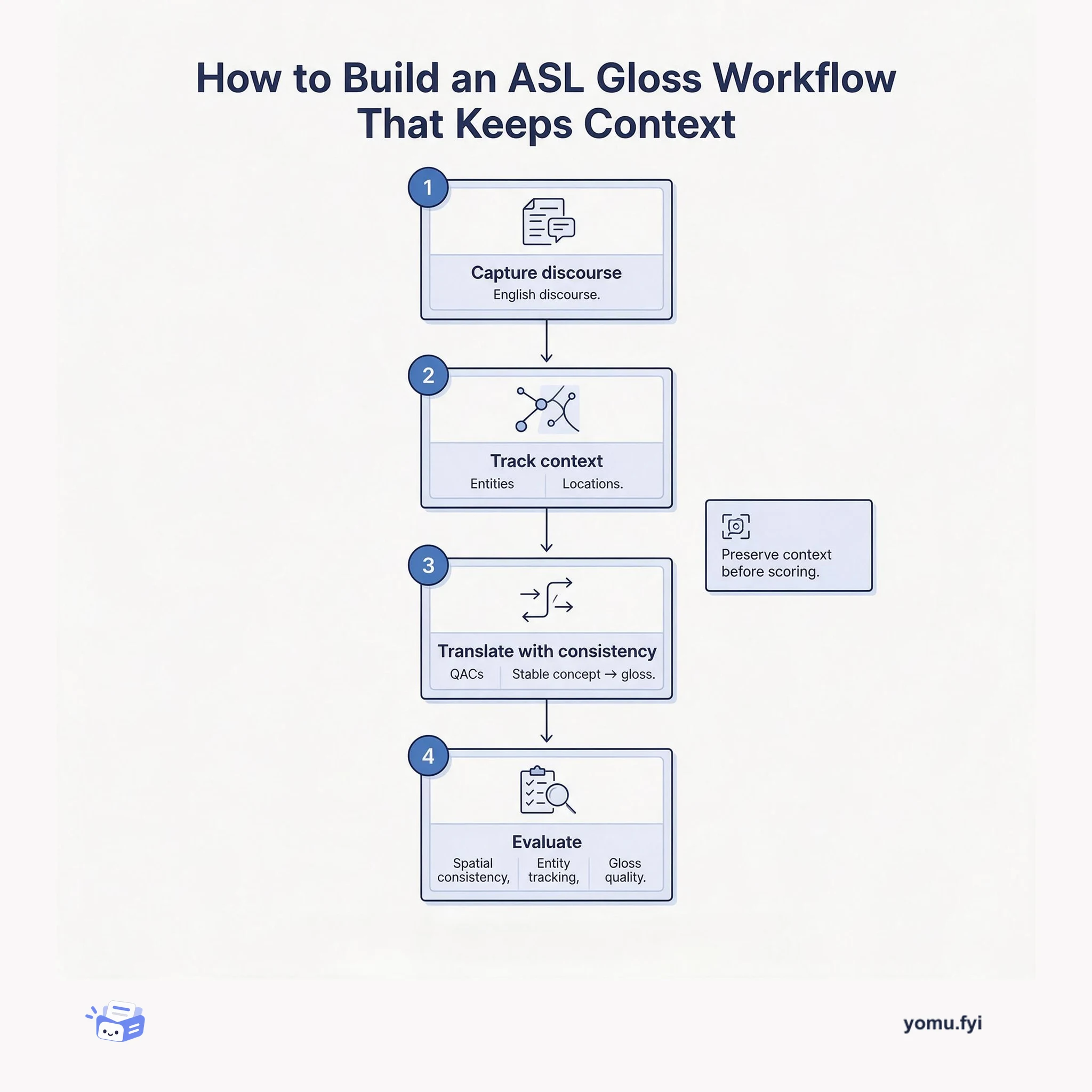
How to Build an ASL Gloss Workflow That Keeps Context
Learn a practical workflow for translating English discourse into ASL gloss while preserving spatial references, question-answer structure, and consistent concept-to-gloss mappings.
Loading…
Topic
483 posts about AI. Every summary links to the original.
See the idea
Learn a practical workflow for translating English discourse into ASL gloss while preserving spatial references, question-answer structure, and consistent concept-to-gloss mappings.
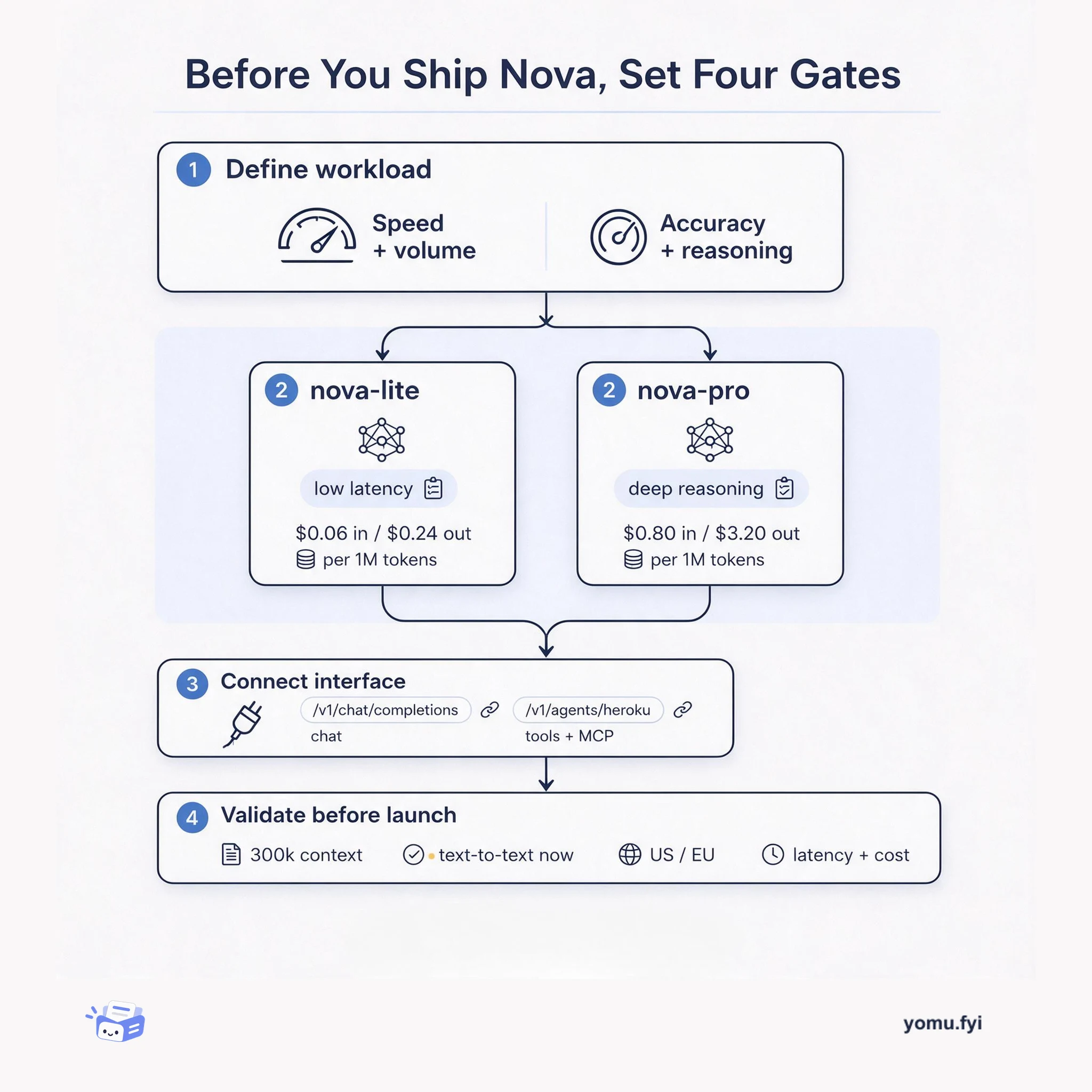
A practical checklist for putting Amazon Nova into an application: choose nova-lite or nova-pro by workload, expose tools, and verify context, modality, region, and cost constraints.
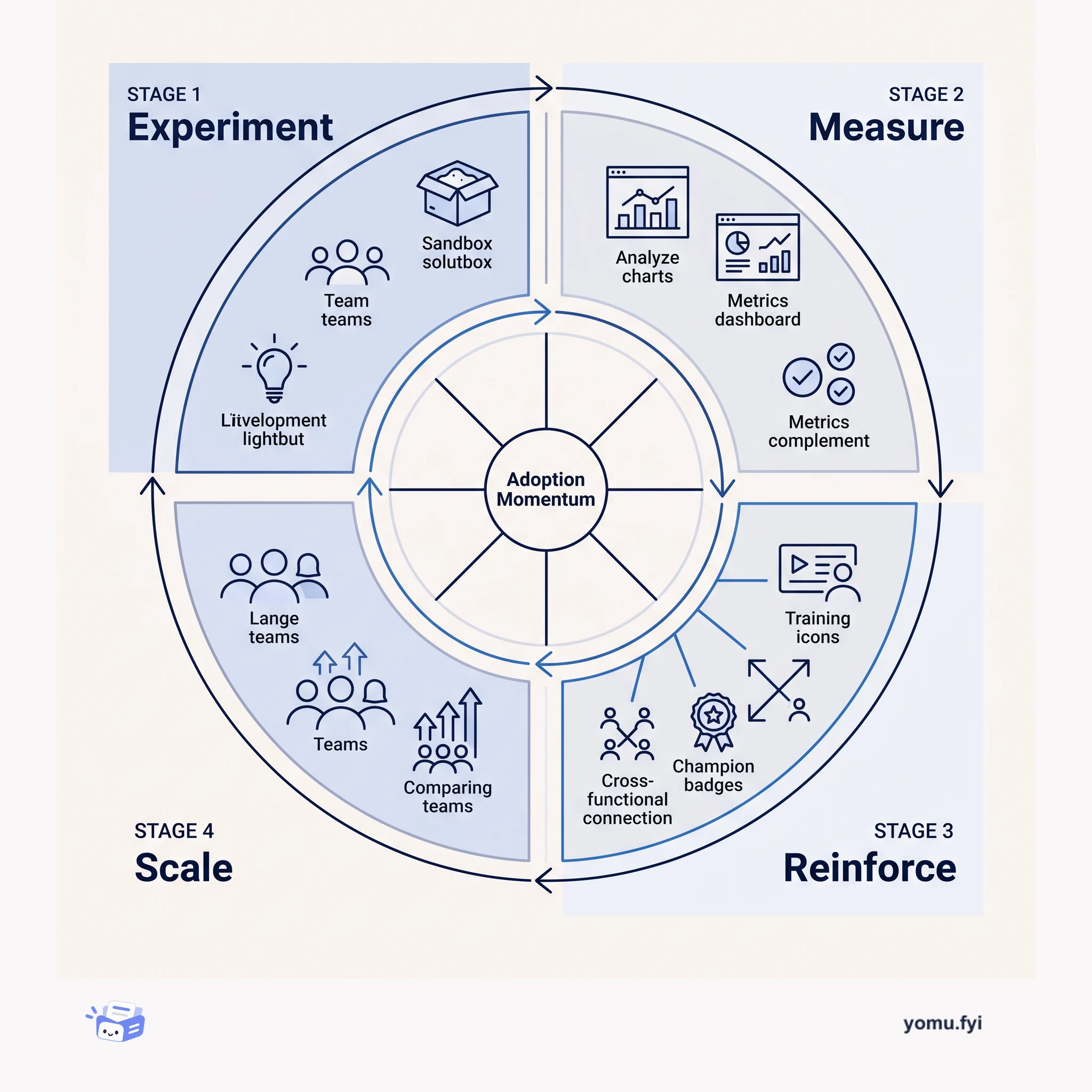
Adoption moves through experimentation, measurement, and reinforcement loops. Learn how leading companies build momentum from pilot programs into enterprise-wide habits and measurable business impact.
The Good Stuff
Paid picks we use ourselves. Links carry a referral code — a subscription through one earns us a commission at no extra cost to you.
Newest first
Databricks has announced its third annual Built-On Databricks Startup Challenge, inviting early-stage startups that use Databricks as a core part of customer-facing, B2B applications to compete for more than $1M in prizes. Eligible companies must have been founded within the last five years, be incorporated in one of the listed countries, and be no later than Series B if funded. The competition offers a potential Databricks Ventures investment of up to $600,000, up to $500,000 in Databricks product credits across finalists, and access to Databricks resources, workshops, mentorship, and feedback. Judging considers Databricks usage, market potential, and founding team strength and experience; applications close May 22, 2026, with judging in late May and winner announcements during the week of June 15, 2026, at the Databricks Data + AI Summit in San Francisco.
Agentic analytics increases the need for trustworthy semantics and governance because AI systems must interpret business definitions, trace outputs, and support follow-up questions beyond static dashboards. Nick Eayrs argues that fragmented metrics across BI tools, proprietary semantic layers, and duplicated pipelines erode trust, slow decisions, and increase engineering cost. The proposed foundation is an open, interoperable semantic layer where certified metrics such as revenue, churn, and customer lifetime value are explicitly defined, reusable, and accessible through SQL to BI, AI interfaces, notebooks, and agents. Organizations should establish governed data foundations and a catalog first, certify metrics next, then add AI and evaluate its outputs. Examples include NTT Docomo reducing manual log-analysis time from 66 hours to 6 hours and Net One Systems cutting support response time by 75 percent.
Databricks is introducing a Lakeflow Connect Free Tier to help teams ingest SaaS application and operational database data into the Databricks Data + AI Platform, addressing silos that can leave AI agents without complete enterprise context. Each workspace automatically receives 100 free DBUs per day for managed SaaS and database connectors only, with capacity advertised as up to 100 million records per workspace per day across eligible supported sources. Lakeflow Connect offers 30+ connectors, including SaaS services and databases, through a point-and-click UI and API, with Unity Catalog providing unified governance and end-to-end lineage. The offer uses standard pricing without volume-based premiums or row-based pricing, but actual capacity varies with workload characteristics, record sizes, and source types.
Zalando describes how it is building a unified data foundation for analytics and AI across a microservices-driven ecosystem serving more than 50 million active customers and 7,000 brands and partners. Its architecture combines private domain-owned catalogs for autonomous development with a centrally governed shared catalog that exposes cross-team data through Dynamic Views, enabling identity-based policies, GDPR checks, column classification, and auditability. Databricks Metric Views provide a governed semantic layer where business logic and KPI definitions are centralized and reusable across SQL, dashboards, notebooks, and AI agents. Genie uses those metrics plus enriched metadata to answer natural-language questions more reliably, although poorly curated or unaggregated data can increase costs; Zalando plans broader enterprise adoption through curated spaces and additional orchestration.
The Life Sciences Verification Program (LSVP) opens beta access to Mythos, Opus, and Sonnet models for verified life science teams whose work may be blocked by generally available Fable models. Applicants undergo review of research credentials, security standards, and ethical oversight, then may receive annual Standard Use grants or six-month, project-specific High-risk Use grants. Standard Use employs more permissive biology classifiers across research, clinical, manufacturing, and other workflows, while High-risk Use removes life-science safeguards for specifically vetted projects; cyber safeguards remain. The program shifts enforcement from request-level blocking to offline monitoring of behavioral patterns, requiring 30-day retention of flagged-activity data, compartmentalized from training and life sciences research teams. Access is available through API, Claude Science, Claude.ai, Claude Code, and Enterprise or Team plans, but not individual plans, third-party platforms, or BAA-enabled organizations during beta.
Twilio used AI to update 1,138 error-code documentation pages over about 12 weeks, with a human reviewing every change. The team first scored roughly 2,692 pages with a deterministic script covering structure, content, and resources, then routed low-scoring pages to an LLM pipeline while sending borderline pages to human review. That pipeline used OpenAI's gpt-5.4 via the Responses API, generated full-file responses, sanitized them, converted them into git apply patches, linted results, and rejected any page whose code snippet fingerprint changed. Small-batch pull requests, tracking files, local-modification checks, and named reviewers limited duplicate work and kept approval in the workflow. Across about 27 pull requests from March to May 2026, the process marked 1,138 error codes complete, while the team acknowledged that human review was the quality bar and that future scaling would benefit from an automated evaluation harness and diff-based generation.
Modern storefronts can appear healthy while malicious JavaScript diverts affiliate credit, hijacks searches or clicks, tampers with analytics, or loads further code. Cloudflare describes four operations spanning eight payloads that Page Shield ML detected in live traffic; humans verified the findings afterward, while seven payloads were absent from VirusTotal and none received a malicious verdict from URLScan. The detection system represents JavaScript as a graph with a graph neural network (GNN), sends fewer than 0.3% of analyzed scripts to a lightweight LLM on Workers AI, and uses a teacher cohort of frontier models for difficult investigations. This combination handles minification, renaming, some obfuscation, and behavior gated by device, time, geography, referrer, browser state, or cooldowns. The post concludes that continuous browser visibility and runtime context are needed because static, one-time scans can miss selectively executed attacks.
Spotify examines how AI-accelerated development and broader industry compute demand challenged quality across content processing, fleet updates, regional failover, and the mobile app. At its scale—777 million monthly active users, about 100 million concurrent clients, 11–12 million backend requests per second, and nearly 3,000 production services—small control gaps can become visible to listeners and creators. A June 24 processing incident combined competing batch work, higher per-episode compute, and a scheduler bug that cut throughput about 10%, leading to hour-long publication delays; Spotify responded with end-to-end monitoring, scheduler fixes, prioritization, and more capacity. Incident reviews found no material direct contribution from AI-authored code, but change volume outpaced some verification controls, prompting stronger review, testing, rollout, observability, rollback, quality signals, and failover practices. Spotify reports no corresponding rise in rework rate, while continuing to watch increasing PR size and complexity.
Enterprise AI needs a way to assemble the smallest sufficient set of current, relevant, and authorized evidence for each agent turn instead of sending an entire data estate to a model. Salesforce presents Data 360 as a shared Trusted Context runtime spanning Salesforce, external platforms such as Databricks and Snowflake, operational systems, documents, knowledge bases, and live signals. Its progressive pipeline connects data through ingestion and Zero Copy, then harmonizes, unifies, models, retrieves, reconciles, governs, and compiles evidence into a token-fit Context Pack with citations and action contracts. The Agent Context Engine also returns typed interaction traces, promoting only approved facts into durable memory and validated outcomes into learnings. Q2 FY27 production usage is reported at 104.3 trillion connected records, including 81.5 trillion Zero Copy rows, while proposed benchmarking covers correctness, authorization, provenance, freshness, latency, cost, and memory continuity.
Discrete flow matching can parallelize text generation across positions, but reaching high quality may require hundreds or thousands of model evaluations. The paper argues that few-step distillation fails primarily because teacher trajectories are built from blind stochastic jumps: an early poor midpoint decision propagates, and the student is trained to imitate it. Its Trajectory-Shaped Discrete Flow Matching (TS-DFM) uses a lightweight energy compass during training to score candidate continuations at each midpoint and select the most coherent path, without adding inference cost. In experiments with 170M-parameter language models, an eight-step shaped student achieves 32% lower perplexity than a 1,024-step teacher and runs 128 times faster, with gains across source distributions and three evaluators; it also outperforms the compared discrete-generation baselines, including systems using more data or larger models.
Cloudflare announces a Disallow AI Training setting intended to let website owners refuse AI training while keeping content available to search crawlers. The problem is mixed-use crawlers such as Applebot, Bingbot, and Googlebot, which can serve both search indexing and model training, making a simple block affect discoverability. Cloudflare says its network can publish preferences, identify and classify crawlers, block those that ignore controls, and report operator behavior on Radar; the setting publishes a no-training preference through robots.txt while allowing Accountable mixed-use crawlers for search. Apple, Google, and Microsoft meet or have committed to meet the Accountable requirements, which include training and summary opt-outs, URL-level visibility, metrics, and assurance that training opt-outs will not affect traditional search.
Modal added day-zero support for Kimi K3, Qwen 3.8, GLM 5.3, and GLM 5.3 Flash on Auto Endpoints, with custom DFlash speculators boosting throughput to 460 tokens per second. New environment-level budgets give Team and Enterprise workspaces per-environment compute limits, while the pricing multiplier for broad region selection dropped from 1.5x to 1.15x. The dashboard got a refreshed navigation, color system, and beta light mode, and Private Environments now support a default No Access role. Sandbox Sidecars are in public alpha, running additional containers via low-latency internal networking, and VM Sandboxes are in public beta with a real Linux kernel for Docker and eBPF. Sandbox directory snapshots and a new filesystem API are now GA, and regional Proxies allow selecting a region for static outbound IPs, while SDK updates improved log APIs and autoscaler reporting.
Harbor addresses a gap in Stripe’s AI-assisted workflows: designers needed dynamic information to assess stripe.com designs, but could not always justify a full engineering prototype. Built initially by one engineer in about 40 days, it lets designers describe an idea and use Stripe design systems and realistic mock data to generate shareable, browser-based prototypes without understanding code. Its agent writes a multi-file source tree, while Drydock compiles and renders React and TypeScript in the viewer’s browser; the agent can inspect pages, interact with elements, switch viewports, and iterate before publishing a single snapshot. Since May 2026, more than 3,000 Stripes have created 12,000 prototypes, and Harbor now integrates with other AI tools through MCP and Drydock’s standalone rendering contract, although live data and prototype-scoped state remain future goals.
Health plan finance teams can see when medical loss ratio (MLR) moves above budget, but the variance alone does not explain which business areas, costs, populations, or providers caused it. Conversational AI is presented as a way for finance leaders to ask follow-up questions across claims, membership, provider, contract, clinical, quality, risk, and financial data without repeatedly commissioning reports. Its usefulness depends on explicit payer context: MLR combines premiums with medical-care components such as pharmacy rebates, IBNR, recoveries, risk adjustment transfers, and provider settlements, while cohort definitions and metric logic vary. Abacus supplies normalized, connected healthcare data and payer-specific business context; Databricks provides governed enterprise data and AI capabilities for conversational analytical experiences. Together, they are described as creating a reusable foundation for tracing executive signals into operational questions across MLR and other payer domains, while leaving action judgment to the organization.
Anthropic announces two initiatives for higher education: an advisory board to guide Claude’s development for teaching, learning, and research, and three AI Fluency courses co-created with educators. The board, chaired by Rick Levin, includes academic leaders whose expertise spans university leadership, educational technology, learning science, and postsecondary policy, with a stated aim of strengthening learning and critical thinking while upholding academic integrity and student privacy. The courses address educators, students, and institutions: they cover classroom materials and assessments, responsible AI collaboration, critical thinking, personal commitments, instruction, assessment, and curriculum planning. Co-developed with Rick Dakan and Joseph Feller, all three are available under a Creative Commons license so institutions can adapt them. The announcement positions the board as strategic guidance and the courses as practical support for universities navigating AI integration.
Anthropic announced the formation of its National Security and Public Sector Advisory Council, a bipartisan group of former officials and public policy practitioners supporting work with the U.S. government and closely allied democracies. The council includes former senators and leaders from Defense, intelligence, Energy, Justice, and congressional national security offices, and will help identify applications in cybersecurity, intelligence analysis, and scientific research. It will also deepen public-private partnerships and support standards for responsible national security applications. Anthropic describes related efforts including Claude Gov models, a $200 million Department of Defense partnership, Claude access for 10,000 Lawrence Livermore National Laboratory scientists, nuclear safeguards work, $1 access for all three government branches, and voluntary testing of biological, cyber, and AI R&D capabilities.
An analysis of educator AI adoption in higher education examines how faculty use Claude across teaching, research, and administration. The researchers analyzed approximately 74,000 anonymized conversations from Claude.ai Free and Pro accounts associated with higher education email addresses during May and June, automatically filtering educator-specific tasks and matching them to O*NET categories; they also drew on survey and qualitative research with 22 Northeastern faculty. Curriculum development was the leading use, appearing in 57% of analyzed conversations, followed by academic research at 13% and student-performance assessment at 7%. Faculty also used Claude Artifacts to build interactive games, quizzes, simulations, data visualizations, scheduling tools, and budget planners, shifting from conversational assistance toward deployable educational resources. The analysis found more augmentation for lesson design, advising, and grant writing, while routine administrative work was more automation-heavy; grading was automated in 48.9% of relevant cases despite faculty rating it AI’s least effective application.
Anthropic has completed a $13 billion Series F led by ICONIQ and co-led by Fidelity Management & Research Company and Lightspeed Venture Partners, valuing the company at $183 billion post-money. The financing follows rapid expansion since Claude launched in March 2023: run-rate revenue rose from approximately $1 billion at the beginning of 2025 to more than $5 billion by August, while Anthropic reported over 300,000 business customers and nearly sevenfold growth in large accounts over the past year. Claude Code, fully launched in May 2025, had already surpassed $500 million in run-rate revenue, with usage increasing more than 10x in three months. Anthropic says it will use the investment to expand enterprise capacity, deepen safety research, and support international expansion while building reliable, interpretable, and steerable AI systems.
Anthropic announces Chris Ciauri as Managing Director of International amid expanded global operations, new offices, and increasing enterprise demand for Claude. Ciauri brings more than 25 years of experience scaling enterprise technology businesses globally, including roles as CEO of Unily, president of EMEA at Google Cloud, and EVP and GM of EMEA at Salesforce, where he helped grow revenue from under $200 million to over $3 billion. He joins Paul Smith’s international leadership group with Guillaume Princen, Hidetoshi Tojo, and Kate Jensen, while Anthropic adds more than 100 EMEA roles, opens its first Asia office in Tokyo, and plans further European locations. Anthropic says this momentum reflects technical talent, safety, and frontier research, including alignment and interpretability work. The company reports run-rate revenue above $5 billion in August 2025, more than 300,000 business customers, and customer examples spanning productivity, documentation, service quality, fraud reduction, and software development.
Anthropic and Deloitte announced an expanded alliance that will make Claude available to more than 470,000 Deloitte people across its global network and create industry-specific solutions powered by the model. Deloitte will establish a Claude Center of Excellence, with trained specialists developing implementation frameworks, sharing deployment practices, and providing ongoing technical support to move AI pilots into production at scale. The organizations are also creating a certification program for 15,000 professionals, while combining Claude’s safety-first design with Deloitte’s Trustworthy AI framework to build compliance-oriented tools for regulated industries including financial services, healthcare and life sciences, and public services. The announcement describes the deployment as Anthropic’s largest enterprise AI deployment to date, with Claude intended for uses ranging from coding and software development to customer engagement and industry-specific advisory.
The best engineering reads, once a week.