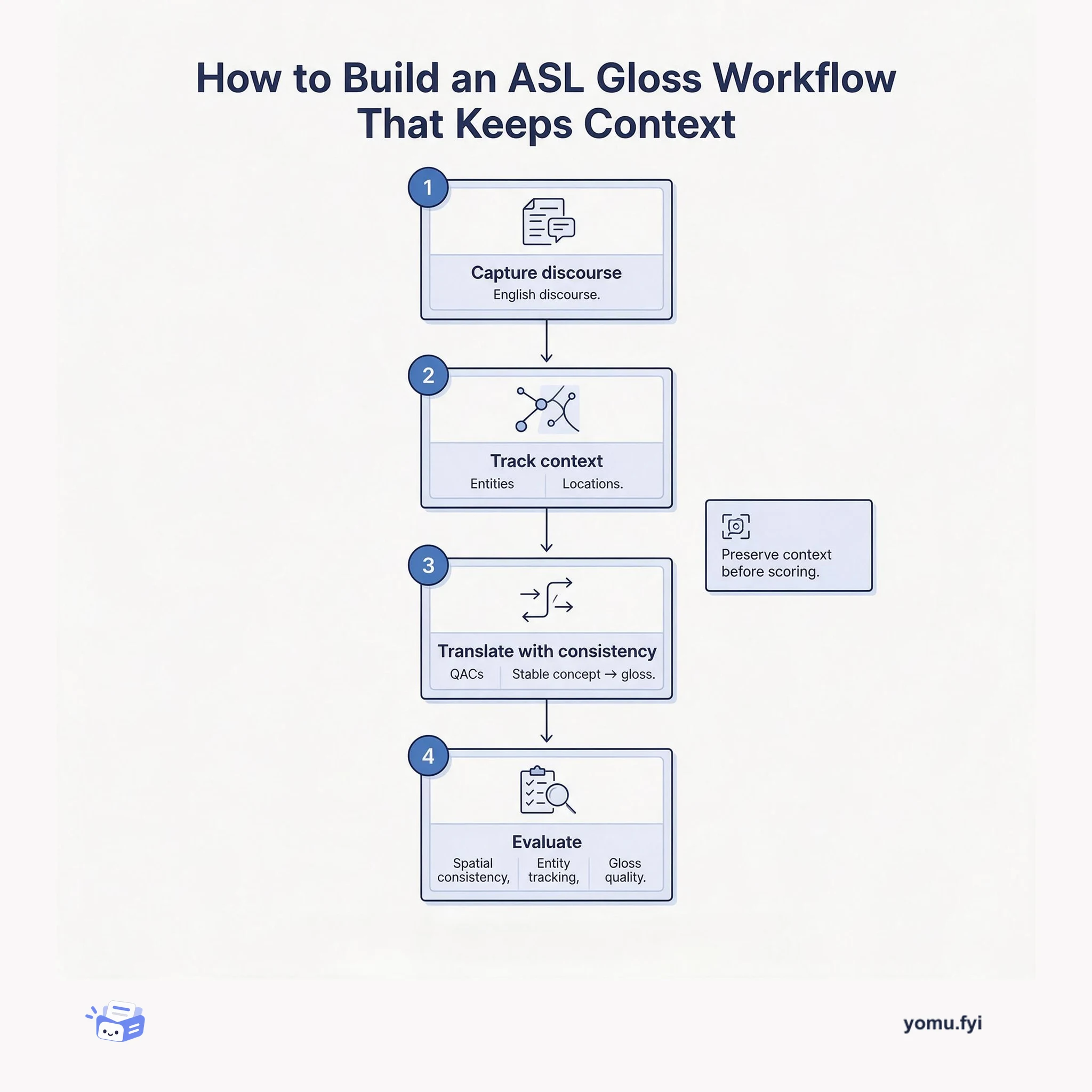
How to Build an ASL Gloss Workflow That Keeps Context
Learn a practical workflow for translating English discourse into ASL gloss while preserving spatial references, question-answer structure, and consistent concept-to-gloss mappings.
Loading…
Topic
483 posts about AI. Every summary links to the original.
See the idea
Learn a practical workflow for translating English discourse into ASL gloss while preserving spatial references, question-answer structure, and consistent concept-to-gloss mappings.
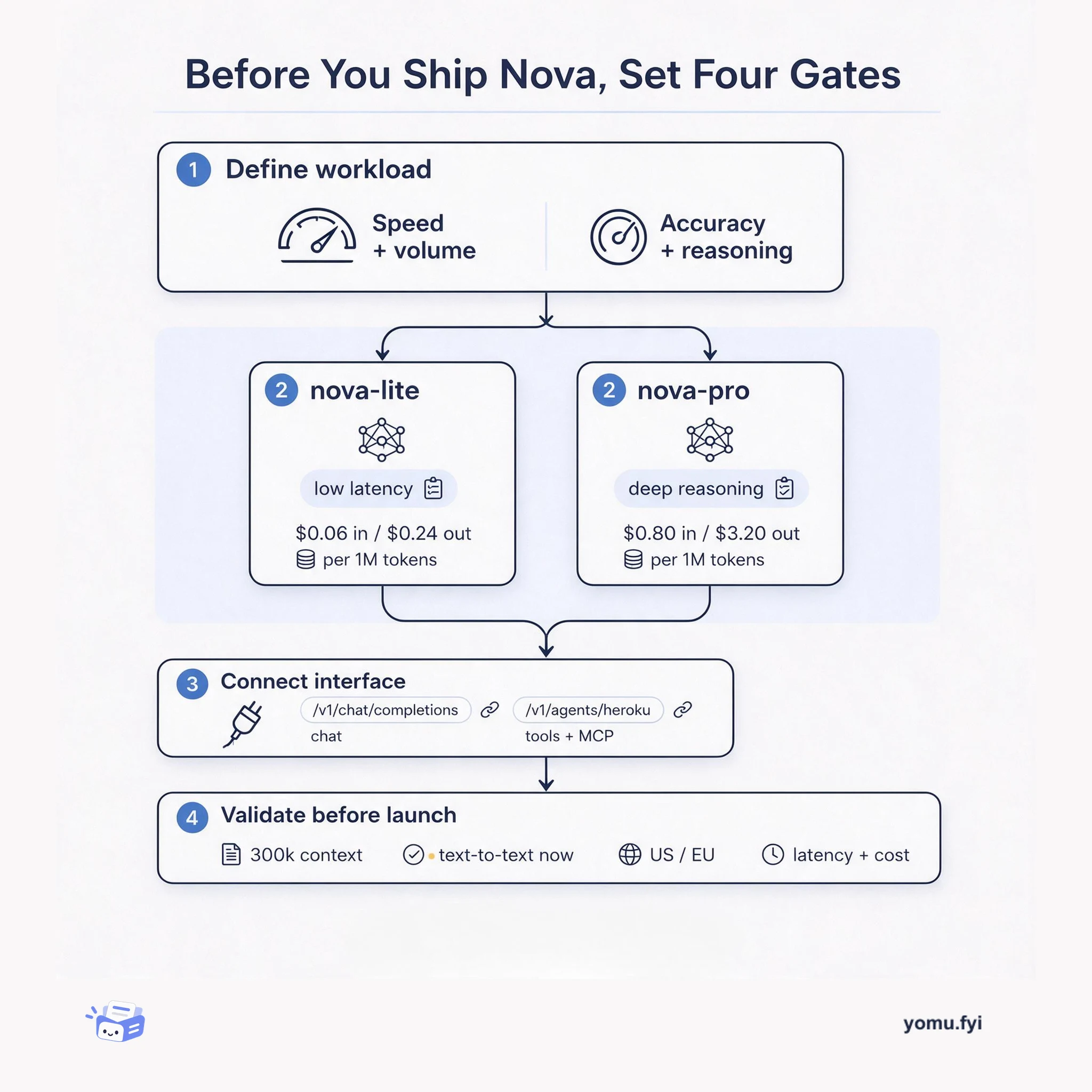
A practical checklist for putting Amazon Nova into an application: choose nova-lite or nova-pro by workload, expose tools, and verify context, modality, region, and cost constraints.
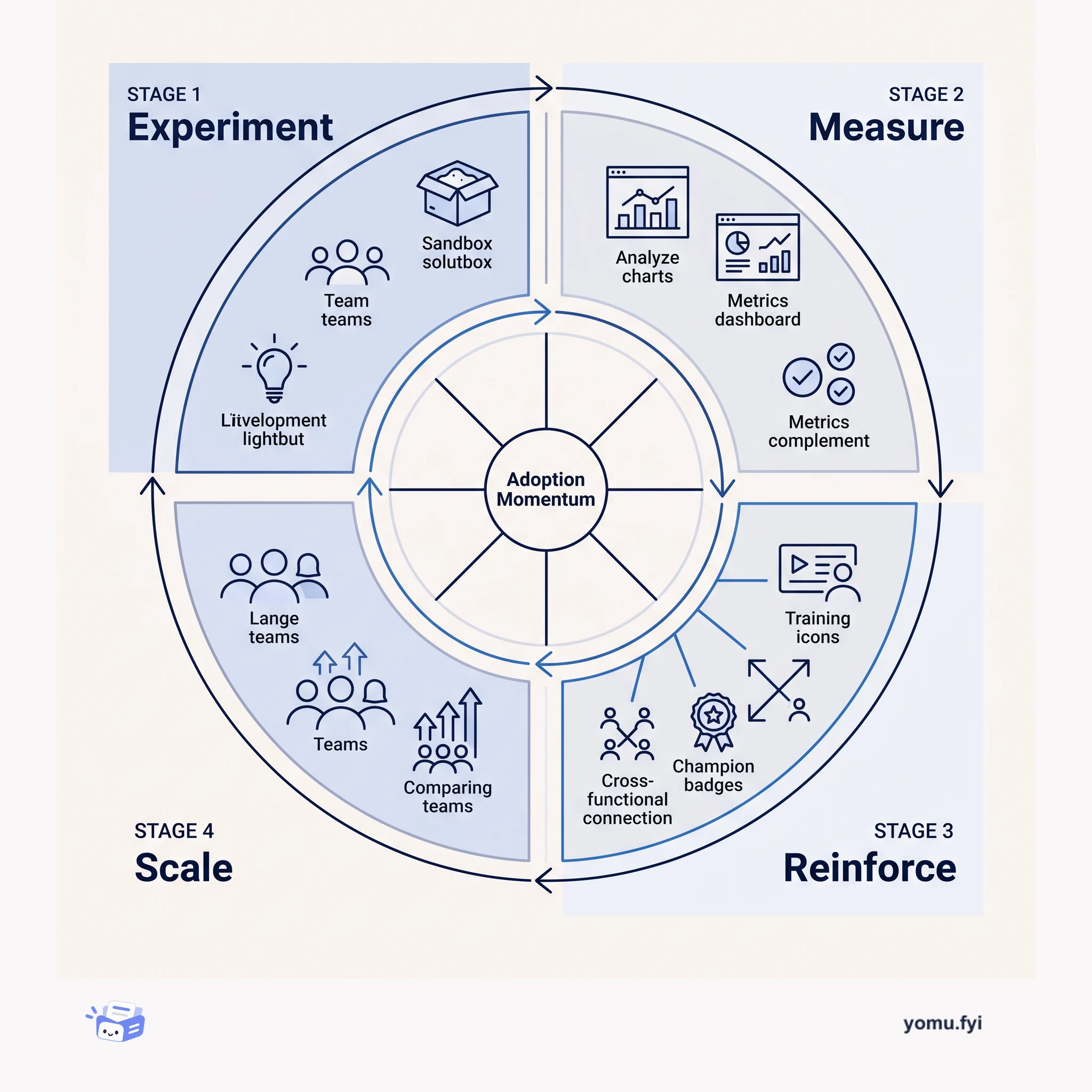
Adoption moves through experimentation, measurement, and reinforcement loops. Learn how leading companies build momentum from pilot programs into enterprise-wide habits and measurable business impact.
The Good Stuff
Paid picks we use ourselves. Links carry a referral code — a subscription through one earns us a commission at no extra cost to you.
Newest first
Anthropic announced that Rahul Patil has joined as its Chief Technology Officer, overseeing engineering across product, compute, infrastructure, inference, data science, and security as Claude scales to meet growing enterprise demand worldwide. Patil brings more than 20 years of experience building and maintaining industry-leading infrastructure, most recently as CTO of Stripe, where he guided technology supporting millions of businesses processing more than trillion dollars annually. Earlier roles at AWS, Microsoft, and Oracle Cloud Infrastructure developed his expertise in reliable, scalable mission-critical systems, while co-founder Sam McCandlish moves from CTO to Chief Architect to focus on large-scale model training, pretraining, research productivity, and RL infrastructure. The announcement frames Patil’s appointment as a commitment to world-class infrastructure and reliability at scale for developers building with Claude.
Anthropic announces plans to open a Bengaluru office in early 2026, its second Asia-Pacific location after Tokyo, to serve India’s growing AI ecosystem and rising demand for Claude. CEO and co-founder Dario Amodei is visiting India to meet public officials and enterprise partners, while the company says its regional work will target social impact in education, healthcare, and agriculture and support enterprises, nonprofits, startups, and the entrepreneurial ecosystem. India ranks second globally in consumer Claude usage, with substantial use for programming tasks; Anthropic says Claude Code usage grew more than 10x in its first three months after launch. The expansion also includes enhanced Hindi performance and support improvements for nearly a dozen other Indic languages, intended to broaden public-sector adoption and access.
Anthropic CEO Dario Amodei says the company’s aim is to advance American leadership in powerful, beneficial AI while maximizing helpful applications and limiting harmful ones. He describes cooperation with the federal government, support for a national AI standard, and support for California’s SB 53, which requires the largest AI developers to publish frontier-model safety protocols and exempts companies below $500 million in annual gross revenue. Amodei also says Anthropic restricts AI-service sales to PRC-controlled companies, works with startups, and has hired advisers from both political parties. Addressing claims of unusual political bias, he cites Manhattan Institute and Stanford findings and Anthropic system cards as evidence that its models are not uniquely biased, while acknowledging that no model is fully balanced in every reply.
Anthropic plans to open an office in Seoul in early 2026, making it the company’s third Asia-Pacific location after Tokyo and Bengaluru as it expands operations in Korea. Korean users rank among Claude’s top five globally for total and per-capita usage, while Asia-Pacific countries account for more than a quarter of Claude Code users and weekly users in Korea have grown sixfold in four months. Anthropic attributes the expansion to regional momentum, including more than tenfold run-rate revenue growth in the past year and an eightfold increase in large Asia-Pacific business accounts; it also points to Korean deployments such as Law&Company’s legal assistant and SK Telecom’s customer service model. The Seoul team will support Korean enterprises and startups, work with government, research, and industry partners, and align with Korea’s strategy for responsible AI development and deployment.
Anthropic is expanding Claude for Financial Services with a beta Excel add-in, real-time data connectors, and six pre-built Agent Skills for finance workflows. Claude for Excel operates in a Microsoft Excel sidebar, where it can read, analyze, modify, debug, and create workbooks while tracking changes, explaining actions, and linking explanations to referenced cells. New connectors provide live or governed access to earnings events, portfolio data, internal data rooms, market data, credit research, and financial news through Aiera, Chronograph, Egnyte, LSEG, Moody’s, and MT Newswires. The six skills cover comparable company analysis, discounted cash flow models with WACC, scenarios, and sensitivity tables, due-diligence data packs, earnings analysis, and initiating coverage reports. Sonnet 4.5 scored 55.3% on Vals AI’s Finance Agent benchmark; these previews are available to Max, Enterprise, and Teams users, while Claude for Excel will gather feedback from 1,000 initial users.
Anthropic opened its first Asia-Pacific office in Tokyo as part of its international expansion, building a local team to work with industry, government, and cultural partners. During the week, CEO and co-founder Dario Amodei met Japan’s prime minister, the LDP Digitization Headquarters Committee, and customers, while Anthropic signed a Memorandum of Cooperation with the Japan AI Safety Institute on AI evaluation methodologies and emerging trends. Anthropic also joined the Hiroshima AI Process Friends Group and extended its partnership with the Mori Art Museum. The company reports that Japan is in the top 25% globally for AI adoption, with businesses using Claude for research, writing, document analysis, coding, and other productivity tasks. It plans to expand next to Seoul and Bengaluru, while reporting Asia-Pacific run-rate revenue growth of more than 10x in the past year.
Anthropic announces plans to open offices in Paris and Munich as it expands operations across Europe. The offices will serve as regional hubs for commercial growth, policy collaboration, and partnership development, with European staff spanning research and engineering through sales and operations. The expansion follows a year in which EMEA employee numbers tripled, run-rate revenue grew more than 9x, and large business accounts grew more than 10x; EMEA is described as Anthropic’s fastest-growing region. New leadership roles will cover startups and digital-native businesses, northern and southern EMEA, and, pending an announcement, DACH and CEE, while partnerships with European educational and cultural organizations will support exhibitions, hackathons, and AI education.
Anthropic announces a $50 billion investment in American computing infrastructure, with data centers being built by Fluidstack in Texas and New York and additional sites planned. The facilities are custom built for Anthropic, with efficiency for its workloads intended to support continued frontier research and development. Sites are expected to come online throughout 2026, creating approximately 800 permanent jobs and 2,400 construction jobs, while the project is described as supporting goals in the Trump administration’s AI Action Plan and domestic technology infrastructure. Anthropic says the investment is needed to meet demand from hundreds of thousands of businesses using Claude; it reports more than 300,000 business customers and nearly sevenfold growth in large accounts over the past year. Fluidstack was selected for its ability to deliver gigawatts of power rapidly, and Anthropic says it will continue pursuing cost-effective, capital-efficient ways to scale.
Maryland has announced a partnership with Anthropic to deploy Claude across state agencies, aiming to improve government operations and serve more than six million residents. The partnership includes a Claude-powered virtual assistant for SNAP, Medicaid, temporary cash assistance, and WIC; it will also identify other programs residents may qualify for. Caseworkers will use Claude to process and verify more than 150,000 documents manually handled each month, validate eligibility, and receive policy guidance for complex cases. Maryland will explore an AI upskilling pilot for early-career professionals in “lighthouse” industries, while a Governor’s Innovation Team tool will use Claude to identify unmet local needs such as fresh food and childcare. The effort builds on a bilingual chatbot launched in June for more than 600,000 SUN Bucks recipients, which simplified information access and reduced call center volume.
Microsoft, NVIDIA, and Anthropic announced strategic partnerships to scale Anthropic’s Claude models on Microsoft Azure and broaden enterprise access to them. Anthropic committed to purchase $30 billion of Azure compute capacity and contract additional capacity up to one gigawatt, initially using NVIDIA Grace Blackwell and Vera Rubin systems. NVIDIA and Anthropic will collaborate on design and engineering to optimize Anthropic models for performance, efficiency, and total cost of ownership, while adapting future NVIDIA architectures to Anthropic workloads. Microsoft Foundry customers will be able to access Claude Sonnet 4.5, Claude Opus 4.1, and Claude Haiku 4.5, while Claude remains available across Microsoft’s Copilot products. Microsoft and NVIDIA committed up to $5 billion and $10 billion, respectively, to Anthropic; Amazon remains its primary cloud provider and training partner.
Anthropic and Accenture announced an expanded partnership aimed at helping enterprises move AI projects from pilots to full-scale deployment. The companies are forming the Accenture Anthropic Business Group, a dedicated Claude-focused practice, and plan to train approximately 30,000 Accenture professionals, including engineers who embed Claude in client environments. Their first joint offering places Claude Code at the center of software development and combines productivity and ROI measurement, workflow redesign, and change management and training for CIOs. Initial industry solutions target financial services, life sciences, healthcare, and the public sector, where security and governance requirements are strict; the partnership also brings Claude to Accenture Innovation Hubs and establishes a Claude Center of Excellence for co-designing offerings.
Claude’s safeguards for conversations involving emotional support focus on suicide and self-harm, sycophancy, and an 18+ access requirement. For suicide and self-harm, the approach combines system-prompt guidance, reinforcement learning informed by human preference data and expert input, and a classifier that can display country-specific crisis resources supplied by ThroughLine. The post reports that Claude Opus 4.5, Sonnet 4.5, and Haiku 4.5 respond appropriately to clear-risk single-turn prompts 98.6%, 98.7%, and 99.3% of the time, while multi-turn results are 86% and 78% for Opus 4.5 and Sonnet 4.5. Prefilled real-conversation stress tests produced 91% and 73% for those models, versus 36% for Opus 4.1. The work also describes efforts to reduce sycophancy, evaluate model behavior, identify underage users, and continue publishing methods and results.
Anthropic and the US Department of Energy (DOE) announce a multi-year partnership under the Genesis Mission, targeting American energy dominance, biological and life sciences, and scientific productivity across potentially all 17 national laboratories. Anthropic plans to give DOE researchers access to Claude and engineers who can build purpose-built AI agents, Model Context Protocol servers connecting Claude with scientific instruments and tools, and Claude Skills for specialized workflows. Proposed applications include speeding permitting reviews, supporting nuclear technology research and energy security, developing pandemic and biological-threat early-warning systems, accelerating drug discovery, and using fifty years of DOE research to surface ideas and patterns. The partnership extends prior DOE work, including a nuclear risk classifier co-developed with the National Nuclear Security Administration and Claude’s rollout at Lawrence Livermore National Laboratory. Anthropic says future arrangements could develop a model for collaboration between AI and human researchers.
The post introduces a Twilio Agent Connect integration for building production-ready voice AI experiences with OpenAI’s GPT-Live-1 speech-to-speech model. It addresses the gap between real-time speech intelligence and customer-facing communications by connecting GPT-Live-1 to Twilio Voice and Conversations while preserving context across channels and supporting reliable scale. The SDK supplies a native GPTLiveProvider that links Twilio Voice Media Streams directly to the OpenAI API without custom WebSocket plumbing, and handles turn-taking, audio streaming, interruption handling, and tool delegation. Tutorials, documentation, and example repositories cover inbound and outbound agents implemented with Python and Node.js, giving developers materials to build, test, and deploy voice applications.
An enterprise RAG pipeline scored above 90% on standard text-retrieval benchmarks but approximately 46% on complex, customer-representative documents, with failures spanning parsing, chunking, enrichment, embeddings, retrieval, and answer generation. The proposed diagnostic traces wrong answers backward from generated response to retrieved context, chunks, and parsed source, using human-validated end-to-end evaluation and changing one stage at a time. Intelligent Parsing routes pages according to complexity and preserves relationships in structures such as multi-page tables; in a staged benchmark, it raised accuracy from 65.1% to 84.4%, while Enriched Indexing raised it to 86.8%. Retrieval improvements include dynamic metadata pre-filters for explicit constraints and GraphRAG for multi-hop evidence, with GraphRAG slated for general availability in November 2026. Across broader improvements, complex-document accuracy exceeded 90%, and service-based Just-in-Time indexing reduced sub-100 MB payload indexing from 30+ minutes to approximately seven to ten minutes.
California’s Transparency in Frontier AI Act (SB 53), taking effect January 1, requires frontier AI developers to publish frameworks explaining how they assess and manage catastrophic risks. Anthropic’s public Frontier Compliance Framework (FCF) covers cyber offense; chemical, biological, radiological, and nuclear threats; AI sabotage; loss of control; model-weight protection; and safety-incident response. It describes a tiered system for evaluating model capabilities across those risk categories and the mitigations used, while building on the company’s Responsible Scaling Policy and model system cards. Anthropic says the FCF will serve as its compliance framework for SB 53 and other regulatory requirements, while the RSP remains a voluntary policy that may go beyond current rules. The company also argues for a federal standard requiring public secure-development frameworks, deployment system cards, whistleblower protections, flexible minimum standards, and coverage limited to established frontier developers.
Anthropic is expanding Labs, a team dedicated to incubating experimental products at the frontier of Claude’s capabilities. The announcement describes a product-building model that combines edge experimentation, testing unpolished versions with early users, and scaling successful ideas into dependable customer products; it cites Claude Code, MCP, Skills, Claude in Chrome, and Cowork as examples. Mike Krieger is joining Labs to build alongside Ben Mann, while Ami Vora will lead Product in partnership with CTO Rahul Patil to scale Claude experiences. Anthropic says the structure is intended to support both experimental discovery and responsible scaling for enterprise customers and a growing user base, and it is hiring builders focused on emerging technology.
Anthropic has appointed Irina Ghose as Managing Director of India as it prepares to open its first office in the country. Ghose brings more than three decades of experience scaling technology businesses and most recently led Microsoft India, where she drove enterprise AI adoption across banking and financial services, healthcare, manufacturing, and government. In her new role, she will help grow teams, engage policymakers and academic institutions, strengthen developer engagement, and build partnerships with enterprises and organizations addressing local challenges, with an emphasis on local insight, trust, safety, and long-term impact. India is Claude.ai’s second-largest market globally, and Anthropic says nearly half of usage there is concentrated in computer and mathematical tasks, according to its fourth Economic Index.
Anthropic’s Long-Term Benefit Trust has appointed Mariano-Florentino (Tino) Cuéllar as a new member, adding experience in law, governance, international affairs, and technology’s effects on public institutions. Cuéllar is a former Justice of the Supreme Court of California, former leader of Stanford’s Freeman Spogli Institute, current President of the Carnegie Endowment for International Peace, and chair of the William & Flora Hewlett Foundation; he plans to leave Carnegie in July 2026 for Stanford roles. The independent Trust selects members of Anthropic’s Board of Directors and advises Anthropic’s Board and leadership on maximizing advanced AI’s benefits and mitigating its risks, with no Trustee holding a financial stake in Anthropic. Kanika Bahl and Zachary Robinson, who served since the Trust’s founding, concluded their terms.
Anthropic has been selected by the UK's Department for Science, Innovation and Technology (DSIT) to help build and pilot a dedicated AI-powered assistant for GOV.UK. The assistant will initially support people entering or re-entering the workforce by helping them find work, access training, understand available support and resources, and route them to relevant services. Powered by Claude, the agentic system is designed to provide individually tailored guidance, maintain context across interactions, and let users control what data is remembered or opt out; personal information will be handled under UK data protection law. Using DSIT’s “Scan, Pilot, Scale” framework, the partners will test and iterate the assistant before wider rollout, building government expertise to maintain it independently.
The best engineering reads, once a week.