How to Build an ASL Gloss Workflow That Keeps Context
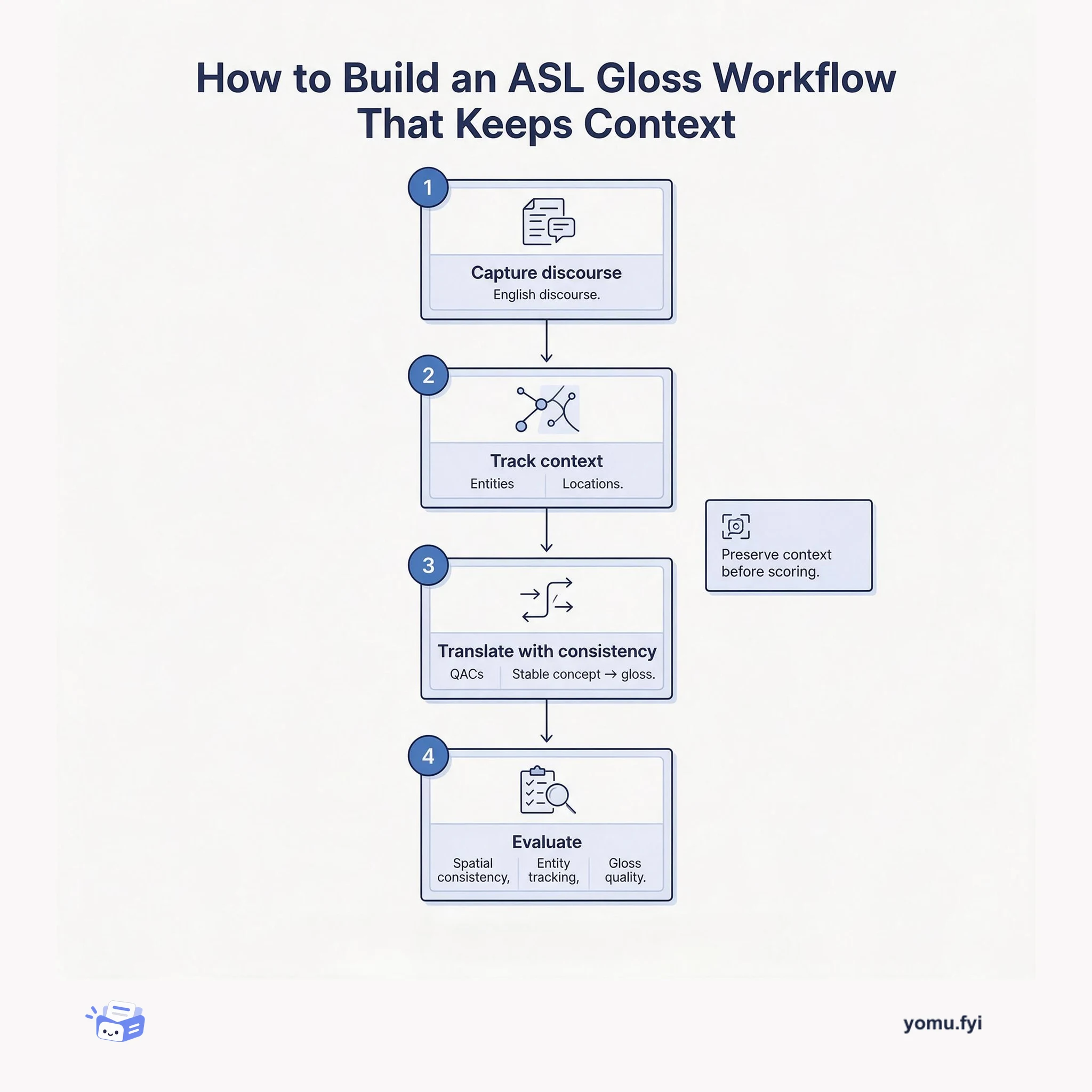
Learn a practical workflow for translating English discourse into ASL gloss while preserving spatial references, question-answer structure, and consistent concept-to-gloss mappings.
Loading…
Topic
454 posts about AI. Every summary links to the original.
See the idea
Learn a practical workflow for translating English discourse into ASL gloss while preserving spatial references, question-answer structure, and consistent concept-to-gloss mappings.
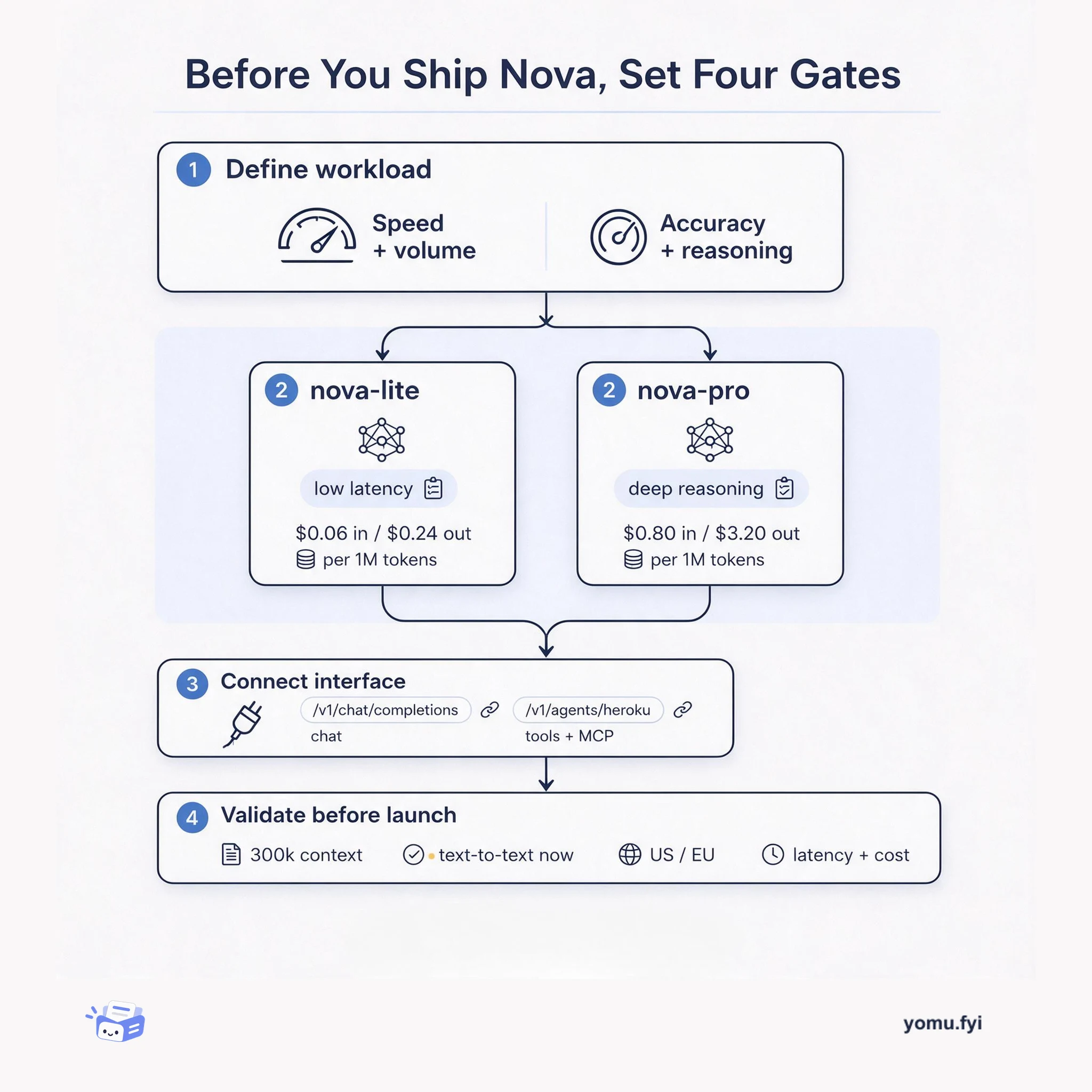
A practical checklist for putting Amazon Nova into an application: choose nova-lite or nova-pro by workload, expose tools, and verify context, modality, region, and cost constraints.
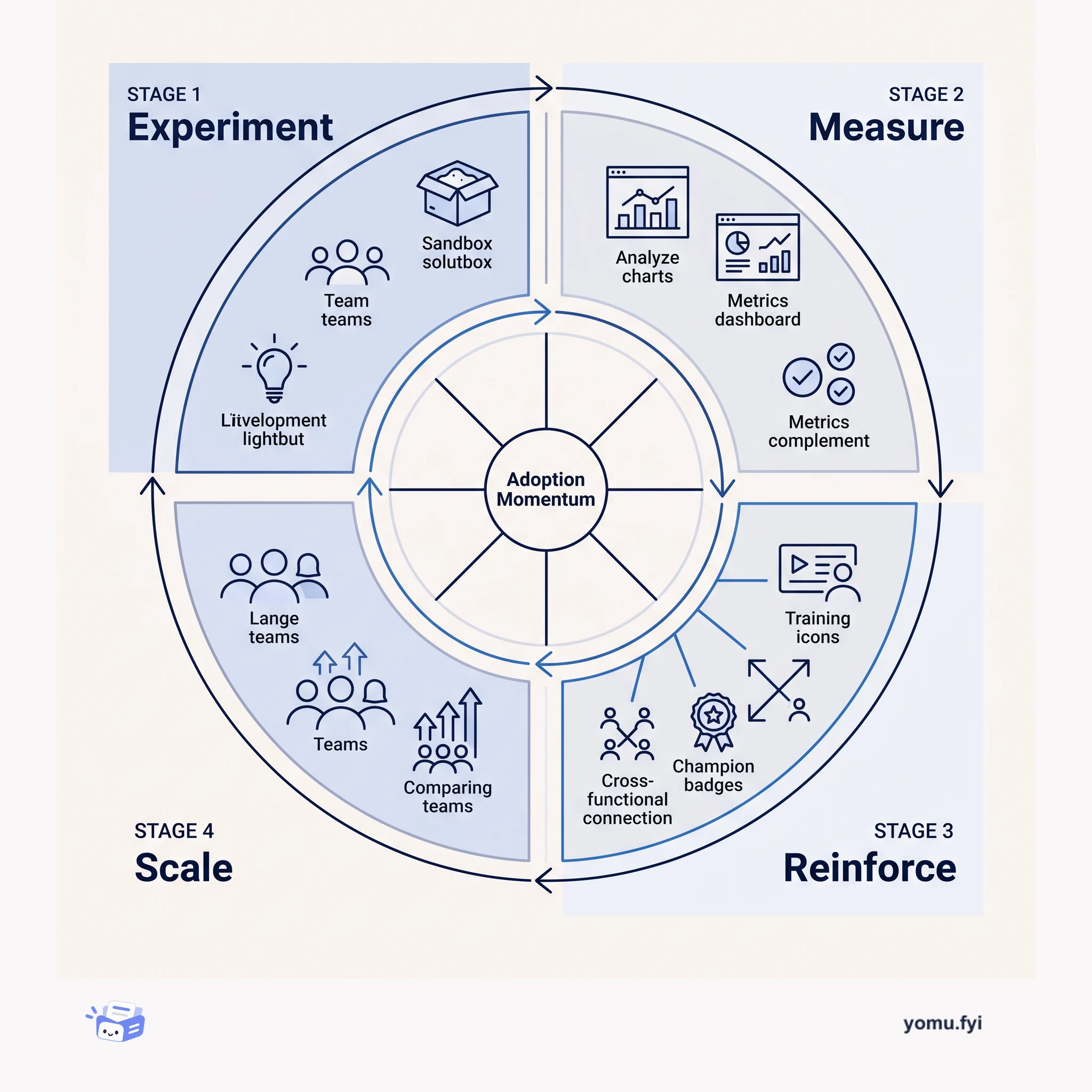
Adoption moves through experimentation, measurement, and reinforcement loops. Learn how leading companies build momentum from pilot programs into enterprise-wide habits and measurable business impact.
The Good Stuff
Paid picks we use ourselves. Links carry a referral code — a subscription through one earns us a commission at no extra cost to you.
Newest first
NeoMME is a family of 260M and 800M multilingual multimodal encoders designed to represent text and images without a separate pretrained vision tower or causal language model. A single bidirectional Transformer processes text tokens and raw 32×32 image patches, while pretraining from scratch uses a masked discrete-diffusion text-denoising objective with high masking to encourage image-grounded reconstruction. The retrieval variant adds jointly trained dense mean-pooled and 128-dimensional late-interaction heads, returning both in one forward pass for page-image retrieval. On ViDoRe v3, the 260M model reaches 0.523 and both sizes lie on the model-size Pareto frontier; at 2048×2048, it encodes about 51 pages per second on an NVIDIA L40S, roughly twice ColModernVBERT's throughput. Hierarchical token pooling and asymmetric quantization reduce late-interaction storage from roughly 1.5 MB to 6 kB per page, a 255× reduction, while retaining more than 95% of baseline nDCG@10.
An interview with Python educator Ardit Sulce examines how beginners should learn programming as AI changes development and teaching. Sulce says AI now handles many small questions, while teachers provide curated learning paths, judgment, and context; he also argues that students should preserve productive struggle while outsourcing setup friction. He recommends evaluating understanding through code explanation, review, and debugging rather than treating working code as proof, and identifies reading unfamiliar code, debugging, and system understanding as important junior skills. His proposed three-stage path moves from writing syntax by hand in a professional IDE, to using AI as a tutor, and finally to using it as a co-worker while reviewing increasingly complex projects.
TeamCity 2026.2 makes pipelines generally available on TeamCity Cloud and On-Premises, moving them beyond the Early Access Program and adding branch-aware editing, failure-tolerant job execution, promotion, job debugging, and VCS-unbound workflows. The release also expands AI capabilities: AI Assistant supports Bring Your Own Key for Anthropic, OpenAI, Google Gemini, other supported models, or a local LLM, while MCP adds pipeline management tools and OAuth/PKCE authorization. Additional changes include configurable retries for failed dependencies, IDEA plugin improvements, GitHub pull-request matching by source branch, and a choice of server- or agent-side Kotlin DSL compilation. The pipeline MCP post and delete tools require manually enabled Brave mode, and DSL compilation on agents is described as less restricting and more secure but subject to trade-offs. Bug-fix updates 2025.11.8 and 2026.1.4 also ship.
IBM and Confluent are making IBM Granite Time Series foundation models available in Early Access on Confluent Cloud, bringing forecasting and other time-series capabilities into streaming workflows. The announcement addresses the cost and delay of bespoke models by offering models that generalize across previously unseen series and can be used for forecasting, anomaly detection, similarity search, classification, gap-filling and optimization. Native inference runs directly in Apache Flink through Confluent’s AI_FORECAST and AI_DETECT_ANOMALIES functions, with Flink maintaining keyed, fault-tolerant state for each series and results written to Kafka topics. Confluent manages serving, scaling and runtime operations while retaining schemas, lineage, access controls and replayable data within the platform. Early Access starts on Confluent Cloud on AWS at no charge, with Confluent Platform planned next for on-premises and hybrid environments.
Modal is expanding in Europe with a new London office, its second in the region, representing a larger investment in the area. The company already has nearly 20 engineers in Stockholm who built core parts of Modal, including its custom file system and Sandboxes product. Hugh Killingbeck-Jones joins as VP EMEA to lead go-to-market teams in London, which the company considers the AI capital of Europe. European AI-native companies like Black Forest Labs and Legora, as well as global platforms like DoorDash, run on Modal for tasks such as model evaluation and agent testing. The company is hiring across sales, engineering, and other roles in London and Stockholm, and plans meetups across EMEA.
Botika builds agentic e-commerce teams that automate visual production for global fashion brands, using proprietary foundation models and a 100-terabyte image dataset. The company runs its entire full-stack AI operation on Modal, with the data pipeline processing 100 terabytes at less than 1% error rate across thousands of containers. Before Modal, the team struggled with Kubernetes fleet management and slow GCP Batch jobs; now a single researcher can launch 50 experiments daily using Claude, and they set up reinforcement learning infrastructure in less than a day. Modal handles autoscaling, cold starts, and multi-node training with RDMA, allowing Botika to double traffic in seconds, and they serve about 15 models on L4s, L40S, A100s, and H100s. The infrastructure is not Modal-specific, enabling the team to run open-source and custom frameworks without modification.
BenchMIRT is a method for auditing LLM benchmarks at the individual-prompt level, where questions may measure capabilities beyond a benchmark’s stated goal. It applies multidimensional Item Response Theory (MIRT) to model and question results, estimating model abilities plus each item’s difficulty and discrimination across dimensions. Trained on 100 LLMs, 16 benchmarks, and more than 34K questions, it independently recovered safety and general reasoning as dominant dimensions, repeatedly producing the same result. The analysis found, for example, that BBQ and WMDP aligned more strongly with reasoning than safety, while HarmBench combined safety- and reasoning-associated question groups; retaining 10% of items generally preserved capability rankings, and held-out correctness prediction reached 79% versus 70% for a baseline. BenchMIRT’s dimensions depend on the benchmark set, and its item-level transparency can also enable evaluation trimming.
Anthropic describes a text-watermarking system planned for Claude to estimate whether Claude was involved in generating or processing text, primarily to comply with the EU AI Act. The method uses a key and preceding words to influence the source of randomness in low-stakes word choices, creating a detectable pattern without adding characters, tokens, identifying information, or extra cost. Anthropic says internal testing found no impact on content, creativity, readability, or perceived quality, while detection confidence improves with longer passages and weakens when text offers few valid alternatives, such as factual statements, proofreading, or code. The watermark can indicate only that Claude was likely involved, not whether text was human-written, who authored it, or which person or organization used Claude; light editing may not remove it, but a complete rewrite will.
NVIDIA and CrowdStrike describe an agentic cybersecurity system that links red-agent attack execution with blue-agent detection engineering in a continuous offense-defense testing loop. In an isolated environment modeled on NVIDIA accelerated computing infrastructure, Falcon sensors captured telemetry while Nemotron 3 Ultra orchestrated the defensive workflow and a customized Nemotron 3 Super generated or repaired detections. The harness grounded agents in sensor schemas and attack traces, then applied linting, replay, structured correction, and independent review before deployment. Backtesting raised mean detection of the recorded attack from 16.5% to 41.9% with the optimized open pipeline across independently seeded sessions. In live-fire tests, five of 11 open detections detected an unseen attack, three qualified as gold, and those three covered all eight attacks; the authors call the result a directional case study because it used one scenario family and limited benign traffic.
Becoming an AI team requires more than adding assistants to existing workflows: it changes ownership, planning, roles, and execution. At Pinterest, infrastructure teams face the scale of serving billions of Pins, boards, ads, and real-time signals, making AI adoption an operational necessity for reliability, cost efficiency, and developer productivity. AI code-generation and transformation models can turn a widespread legacy-codebase refactor, such as replacing “foo” with “bar,” from a months-long effort into work completed and verified in a week or less. As routine execution is increasingly augmented or automated, engineers, product managers, and designers are expected to spend more time on strategy, problem definition, and user validation, while managers emphasize vision, trade-offs, mentorship, and collective impact. The conclusion is that teams must continuously optimize an AI-driven operating system rather than treat AI as a side project.
The Databricks Partner Network has launched Bronze, Silver, Gold, and Platinum tiers for ISVs and data providers, with placement based on customer impact, technical excellence, strategic alignment, readiness and enablement, and joint go-to-market activity. Technical Excellence is evaluated through the Partner Well-Architected Framework (PWAF), which provides prescriptive, AI-ready guidance for secure, reliable integrations and serves as the standard for validated architecture. For customers, the tiers signal that a partner solution has met a high bar for architecture, security, compliance, and joint customer success, reducing vetting effort. For partners, each tier defines requirements and a roadmap tied to greater visibility, co-selling, and go-to-market support, while Databricks plans to refine the program and expand benefits over the coming months.
Customer service teams may avoid disclosing AI because they fear customers will leave, but the post argues that unclear or delayed disclosure creates more frustration than honesty. It recommends a short first-turn greeting that says “AI,” explains what the agent can do, and offers an immediate route to a human, with renewed disclosure when a conversation moves to SMS or voice. Web chat, SMS, and voice examples show how to pair disclosure with an exit, while voice should disclose before the caller explains the issue and leave a pause. The post identifies burying the disclosure, using ambiguous labels, apologizing, over-explaining, and omitting escalation as failure modes. It proposes checking Twilio Conversation Intelligence transcripts alongside containment and escalation rates to assess wording changes, citing research on customer expectations and bypass behavior.
An AI copilot is an assistant embedded in a software application that uses workflow context to offer suggestions, generated content, or approved actions while keeping the human in control. Unlike a standalone chatbot, it combines an LLM with contextual grounding, retrieval-augmented generation (RAG), access to enterprise data, and action layers that can call APIs, execute code, trigger workflows, or update records. The explainer surveys code, productivity, data and analytics, customer-facing, and domain-specific copilots, including uses such as SQL generation, dashboard creation, email drafting, and case summarization. Reported benefits include faster routine work, broader data access, more consistent outputs, and less context switching; a cited GitHub study found Copilot users completed a controlled coding task 55% faster. It also stresses hallucinations, privacy, bias, overreliance, integration complexity, cost, and the requirement for human review, governance, and accountability.
Claude for Teachers gives verified US K-12 educators free access to premium Claude capabilities, tailored teaching skills, Learning Commons curricula, and academic standards across all 50 states. It is designed to help teachers apply differentiation, mastery-based learning, and small-group instruction despite limited time, resources, and large classes, with an emphasis on protecting time with students. Once verified, users can ask Claude to draft standards-aligned lessons, differentiate materials, analyze de-identified classroom data, and schedule recurring tasks; Claude Code and Cowork support carrying work forward. The offering includes no model training on verified teacher conversations, FERPA-aligned protections, and district and state control over educational-data use. Anthropic is releasing connectors, open-source teaching skills, and an evaluation write-up, while planning a Detroit Public Schools Community District pilot focused on educator wellbeing and practice.
Anthropic is expanding support for scientific researchers through free and discounted Claude subscriptions, research credits, and products designed for scientific work. The new Claude team plan for scientists opens 10,000 seats worldwide for one year: standard seats are free, while premium seats with five-times usage limits cost $15 per month; the program is intended to grow beyond that initial allocation. Its AI for Science program, previously focused largely on biological sciences, will offer credits to researchers in additional fields, including compute-heavy work, with up to $50,000 available per project after lab usage exceeds standard or premium allowances. Access requires principal investigators or equivalent leaders at academic or nonprofit institutions to verify their labs, while biology and chemistry researchers remain limited to Opus-class models and Fable continues to block professional biology and drug-development queries because of dual-use risks.
Anthropic is launching Anthropic's AI for Science program, an initiative that provides free API credits to researchers pursuing high-impact scientific projects, with particular emphasis on biology and life sciences. Qualified researchers will be selected according to their contributions to science, the potential impact of proposed research, and whether AI can meaningfully accelerate the work. The program is intended to support uses including analyzing complex scientific and genetic data, generating hypotheses, designing experiments, communicating findings, understanding biological systems, accelerating drug discovery, and increasing agricultural productivity. Researchers attached to research institutions can apply through an application form, with reviews conducted by Anthropic's team and subject matter experts in relevant fields.
Claude for Education is adding integrations with Canvas, Panopto, and Wiley to bring course materials, lecture transcripts, and peer-reviewed content into student conversations. Canvas LTI lets students use Claude inside courses, while Wiley and Panopto connect through pre-built MCP servers. Conversations are private by default, excluded from AI training by default, institutional data requests require formal approval, and self-serve data exports are limited by default. The announcement also covers new institutional partnerships, a tenfold expansion of the student ambassador program, and Claude Builder Clubs featuring hackathons, workshops, and demo nights. It frames responsible collaboration, ethics, privacy, and equitable access as necessary to avoid deepening existing divides while AI transforms education.
Anthropic is expanding Claude into a life sciences partner intended to support work from early discovery through translation and commercialization, beyond earlier uses for coding and paper summarization. The rollout combines model improvements, scientific connectors, Agent Skills, a prompt library, and dedicated support for researchers, clinical coordinators, and regulatory affairs managers. On Protocol QA, Sonnet 4.5 scores 0.83 against a human baseline of 0.79 and Sonnet 4’s 0.74, while BixBench shows a similar improvement over its predecessor. Connectors include Benchling, BioRender, PubMed, Scholar Gateway, Synapse.org, and 10x Genomics, while a single-cell-RNA-QC skill applies scverse best practices to quality control and filtering; use cases also cover literature reviews, protocols, bioinformatics, and regulatory submissions. The offering is available through Claude.com and the AWS Marketplace, with Google Cloud Marketplace availability described as coming soon.
Anthropic and Iceland’s Ministry of Education and Children are launching a national AI education pilot that will give hundreds of teachers across every region access to Claude. The initiative combines the AI tool with educational resources, training materials, and a dedicated support network while examining how artificial intelligence can support instruction, lesson preparation, and student learning. Teachers will be able to analyze content ranging from complex texts to mathematical problems, create personalized lesson plans, adapt materials for different learners, and use Claude’s recognition of Icelandic and other languages to support students. Iceland’s education minister says the project will examine AI’s use across education with teachers’ needs guiding the work and with harm prevention in view, while Anthropic describes it as a practical model for responsible public-sector deployment.
Anthropic announces Claude for Healthcare and expanded Claude for Life Sciences capabilities, adding HIPAA-ready tools for providers, payers, health-tech companies, and individuals managing personal health data. Healthcare connectors cover CMS coverage determinations, ICD-10 codes, the National Provider Identifier Registry, PubMed, and beta integrations with HealthEx, Function, Apple Health, and Android Health Connect; new Agent Skills support FHIR development and prior-authorization review. Life sciences additions connect Claude to Medidata and ClinicalTrials.gov while extending support from preclinical research toward clinical trial operations and regulatory work. The announcement presents Claude Opus 4.5 as a major step in agentic performance on detailed medical and scientific simulations and says its extended-thinking mode improves correctness on honesty evaluations, while emphasizing opt-in permissions, user-controlled access, no training on health data, contextual disclaimers, and referral to healthcare professionals.
The best engineering reads, once a week.