Brand: Artifact vs Operating System
Compare two mental models for brand: a static artifact (logos, guidelines, centralized control) and a living operating system (values, APIs, support, trust). See which choices fit your engineering team.
Loading…
Topic
446 posts about Developer Experience. Every summary links to the original.
See the idea
Compare two mental models for brand: a static artifact (logos, guidelines, centralized control) and a living operating system (values, APIs, support, trust). See which choices fit your engineering team.
An app store is a distribution surface, a versioned contract, and a health loop between a platform and its developers. Here is how those parts fit together and why each one fails loudly if ignored.
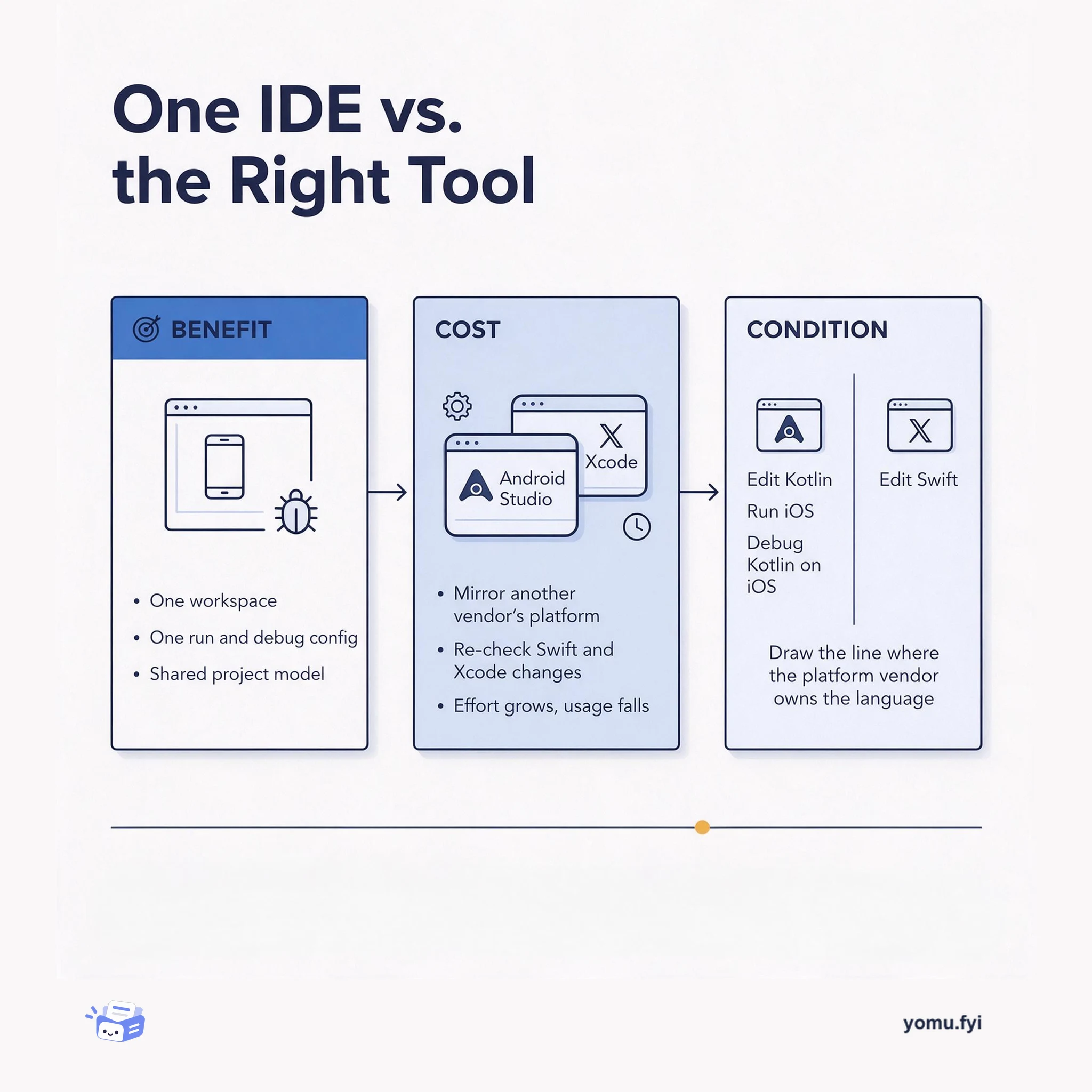
Android Studio keeps cross-platform Kotlin run and debug in one workspace but hands Swift editing to Xcode. This explainer maps the benefit, cost, and condition behind that boundary.
The Good Stuff
Paid picks we use ourselves. Links carry a referral code — a subscription through one earns us a commission at no extra cost to you.
Newest first
The Shop Store team implemented a server-driven UI architecture for the Shop App’s Store Screen to personalize sections and layouts for different merchants. Previously, the client rendered a fixed layout, limiting customization, experiment timing, and the speed of fixes after weekly app releases. The new design uses template processing, orchestration, data loading, and a shop-server GraphQL layer, with ProductsSection and CollectionsSection types and configurable GridLayout or ShelfLayout options. On the client, ServerDrivenStoreScreen and StoreSectionContainer render the sections returned by the server, while default layouts allow older app versions to handle unfamiliar section or layout types. The architecture enables backend-controlled experiments and section changes without requiring an app release, while giving the product team a system intended to grow with the store experience.
FlashList is Shopify’s React Native list library, created after Shopify’s migration from native technology exposed poor list performance in React Native. The post explains how a four-person team prototyped a library that combined FlatList’s familiar API with RecyclerListView’s performance, while addressing blank spacing and low frame rates on some devices. It also describes a launch planned six months ahead around a landing page, documentation, blog storytelling, social media, conference exposure, and feedback from external users. The post says FlashList was used in production on some Shopify app screens, and the launch achieved 1,000 GitHub stars in less than 24 hours. The broader conclusion is that successful open-source projects require product thinking, user empathy, community building, and a long-term authority-building strategy in addition to code.
Supabase’s October 2022 update reports a broad set of product, documentation, and community releases, while announcing that Launch Week 6 will run from December 12–16. The new supabase-js v2 and supabase-flutter v1 SDKs reached full release, alongside a revamped Next.js quickstart with pre-built Auth UI and Auth Helpers and a Next.js 13 example for fetching and caching data from the Serverless API. Documentation covers Supabase Auth’s server-side rendering flow, and a database-testing framework uses pgTAP and pg_prove; Edge Functions also gained support for GET, PUT, PATCH, and DELETE requests. Additional changes include functions support in supabase-py, session refreshing, provider refresh tokens, request-location detection through X-Forwarded-For, expanded logging, and storage downloads via a query parameter, alongside three featured community apps and hiring announcements.
Shopify announces that the open-source web framework Remix and its team are joining the company to help developers deliver lightning-fast, resilient web experiences. Remix combines multi-page and single-page strengths through a full-stack React framework with data loading and code splitting handled without requiring front-end developers to manage those backend tasks. It also emphasizes progressive enhancement, with links, buttons, and forms working before JavaScript loads, and supports edge, service-worker, and Node runtimes. Shopify will use Remix across projects including Hydrogen; Hydrogen is moving from server components to Remix's data-loading pattern for faster performance and a simpler developer experience, with ~90% of developers' code expected to remain unchanged. Remix will remain independent and open-source while Shopify supports its roadmap and community.
Developer infrastructure managers must balance three poles: management support, system and domain expertise, and organization-wide road maps, with the tension intensified by teams that often lack dedicated product managers and support critical systems for hundreds or thousands of users with six to eight developers. Domain-focused teams build deep knowledge needed for maintenance, migrations, incident investigation, on-call coverage, and developer-experience improvements, but their local road maps can diverge from the department’s highest-impact opportunities. The proposed responses are temporary individual assignments, having a whole team contribute to another team’s goals, and forming a cross-functional tiger team; each shifts trade-offs among focus, maintenance, expertise, motivation, and management oversight. A month-long tiger team built the first Spin proof of concept, which led to a dedicated team, but no structure eliminates the tensions, so choices must be judged according to context.
Working across time zones can make live collaboration difficult when teammates are nine to 12 hours apart, as described by a developer based in Singapore. The proposed alternative is to treat much of the work as asynchronous and deliberately document progress, blockers, decisions, and context. Examples include taking turns across working hours, annotating non-obvious pull request changes, posting end-of-day summaries with links or investigation notes, and recording meetings with agendas, key decisions, and action items. During Shopify's Hack Days prototype work on Linkpop, a Singapore-based frontend developer handed off updates before sleeping while North American teammates extended backend functionality and responded to blockers. The post concludes that these practices become habits that support handoffs, reduce back-and-forth, preserve information for absent teammates and future reference, and can provide longer uninterrupted focus periods.
Supabase has released the stable v1 of its supabase-flutter SDK after several months of developer preview feedback and improvement. The release targets developer experience by reducing boilerplate and introducing more intuitive APIs, including removal of the required .execute() call from select, insert, update, delete, and stream operations; query errors are now thrown rather than returned. Authentication methods use more descriptive names such as signInWithPassword and signInWithOAuth, while onAuthStateChange returns a Dart stream. The SDK also adds first-class support for Realtime Multiplayer's broadcast and presence methods, including low-latency data sharing and client-status tracking, and the announcement provides updated documentation, a quick start guide, and a v0-to-v1 migration guide.
Shopify’s Trust team faced rising complexity in securing a distributed device fleet, including many tools, provisioning and patching work, varied networks, and the loss of in-person remediation. Hubble was built as a unified layer over mobile device management and other security systems, ingesting and standardizing their data while sending commands back with granular access controls and centralized auditing. IT staff use it for inventory, device management, and security, while employees can view device health and compliance, receive remediation guidance, and manage test-device or beta participation. The platform also serves as a standardized source for automation, and the post presents encapsulation and cross-team investment as ways to reduce administrative overhead, support proactive security, and limit risk.
Supabase-js v2 has been released after a release-candidate period during which the team incorporated user feedback and updated documentation, examples, quickstart guides, and a migration guide. The release’s major addition is built-in TypeScript support, including a CLI that generates types directly from a database. It also includes improvements aimed at addressing some of the largest pain points identified by users, with the announcement providing updates and differences from v1. Version 2.0 was produced through contributions from several Supatroopers, more than 100 contributors to the libraries, and more than 450 contributors to the documentation and websites; the listed package contributions include functions-js, gotrue-js, postgrest-js, realtime-js, storage-js, and supabase-js.
The article argues that pull request (PR) discipline matters beyond code correctness because implementation and maintenance both benefit from changes that are clearly structured and documented. It describes a PR as a proposal whose title, summary, commits, comments, reviewers, labels, projects, and linked issues should intentionally communicate scope, design reasoning, low-level details, ownership, and historical connections. Its practical guidance focuses on precise titles, useful summaries, logically ordered commits, deliberate remote-branch changes, defined PR boundaries, and moving asides into follow-up PRs. It also recommends smaller, well-ordered PRs, permalink-based code references, distinctive branch-name prefixes, and learning Git commands including reflog, cherry-pick, and rebase. The article treats discipline as judgment rather than rigid law, allowing emergency exceptions while encouraging post-resolution documentation.
The article argues that developers can minimize code reading when fixing bugs or changing features by focusing on information not already checked by tools. It recommends locating a user-visible entrypoint, then making a deliberately breaking edit and climbing the callstack through build errors rather than reading each caller. Strict types, tagged unions, exhaustive switches, linters, and unit tests expose incompatible inputs, missing cases, deprecated patterns, and affected consumers; pure functions separated from side-effect code keep tests simple and informative. After the tooling-driven passes, developers manually confirm behavior, revisiting the design when runtime issues remain and making future changes more "unread"-able.
Supabase’s September 2022 update centers on reducing technical debt and clearing its backlog after five Launch Weeks. The team ran three Kaizen weeks focused respectively on QA and testing, documentation, and issue backlog and automation, closing over 250 open issues and 50 pull requests while pausing feature development. Product releases included Auth UI, a pre-built React component for Supabase Auth with custom themes and extensible styles, plus an open-source Postgres WASM release with Snaplet for running Postgres in a browser through an embeddable Linux Virtual Machine. Security changes to Dashboard database interactions simplify permissions and reduce the security surface area; they were scheduled for automatic application in November or could be run earlier through the Dashboard. Other updates covered Edge Functions, documentation, migration tooling, and community projects.
The post presents feedback as a professional tool that can either support growth and collaboration or fuel ego-driven competition. It focuses first on pull request reviews, where engineers should prioritize critical code and logic over stylistic nitpicks, use linters or pre-commit hooks for uniform formatting, and frame comments to preserve a two-way educational dynamic. Recommended practices include discussing team review processes, explaining feedback goals, drafting messages before sending, reinforcing strengths, asking questions, separating behavior from identity, and making comments specific and timely. For broader workplace issues, the post advises asking whether feedback must be said, by the speaker, and immediately, then using considerate timing and SMART framing to improve the chance that it will be heard and produce change.
Pair programming is presented as a mentoring and onboarding tool for early-career developers in Shopify’s Dev Degree program, where interns use it to build technical and communication skills. The author created a flexible framework to address progress tracking, session goals, a safe space, and communication, then refined it through an interactive RenderATL workshop with more than 30 attendees. The framework lets pairs choose roles, structure, agenda, environment, and communication practices; one described style assigns a driver to type and explain thought processes while a navigator reviews, observes, and suggests edge cases or refactorings, with frequent role switches. It also warns against hostile, passive-aggressive, and overly absolute language, and the pilot received positive intern feedback for supporting learning goals in a flexible format while continuing to evolve.
Shopify’s tutorial shows how to manage a React product form with the open-source react-form library from its Quilt repository. It replaces component-level useState and earlier input and submit handlers with the useForm and useField hooks, which provide form and field state, event handlers, submission, reset, and dirty tracking. The example connects each TextField to its corresponding fields entry, using its value and onChange properties so typed input is captured and displayed. It then wires the hook’s submit function, resets the form after data is handled, and disables Save until either field changes. Finally, the notEmpty validation hook requires a title and displays a required-field error when a submission contains only a description.
Server-side WebAssembly offers Shopify Functions low cold-start latency and robust security, but debugging remains difficult because step-debugger support is less refined. The post compares four approaches: compiling to a native architecture, using LLDB or GDB with Wasmtime, using a dedicated WebAssembly debugger, and using browser developer tools. Native debugging generally provides the best variable rendering and a familiar workflow, though it may require stubs for external calls and cannot reproduce WebAssembly-specific behavior. Wasmtime keeps execution closer to the target environment, while dedicated and browser-based tools offer WebAssembly-specific capabilities but have missing features or lower-fidelity variable views. The recommended choice depends on whether the issue reproduces natively, and browser-based tooling may become more accessible as it improves.
The post examines how cultural differences in politeness, directness, and face-saving can distort written code reviews, causing useful feedback to be softened, misread, or ignored. It contrasts a passive-aggressive Shopify pull-request exchange about missing permalink tests with a more curious and explicit version that states why a separate test would be worthwhile. The discussion distinguishes assuming positive intent from asserting it: context can reduce bias, but it must not erase the impact of embarrassing or harmful communication. It recommends treating reviews as collaborative invitations, asking questions, explaining reasoning, acknowledging reviewers as contributors, and looking past stylistic language to shared goals. The conclusion is that clearer communication and shared ownership can make disagreement productive and improve both learning and the codebase.
Oxygen is Shopify’s hosting counterpart for Hydrogen custom storefronts, designed to provide globally available, fast storefronts with secure Shopify integration without additional third-party hosting costs. Its architecture combines GitHub and GitHub Actions with Cloudflare Workers and edge distribution, Shopify CDN, Admin API, Identity and Access Management, and Oxygen-scoped developer tooling and observability. Requests pass through a Gateway Worker, which validates authorization for the shop and storefront version before using Cloudflare’s Dynamic Dispatch API to route traffic to a Storefront Worker running Hydrogen code. Rather than build proprietary infrastructure, Shopify reused Cloudflare’s worker platform to reduce upfront complexity, scale, and security risks, while its observability stack uses Grafana, Cortex, Loki, and Tempo. Oxygen is used in production by Allbirds, Shopify Supply, Shopify Hardware, and Denim Tears, and is generally available to Plus merchants.
During Launch Week, Supabase announces six product updates spanning database security, authentication, dashboard administration, and developer tooling. Supabase Vault is a Postgres extension for managing secrets and encryption inside the database, built as a thin usability layer over pgsodium and released to gather user feedback rather than for immediate Supabase Platform availability. Auth UI moves from the @supabase/ui library into @supabase/auth-ui-react, with customizable themes, CSS and inline styles, and overridable labels for multilingual support; the initial release supports React. The update also adds granular Dashboard roles, pg_jsonschema for JSON Schema validation on json and jsonb, pg_graphql v0.4.0 with json/jsonb, the in filter, and larger-schema introspection, plus early-access signups for Supabase Auth MFA.
Supabase announces supabase-js v2, a release focused on developer quality-of-life improvements and designed around incremental changes rather than a large rewrite. Its type system uses CLI-generated database definitions at the client level, while authentication adds explicit signInWithPassword() and signInWithOtp() methods, makes most Auth operations asynchronous, and moves server-side methods under auth.admin. Data mutations return minimal by default unless select() is appended, constructor options are scoped by library, and Edge Functions automatically detect request and response content types. The release also introduces typed errors, a channel() interface for presence and PostgreSQL change subscriptions, and a preparatory path toward multiplayer features; older realtime syntax remains supported for now. Developers can install v2, consult updated documentation and migration guidance, while v1 continues receiving security fixes and maintenance patches for three months.
The best engineering reads, once a week.