Brand: Artifact vs Operating System
Compare two mental models for brand: a static artifact (logos, guidelines, centralized control) and a living operating system (values, APIs, support, trust). See which choices fit your engineering team.
Loading…
Topic
446 posts about Developer Experience. Every summary links to the original.
See the idea
Compare two mental models for brand: a static artifact (logos, guidelines, centralized control) and a living operating system (values, APIs, support, trust). See which choices fit your engineering team.
An app store is a distribution surface, a versioned contract, and a health loop between a platform and its developers. Here is how those parts fit together and why each one fails loudly if ignored.
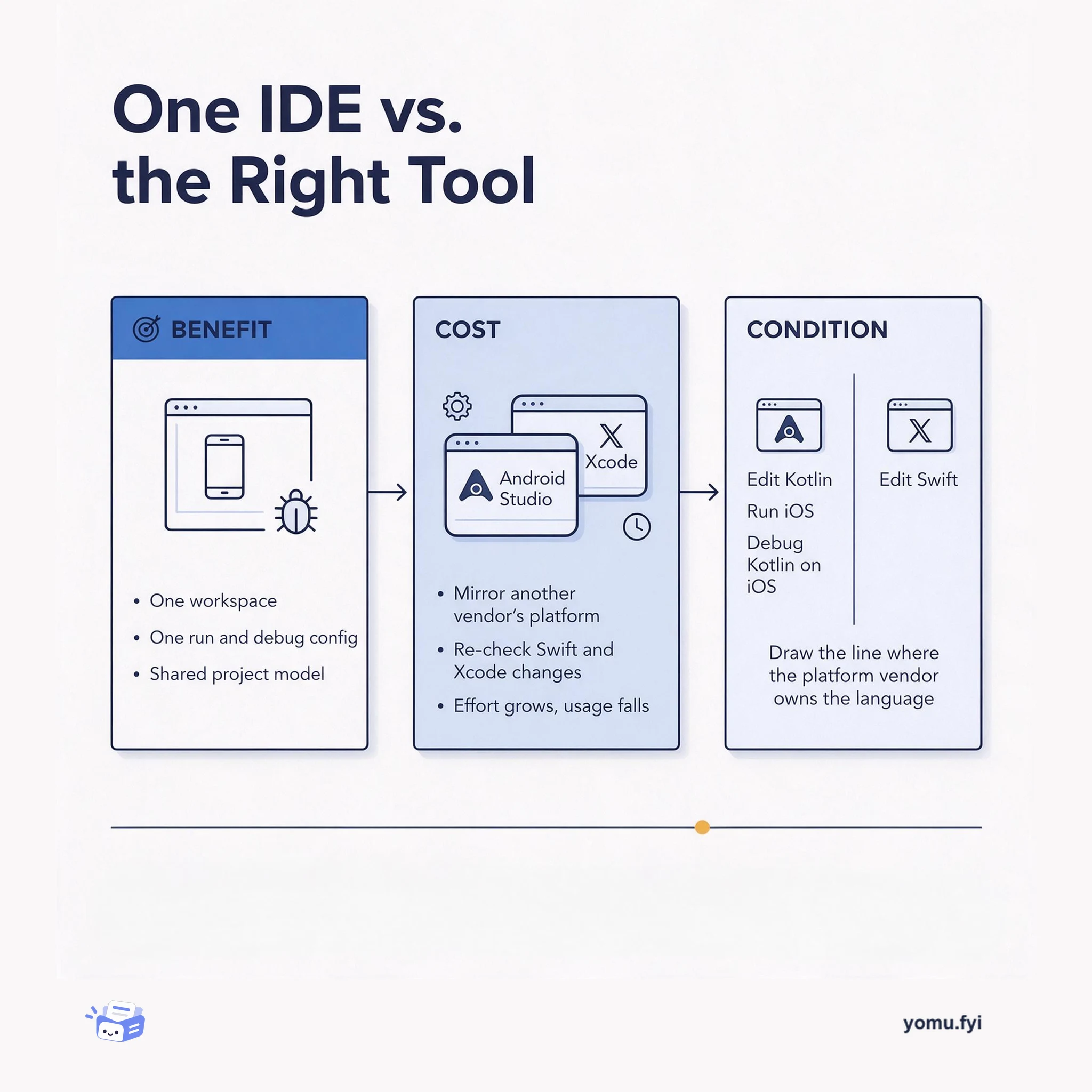
Android Studio keeps cross-platform Kotlin run and debug in one workspace but hands Swift editing to Xcode. This explainer maps the benefit, cost, and condition behind that boundary.
The Good Stuff
Paid picks we use ourselves. Links carry a referral code — a subscription through one earns us a commission at no extra cost to you.
Newest first
Supabase Studio 2.0 adds AI-assisted database development alongside a set of Postgres, GraphQL, and Table Editor improvements. The ⌘K menu can use AI to create tables, views, indexes, functions, and triggers, while also providing Studio navigation and Docs search; a future opt-in will send table schemas to OpenAI to help fine-tune queries. The release adds integrated GraphiQL, cascade-delete configuration, a Query Performance tool for investigating slow queries, foreign-key row selection, revised Postgres role management, editable database webhooks that can call Edge Functions, SQL definitions, API autodocs, and downloadable TypeScript types. It also improves responsiveness with many tables, expands JSON editing, and permits text and boolean cells to be null or empty, while the announcement says future work will focus on RLS policy assistance.
Shopify’s smart order routing replaces a one-size-fits-all approach to choosing which inventory location fulfills an order with configurable routing rules. Rules can rank eligible locations by proximity to the destination, staying within the destination market, or merchant-defined location priorities, and merchants can arrange them in an order in the admin. Each rule is a Shopify Function written in Rust, receives data shaped through a GraphQL query, and returns location rankings; a reducer resolves ties by applying later rules to locations tied at rank 0. The rebuilt process uses the pipeline pattern to separate input preparation, rule execution, reduction, and final location selection, improving readability and debugging compared with the earlier tightly coupled implementation. This first stage dogfooded Shopify Functions on its own merchant stores, with a later stage planned to let developers add more complex rules.
SupaClub is announced as the “world’s first Software Engineering Nightclub,” a Bali venue intended to combine Hardcore Techno with software engineering for South East Asia’s digital nomads. The stated motivation is that Supabase team members working remotely in Bali could not bring laptops into established nightclubs, preventing them from fixing bugs while listening to music. The venue is described as being in Canggu, opening the following Friday, with capacity for 4,000 developers across four floors, dedicated DJs, breakout rooms, 1Gbps WiFi, and bookable standing desks. Its private conference rooms reportedly offer SupaBrew bottle service, whiteboards, and UltraWide monitors, while the opening-night announcement names Ja Rule and Niki Minaj as performers. The post invites readers to request guest-list spots by email with a GitHub link and the subject “Re: april fools.”
As Grab expanded its superapp, manual QA sign-offs led to prolonged testing cycles and a peak in major production defects around 2019. To counter defect leakage and improve delivery pace, the engineering organization transitioned to a shift-left testing strategy across its software development lifecycle. Quality engineers began writing Given/When/Then acceptance tests prior to coding so that software engineers could execute them during development, accompanied by Definition of Ready and Definition of Done standards. The team also structured a multi-layer test strategy spanning unit tests, pipeline-executed UI component tests with mocked APIs, backend integration tests, and a custom internal end-to-end framework. Between 2019 and 2022, these changes reduced major and critical production issues by 60% and development-phase critical bugs by 40%.
OVO faced maintainability issues caused by fragmented web technology stacks, including PHP, Vue, React, Nuxt, and Go, alongside outdated documentation. This fragmentation resulted in severe context-switching costs during code reviews and prolonged onboarding times for new engineers. To establish a single primary front-end stack, the team compared React and Vue against maintainability principles encompassing operability, simplicity, and evolvability. Vue was selected because its standardized framework structure and documentation minimized architectural variations across projects. Implementation entailed creating a standardized Vue boilerplate, updating the internal UI library, and scheduling periodic upgrades for legacy React services rather than migrating them entirely.
Front-end internationalization can fail when code encodes English assumptions about word order, punctuation, pluralization, gender, or text layout. The post uses an image-status example to show why a complete sentence should be translated as a whole, then examines interpolation through a reusable status bar whose file-type and count values vary across languages. It explains that plural categories can include zero, one, two, few, many, and other, with Polish examples showing why numeric rules should not be hardcoded, and that gender can affect articles and adjectives, as in French. Its recommended practices include keeping linguistic decisions in translation strings, avoiding code-level text construction and elaborate styled layouts, and letting i18n libraries select plural forms from quantities; complex promo layouts may need simplification or language-specific images.
The Ruby LSP is a language server intended to improve Ruby’s developer experience by providing editor features through the Language Server Protocol, without typechecking code or requiring type annotations. It targets performance and stability in Shopify’s Core monolith, where it must analyze thousands of files that may themselves contain thousands of lines, and is opinionated toward Ruby on Rails. The article explains LSP’s client-server model, in which editors exchange JSON requests and responses over STDIN and STDOUT, then focuses on nonpositional features such as Folding Range, including document synchronization and parsing. It also outlines future work on parallel request processing, codebase indexing, caching, and a plugin system for framework-specific capabilities such as Rails navigation and model information.
Technical debt is framed as four categories that need different responses: yearly debt may involve rewrites or gradual replacement, monthly debt requires team-sized planning, weekly debt can become a sprint card, and daily debt is code tidying during ordinary work. The article cautions that some apparent yearly debt reflects growth or changing markets rather than a past mistake, while smaller debt can be deferred only if it is recorded and scheduled. The proposed 25-percent allocation gives 10% to daily improvements, 10% to weekly work, and 5% to planning monthly and yearly debt, with the latter focused on prioritization rather than implementation. Its conclusion is that sustainable remediation depends on team culture: engineers need permission and encouragement to refactor, teams need space to schedule broader work, and leaders need to weigh costs and tradeoffs.
Shopify is introducing a Local Developer Preview that lets developers run JavaScript Shopify Functions locally, alongside Rust, while production deployment remains unavailable. Shopify Functions execute as WASI modules that read JSON from stdin and write JSON to stdout, with a 256KB size limit and a five-millisecond runtime limit; the post notes that the timing constraint varies by machine load. Javy addresses JavaScript’s WebAssembly runtime challenge by bundling the QuickJS interpreter into a Wasm binary, using Rust wrappers and Wizer to snapshot compiled QuickJS bytecode. Initial tests found Javy-created modules about three times slower than equivalent Rust modules, but both are likely to stay under five milliseconds for realistic use cases; Shopify is also pursuing SpiderMonkey in Wasm and researching JIT support for future performance.
Cailyn Edwards recounts how she moved from leaving high school and running an organic farm to a career in infrastructure security through Shopify’s Dev Degree program. Before entering the program, she completed a horticulture co-diploma, finished high school and the required math courses, and pursued computer science while needing to pay her mortgage and maintain work-life balance. Dev Degree’s training path and rotating placements exposed her to computer science fundamentals, pair programming, Ruby on Rails on the orders team, infrastructure security, and network foundations, leading her to discover a strong interest in cyber security and cloud infrastructure. After graduating in September 2021, she joined Infrastructure Security full-time and later reports projects, internal security talks, a promotion to Senior Infrastructure Engineer, and Kubernetes contributions including a contributor award.
The post describes techniques for making draggable elements in a React Native Sheet component feel more natural during open-and-close gestures. A gesture handler updates yPosition as the user’s finger moves, then chooses an open or closed destination when the drag ends, but a position-only decision can ignore a fast flick and a fixed 600 ms animation ignores distance. The revised interaction adds event.velocityY, weighted by a multiplier, to the destination decision and uses withSpring so distance and release velocity affect the animation. It also divides overdrag distance when the Sheet is already open, creating resistance that communicates the boundary, and reports that flicks become easier while movement feels more realistic; the examples are ultimately recommended for testing on a real device.
Internal documentation is presented as a productivity and scaling tool for engineering organizations, especially as people move between teams, projects, or companies and remote work makes writing a default channel for knowledge sharing. Shopify’s approach combines standardized writing practices with three primary locations: Markdown microsites built with Docusaurus, internal GitHub for issues, READMEs, setup guidance, and searchable code, and the Vault, a GitHub- and Markdown-powered source of contextual information. The article argues that documentation should be treated as a product: it should be searchable, user-friendly, kept fresh, integrated into CI/CD, and hosted where engineers already work. It also recommends making writing routine through small contributions, paired writing, peer review, and audience-aware context, concluding that accessible documentation speeds onboarding, reduces duplicated problem-solving, supports asynchronous and cross-team collaboration, and improves developer literacy.
Shopify rewrote its unified CLI from Ruby to TypeScript running on Node after growing dependencies on Node tooling, Hydrogen’s preference for npm-managed dependencies, and a broader fit with web technologies. The rewrite aims to reduce system requirements, improve terminal consistency, and make contribution easier, while using a modular architecture of domain NPM packages built on @shopify/cli-kit. The team established shared code, UI, convention, and principle foundations, addressed cross-OS support, used TypeScript for stronger contracts, and applied Cucumber for end-to-end testing. The Node CLI unified and streamlined app development and added extensibility such as functions, but Theme commands still use Ruby and removing that dependency remains future work.
As Tinder scaled over a decade, maintaining visual consistency across its client applications became unsustainable and increased engineering overhead. To address this, the UI Platform team developed Obsidian, a unified design system combining design tokens, reusable components, and documentation. Designers define base and context tokens in Figma using the Tokens Studio plugin, which are then transformed by Style Dictionary into native artifacts for iOS, Android, and Web. Web developers integrate these tokens using Atomizer to generate static stylesheets, while a Zeroheight documentation portal and a custom token lookup tool assist legacy migrations. The ongoing migration has streamlined collaboration between designers and engineers, resolved styling ambiguities, and improved color contrast accessibility across platforms.
Aaron Patterson’s 2022 review surveys developments in Ruby and Rails, pairing runtime performance work with tools intended to improve developer productivity. YJIT’s compiler was rewritten in Rust, enabling ARM and Apple Silicon support while producing faster machine code; Variable Width Allocation adjusts object slot sizes to keep instance variables embedded and improve data locality. Ruby 3.2’s Object Shapes use property order as a class-independent inline-cache key, while Ruby LSP adds editor services and Error Highlight adds column-level diagnostics that now appear on Rails error pages. Patterson predicts—more accurately, hopes—that languages, frameworks, and development environments will become more interconnected, providing better suggestions, context, and assistance so developers can spend less time coding and more time solving problems.
Supabase is releasing Custom Domains and Vanity Subdomains to give projects a more branded user-facing address. Custom Domains let a project use its own domain, such as api.example.com, instead of an assigned supabase.co hostname; they are generally available as a paid add-on through the Supabase dashboard. Vanity Subdomains let paid-plan projects choose a relevant subdomain on Supabase's domain, such as my-example-brand.supabase.co, at no additional cost, and the feature is launching in closed beta with setup instructions in the documentation. The release currently supports only one custom domain or vanity subdomain per project, while Edge Functions must still be accessed through their existing endpoint because they do not support either feature yet.
Supabase released a new version of its documentation, rebuilding the site with Next.js after outgrowing Docusaurus. The earlier setup became harder to maintain as client-library versioning expanded, contributions grew more difficult, and the docs remained separate from Supabase’s Next.js and Turborepo monorepo. To reduce migration risk, the team first created a one-week Next.js MVP that copied Docusaurus, then spent a month developing the new release with two full-time developers. It introduces a new design, a single sidebar for broader discoverability, and reference pages that group all functions in a library while improving TypeDoc-based generation. Future work described includes unified authentication, project-specific documentation, runnable Postgres WASM examples, interactive tutorials, improved Postgres full-text search, and balancing sparse and overly verbose content.
Supabase describes the hiring traits and operating model it believes support its growth, arguing that people matter more than methodology. It looks for extreme asynchronous effectiveness, egoless execution, continuous incremental improvement, a bias toward immediate action, ambitious problem-solving, and a founder mindset; seniority does not exempt anyone from independent-contributor work, self-management, or maintenance. The 60-person team spans 25 countries, uses meetings as a last resort, and gives autonomous product teams access to shared metrics, user feedback, and equity through an ESOP. Teams are organised around products such as Postgres, Auth, Storage, Realtime, and Functions, while cross-cutting groups consult rather than merely receive delegated tasks. Three-month product cycles set ambitious goals, and Kaizen Weeks focused on QA, documentation, and performance help address technical debt and incorporate improvements into ongoing workflows.
After Shopify became a fully remote-first company, its engineering organization refined how teams communicate, collaborate, and work across time zones. The recommended team structure concentrates engineers in related time-zone regions to maximize synchronous availability for discussion, pair programming, mentorship, and questions, while relying on asynchronous writing and documentation between teams. Teams are also asked to define communication norms that specify which medium to use, expected response times, and whether contact is appropriate after hours; documenting these rules reduces ambiguity and protects focus. Individuals should intentionally shape routines and work-life boundaries around their own energy, productivity, health, and responsibilities, then integrate those preferences with team norms. Together, these practices support flexible remote work by combining synchronous collaboration within teams, asynchronous coordination across teams, and greater control over the working day.
The post announces Supabase’s Content Storm, a community campaign created to promote Launch Week 6 through a coordinated release of external content. Supabase invited well-known YouTubers, community members, makers, the SupaSquad, and others building with Supabase to publish related material on the same day, while giving participants an opportunity to build personal brands or promote products and startups. More than 30 creators took part, producing videos, livestreams, tutorials, project write-ups, and a Twitter thread covering topics such as authentication, migrations, Edge Functions, Storage, GraphQL, Flutter, Rust, and TypeScript integrations. The content was published on Tuesday, December 6, and the post provides a complete list of works and authors while directing readers to bookmark the collection, give feedback, and follow contributors.
The best engineering reads, once a week.