Brand: Artifact vs Operating System
Compare two mental models for brand: a static artifact (logos, guidelines, centralized control) and a living operating system (values, APIs, support, trust). See which choices fit your engineering team.
Loading…
Topic
446 posts about Developer Experience. Every summary links to the original.
See the idea
Compare two mental models for brand: a static artifact (logos, guidelines, centralized control) and a living operating system (values, APIs, support, trust). See which choices fit your engineering team.
An app store is a distribution surface, a versioned contract, and a health loop between a platform and its developers. Here is how those parts fit together and why each one fails loudly if ignored.
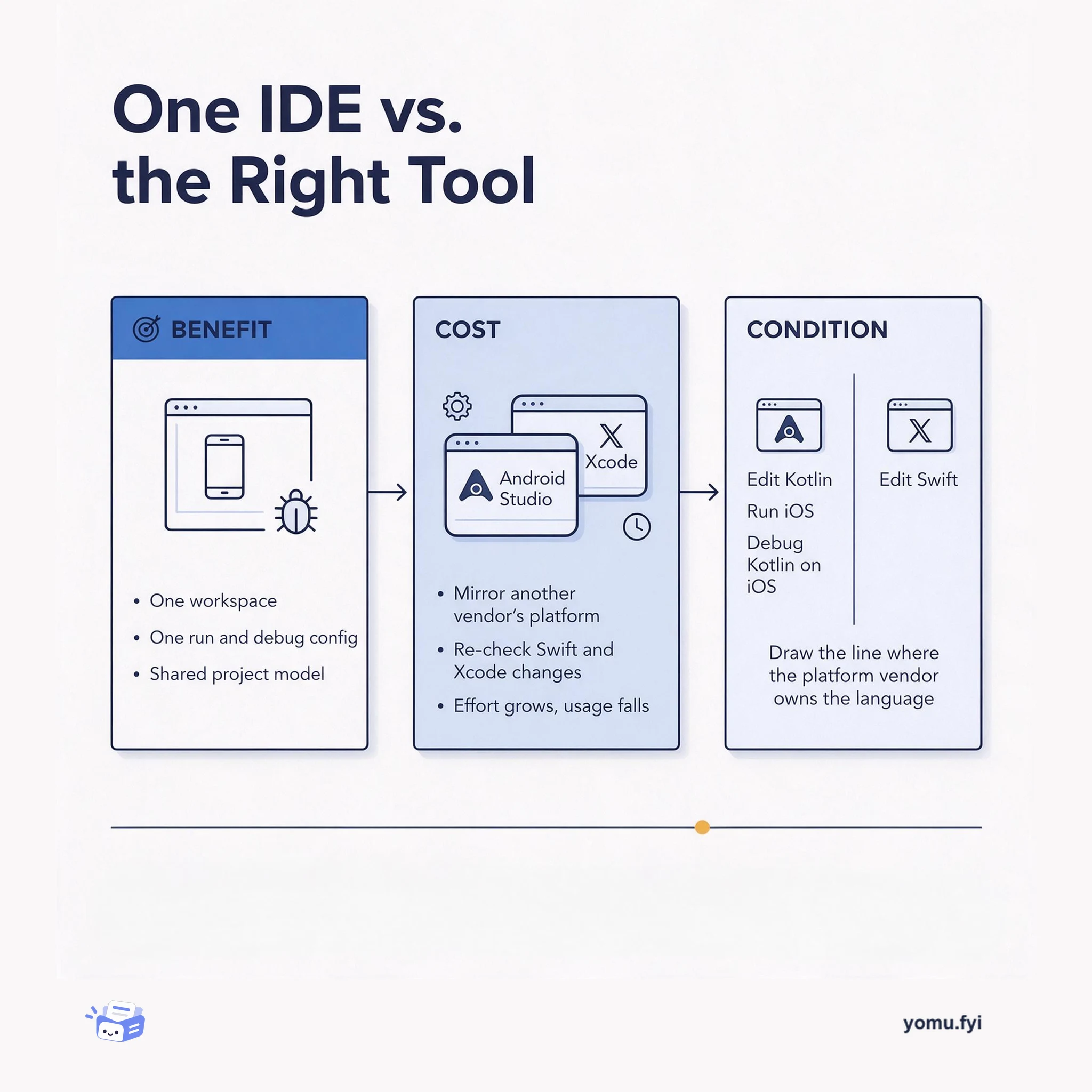
Android Studio keeps cross-platform Kotlin run and debug in one workspace but hands Swift editing to Xcode. This explainer maps the benefit, cost, and condition behind that boundary.
The Good Stuff
Paid picks we use ourselves. Links carry a referral code — a subscription through one earns us a commission at no extra cost to you.
Newest first
Hydrogen uses Tailwind as the default styling option in its React-based starter, allowing developers to build storefronts with utility classes from the moment they run create-hydrogen-app. The article presents componentization as a central way to organize those classes: React components can encapsulate responsive, hover, flexbox, spacing, typography, and visibility utilities and be reused across a storefront. It contrasts this with semantic class systems whose names can become coupled to a product component, making reuse, renaming, or duplication more cumbersome. Tailwind’s learning curve still requires CSS knowledge, but its documentation and VS Code extension support autocomplete, style representations, and color previews. The conclusion is that Tailwind’s constraints, customizable design system, and composable styles complement Hydrogen’s starter components and developer experience, although the author acknowledges that readers may still prefer other approaches.
React Server Components (RSC) introduced a paradigm shift for the team building Hydrogen, a React-based framework for custom storefronts. The post presents patterns developed through trial and error, beginning with shared components as a middle ground and reserving client components for interactivity, useState or useReducer, lifecycle logic, unsupported libraries, or browser APIs. Components should instead become server components when they contain secrets or proprietary logic, need filesystem or database access, fetch storefront API data, or do not execute on the client. The examples extract newsletter form controls and FAQ accordion behavior into client components, then rename the remaining wrappers as server components when their usage allows it; the FAQ server component is passed through a client component as children.
Updated for Hydrogen 0.26.0, the tutorial builds a simple product page for a custom Shopify storefront using Hydrogen’s React-based framework. Starting from the Hello World template on StackBlitz, it adds Tailwind CSS, creates a file-based dynamic product route, and queries product data through the Storefront API with the useShopQuery hook. The implementation then uses React Server Components alongside a client component and ProductOptionsProvider to track selected variants and options, update prices, and support a BuyNowButton checkout flow. A media gallery and additional styling complete the page, which uses products and media from the Hydrogen Preview store. The post concludes that Hydrogen’s components, hooks, and utilities reduce repetitive storefront work and speed development.
Programmatically searching the Hugging Face Hub previously required navigating web browser widgets or enduring trial and error to guess exact query string formats. The huggingface_hub library solves this issue by introducing helper utilities such as ModelSearchArguments, DatasetSearchArguments, and ModelFilter alongside HfApi. These namespace helpers translate accessible Python attributes into the formatted parameters expected by the backend API, covering datasets, tasks, and libraries. For complex queries across multiple tasks, frameworks, and datasets, developers can combine criteria inside ModelFilter instances and retrieve matching model metadata via api.list_models. Under the hood, the library uses AttributeDictionary, a data structure inspired by fastcore that enables nested tab-completion while supporting standard dictionary key indexing for special characters.
Shopify’s 2021 BFCM four-day event exposed the scale its commerce platform must absorb: peak app-server traffic exceeded 32 million requests per minute, load balancers surpassed 34 million RPM, and a flash sale used more than 20% of total computing capacity. The post frames larger, spikier sales, mobile and social commerce, and expanding buying environments as enduring engineering challenges for supporting millions of merchants. Planned work includes evolving the large Rails codebase into modular components, moving storefront rendering out of the monolith, expanding Spin cloud development environments, and making in-house load testing part of product development. The storefront split and refactoring produced four-times-faster cache fill rates and five-times-faster page rendering, while YJIT ran 31% faster than interpreted CRuby and 26% faster than MJIT; Shopify also remains committed to Rails and React Native.
Supabase announced the acquisition of Logflare, a realtime log ingestion and analytics platform. Modern database architectures encompass APIs, authentication, storage, and CDNs, requiring unified observability to diagnose slow queries and trace user requests effectively. Built with Elixir—the same language powering Supabase's Realtime Engine—Logflare automates schema adaptation for streaming inserts and enables developers to construct APIs from SQL queries via Logflare Endpoints. The integration roadmap includes embedding log querying with SQL directly into the Supabase Dashboard, maintaining existing integrations for Vercel and Cloudflare, and transitioning Logflare toward a fully open-source implementation with multiple backend storage engines. Over the coming months, existing Logflare users will be migrated to the Supabase platform under matching pricing tiers.
Shopify describes a UI extension architecture designed to give third-party code consistent, accessible, cross-platform experiences without allowing it to compromise the host application. Its remote-rendering approach separates UI definition from rendering, with extensions communicating with hosts through MessageChannel-based message passing; hosts are implemented in JavaScript, Kotlin, and Swift. The open-source remote-ui library supplies RPC for passing callbacks across postMessage, automatic memory management, a DOM-like RemoteRoot that serializes updates as JSON, and receivers that map remote components to DOM or React components. A sandbox isolates untrusted extension code and controls exposed APIs across web workers, Android web views, and iOS JsCore. The system powers product-subscription and post-purchase extensions, while a DOM-based version began releasing in July 2025.
Supabase has released Supabase Studio, making the web dashboard used on its hosted platform available for local development and self-hosted environments. The dashboard originally existed within a single internal monorepo alongside cloud infrastructure, but managing split repositories and code synchronization significantly slowed down production release cycles. To streamline development, the team unified the frontend into a single open-source codebase modeled after Sentry's shared architecture strategy. Built with Next.js, Tailwind CSS, Supabase UI, and MobX, the application works directly with existing deployments across Docker and the Supabase CLI. The open-source release focuses strictly on database management features, including SQL editors, role policies, and extensions, while excluding cloud project administration.
Following their participation in YCombinator, Supabase sought a structured method to maintain product momentum and recreate the urgency of an accelerator internally. The team established Launch Week, a quarterly shipping sprint using a fixed-timeline and flexible-scope model where a major feature or announcement releases each day for a week. Each cycle begins with a broad distributed planning session that maps high-level goals and generates ideas, followed by execution and finely scheduled launch days covering coordinated social media, blog posts, and community engagement. Following the launch, team members transition into maintenance mode and downtime to handle support, bug fixes, and open-source contributions. Finally, a structured retrospective evaluates successes, failures, and process relevance before carrying lessons into the next planning meeting.
Supabase organized Launch Week III: Holiday Special from November 29 to December 3, 2021, delivering daily product releases, tooling improvements, and ecosystem announcements. The week began with Community Day to showcase external contributions and open source tooling utilized by the team. On Tuesday, Supabase released Supabase Studio, allowing engineers to utilize the official platform management dashboard in self-hosted configurations and local development workflows. Midweek releases included the rollout of Realtime Row Level Security on Wednesday, followed immediately by Thursday's announcement detailing the acquisition of Logflare. The five-day launch series concluded on Friday with a final batch of five distinct feature announcements across the Supabase platform.
Early-career engineers may struggle to learn and grow while adapting to a new job, especially when time and energy are limited. The guidance recommends identifying knowledge gaps, pairing with teammates, and learning by contributing to unfamiliar project areas, then taking ownership of a defined component through completion, technical decisions, and communication. It also emphasizes teaching and documenting what was learned, tracking accomplishments in a “brag document,” sharing progress with leads and colleagues, and mentoring interns or others to build leadership skills. The author frames growth as intentional “own your own development,” supported by a professional development plan, and gives personal examples including closing gaps in React, Redux, and GraphQL, contributing to technical designs, and giving talks.
Annual or infrequent performance reviews can create surprises, incomplete records of contributions, recency bias, and missed opportunities for timely feedback, correction, and career growth. The proposed alternative is “always-on” calibration, which treats individual development like continuous deployment: managers and team members repeatedly align expectations, discuss impact, and identify just-in-time opportunities. Each quarter, team members create a living document with intended outcomes, top and other accomplishments, upcoming opportunities, coworker feedback, and a quarterly review connecting impact to organizational expectations for role and level. They align on outcomes at the quarter’s first one-on-one and update accomplishments and feedback weekly before subsequent one-on-ones. Quarterly rollups provide smaller contribution snapshots, enable performance ratings and earlier course correction, and distinguish missed personal-development outcomes from missed role or level expectations.
The author reflects on a three-month software engineering internship at Ramp from March to June, describing lessons about execution, company choice, and location. Ramp’s charge card appeared to be a commodity, but the author credits its bias for shipping quickly, technical and product strength, differentiated technology, and favorable capital secured through finance expertise with turning it into a distinctive product. Compared with more formal, lower-stakes internships, Ramp offered flexibility, mentorship, and exposure to a fast-growing organization, although its pace and limited documentation could be challenging. The experience also shaped the author’s view that working on large problems at such a company can magnify impact, while New York provided experiences and a tech community distinct from San Francisco’s.
The AWARE Development Plan presents a structured way to pursue long-term goals in software development, education, dance, or other areas of interest. David Ward developed it after seeing team members struggle to define their growth paths and describes using a similar process for his own goals. AWARE stands for Aim, Work Back, Achieve, Reflect, and Encore: define the desired outcome, work backward into smaller aims, execute measurable objectives, learn from the result, and maintain the plan. Short- and medium-term aims act as checkpoints, allowing people to identify missing experience, seek opportunities, and course-correct. Ward recommends reviewing the plan with a lead or manager, including during weekly one-on-ones, to select next steps, connect opportunities to aims, and ensure completed aims are reflected on.
Recent findings from the 2021 State of AI Report and Kaggle State of Machine Learning and Data Science Survey indicate that machine learning is expanding into critical infrastructure while Transformers become general-purpose architectures across text, vision, and audio. In response, organizations face questions about scaling infrastructure, team composition, and engineering maturity. Rather than treating machine learning as isolated sandbox experiments or hiring solely data scientists, teams benefit from adopting established software engineering and DevOps principles like versioning, testing, automation, and continuous deployment. Furthermore, the rise of pre-trained Transformer architectures enables practitioners to fine-tune existing off-the-shelf models rather than training from scratch, reducing compute costs and training duration. Tools from platforms such as Hugging Face streamline model deployment, latency optimization, and infrastructure abstraction.
The organizers of the second open-source Hacktoberfest Hackathon announced the top ten projects across five distinct categories, selecting a winner and runner-up for each. Awarded projects include Pickle, a privacy-focused developer analytics service featuring realtime event synchronization, and CourseBuddy, a collaborative study platform for students. Other winning entries encompass the Feedback widget for sentiment collection, a utility management Flutter application, and Spookd, a Halloween-themed game built with Framer and connected to Supabase. Runner-up projects feature tools such as og:supa for generating Open Graph preview images, Relm for community management, Party Parrot as a Service, the TLWR path logger for Flutter, and the uwudaily mood-logging website. All winners receive custom gold medal shirts, runners-up receive silver medal shirts, and every participant receives a limited-edition participation tee.
The September 2021 beta update for Supabase outlines several product enhancements, documentation revamps, and community milestones. Developers using the JavaScript library can now leverage AbortController support to cancel long-running queries. Multiple PostgreSQL capabilities have been surfaced directly within the Supabase Dashboard, allowing users to apply custom column types, configure unique constraints on tables, view and edit columns in bulk, and manage table relationships spanning multiple schemas. In addition, the authentication documentation has been restructured into dedicated sections for Authentication and Authorization alongside an accompanying deep dive series. The update also marks two years since the initial commit to the Realtime Postgres engine, details upcoming events such as a Hacktoberfest hackathon, and announces open hiring for Site Reliability Engineers.
During her first 12-month Dev Degree placement, the author worked as a back-end developer on Shopify’s Docs & API Libraries team, which builds libraries, tools, and documentation for developers. She describes an initially steep learning curve through work on Shopify CLI, including a change allowing Rails flags such as --db=DB during project scaffolding, and a Shopify Admin API Library for Node written in TypeScript. To handle uncertainty, she kept an Achievement Log, learned by adapting existing code and tests, paired with colleagues, asked for help, and reviewed draft pull requests with teammates. The placement challenged stereotypes about “real” developers and showed that imposter syndrome can coexist with genuinely needing more knowledge. She concludes that learning is collaborative, representation can strengthen inclusion, and becoming comfortable with discomfort is part of development.
Shopify’s React Native teams needed to reuse shared functionality across Shop, Inbox, Point of Sale, Shopify Mobile, and Local Delivery without requiring each team to build and maintain separate package infrastructure. The React Native Foundations team chose a monorepo containing npm packages, a fixture app, shared root configuration, generated CI, and an internal documentation site, with code generation for package bootstrapping. Packages use TypeScript project references, Yarn Workspaces, Lerna publishing, and custom Babel, Metro, and Podfile configuration to support cross-package references, hot reload, and local native dependencies. Dependency graphs and file-change triggers limit CI work to affected packages and dependents, while independent versioning and release scripts manage publication; since June 2020, 17 packages have been developed, including 10 contributed by product teams, although release automation and coordination across multiple monorepos remain future improvements.
Supabase announced its virtual open-source hackathon tied to Hacktoberfest 2021, running from October 1st to October 10th. Participants can compete individually or in teams of up to five to build a new open-source project with Supabase or contribute to designated community repositories. Submissions may use any programming language or framework but must be created during the event and made open source with a public code repository. Entries are evaluated on criteria including technical complexity, visual polish, functionality, and Supabase feature adoption across five award categories. Winners and runners-up receive limited edition Supabase swag, while participants retain full intellectual property rights over their submissions.
The best engineering reads, once a week.