Brand: Artifact vs Operating System
Compare two mental models for brand: a static artifact (logos, guidelines, centralized control) and a living operating system (values, APIs, support, trust). See which choices fit your engineering team.
Loading…
Topic
448 posts about Developer Experience. Every summary links to the original.
See the idea
Compare two mental models for brand: a static artifact (logos, guidelines, centralized control) and a living operating system (values, APIs, support, trust). See which choices fit your engineering team.
An app store is a distribution surface, a versioned contract, and a health loop between a platform and its developers. Here is how those parts fit together and why each one fails loudly if ignored.
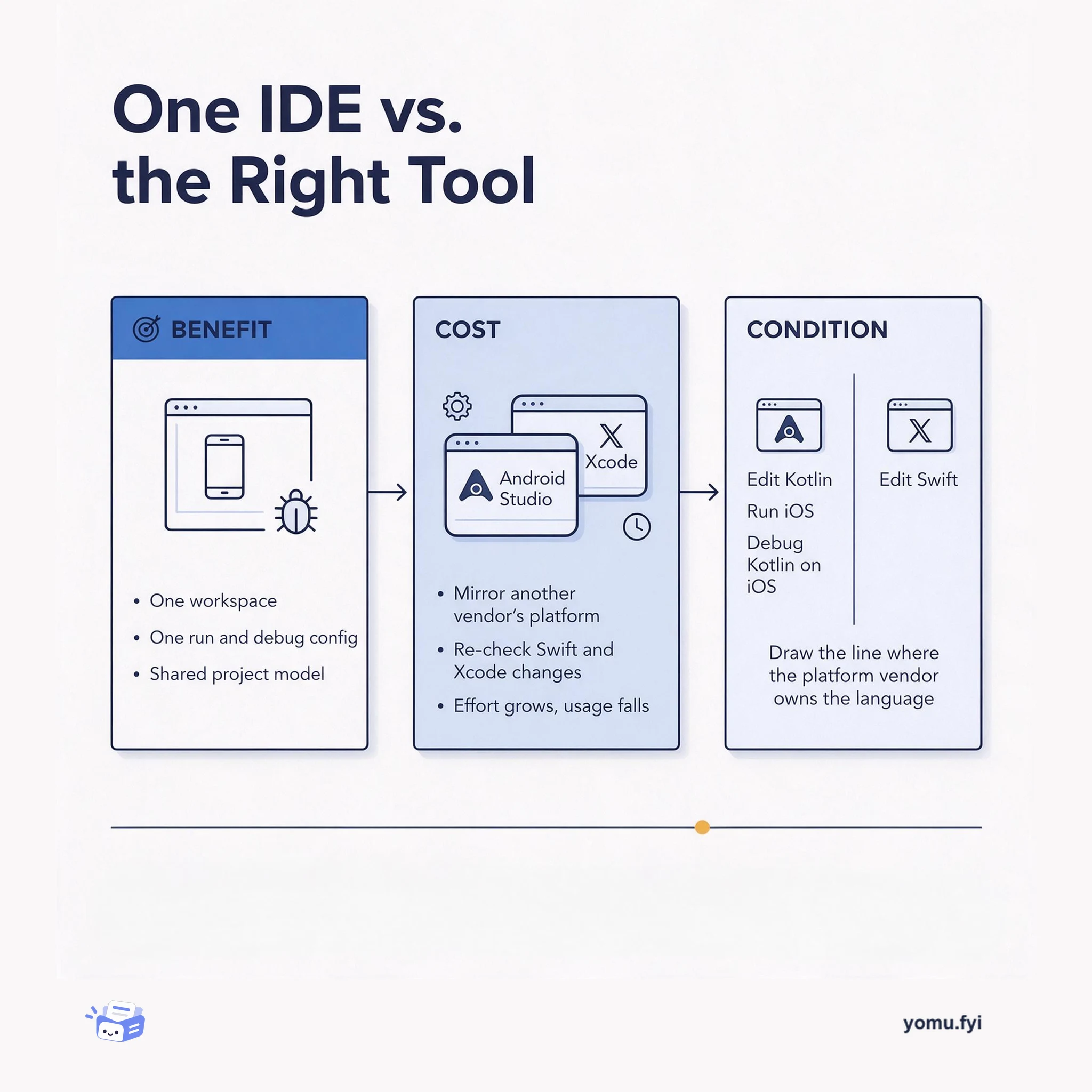
Android Studio keeps cross-platform Kotlin run and debug in one workspace but hands Swift editing to Xcode. This explainer maps the benefit, cost, and condition behind that boundary.
The Good Stuff
Paid picks we use ourselves. Links carry a referral code — a subscription through one earns us a commission at no extra cost to you.
Newest first
Shopify’s React Native teams needed to reuse shared functionality across Shop, Inbox, Point of Sale, Shopify Mobile, and Local Delivery without requiring each team to build and maintain separate package infrastructure. The React Native Foundations team chose a monorepo containing npm packages, a fixture app, shared root configuration, generated CI, and an internal documentation site, with code generation for package bootstrapping. Packages use TypeScript project references, Yarn Workspaces, Lerna publishing, and custom Babel, Metro, and Podfile configuration to support cross-package references, hot reload, and local native dependencies. Dependency graphs and file-change triggers limit CI work to affected packages and dependents, while independent versioning and release scripts manage publication; since June 2020, 17 packages have been developed, including 10 contributed by product teams, although release automation and coordination across multiple monorepos remain future improvements.
Supabase announced its virtual open-source hackathon tied to Hacktoberfest 2021, running from October 1st to October 10th. Participants can compete individually or in teams of up to five to build a new open-source project with Supabase or contribute to designated community repositories. Submissions may use any programming language or framework but must be created during the event and made open source with a public code repository. Entries are evaluated on criteria including technical complexity, visual polish, functionality, and Supabase feature adoption across five award categories. Winners and runners-up receive limited edition Supabase swag, while participants retain full intellectual property rights over their submissions.
Supabase announced a thirty million dollar Series A funding round alongside multiple product updates and platform improvements during August 2021. The team opened an RFC for WALRUS, an initiative aimed at bringing Row Level Security to Postgres subscriptions via Write Ahead Log Realtime Unified Security. Auth updates included customizable SMS login messages, HCaptcha integration for passwordless authentication, and a revised email change flow that notifies both old and new addresses. Platform enhancements introduced a twelfth hosting region in Seoul, improved CSV importing for large files, and Dart reference documentation covering CRUD, Auth, and Realtime operations. Supabase reiterated an ongoing engineering focus on security, performance, and reliability to prepare the platform for production readiness across all workloads.
Immutable state objects are used to keep rendering code from modifying shared values, supporting clearer value origins, fewer bugs, and more focused testing. Kotlin data classes provide a copy function that replaces selected fields while preserving the rest, allowing the new object to become the source of truth. Swift structs lack an equivalent convenience, and defining a complete initializer plus a parameter-based copy method becomes cumbersome, particularly with many or nested properties. Optional properties expose a further issue: nil must sometimes mean “set this field to nil,” not “use the existing value.” A functional builder closure solves that distinction by collecting overrides while retaining the original struct’s values for other fields, and a Sourcery stencil can generate the initializer and builder boilerplate.
Developer Infrastructure at Shopify spans local and cloud development environments, CI systems, deploys, and technology-specific foundations for web and mobile applications. The post models these teams against a three-phase develop–validate–deploy workflow, distinguishing horizontally integrated teams that own one phase from vertically integrated teams whose systems span phases for a particular technology. It uses this model to identify dependencies, gaps, differing scopes, collaboration patterns, and three work avenues—concentration, expansion, and interfacing—with the mission of improving and scaling the cycle. The analysis informed organizational changes, including a Client Foundations team, closer collaboration, and plans for workflow-wide user research focused on the developer journey from writing a patch to production.
Supabase concluded July 2021 with its second Launch Week event, delivering daily product updates and infrastructure upgrades across its platform. Authentication features expanded to support SMS logins through Twilio, Twitch authentication, and API endpoints for generating custom email authentication links. Storage capabilities were upgraded to include media streaming, public buckets, directory uploads, and speed improvements, alongside dashboard enhancements for usage statistics and database insights. Furthermore, all newly created Supabase projects now run PostgreSQL 13.3 by default, and instances incorporate the updated PostgREST version 8.0 server to generate CRUD APIs. The release also introduced preliminary components for Supabase functions as development continues toward general availability.
Shopify describes how distance between developers and end users can weaken product context and empathy as companies grow. The company created Bridge the Gap in 2014, connecting employees with merchants through Support teams. The program uses workshops, an internal podcast built from support-call clips and discussions, and voluntary one-hour shadowing sessions in which participants observe Support Advisors helping merchants via chat, phone, or email. Direct exposure is presented as a way to understand unexpected product use, identify customer workarounds that may inform fixes or new products, broaden domain knowledge, and develop listening, communication, patience, empathy, and expectation-setting skills. The broader goal is to make merchants accessible to Shopify’s workforce as people rather than abstract accounts or personas.
Following the conclusion of Launch Week II: The SQL, Supabase announced its first week-long hackathon running from July 30 to August 6, 2021. Participants can enter individually or in teams of up to five to build any open-source tool, library, or application using Supabase. The judging criteria evaluate creativity, visual appeal, technical execution, and the integration of Supabase features across five distinct prize categories. All code and design elements must be created during the event and submitted via a repository link prior to the deadline. Winning teams receive limited edition Olympic gold and silver themed shirts while retaining full ownership of their intellectual property.
Supabase has officially launched the Supabase Swag Store to meet ongoing community demand for branded merchandise. The company built the online storefront using Shopify to go live quickly during launch week rather than dogfooding internal systems for e-commerce. Gifting remains the primary goal of the swag program, prioritizing contributors who create content, report bugs, answer community questions, or submit pull requests. All items are designed, packed, and dispatched directly by the internal team from Singapore in limited production batches of around one hundred items per run. Due to hands-on fulfillment and ongoing international shipping disruptions, inventory is scarce, and some small-batch designs will remain permanently limited editions.
A six-person team drawn from three teams had six weeks to complete an ambitious Shipping project, while several members were new to the domain or company and had not worked together. Pairing was uncommon, and pull requests received little substantive feedback, creating uncertainty about whether the team was growing, connecting, and learning. After Sheldon Nunes introduced mob programming, the team used a shared screen and ten-minute driver rotations, with each driver pushing changes before the next person pulled them. This kept everyone engaged, accelerated reversible decisions, limited context dumps, and made most code review back-and-forth unnecessary. Across nearly daily sessions for three months, the team reported stronger relationships, easier feedback, restored remote learning, and better support for newcomers, while identifying drawing, public discoverable calls, simple environments, cross-disciplinary participation, and breaks as important practices; tests and documentation were considered poor fits for mobbing.
Supabase introduced a dedicated Reports section and updated project home pages to deliver observability across hosted Postgres projects and complementary services. Because developers can run unconstrained database queries and custom workloads, monitoring both project-level service usage and underlying infrastructure metrics is essential. The new dashboard displays one month of historical data, including CPU and memory usage alongside request volumes for Database, Auth, and Storage APIs. To collect metrics across hundreds of thousands of targets without high latency, Supabase implemented a federated monitoring architecture running regional Prometheus instances that scrape local exporters and aggregate subsets into a central VictoriaMetrics instance. All project databases now also launch with the pg_stat_statements extension enabled for future query statistics.
Supabase released Storage Beta with several functional and architectural improvements three months after its alpha launch. The storage service now supports the Content-Range HTTP header for streaming audio and video, alongside entirely public buckets configured with dashboard safeguards and standard authorization policies. Directory uploads are enabled via the File and Directory entries API, while self-hosted instances can use a new local filesystem backend rather than requiring AWS S3 configuration. To support Node.js without adding polyfills or bundling complexity, the storage server was updated to accept binary data and streams directly. Additionally, the dashboard storage explorer simulates filesystem directories using hidden placeholder files and implements list virtualization.
Supabase scheduled Launch Week II: The SQL for the week of Monday 26 July 2021, occurring four months after its initial launch week held in March. The five-day schedule opens by spotlighting the latest developments from the community alongside core ecosystem tools including Postgres and PostgREST. Tuesday introduces Storage Reloaded, representing four months of further engineering work following the Version 1 storage release. Wednesday focuses on authentication capabilities, specifically passwordless login features that build upon existing platform support for eight distinct OAuth providers. The week concludes with platform dashboard improvements alongside announcements regarding Supabase Functions updates, a community hackathon, and the official Supabase Swag Store.
Shopify describes a playbook for running large engineering programs as platform complexity grows across products, tooling, and architecture. The framework begins with a Program Plan covering the problem statement, objectives, guiding principles, definition of done, risks, mitigation, staffing, scope, and a path to completion. Execution uses six-week cycles that revisit unfinished goals, regressions, emerging risks, and the planned route to completion; the described program spans 200 people, nine sub-organizations, and 92 projects. Supporting rituals include weekly updates, status checks, risk and escalation triage, cycle reviews, retrospectives, RFCs, and performance testing with Lua scripts orchestrated by Genghis. The post concludes that engineering program management must adapt to each organization and that a combination of scheduled and ad hoc rituals helped Shopify pursue its goals.
Three Shopify developers—web developer AJ Robidas, Android developer Michelle Fernandez, and iOS developer Ash Furrow—describe how React Native changes mobile development for people from different backgrounds. They say its React-based model lets web developers build for iOS and Android, helps native developers create interfaces faster and reach a wider audience, and supports collaboration across web, Android, and iOS teams. The developers discuss surprises including React Native’s small set of building blocks, fast UI feedback, native bridge modules, existing SDK integration, and apps that can be difficult to distinguish from Swift or Objective-C software. They also identify challenges such as mobile-specific performance concerns across the RN Bridge, the Metro and Node ecosystem, and the large dependency stack. At Shopify, Visual Studio Code, command-line tooling, internal foundations, workshops, and cross-disciplinary teams support adoption.
Grab transitioned its monolithic mobile application into a modular architecture to resolve increasing code conflicts, slow releases, and difficult team collaboration. The team decomposed the single module by establishing base infrastructure modules, shared UI and utility libraries, discrete feature modules, and bridge kit modules for inter-module communication. Dependency injection using Dagger ties these components together in the main app module while preventing feature modules from directly depending on one another. The architecture spans over 1,000 modules across the app, with more than 200 modules in the Grab Financial Group payments domain where over 95% of modules build in under 15 seconds. This approach accelerated Gradle CI and local builds through parallel compilation and caching, though it increased Gradle sync times, IDE memory usage, and configuration maintenance overhead.
Shopify describes patterns and infrastructure adaptations used to keep its large Rails monolith maintainable as its organization and platform scale. Its dev command-line tool standardizes project setup, dependencies, services, environment variables, integrations, and command aliases across hundreds of active projects. Shopify Core uses pods to partition shops across independent databases and extends the shard concept across provisioning, deployment, load balancers, caching, and servers, while splitting code into domains without separate databases. The post also details safeguards including short-term Active Record migrations consolidated periodically into structure.sql, automated tests, a pod-aware maintenance task system, and a translation platform that commits translated strings through Git. Finally, Monorail imposes versioned JSON event schemas between Kafka producers and consumers and supports review and automated scrubbing of PII fields.
Hugging Face has integrated spaCy pipelines into the Hugging Face Hub to simplify the distribution, testing, and deployment of natural language processing models across the community. More than 60 canonical models from the spaCy 3.1 release are hosted in the spaCy organization, alongside discoverable community pipelines. Users can package and upload models directly through the command line using the spacy-huggingface-hub extension, which auto-generates required metadata and model cards. Hosted pipelines offer direct pip installation from live wheel URLs, interactive browser exploration, and production-ready HTTP endpoints through the Inference API. The platform provides immediate interactive widget support for named entity recognition components, with upcoming support planned for text classification and part-of-speech tagging pipelines.
Shopify’s Polaris team needed to update an illustration style across a product whose assets had become fragmented across more than 6,000 repositories. Illustrators and developers could not reliably identify an image’s repository, code references, reuse, or file type, while GitHub API limits and search behavior prevented dependable large-scale discovery. An initial Node.js monorepo cloned repositories, used globby to find PNG, SVG, and WebP files, searched source lines, and served JSON results through a Preact interface, but rebuilding 24 repositories took more than 35 minutes and produced inaccurate data. The team replaced it with @shopify/get-repo-images, a Go executable that parallelizes file operations, bundles crawling and site generation, and exposes a searchable Next.js interface through NPM. Search and build time fell to eight minutes, with repository cloning as the remaining bottleneck, and the tool was open-sourced.
Supabase announced a series of platform updates, documentation additions, and tooling enhancements for June 2021 ahead of its scheduled Launch Week. Developers can now provision a Postgres database directly through a new Vercel integration and enable authentication using Discord logins. Supabase Storage added support for upsert operations alongside public buckets that allow unauthenticated file access. The web dashboard introduced a restart button for debugging and a table policy editor with templates to configure Row Level Security. Additional backend improvements include timestamps for PostgREST error logs, an OpenAPI mode patch ignoring anonymous privileges for Prisma users, and an XSS fix in the Auth0 Next.js library.
The best engineering reads, once a week.