Brand: Artifact vs Operating System
Compare two mental models for brand: a static artifact (logos, guidelines, centralized control) and a living operating system (values, APIs, support, trust). See which choices fit your engineering team.
Loading…
Topic
446 posts about Developer Experience. Every summary links to the original.
See the idea
Compare two mental models for brand: a static artifact (logos, guidelines, centralized control) and a living operating system (values, APIs, support, trust). See which choices fit your engineering team.
An app store is a distribution surface, a versioned contract, and a health loop between a platform and its developers. Here is how those parts fit together and why each one fails loudly if ignored.
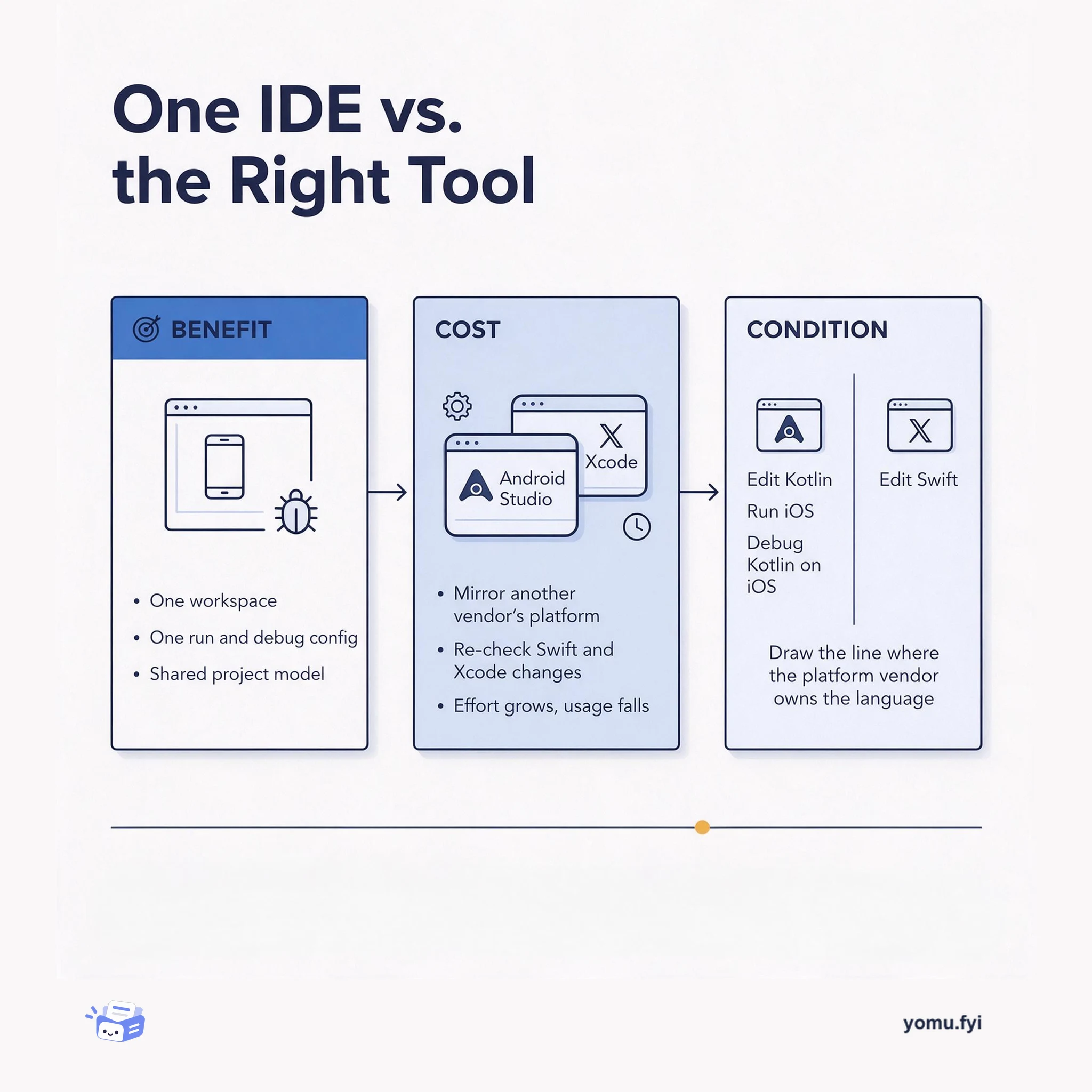
Android Studio keeps cross-platform Kotlin run and debug in one workspace but hands Swift editing to Xcode. This explainer maps the benefit, cost, and condition behind that boundary.
The Good Stuff
Paid picks we use ourselves. Links carry a referral code — a subscription through one earns us a commission at no extra cost to you.
Newest first
The article argues that development models turn implicit lessons into shared, conscious practices as teams, codebases, and responsibilities grow. It presents Grep Driven Development, emphasizing expressive and consistent names so behavior remains searchable, refactorable, abstractable, and predictable, while warning that premature abstraction and locally “improved” naming can hinder later change. It also makes the case for Copy/Paste Driven Development as a deliberate, judgment-based tool, noting that duplication can be cheaper than the wrong abstraction and that abstractions with flags and conditionals may create their own costs. The article names Ego Driven Development and Stickler Driven Development among its four approaches, then concludes with Human Driven Development: choosing, bending, or breaking rules to make work easier for present and future teammates.
Shopify Engineering treats context—the why, what, and how behind development philosophies, approaches, and choices—as essential to company, team, and individual growth. It describes the Development Handbook, which evolved from a 2015 Google Doc into a searchable internal website in 2018, with hundreds of developer-contributed topics maintained through GitHub pull requests, reviews, and Markdown. Dev Talks began as a weekly open stage and became an on-demand recording program after the 2020 shift to Digital by Design, with most presentations lasting 15 to 20 minutes. The Technical Leadership Team’s Shift podcast provides monthly, in-depth discussions of technical decisions, distributed in audio and video with transcripts. The programs continue to evolve while facing content-maintenance and participation challenges.
Conveyor, an in-house continuous delivery system at Grab, introduces hermetic deployments by tracking application code alongside static and dynamic configuration parameters. This hermeticity guarantees that production releases use combinations of versioned artifacts previously verified in staging, preventing rollback incompatibilities. Conveyor replaces single multi-environment pipelines with decoupled pipelines, while automating cluster locking, deployment slot scheduling, release note generation, and canary monitoring with automated rollbacks. These automations reduced production deployment failure rates from 1.5% to an average of 0.3% over a three-month period. Grab also doubled the volume of production changes between 2018 and 2020 while saving more than 5,000 man-days of engineering effort in 2020.
Supabase focused on platform stability, security enhancements, and community support during its April 2021 beta update cycle. To address visual accessibility needs for developers with astigmatisms or those operating in brightly lit environments, the team delivered Light Mode within the dashboard settings. The release also introduced OpenAPI-powered Storage API documentation, community translations for the main repository spanning nineteen distinct languages, and an experimental synchronization server connecting Postgres with Stripe. Dashboard components are systematically migrating into an open-source UI library, establishing necessary foundations for local development tooling and self-hosted environments. Additionally, the team reported substantial contributor growth across its realtime server and UI repositories while continuing engineering on a Workflows engine aimed at a July release.
Agent typing time represented a large portion of Grab's chat support journey, and 85% of messages were still free typed because agents customized static templates to fit their personal style. To accelerate typing across multilingual markets without robotic templates, Grab built SmartChat, a machine learning feature that provides contextual sentence completion. The team opted for a lightweight seq2seq architecture using single-layered GRU encoder-decoders in TensorFlow instead of bulky attention models to keep model latency under 100ms. The user interface was implemented in React using a content-editable div with inline typeahead suggestions activated via keyboard shortcuts.
Supabase announces its CLI as the first step toward running Supabase locally, managing database migrations, generating types and API or validation schemas from a database, managing projects, and eventually pushing local changes to production. The local stack runs through Docker Compose, using tools described as 100% compatible with every Supabase project, and a React setup can initialize it with supabase init before supabase start. For schema changes, the post favors database diffing over accumulating manual SQL migrations and adds a CLI mode and Docker image for pgAdmin Schema Diff, which tracks view-owner changes needed for Row Level Security and handles domains. The supabase eject command outputs Docker Compose, Kong, and Postgres configuration for self-hosting. An update dated 15 August 2022 states that CLI V1 is generally available and that a Management API is in beta.
Supabase announced a 6 million dollar seed round led by Coatue, Mozilla, and Y Combinator, accompanied by over twenty technical angel investors. To guide its mission of providing an open-source alternative to Firebase, the company deliberately assembled a roster of angel backers comprising CTOs, developers, and developer advocates. The post features short interviews with several angel investors who share their career backgrounds, coding habits, and rationale for supporting the platform. Many investors highlighted the appeal of Supabase's developer ergonomics, its open-source foundation, and the advantages of utilizing Postgres directly alongside built-in authentication over proprietary NoSQL alternatives. Supabase also teased its upcoming Launch Week, during which the team plans to release one new feature daily for a week.
Freelance engineer Kevin Grüneberg created intheloop.dev as an open-source aggregator to help developers track software updates, release notes, changelogs, tweets, and community discussions from a single platform. The initial release provides dedicated coverage for React, Kotlin, and Vite, with plans to introduce user accounts, notifications, and personalized digests. Although Grüneberg previously used Firebase for rapid prototyping, he found relational requirements like count queries, normalization, and foreign keys difficult or impossible to implement. He selected Supabase as the backend to combine fast integration with PostgreSQL capabilities, including SQL queries, constraints, views, and materialized views. This database architecture allows the application to handle structured data relationships efficiently while scaling future feature additions without restructuring core models.
Replit provides a collaborative, browser-based coding environment, but applications requiring structured relational queries or larger datasets need external database infrastructure. Developers can integrate a Node.js repl directly with a hosted Supabase relational database without provisioning or managing server instances. The setup process involves importing the @supabase/supabase-js client library and authenticating using the project URL alongside the anonymous API key obtained from the Supabase dashboard settings. Once initialized, developers can populate sample datasets like Countries and execute read queries using standard promise handlers or async/await syntax. The client library also supports diverse query filtering methods such as .or(), .is(), .in(), and .neq() to manipulate relational datasets directly in JavaScript.
Supabase published its February 2021 beta update marking one year of development as an open-source Firebase alternative. The release introduces dashboard interface improvements across the Table view, Auth section, and SQL Editor, which now features autocomplete suggestions for tables and columns. Authentication updates allow user redirection to specific site routes upon invoking signIn and signUp, while a new database management interface lets users configure Postgres replication settings and events for the realtime API. Infrastructure additions include a new deployment region in South Africa and a Docker Compose configuration intended to power local development in the forthcoming CLI. Documentation expanded with resources for GoTrue and Google OAuth, alongside ongoing RFCs covering connection pooling and local workflows.
Shopify’s Engineering Mentorship Program was created to give developers a structured way to pursue technical and leadership growth alongside the company’s existing just-in-time collaboration. Survey findings indicated that developers wanted to learn from colleagues but struggled to make dedicated time, motivating a recurring program designed around those constraints. Each six-week cycle uses voluntary sign-up, automated matching based on expertise, reporting relationships, and job level, weekly one-hour meetings, goal setting, Slack support, and an optional guidebook. The time-bound format lets participants try a mentorship relationship without an open-ended commitment, while mentors also practice teaching and leadership; by 2020, more than 300 developers had participated as mentees and more than 200 as mentors, 98% of survey respondents said they would recommend it, and demand exceeded available mentor capacity.
Grab's mobile superapp scaled past 2.5 million lines of code across both Android and iOS, leading to unsustainable local and CI build times under Gradle and Xcode. To address these bottlenecks, the engineering team analyzed their dependency trees and introduced an internal tool to calculate and optimize the build critical path. They also deployed a Kubernetes-autoscaled remote build system using Mainframer for Android and implemented Test Impact Analysis to run only affected tests in pre-merge validation. While dependency decoupling yielded modest 7% to 10% gains and iOS remote builds proved unscalable on Apple hardware, Android remote builds reduced local compile times by up to 50%, and targeted test execution reduced pre-merge pipeline durations by more than 30%.
After nine months of development, Supabase introduced several platform updates as it progressed closer to its beta release. The dashboard now supports manual user creation alongside administrative actions such as deleting users and sending password reset emails or magic links. Database management gained direct browser support through a full Monaco SQL editor and new foreign key controls within the table editor. Platform reliability and security were addressed through a DigitalXRAID audit, default email confirmations on signups, and a dedicated status page tracking uptime and latency. Additional progress included community integration work with Vercel, Stripe, and Redwood, as well as an updated benchmarking suite for realistic server workloads.
Eight months into building Supabase, the team released product updates focused on stability, reliability, and performance while preparing to transition from Alpha to Beta. The release introduces supabase-js version 1.0, incorporating extensive community feedback to deliver major developer experience improvements across client libraries. Platform interface updates include tabs and full-screen mode for the SQL Editor, alongside new keyboard shortcuts to help power users navigate and manipulate tables rapidly. For user authentication, Supabase added magic link capabilities, enabling passwordless login flows for both new and existing users either as a standalone method or alongside passwords. Under continuous improvement efforts, the team converted realtime-js to TypeScript, heavily optimized dashboard routing performance, and established a repository to benchmark all integrated open source tools.
Supabase has launched Supabase.js 1.0, updating its client library ecosystem with breaking API changes, scalability enhancements, and new documentation tooling. The release introduces native TypeScript implementations across all underlying sub-libraries, including supabase-js, postgrest-js, gotrue-js, and realtime-js, which also enables auto-generated reference docs. In response to community feedback, database and authentication operations now return structured error objects alongside data payloads instead of throwing runtime exceptions. Realtime client scalability is improved by consolidating multiple active subscriptions into a single socket connection per Supabase client. Additionally, the release updates authentication workflows via the newly created gotrue-js library to support third-party logins and OAuth providers alongside revised method names.
Around the end of 2018, Grab's backend architecture consisted of roughly 270 services managed through fragmented, manual deployment workflows. Engineers copied release parameters between build logs, wiki pages, Slack bots, and multiple Jenkins jobs, leading to high operational friction and an average of 10 business days between production updates for a service. To streamline delivery, Grab built Conveyor, an internal automation platform built on top of open-source Spinnaker. Conveyor introduced a custom user interface focused on pipeline visibility and a pipeline-as-code DSL called Artificer using Jsonnet files in the monorepository. The platform automatically registers build artifacts with commit metadata to eliminate manual parameter entry and automatically provisions integration, staging, and production pipelines.
Supabase announced its participation in Hacktoberfest 2020 by organizing a series of community events and open-source contribution activities. Contributors can attend scheduled live broadcasts, including a GitHub Open Source Friday stream featuring @kiwicopple on Twitch alongside an online introductory meetup hosted on YouTube. To coordinate development, Supabase launched a GitHub project board containing tasks and idea notes, requiring participants to label new issues with the hacktoberfest tag for official challenge qualification. Available engineering efforts span creating framework examples for Blitz.js and Redwood.js as well as writing specialized Postgres templates for diverse use cases. Non-code contribution pathways are also supported, encouraging community members to submit documentation improvements, user experience adjustments, illustrations, custom loading pages, or Lottie animations.
Six months into developing its hosted database platform, Supabase announced updates focusing on authentication, table view management, and community developer tooling. Users can now create database tables and columns directly from the table view interface as well as invite team members to their organizations. The authentication system introduced configurable email confirmations for new user registrations, allowing administrators to toggle confirmations and edit email templates directly from the dashboard. Community contributors added TypeScript support to Supabase, implemented UMD support in supabase-js, and began building Python client libraries starting with postgrest-py. Supabase is preparing to transition from Alpha to Beta by stabilizing its Auth API, improving dashboard performance, and benchmarking platform systems.
Managing dependencies in a multi-module monorepo created developer friction at Grab due to unexpected changes from previous vendoring attempts and accidental imports. Because Go modules were not yet enabled directly for builds, the team implemented a continuous integration check that executes go mod vendor and rejects merge requests if any diffs exist in go.mod or the vendor directory. Adopting this CI check required configuring SSH deploy keys for private repositories, adding retry logic for network-related false positives, and standardizing on a single Go version to prevent checksum discrepancies. To streamline ongoing maintenance across hundreds of dependencies, the team developed an automated tool named AutoVend Bot. The bot runs go list -m -u all to detect updates and opens a scheduled batch of merge requests each day for human review.
Supabase announced the release of Supabase Auth following five months of development, providing resources and a video tutorial on implementing authentication with PostgreSQL Row Level Security. The Table Editor now allows users to drill multiple levels deep into table relationships as well as add, delete, and download rows directly. Newly created projects also include access to additional Postgres extensions, including pgsql-http, pgjwt, plpgsql_check, and pljava. Further platform updates include an or filter in the client library, expanded capabilities for the postgres-meta REST management server, and persistence for open tabs in the Table View. Additionally, the auto-generated documentation now integrates authentication guides, and visual page transition glitches have been resolved.
The best engineering reads, once a week.