Brand: Artifact vs Operating System
Compare two mental models for brand: a static artifact (logos, guidelines, centralized control) and a living operating system (values, APIs, support, trust). See which choices fit your engineering team.
Loading…
Topic
446 posts about Developer Experience. Every summary links to the original.
See the idea
Compare two mental models for brand: a static artifact (logos, guidelines, centralized control) and a living operating system (values, APIs, support, trust). See which choices fit your engineering team.
An app store is a distribution surface, a versioned contract, and a health loop between a platform and its developers. Here is how those parts fit together and why each one fails loudly if ignored.
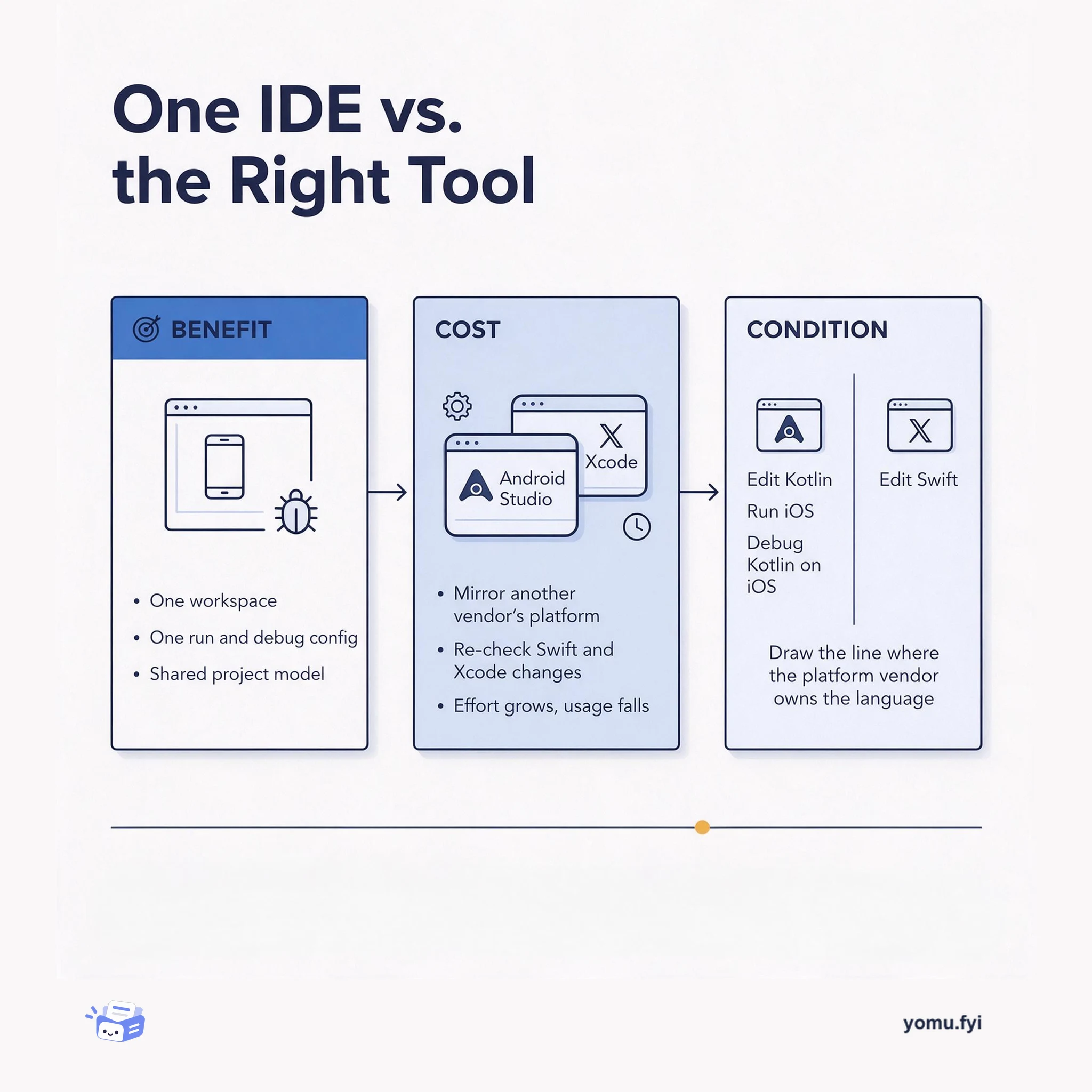
Android Studio keeps cross-platform Kotlin run and debug in one workspace but hands Swift editing to Xcode. This explainer maps the benefit, cost, and condition behind that boundary.
The Good Stuff
Paid picks we use ourselves. Links carry a referral code — a subscription through one earns us a commission at no extra cost to you.
Newest first
Thumbtack is transitioning its engineering workflow from ad-hoc tool experimentation to end-to-end agentic software development. Unlike previous deterministic abstractions such as compilers or high-level languages, artificial intelligence introduces non-determinism where identical prompts can produce varying code and trade-offs. Because consumer marketplace experiments still require weeks for behavioral signals to stabilize, accelerated implementation primarily helps teams prepare cleaner experiment designs and parallelize hypotheses within experimentation bandwidth constraints. Consequently, day-to-day engineering responsibilities shift upstream from manual coding toward problem framing, system architecture, validation, and co-designing features with product managers. Teams maintain technical sharpness by rigorously reviewing generated code while accepting that long-term specialization above the abstraction layer will become standard across the organization.
Dropbox developed Nova, an internal platform that runs AI coding agents in isolated cloud environments integrated with their Bazel monorepo. The platform supports both interactive developer workflows and autonomous background tasks, such as automated CI debugging, flaky test remediation, and codebase-wide migrations. By pairing code generation with automated validation and strict execution guardrails, Nova ensures generated fixes are tested and reproducible.
Software engineers frequently rely on separate product analytics tools and teams to answer user behavior questions, creating disjointed data models and delayed insights. Existing debugging telemetry within tools like Sentry—specifically spans, structured logs, and application metrics—can serve as the primary source for product metrics. Developers enrich request spans with business-level attributes, record discrete business events through wide structured logs, and track KPIs with metric counters and distributions. This unified telemetry links business outcomes directly to underlying traces, errors, releases, and source code lines, enabling immediate root-cause analysis and automated alerts. While multi-session cohort and funnel aggregation remains a current tooling gap, standard telemetry solves day-to-day adoption, performance, and revenue questions.
clickhousectl v0.2.0 expands the beta CLI with local and ClickHouse Cloud managed Postgres, ClickPipes, SQL over HTTP for Cloud services, agent-oriented output changes, and a standalone Rust client for the ClickHouse Cloud API. Local Postgres runs in Docker, is keyed by name and major version, stores isolated data under .clickhouse/servers/-pg/data/, and supports versions 16, 17, and 18. ClickPipes covers batch, streaming, CDC, and snapshot sources including object storage, Kafka-compatible systems, Kinesis, Postgres, MySQL, MongoDB, and BigQuery. Cloud queries use a provisioned or lazily enabled Query Endpoint and service-scoped API key, while the endpoint uses sql_console_admin and the key has no organization-level roles. The release also adds Markdown-style tables and credential debugging, with more than 5,000 users reported five weeks into the project.
As Yelp's JavaScript monorepo expanded over time, Webpack build speeds became a significant engineering bottleneck. To resolve this without rewriting complex configurations, the team selected Rspack for its direct compatibility with existing Webpack setups and plugins. Yelp implemented an adapter pattern to generate Rspack configurations dynamically from original Webpack files, enabling a staged opt-in rollout across development tools and CI environments. Following the initial migration, engineers addressed performance issues in barrel files using automated codemods to replace star re-exports and import-then-export patterns with named re-exports. Combined with Rspack's portable persistent caching, the migration reduced integration build times by approximately 52 percent and warm cache builds by up to 80 percent.
PaddleOCR 3.5 adds a more flexible inference-engine interface for OCR and document parsing, allowing supported models to run with a Hugging Face Transformers backend selected through engine="transformers". It keeps pipelines managed by PaddleOCR while exposing backend-specific settings such as dtype, device placement, and attention implementation through engine_config. The release supports command-line and Python usage, with examples configuring GPU execution and float32, bfloat16, or SDPA options according to hardware and deployment environment. This provides a more natural path for RAG, Document AI, search, analytics, and agent stacks centered on PyTorch and Transformers, while the default paddle_static backend is usually recommended when maximizing OCR or document parsing throughput is the priority.
Autonomous AI coding agents increasingly handle developer workflows, but their execution model introduces critical security risks. Operating with the executing user's full permissions, these agents can read ambient secrets, inherit cloud credentials, and run destructive shell commands without human intervention. Documented incidents between October 2024 and February 2026 reveal systemic hazards, including unintentional home directory deletions and increased security vulnerabilities in generated code. To address these vulnerabilities, Docker Sandboxes isolate agent execution within dedicated microVMs, preventing access to the host filesystem and blocking common credential paths by default. Routing changes through Git worktrees and restricting network egress ensures that agent actions remain strictly bounded and reviewable before affecting main branches or production infrastructure.
Grab’s passenger Android monorepo contains roughly 2,000 modules and 11 million lines of code, making Gradle-based Android Studio syncs increasingly slow and memory-intensive even though Bazel handles builds. A cold full sync could exceed 35 minutes, and a survey of 55 developers found that 82% wanted an option to exclude modules from syncing. The team built a custom Focus plugin that uses a dependency graph generated during migrateToBazel, avoids repeating Gradle’s configuration phase, and integrates with Android Studio through a one-click Select → Focus → Sync flow; a Groovy include-shadow technique avoids requiring teams to reorganize settings files. Typical focused syncs fell below two minutes, while reported results show reductions from 35 minutes to under one minute depending on module size, memory usage from 10 GB to 2 GB, and improved Compose preview updates, with broader IDE operations requiring expanded focus or full sync.
GitHub Issues addressed navigation latency by shifting workloads to the client using a local-first, stale-while-revalidate architecture. To evaluate perceived delays, the team tracked user transitions through Highest Priority Content thresholds, aiming for instant rendering in under 200 milliseconds. The core implementation added a persistent client-side cache using IndexedDB, paired with a synchronous in-memory tier to serve hot issue payloads without asynchronous overhead. A selective preheating mechanism resolves missing cache entries for high-intent links without overburdening backend capacity with redundant requests. Following broad rollout, the proportion of instant React soft navigations increased from 4% to approximately 22%, yielding an overall cache-hit ratio of around 33%.
Pre-configured monitoring templates often fail to meet organization-specific needs, forcing developers to manually build dashboards widget by widget. Sentry introduced AI-agent-powered dashboard creation and editing in open beta, alongside CLI management tooling and template revisions. Users can prompt an AI chat interface to build or adjust dashboards, duplicate and customize uneditable Sentry-built templates, or execute dashboard commands directly in their terminal. Dashboards leverage issue, tracing, and application metric data across frontend, backend, mobile, and framework-specific views like Next.js and Laravel. Edits made through the UI, CLI, or AI agent are automatically tracked in a revision history that supports one-click rollbacks.
Stripe engineers ran roughly a dozen experiments to determine how to get AI agents to use current API versions, follow integration best practices, and load the Stripe skill. Passive hints, including SDK files, AGENTS.md guidance, and API warning responses, were largely ignored, while active prompts and distribution mechanisms performed better. A modular, progressively disclosed skill structure outperformed a monolithic file by roughly 10% and reduced token usage; a CLI login prompt led 30–35% of viewers to copy its install command, and explicit compatibility-mode errors prompted agents to correct version mismatches. The results suggest that agent-facing developer experience is primarily a distribution problem, with hard steering through errors and loaded instructions more reliable than soft hints agents may never encounter.
Software engineers deploying AI agents often encounter unreliable skill invocation for repository-specific architectures, such as Pinterest's iOS framework. To quantify and resolve this issue, a Bash test harness piped positive and negative prompts into Pin-agent and Claude Code while parsing streamed JSON logs for execution signatures. Initial vanilla benchmarks yielded baseline accuracies of 73% for GPT 5.2-codex and 62% for Opus 4.5 Claude. Optimizations such as expanding YAML frontmatter descriptions with architectural context, utilizing capitalized imperative directives, and adding reference tables in AGENTS.md raised invocation rates. Both agents reliably loaded skills when prompts contained explicit invocations, demonstrating that empirical testing paired with descriptive prompting stabilizes agent skill adoption.
Rapid enterprise AI agent adoption without centralized infrastructure introduces widespread tool sprawl, duplicated engineering effort, and severe operational opacity. Individual application teams frequently build ad hoc, undocumented integrations, leaving security teams unable to discover, audit, or approve active agent capabilities. Internal enterprise tool registries address this coordination failure by establishing an organization-specific catalog tailored to internal security policies, data, and compliance requirements. A production-grade registry delivers core discovery and version tracking functionality while surfacing security certification metadata and enabling consistent identity-scoped access control across teams. Organizations establishing centralized tool infrastructure can accelerate agent onboarding, implement deny-by-default governance policies, and mitigate technical debt before uncoordinated deployments compound across the enterprise.
PayPal describes how it used Cursor to accelerate software development across an organization of 8,000 developers and a codebase spanning decades. It began with high-impact teams because the company moves money for more than 400 million customers and mistakes are costly; within two weeks, those teams were deploying daily rather than weekly or biweekly, and adoption spread organically. The company says a Java upgrade across 3,000 applications took two months instead of an estimated eight to twelve, while highly adopting teams saw more frequent deployments, shorter lead times, and lower change failure rates. PayPal continues to measure deployment frequency, lead time, and change failure rate rather than AI-generated code, and Michelle Chance believes the company could deliver 40% more capabilities in 2026 than in 2025.
JavaScript application performance monitoring tools rely on monkey-patching via require-in-the-middle and import-in-the-middle, which breaks with ECMAScript Modules, bundlers, and non-Node runtimes. To solve this, an initiative is replacing monkey-patching with Node's built-in diagnostics_channel TracingChannel API across server-side JavaScript libraries. Under this pattern, libraries publish structured events while monitoring vendors subscribe to them with zero overhead when unlistened. The author leveraged Claude Code workflows alongside direct maintainer communication to draft proposals, implement code, and manage reviews across 44 target packages. Ten libraries including mysql2, node-redis, ioredis, and unjs modules have merged support, while active efforts continue on shared OpenTelemetry mapper registries and remaining ecosystem packages.
Expo applications generate approximately 75% of the total event volume received from React Native applications in Sentry. In response, Sentry updated its React Native SDK starting in version 8.10 to improve Expo debugging and performance monitoring workflows. The update automatically enriches events with Expo constants and over-the-air update context, including channels, runtime versions, and emergency launch warnings when an OTA update fails. Developers can track remote EAS Build lifecycle failures and successes using dedicated hooks configured in package.json. Performance instrumentation now supports span generation for Expo Router route prefetching as well as asset and image loading through wrapper functions around expo-image and expo-asset.
Supabase is releasing @supabase/server in public beta, a package for authentication verification, client setup, request context, and common server-side boilerplate across backend runtimes. Supabase says an anonymous analysis of 25,000 deployed Edge Functions found developers repeatedly rebuilding setup for clients, JWT verification, claims parsing, CORS, auth context, and shared files. The package's withSupabase wrapper or createSupabaseContext function supplies a SupabaseContext containing a user-scoped client, service-role admin client, verified identity, JWT claims, auth metadata, and auth mode, while declarative modes cover user, none, secret, publishable, or combined access. It returns standard Request-to-Response handlers for Edge Functions, Vercel Functions, Cloudflare Workers, Hono, Bun, and Deno, and includes primitives for custom middleware and adapters. @supabase/server does not replace @supabase/ssr, which remains focused on cookie-based sessions, and the release invites feedback on its public-beta API and adapters.
Sentry launched Application Metrics to capture application signals without pre-aggregating counters or discarding high-cardinality attributes like user IDs, project IDs, and regions. The system supports counters, distributions, and gauges within the existing SDK while linking each metric event directly to trace IDs for integrated debugging. Engineers demonstrated the feature by troubleshooting a Session Replay failure that triggered silently when sessions exceeded 1,000 video segments. By instrumenting distributions for replay event counts with project and replay attributes, the team isolated seven affected occurrences, navigated to connected traces and log lines, and reproduced the issue. Application Metrics comes enabled in recent SDK versions with 5GB included per plan.
Supabase has made dashboard-based database branching the default for all projects, adding a GitHub-free alternative to its existing git-based workflow. Developers can create a branch from the dashboard, work in the SQL Editor or Table Editor against a separate Postgres instance, review a schema diff, and merge changes into production without Git configuration. The workflow uses pg-delta, a new schema-diffing engine in pg-toolbelt that covers tables, columns, RLS policies, functions, triggers, indexes, and extensions, replacing migra as dashboard branching’s default engine; pg-delta is alpha software and is also available in the CLI behind a flag. Git-based branching remains fully supported, and the two approaches can be switched between or used together, while branches created through the Supabase MCP server use dashboard branching automatically.
An agent was used to build a transcription app for a team from initialization through deployment with Stripe Projects, OpenRouter, and Vercel. The app sends video-generated subtitles through an OpenRouter agent with a detailed system prompt and Stripe documentation tool calls, producing a formatted transcription whose speaker and service names are corrected. The author recommends treating agent-generated plans like design documents, verifying provider behavior, and using streaming for long transcripts because Vercel serverless limits made non-streaming responses prone to 504s for a roughly 1,500-line transcript. Testing led to removing an unreliable free-model tier, defaulting to openrouter/auto, and choosing Claude Opus 4.5-thinking over Claude Sonnet 4.5; shared agent files were committed, and a separate review agent was used before human review.
The best engineering reads, once a week.