Brand: Artifact vs Operating System
Compare two mental models for brand: a static artifact (logos, guidelines, centralized control) and a living operating system (values, APIs, support, trust). See which choices fit your engineering team.
Loading…
Topic
447 posts about Developer Experience. Every summary links to the original.
See the idea
Compare two mental models for brand: a static artifact (logos, guidelines, centralized control) and a living operating system (values, APIs, support, trust). See which choices fit your engineering team.
An app store is a distribution surface, a versioned contract, and a health loop between a platform and its developers. Here is how those parts fit together and why each one fails loudly if ignored.
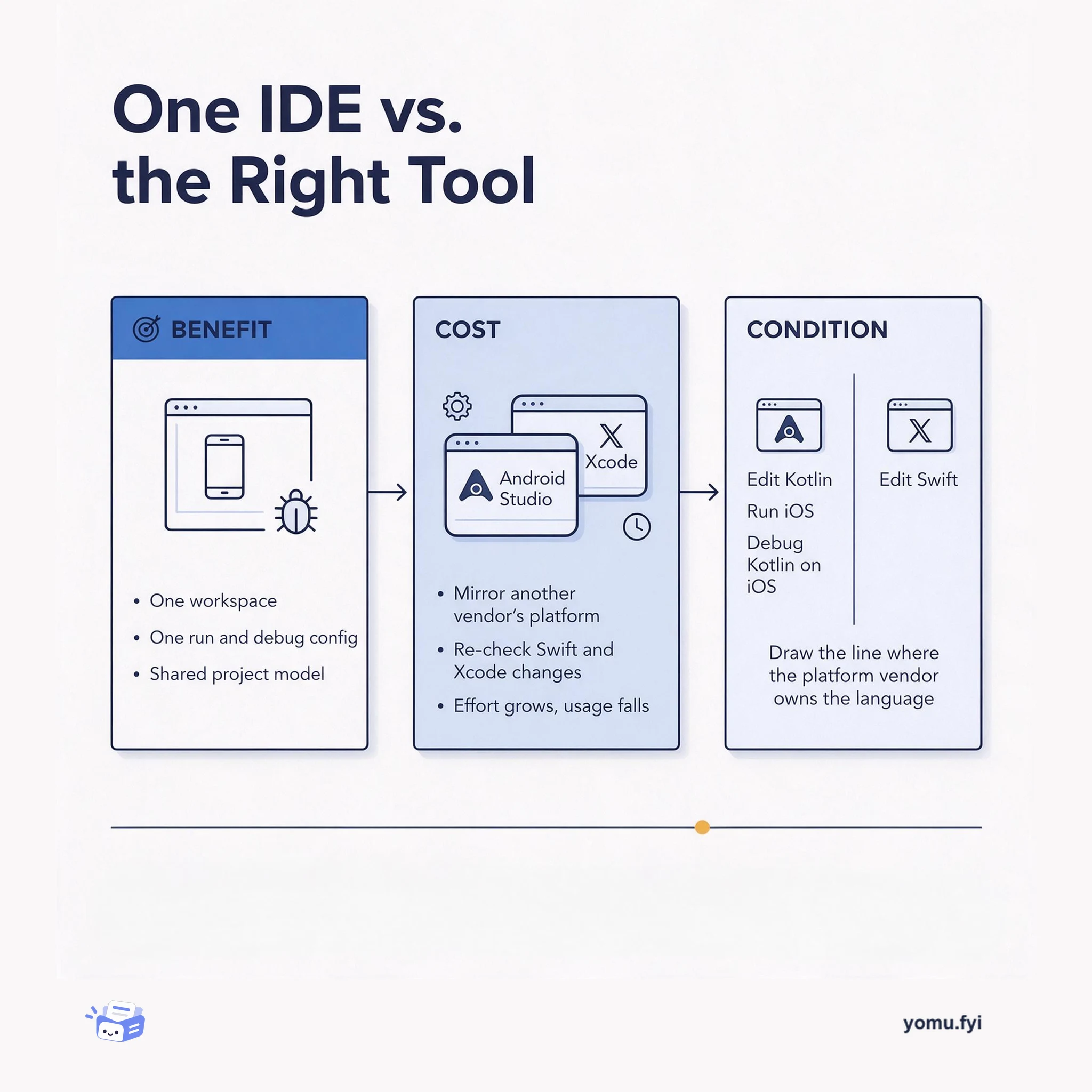
Android Studio keeps cross-platform Kotlin run and debug in one workspace but hands Swift editing to Xcode. This explainer maps the benefit, cost, and condition behind that boundary.
The Good Stuff
Paid picks we use ourselves. Links carry a referral code — a subscription through one earns us a commission at no extra cost to you.
Newest first
Sentry has released the beta version of Sentry Snapshots to catch visual regressions on pull requests across any platform with a frontend. The tool captures screenshots of an application across various viewports, themes, and languages, compares them against a baseline, and blocks pull requests when diffs are detected. Teams can attach custom context metadata, including test file paths, to help developers and AI agents locate test sources and generate additional test cases. By leveraging the sentry-mcp integration, REST API, and sentry-cli, workflows can retrieve base images, diff masks, and run local diff verification before pushing commits. Originally created at Emerge Tools for mobile applications, this iteration expands automated visual testing capabilities to broader frontend codebases.
ClickHouse Cloud is now available through Stripe Projects, a Stripe CLI workflow that lets developers and AI agents provision real infrastructure from the command line. Running stripe projects init my-app and adding a service provisions ClickHouse or managed Postgres, returns working credentials to the environment through .env, and hands control to clickhousectl; clickhousectl greater than v0.3.0 is required. The integration supports ClickHouse for real-time analytics and managed Postgres, identified as a public beta, for transactional workloads; both services use the same CLI workflow, land in the same account, and share credentials, while Postgres uses local NVMe storage and is described as offering microsecond latency and up to 10x faster performance on I/O-heavy workloads. The feature is in developer preview, and agents can continue through clickhousectl for data ingestion with ClickPipes and service queries without manual credential handling or context switching.
Shopify built Quick to make internally created prototypes, dashboards, tools, and games easier to share than deploy, giving employees a secure URL for a folder of HTML and assets. Launched internally in July 2025, it places sites behind Identity-Aware Proxy, serves bucket content through NGINX and gcsfuse, and deploys with a wrapper around gcloud rsync. A service in front of CloudSQL provides database and realtime APIs, while server-held credentials support calls to Shopify’s AI proxy; file uploads, BigQuery access, WebSockets, and employee identity are also available. Quick now hosts more than 50,000 sites, has been used by over half of Shopify employees, and runs on one $200-per-month VM, with constraints, rate limiting, and a migration from Node to Go supporting its operation.
A coding agent built a 3D Paris gallery by chaining two Hugging Face Spaces: an image-generation Space produced dark-background monument images, and VAST-AI/TripoSplat reconstructed each single image as a 3D Gaussian splat. It then handled integration work by correcting the splats’ Y-down orientation, auto-framing monuments, compressing .ply files to .ksplat at about one-third the size, and building and deploying a static Three.js viewer. The Spaces’ agents.md files provided schemas, call and polling templates, file-upload instructions, and authentication guidance, allowing the agent to call them without a client library. The same pipeline produced six-monument galleries for Egypt and Japan after the prompts changed. The account presents callable, documented multimedia components as a way to reduce integration work and make new multimedia applications cheaper to create.
clickhousectl v0.3.0 adds improvements aimed at agentic workflows, additional installation methods, OAuth for Cloud service queries, and custom configuration files for local servers. It detects coding-agent environments and defaults to JSON on stdout, uses gh-style exit codes, reads CLICKHOUSE_ credentials from a working-directory .env file, and hides deprecated API fields from CLI output. Cloud service queries can authenticate with OAuth without provisioning a Query Endpoint; idled services wake automatically, while stopped services fail with a start hint. For local development, selected versions resolve from installed binaries before network lookup, local use can put ClickHouse on PATH, and named XML, YAML, or YML files overlay built-in defaults. The release also adds Python installation options and extends local init with a postgres/ tree alongside clickhouse/.
Sentry maintains 159 open-source SDK packages across multiple languages, leading to high triage volume and significant boilerplate setup overhead when reproducing reported bugs. To streamline this workflow, the team developed a Claude skill that parses GitHub issue URLs to extract language, framework, and SDK versions. The skill generates a reproduction branch, sets up minimal boilerplate using ecosystem package managers like uv or npm, attempts execution, and opens a pull request with explicit run instructions. By allowing the model to exit early when encountering overly complex environments, the tool reliably prepares reproducible playgrounds without stumbling on edge cases. This workflow saved several hours in testing scenarios like Django HTTPS proxy bugs while avoiding excessive bot noise through scoped human interaction.
Modern application telemetry relies on four overlapping signals: errors, traces, logs, and metrics. Each telemetry type addresses distinct engineering questions and powers specific debugging workflows. Errors track grouped, actionable application crashes, whereas traces map timing and execution paths across dependency waterfalls. Metrics aggregate numerical measurements across historical deployments, and logs preserve complete state and decision-making context at specific moments in execution. Emitting telemetry directly into the format needed for a given workflow proves superior to relying on a single wide event, as tools like AI coding agents require structured spans to optimize execution paths while human debuggers rely on unsampled logs and metrics to pinpoint silent failures.
The author recounts a career path from creative interests and technical writing to developer relations, emphasizing that storytelling remained central while the audience changed. She began by producing API documentation, user guides, onboarding content, and other developer resources, then joined JDoodle, where conversations with developers shifted her focus from writing for them to connecting with them. Attending events and conferences, giving product demos, staffing booths, participating in community conversations, organizing hackathons, and running internal events helped her discover that developer advocacy matched her strengths in empathy, clear storytelling, and helping people succeed. She now announces a new role at Okta, where she will work with developers, creators, builders, and community members in identity and security while creating content, attending events, learning, and building connections.
Supabase has raised a $500M Series F at a $10B pre-money valuation, led by GIC. Existing investors participated, Stripe invested again, and Georgian and Salesforce Ventures joined as new investors; the funding will accelerate open-source and Postgres tooling, support growth, and provide employee liquidity. Supabase is also releasing Multigres v0.1 alpha, an open-source, self-hostable scalable operating system for Postgres designed to provide high availability and operational simplicity; a future release is intended to add Vitess-grade horizontal scaling. The alpha is ready to try but not production-ready, with production-readiness expected in a few months. Over the past year, database launches grew 600%, more than 60% of new databases came from AI tools, and nearly 10 million developers built on Supabase.
The post presents a redesign of hf, the Hugging Face Hub’s official CLI, for both human users and coding agents that download, upload, manage repositories, run Jobs, and administer other Hub resources. The CLI detects agents through environment variables, switches to compact, complete TSV output, and supports explicit human, agent, JSON, and quiet formats; agent mode was introduced in hf v1.9.0. Next-command hints, stderr separation, non-interactive failure messages, retry-safe operations, confirmations, and dry-run previews support multi-step automation without removing human-friendly terminal behavior. Benchmarks report equal-or-better success with roughly 1.3× to 1.8× fewer tokens than curl or the SDK on comparable tasks, and up to 6× fewer on complex workflows; the generated hf-cli skill reduced tool calls by about 30% without reducing token use or improving reliability.
Spotify experienced rapid codebase growth alongside widespread adoption of AI coding tools, resulting in a 76% increase in pull request frequency. To manage fleet-wide codebase maintenance and complex refactoring, the company combined its Fleetshift automation platform with Honk, a background coding agent powered by Claude. Honk runs inside Kubernetes pods with access to CI build environments and integrates with Backstage via Model Context Protocol tools to inspect component metadata. Standardized service architectures and active lint guardrails enable the agent to maintain consistency and auto-correct invalid design patterns during execution. By automating routine migrations, Spotify reduced fleet-wide Java backend updates from multi-week cross-team efforts down to three days handled by a single engineer.
Reachy Mini’s conversation app can now call tools hosted in public Hugging Face Spaces through MCP, allowing capabilities such as weather checks and web search to be added without editing the app or downloading tool code locally. The app retains built-in robot tools and custom local tools, while profiles use tools.txt to control which tools the model may call. The tool-spaces command validates a Space, probes its MCP endpoint, discovers tool IDs, and can append them to a selected profile; remote names are namespaced to avoid collisions. The feature supports public MCP-compatible Gradio Spaces, multiple Spaces, and backend-agnostic registration, but not private or authenticated Spaces, non-Gradio Spaces, arbitrary MCP URLs, or guaranteed parallel orchestration.
ClickHouse 26.5 is a monthly release containing 38 new features, 51 performance optimizations, and 224 bug fixes. It reports a record number of performance optimizations and introduces a filesystem table function for running SQL against a local file system. Its main query-planning examples push ORDER BY … LIMIT through eligible LEFT or RIGHT JOINs when the sort key depends only on the preserved side, allowing ClickHouse to limit rows before joining. In a TPC-H benchmark at scale factor 100, enabling this optimization reduced fastest runtime from 1.878 seconds to 0.092 seconds, peak memory from 1.88 GiB to 10.98 MiB, and data read by 1.5×. Additional changes include a GROUP BY … LIMIT shortcut for eligible unordered queries, an experimental in-browser clickhouse-client, and per-subquery query-cache controls.
Tax ID collection at checkout supports compliant tax invoices and tax determination, including reverse-charge treatment for qualifying cross-border business transactions. Validation can be performed synchronously before purchase completion or asynchronously after checkout: synchronous checks reduce correction and audit risk but may increase abandonment and expose conversion to government-service downtime, while asynchronous checks preserve completion but require follow-up on failures. The implementation discussion covers direct national-registry integrations, third-party validation services, and Stripe’s CheckoutSessions and PaymentIntents integrations, where the Tax ID Element uses verification modes of if_supported or none. Stripe first applies a country-specific format check, routes validly formatted IDs to government APIs, may fall back to asynchronous processing after four seconds, and exposes status through customer.tax_id.updated and the customer object.
Dropbox shares how widespread AI code generation shifts software development bottlenecks downstream into code review, CI infrastructure, and validation pipelines. To adapt, they built Nova, an internal coding agent platform that safely automates scoped tasks such as migrations and flaky test remediation. They also evolved their developer productivity framework to measure end-to-end customer impact and code quality rather than simple pull request throughput.
Sentry rebuilt its marketing site and blog of roughly 2,500 pages, replacing a legacy Gatsby setup and traditional headless CMS with Astro, Markdown, Frontmatter, and AI-driven automation. The previous architecture suffered from 14-minute build times, restrictive CMS schema limits, and frequent build failures caused by external API dependencies. A team of 2.5 developers executed the migration in two months using Claude Code agents for data extraction, template translation, and testing. To manage content without a CMS dashboard, Sentry built Claude Skills to guide updates, run local previews, and draft GitHub pull requests. The migration reduced average build times to under 4 minutes, cut broken staging builds by 95 percent, and improved Web Vitals scores from 89 to 97.
Shopify describes how its AI agent, River, grew from an infrastructure bet aimed at making a large, fragmented codebase usable by AI. In early 2024, the company adopted a monorepo called World and Nix as a reproducible substrate for development, CI, and production, despite substantial migration costs. River operates in public Slack channels, where it reads code, runs tests, queries data, inspects production traces, and opens pull requests; in a recent 30-day period it handled 59,918 sessions and contributed to 3,536 merged pull requests. Underneath it, Aquifer provides durable sessions, sandboxes, gateways, event logs, credentials handling, and observability, allowing agent profiles to share one platform across interactive, automated, and batch modes. The central design principle is that the session must survive process and machine failure, while public transcripts create a compounding knowledge corpus.
Large JVM codebases often stall Java upgrades because build-graph constraints require coordinated changes across many owners, while manual scripts and stale inventories repeatedly rediscover blockers. Stripe built AutoJDK to continuously analyze the live build graph, compute eligibility using reverse-dependency, runtime, framework, and dependency-ordering constraints, and generate bounded, idempotent pull requests rather than opaque rewrites. It also tracks adoption and blocker categories, uses AI assistance for selected remediation tasks, and can operate continuously or on specified packages and services. Centralized JDK and runtime policy, CI checks, multi-JDK support, static analysis, and packaging applications with platform-specific JDKs support gradual transitions. After three months, the upgrader had merged more than 160 PRs, made JDK 17 the most common target, eliminated Java 8 services, and reduced the JDK 8 and 11 footprint by roughly 25K targets.
ClickHouse introduces House Mates, a partner community and program bringing together more than 60 ISV, consulting, services, and channel partners to help customers build, scale, and procure ClickHouse solutions. The inaugural cohort includes over 25 ISVs developing validated, production-ready integrations—among them dbt Labs, Fivetran, Temporal, Grafana Labs, Confluent, and Sigma—and over 35 consulting, services, and reseller partners trained and certified through ClickHouse Academy. The program addresses an ecosystem with more than 200 integrations in the wild, demand for trusted regional expertise and preferred procurement channels, and the limits of managing partnerships through one-off arrangements. Its Ignite, Accelerate, and Prime tiers define progression from enablement and first projects or integrations to deeper go-to-market, incentives, co-innovation, and strategic collaboration at scale, while customers gain validated tools, regional experts, and preferred purchasing routes.
Coding agents frequently fail to resolve production bugs when restricted to source code alone, as they lack critical runtime context such as stack traces, breadcrumbs, and environment data. To bridge this gap, Sentry introduces Sentry MCP and the Sentry CLI to supply agents and developers with structured production telemetry. The Model Context Protocol integration supports clients like Claude Code, Cursor, and VS Code, while the CLI enables scripted workflows. When an alert triggers, an agent uses trace and commit metadata to diagnose root causes across service boundaries, generate regression tests, and open draft pull requests. Over six months, the Autofix pull request merge rate increased from 41% to 46%.
The best engineering reads, once a week.