The Basecamp Tradeoff: Small Team, Long Product Life
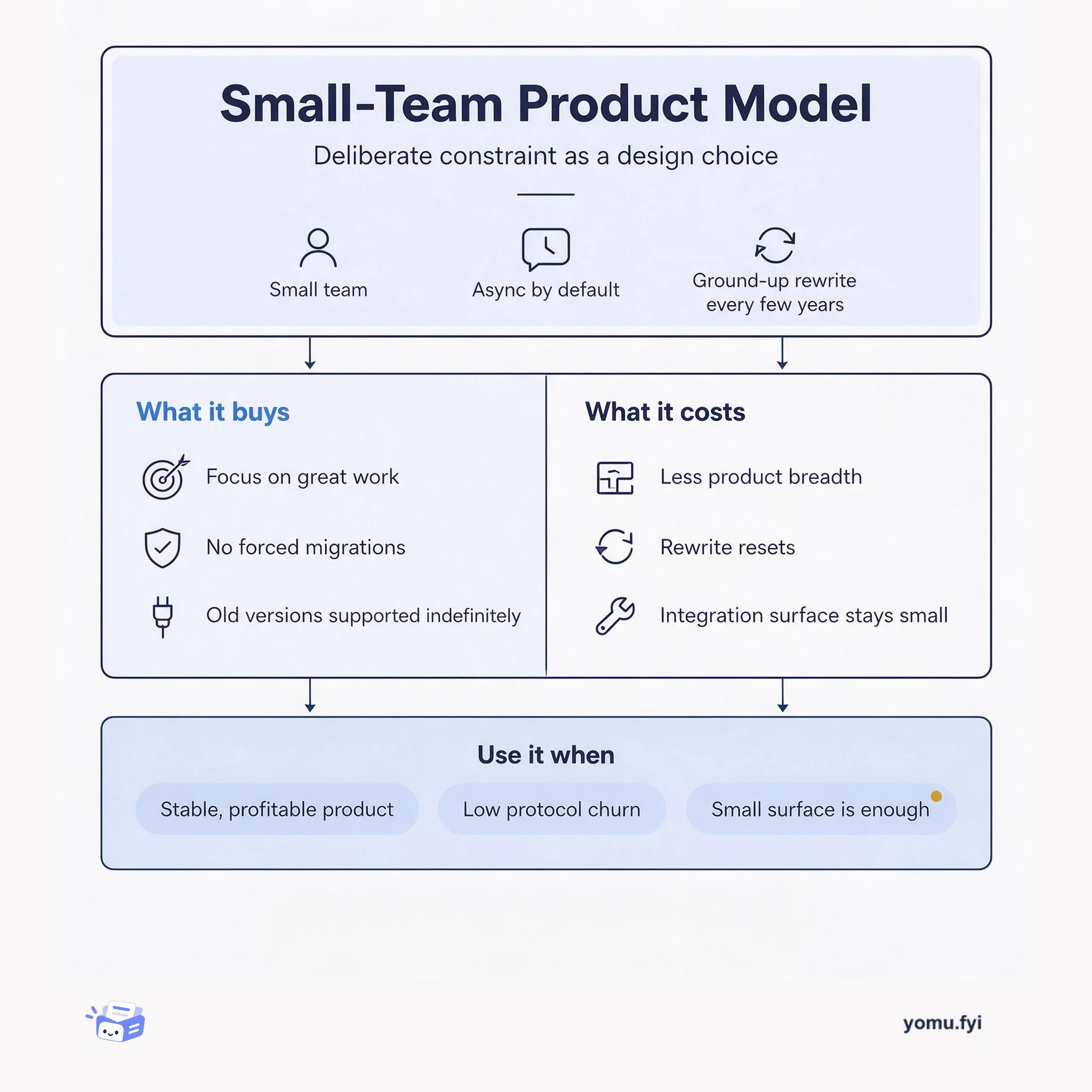
Basecamp keeps a small team, rewrites the product every few years, and supports old versions indefinitely. This diagram maps what that constraint buys, what it costs, and when it fits.
AWS Resilience Hub turns resilience goals into scoped, shareable policies. This explainer maps three trade-offs: label precision versus upkeep, central policy versus local adoption, and assessment versus drift.
AWS Resilience Hub lets a team define resilience requirements once and attach them to a workload boundary. In the next-generation release, that boundary can be a set of Amazon EKS labels, dependencies are summarized by generative AI so cross-Region links get reviewed, and policies are shared through AWS Organizations with events that track adoption. The trade-off is that each of these gains adds an operating cost: labels must stay accurate, a central policy must be adopted by member accounts, and an assessment is only a snapshot of a system that keeps changing. The diagram pairs each benefit with its cost and the condition that should guide the decision.
EKS label support selects Kubernetes resources using existing labels with AND logic, so the workload boundary comes from labels instead of namespace reorganization. The trade-off is upkeep: if labels drift, the assessed scope drifts with them.
A central team defines requirements once and makes them available to member accounts, with policy events tracking adoption. Adoption is not automatic, so someone has to watch those events and follow up with teams that have not applied the tier.
It is a snapshot. The walkthrough applies a tier-1 policy with a 99.9% availability SLO, 5-minute multi-AZ RTO, 1-minute RPO, and 15-minute multi-Region RTO, so the value comes from re-running it as labels, dependencies, and infrastructure change.
The posts behind it
 Auth0 · · Problem & solution
The post argues that the ability to go from idea to pull request using AI agents is now a commoditized problem, with two main approaches: vibe coding for rapid prototyping and human-supervised agentic development for mature products. The real challenges lie in deciding what to build—using criteria such as customer value, clear objectives, product fit, and financial strategy—and validating that the generated code is safe to ship. Validation must cover functional correctness, performance, security, resilience, compliance, and internal code quality using tools like unit tests, contract tests, AI-generated runtime tests, DAST, SAST, dependency scanning, code quality analysis, LLM-based code review, progressive rollout, and formal methods. A risk-based approach applies deeper validation to high-risk components—such as security-critical or data-damaging code—while allowing automated merges for low-risk areas like documentation or demo apps. The focus should shift from code generation to crisp product definition and robust verification pipelines.
 Meta · · Problem & solution
The 2026 FIFA World Cup produced the largest planned stress test of Meta’s infrastructure, with WhatsApp setting an all-time record of over 30 million messages per second during the final and delivering 8.4 billion messages in its peak five-minute window. Traffic analysis revealed that surges in sharing primarily occurred during breaks and final whistles, not during active gameplay, shaping capacity decisions. Instagram and Facebook saw live video watch time spike 90% and 242% respectively, while recommendation traffic rose 80% week-over-week. To absorb these spikes, Meta layered pre-provisioned capacity buffers, country-level graceful degradation, cascade prevention, and early warning signals across all serving tiers. Notably, the team did not shift load between regions or freeze deployments, relying instead on year-round reliability enhancements and phased runbook execution.
 Github · · Problem & solution
Managing outside collaborator access and stale repositories in a shared GitHub organization becomes harder to keep up with as projects grow. Evergreen is a GitHub App built with native GitHub features—scheduled actions, webhooks, issues, and custom properties—that automates two workflows: quarterly outside collaborator access reviews and stale repository detection and archival. Its design principles are fail secure, revoking access if no one responds, and never destroy anything, keeping archived repos recoverable and every change tracked in issues. The app is a Go webhook server that stores state as JSON files in a controller repo, using git history as the audit trail, and interacts via checklist issues in each repository. Rollout included dry-run mode, overcommunication, Splunk observability, and proactive rate-limit pacing; the pattern is adaptable using native GitHub features.
 Stack Overflow · · Problem & solution
Many engineering teams mistakenly think building an internal AI knowledge context layer is as simple as standing up a vector database and wiring a RAG pipeline to documentation. In reality, a production-grade pipeline requires five continuously maintained stages—capture, deliver, govern, organize, and validate—where each stage’s long-term cost compounds as vendor APIs change and content ages. The critical innovation is the knowledge node, a living record carrying source, ownership, and an automatically computed trust score based on authorship, usage, recency, and conflicts. Trust decays over time, prompting owners for lightweight revalidation when confidence drops, and knowledge is automatically scoped to the correct audience without manual filing. For product companies not in the knowledge-infrastructure business, the compounding maintenance burden makes building this pipeline a distraction compared to leveraging existing platforms like Stack Internal.
 AWS · · Tutorial
AWS Resilience Hub’s Next generation, announced September 18, 2026, adds three capabilities to align workload scope and resilience requirements with running environments. Amazon EKS label support selects Kubernetes resources using existing labels with AND logic, establishing precise resource boundaries without reorganizing namespaces. Generative AI-powered Dependency Insights summarizes discovered dependencies and highlights patterns warranting resilience review, such as cross-Region dependencies questioning recovery design. Resilience policy sharing through AWS Organizations lets a central team define requirements once and make them available to member accounts, with policy events tracking adoption. The post walks through scoping a checkout service on EKS using labels, examining dependencies via synthetic traffic, and applying a shared tier-1-critical policy with a 99.9% availability SLO, 5-minute multi-AZ RTO, 1-minute RPO, 15-minute multi-Region RTO, and 60-minute backup intervals.
More like this
Basecamp keeps a small team, rewrites the product every few years, and supports old versions indefinitely. This diagram maps what that constraint buys, what it costs, and when it fits.
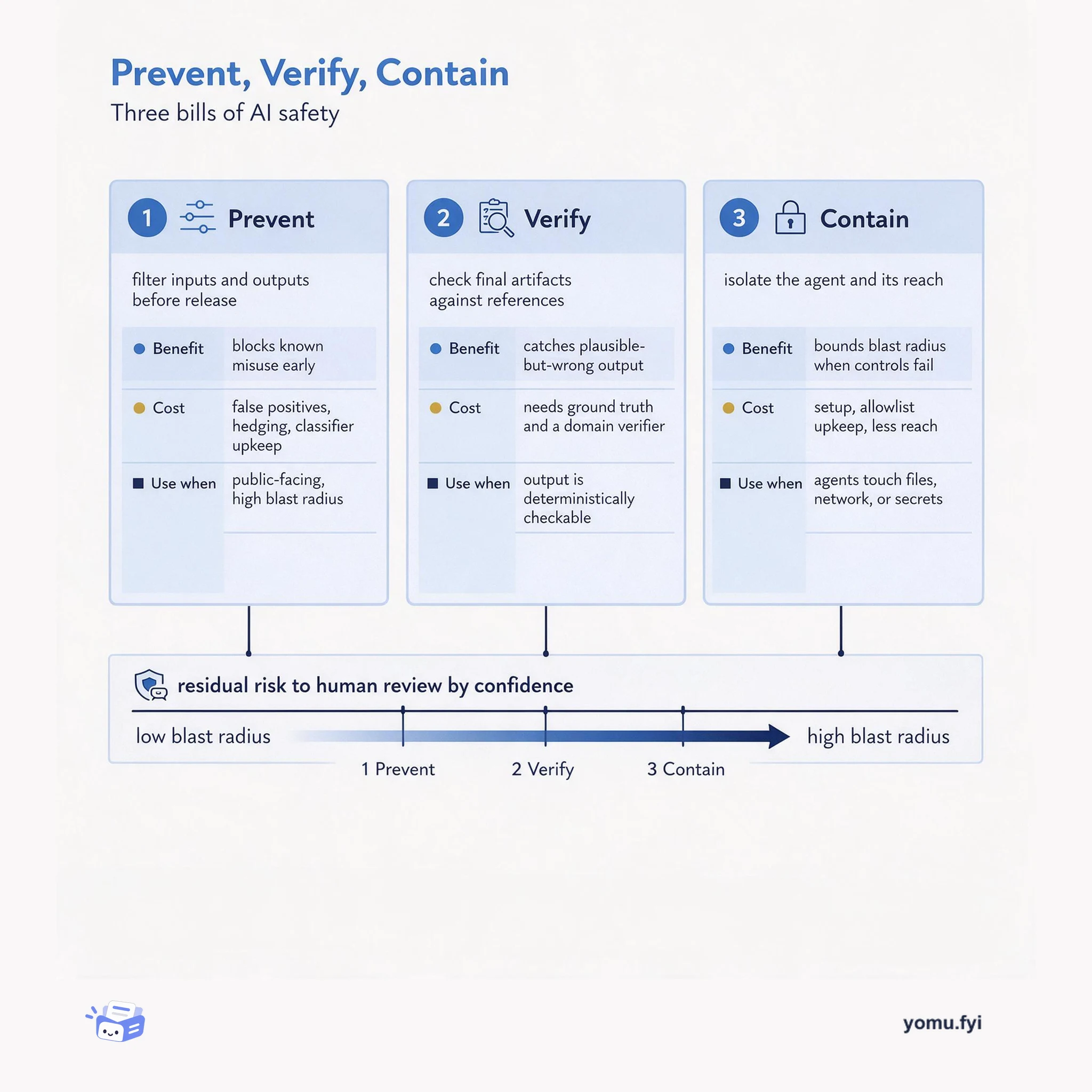
AI safety is a budget: prevention, verification, and containment each buy different protection at a different cost. This map shows what each control costs and when it pays off.
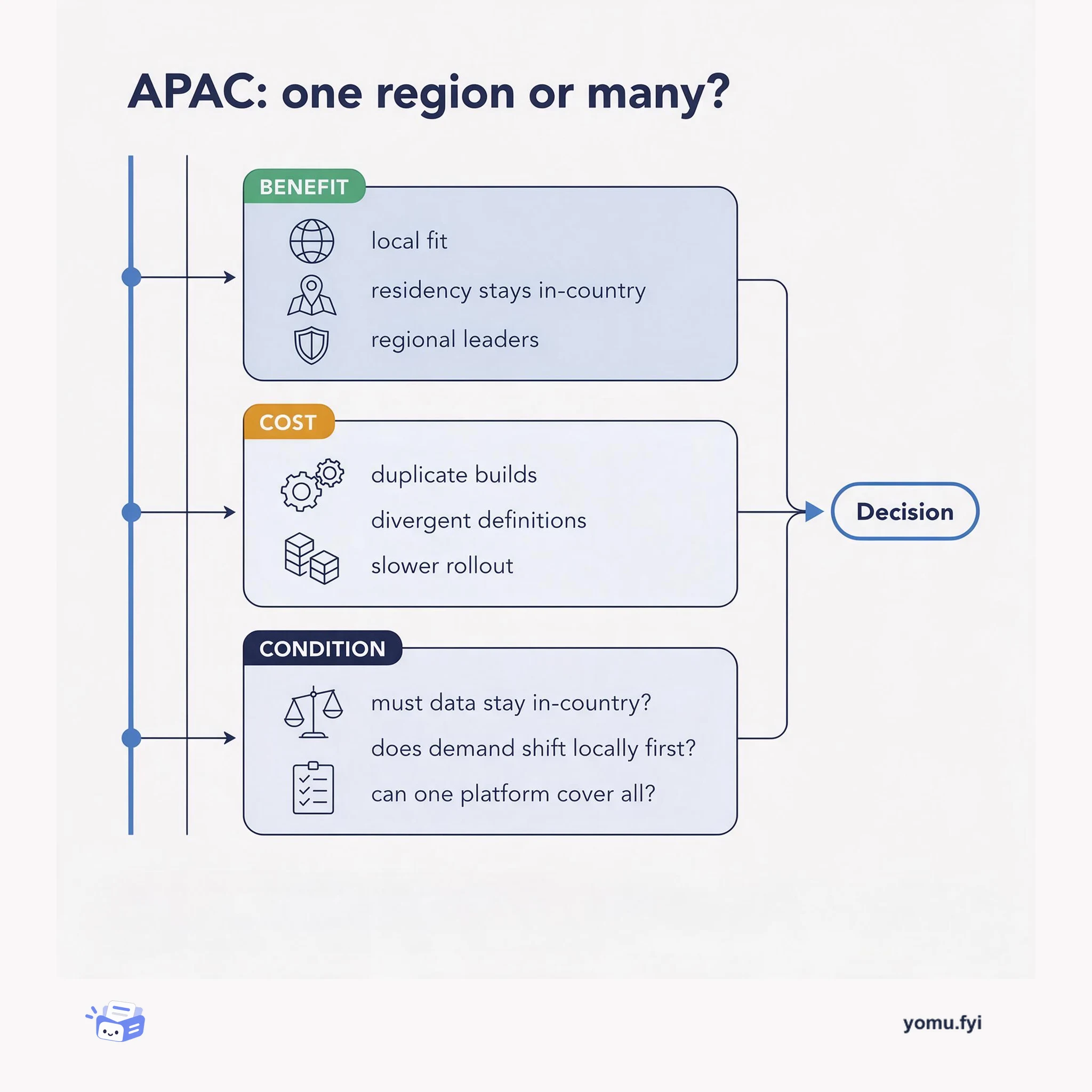
APAC is a federation of markets, not a single deployment region. This diagram maps the tradeoff between local autonomy and one shared platform, and the conditions that decide it.
The Good Stuff
Paid picks we use ourselves. Links carry a referral code — a subscription through one earns us a commission at no extra cost to you.
One useful email. Unsubscribe anytime.