Brand: Artifact vs Operating System
Compare two mental models for brand: a static artifact (logos, guidelines, centralized control) and a living operating system (values, APIs, support, trust). See which choices fit your engineering team.
Loading…
Topic
446 posts about Developer Experience. Every summary links to the original.
See the idea
Compare two mental models for brand: a static artifact (logos, guidelines, centralized control) and a living operating system (values, APIs, support, trust). See which choices fit your engineering team.
An app store is a distribution surface, a versioned contract, and a health loop between a platform and its developers. Here is how those parts fit together and why each one fails loudly if ignored.
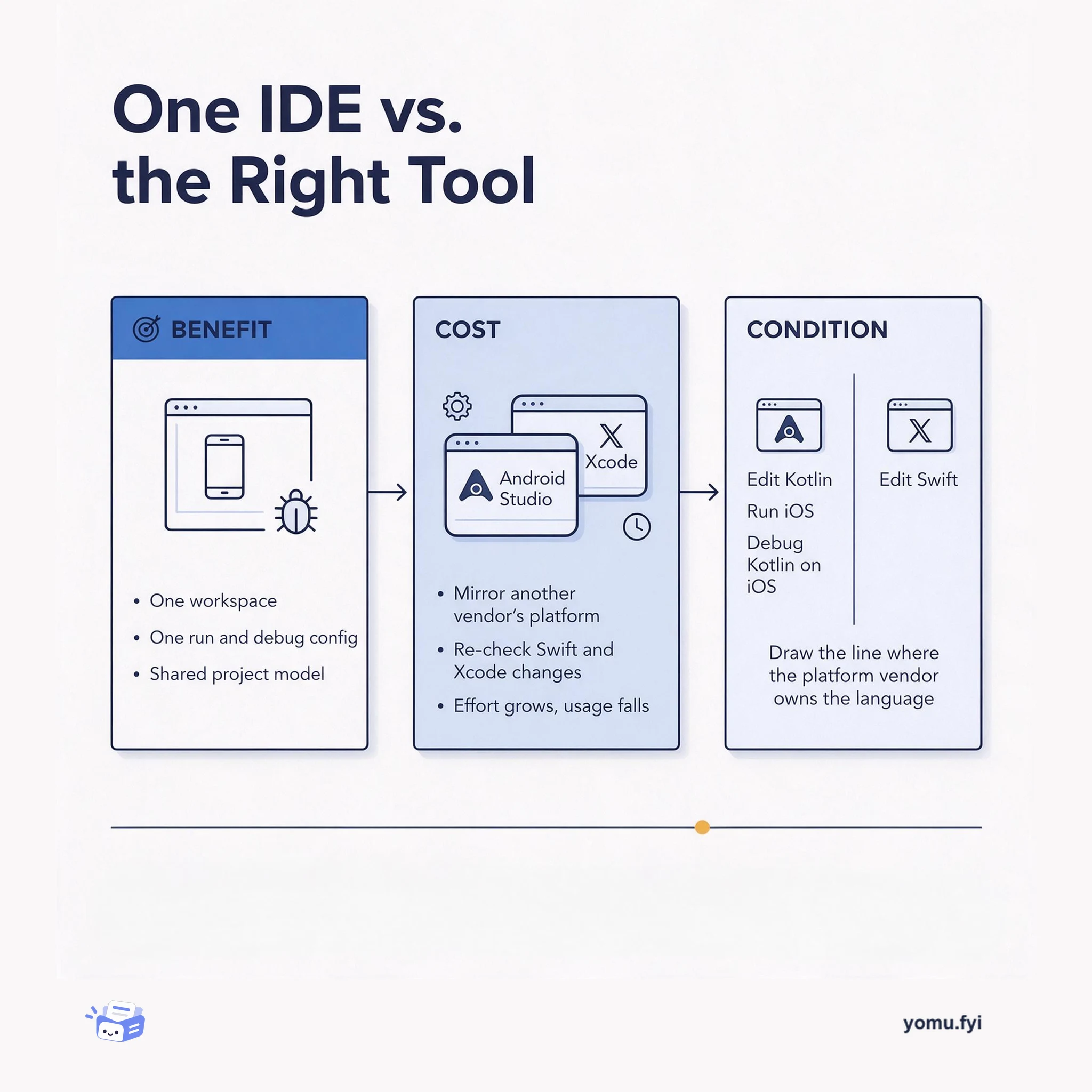
Android Studio keeps cross-platform Kotlin run and debug in one workspace but hands Swift editing to Xcode. This explainer maps the benefit, cost, and condition behind that boundary.
The Good Stuff
Paid picks we use ourselves. Links carry a referral code — a subscription through one earns us a commission at no extra cost to you.
Newest first
The post demonstrates how to debug and fix Stripe Invoicing integration errors with Workbench, a context-aware tool available throughout the Stripe Dashboard. It uses the Overview and Errors tabs to locate a recent parameter_missing error, then examines the failed Invoice create request and identifies the missing Customer object that prevented invoice creation. The Shell and API Explorer let developers list customers, supply a Customer ID, construct and run the corrected create command, and generate an SDK request from the configured fields. Workbench’s Inspector then exposes the invoice’s JSON data map, logs, and lifecycle events; the example confirms successful payment for a zero-dollar invoice and explains that non-zero charges require Invoice Items tied to products and prices.
Grab's Chimera team built Chimera Sandbox to address resource accessibility challenges and enable rapid machine learning experimentation across technical and non-technical teams. The platform runs on multi-cluster Kubernetes infrastructure capable of scaling to thousands of nodes per cluster during peak loads. Users can provision customizable Docker environments with varying CPU and GPU configurations, collaborate in real time, and query data using Spark-on-Kubernetes integrations and helper magic cells. The workspace integrates with Grab's AI Gateway for LLM access alongside tools like MLflow, Optuna, RStudio, and LabelStudio on shared storage, backed by user-level cost attribution.
Stripe Invoicing’s no-code workflow hides the API calls and invoice state transitions that developers may need to inspect when debugging payment failures. Using Stripe Workbench’s Inspector, Logs, and Events tabs, the walkthrough maps object hierarchies, requests, event payloads, and previous_attributes across an invoice lifecycle. Creating an invoice in the Dashboard produces a draft Invoice, a separate Invoice Item, an automatically generated Invoice Line Item, and related creation or update events. Sending it creates a Payment Intent and finalizes the invoice from draft to open; charging captures the Payment Intent, creates a Charge, and changes the invoice to paid. Draft invoices can be deleted, while open invoices can be voided, preserving the record and canceling the Payment Intent, and the same Workbench method can be applied to other Stripe API areas.
Shopify built Tophat to reduce the time and friction involved in manually testing mobile pull requests, where switching branches, stashing changes, and waiting for Xcode or Android Studio builds slowed review. The macOS menu-bar application links GitHub pull requests to iOS and Android artifacts produced by CI and stored in Google Cloud Storage, allowing contributors to install builds on simulators or real devices with one click. Tophat parallelizes tasks such as downloading applications and booting devices, and its Quick Launch feature retrieves builds with up-to-date native code for React Native development. The project also addressed real-device iOS installation and signing challenges, integrated with Shipit Mobile, and provided automated setup guidance. After the latest improvements, daily usage doubled, and Tophat was later made open source.
Stripe payment methods differ in how quickly they confirm attempted payments, with cards reporting status immediately and bank debits, bank transfers, and cash-based vouchers requiring additional processing time. The post uses Stripe Workbench and its in-browser CLI shell to create Checkout sessions in test mode, submit card and ACH Direct Debit payments, and inspect emitted events. For cards, charge.succeeded and payment_intent.succeeded signal successful payment, while integration code must inspect checkout.session.completed payment_status rather than confuse it with the session status. With delayed methods, checkout.session.completed can show unpaid before checkout.session.async_payment_succeeded or checkout.session.async_payment_failed arrives; the former changes payment_status to paid, and production processing can take days.
Online data materialised in Kafka topics at Grab traditionally remained uninspected until ingested into the Data Lake as offline data, introducing latency and making stream processing applications difficult to develop. To enable earlier data exploration, Grab adopted Apache Zeppelin notebooks integrated with an internal data streaming platform. Zeppelin uses a Flink interpreter to convert interactive SQL queries into Flink jobs submitted to a Flink session cluster. The platform dynamically translates Protobuf schemas into SQL Data Definition Language statements to simplify table discovery. Security and compliance risks are addressed by combining mutual TLS authentication with Strimzi's Open Policy Agent to enforce read-only access policies and audit logging on Kafka topics.
Grab’s Coban real-time data streaming team initially relied on direct Terraform merge requests for managing self-served resources like Kafka topics and CDC pipelines. This pure Infrastructure-as-Code workflow faced challenges with CI pipeline failures from manual errors, security risks from lacking access controls, and platform team review bottlenecks. To resolve this, Coban implemented a three-tier control plane comprising the Coban UI, a Go backend named Heimdall, and a Git storage and provisioner repository named Khone. Heimdall translates user form submissions into validated merge requests containing Terraform and metadata files, polling Khone's CI status and alerting users. This architecture abstracts infrastructure code behind a graphical self-service portal while preserving underlying Git auditing and automation.
Fly.io introduces a streamlined version of its fly launch command for deploying applications near their users. The CLI now infers desired infrastructure from application source code and offers opinionated defaults or alternative options when it cannot apply the same shape. Previously, the launch flow asked a series of questions; the change reduces guesswork by folding varied frameworks, languages, and toolchains into a few basic infrastructure shapes. A Rails application using SQLite is given an example set of defaults that developers can build from, while other applications can be configured through a confirmation webpage. Once settings are accepted, the app is built and deployed unless --no-deploy is supplied, and the CLI provides a link to the running app.
Ruvy is an open-source toolchain that takes Ruby code as input and produces a WebAssembly module whose exported _start function executes that code. Built on ruby.wasm, it pre-initializes the Ruby virtual machine and includes Ruby files during the build, while avoiding the need to supply a Ruby script path as a WASI argument at runtime. In Wasmtime benchmarks, Ruvy’s instantiation and _start execution took about 44.4–45.2 ms, compared with 55.8–56.9 ms for ruby.wasm plus wasi-vfs, and its Wasm-to-native compilation took about 440–457 ms versus 1.62–1.68 seconds. These results correspond to roughly 20% faster runtime performance and about 70% less compilation time in the reported tests. Ruvy currently requires users to install build dependencies and compile it because precompiled binaries are not shipped.
ShopifyQL Notebooks, released in October 2022, is a first-party app that lets merchants analyze shop data. To give its guided code-editing experience, Shopify used CodeMirror, which did not natively support ShopifyQL. Because ShopifyQL’s grammar is defined in ANTLR and generates Go and TypeScript code, while the language server follows Microsoft’s Language Server Protocol (LSP), the existing client and server language infrastructure was retained. A custom adapter passes queries to the language server, converts its incremental five-integer token descriptors into CodeMirror-compatible offsets, and reshapes them into a buffer of Lezer nodes for parse-tree construction. The resulting integration supports syntax highlighting, code completion, linting, and hover tooltips through CodeMirror plugins, while using its internal parse tree to inform editing behavior.
Sidekick addresses two streaming problems in LLM chatbots: Markdown fragments can render awkwardly before syntax is complete, and tool-driven responses can delay visible output across multiple LLM roundtrips. Its solution combines a buffering Markdown parser with an event emitter that multiplexes the main response and asynchronously resolved content into one stream. A Node.js Transform stream processes Unicode characters through a finite-state machine, buffering ambiguous sequences such as emphasis, list markers, and links until they resolve or are flushed as raw text. The parser also recognizes card links, triggering asynchronous card-resolution tasks while Server-Sent Events carry named streams to the UI, which demultiplexes them into the main response and placeholders. The design uses Markdown as a human-readable transport between the LLM, backend, and frontend, allowing content to appear as it is produced.
Shopify now recommends Remix for building Admin apps, which merchants use to configure apps, view data, and integrate services within Shopify Admin. Because these apps run in cross-origin iframes, browser restrictions can block cookies, storage, URL updates, and direct access to the Admin interface; App Bridge uses postMessage() to restore capabilities and support deeper integration. The new App Bridge client replaces the previous package, requires only a script tag, and makes standard web APIs such as history.pushState() work with Admin apps. The Remix template uses file-based routes, server-side loaders and actions, implicit API handling, and Shopify-specific integrations supplied by @shopify/shopify-app-remix, with Prisma provided for storage and sessions. Shopify integrated the template into Shopify CLI and describes it as the beginning of broader platform and design-system reworks.
Supabase Launch Week 8 will run an asynchronous hackathon for new Open Source projects that use Supabase in some capacity. The event is listed as starting at 09:00 am PT on Friday 4 August 2023, with the main schedule ending on Sunday 13 August at 11:59 pm PT; the submission instructions separately give a deadline of 11:59 pm PT on Sunday 14 August 2023. Individuals or teams of up to five can build an app, tool, library, or other project in any language or framework, with all design and code created during the event. Judges will award winners and runners-up across five categories, including overall quality, AI use, technical impressiveness, visual appeal, and fun, while submissions must include source code and may earn extra points for a demo video.
Grab's 69.3 GiB multi-module Go monorepo caused commands like go get to take over 18 minutes as Git repeatedly traversed commit history, downloaded large worktrees, and overloaded their GitLab VCS infrastructure. To bypass direct VCS queries without losing automatic updates for external repositories, the team deployed the Athens Go module proxy configured in fallback network mode. They used the GOVCS environment variable to disable Git access specifically for the monorepo path, forcing Athens to fall back to its internal object storage when resolving monorepo modules. A dedicated CI pipeline pre-populates and refreshes the Athens cache whenever new monorepo modules are released. This setup reduced monorepo go get execution times to approximately 12 seconds and allowed a 70% scale-down of the Athens proxy cluster.
Supabase has expanded its authentication support for native Apple and Google sign-in on iOS and Android, addressing a flow that previously required developers to send users through a web browser. Native apps built with Flutter or React Native can use OS-provided authentication dialogs across Apple platforms including iOS, macOS, tvOS, and watchOS, while Android support covers all Android variants. Behind these methods, ID tokens issued by Apple or Google are validated by Supabase Auth to create accounts or link existing accounts based on email similarity. The same signInWithIdToken() method also enables Sign in with Apple JS, Google One Tap, and authentication in Chrome extensions; the Google One Tap example passes the provider’s credential and a matching nonce when one is supplied via data-nonce.
Supabase’s May 2023 update announces two major product areas: Supabase Vector, an open-source toolkit for storing, indexing, and querying Postgres vector embeddings at scale, and Supabase Vault, a Postgres extension and UI for encrypted secrets and data. Auth Helpers now support client and server use of the Next.js App Router and server-side authentication by default with PKCE. The release also adds Turnstile CAPTCHA support, password reauthentication nonces, Wrappers integrations for Firebase, Stripe, S3, and clickhouse, CLI deployment for all Edge Functions, custom and vanity domains, and generally available Image Transformation. Supabase says it reached 50,000 GitHub stars, while the team solicits Dashboard SQL Editor feedback and reports community projects, AI resources, and a first-ever Flutter Hackathon.
The Flutter Hackathon winners were announced across categories including Best Overall Project, Best FlutterFlow Project, Best Dart Edge Project, Most Technically Impressive, and Most Visually Pleasing. Syno won Best Overall for concise video summaries, while Study Genius was runner-up; other recognized projects included Lord Of The Memes, ChatGlobe, Accident Detection, Caffeio, and their respective runners-up. ChatGlobe translates messages into multiple languages as they are sent using Dart Edge and the OpenAI API, while Accident Detection uses machine-learning techniques with accelerometer and GPS data to analyze accident-related changes in speed, direction, and impact force. Winners and runner-up teams receive limited Flutter Hackathon swag, and Syno’s creator also receives a Flutter-themed Supabase keyboard; the announcement also points to Flutter, Supabase, FlutterFlow, Edge Functions, and authentication guides for future projects.
Supabase announced a 10-day Flutter hackathon alongside new Flutter updates announced at Google I/O, inviting participants to build a new app with Flutter/Dart and Supabase in some capacity. Teams of one to five people can enter, with the event running from 7:00 am PT on May 12, 2023, through 11:59 pm PT on May 21, 2023. Submissions must include an accessible demo or demo video and are judged on creativity, smooth functionality, visual appeal, technical impressiveness, Supabase usage, and fun. Five award categories cover best overall, best FlutterFlow, best Dart Edge, most technically impressive, and most visually pleasing, with a winner and runner-up in each category. Rules require one submission per team, prohibit multiple team entries, require that project elements be created during the event, and state that developed intellectual property belongs to its team.
Supabase’s April 2023 Beta Update reports on Launch Week 7 and a broad set of product, ecosystem, and community announcements. It open-sources Logflare as Supabase Logs, adds a self-hostable Edge Runtime for Deno Functions, and presents Storage v3’s resumable uploads for files up to 50GB, with quality filters, Next.js support, and WebP support. Auth additions include SAML 2.0 SSO, PKCE, Sign in with Apple for iOS, and server-side support, while Studio 2.0 brings redesigns, developer-experience improvements, and new AI features. The update also announces dbdev, a PostgreSQL package manager, Trusted Language Extensions for Postgres, pg_graphql v1.2, search using GitHub Discussions, API report improvements, and a storage permission change, while noting Page Assist as the hackathon winner and Firecrawl’s move from Pinecone to Supabase for PostgreSQL vector embeddings.
Cloud Postgres providers often restrict extension installation until extensions are vetted, leaving some useful functionality unavailable on hosted databases. A Trusted Language Extension (TLE) is a Postgres extension written in a trusted language, allowing installation through pg_tle without placing code on the server filesystem. The source explains that conventional extensions may include SQL and functions implemented in languages such as C, while trusted languages follow PostgreSQL's security rules and cannot access raw process memory or system functions. AWS developed pg_tle, and collaboration with Supabase makes it available on Supabase and Amazon RDS for PostgreSQL 14.5 and higher; the dbdev registry can install packages such as langchain-embedding_search through SQL migrations. TLEs are presented as a way to distribute and iterate on trusted extensions without waiting for each cloud provider to preinstall them.
The best engineering reads, once a week.