Brand: Artifact vs Operating System
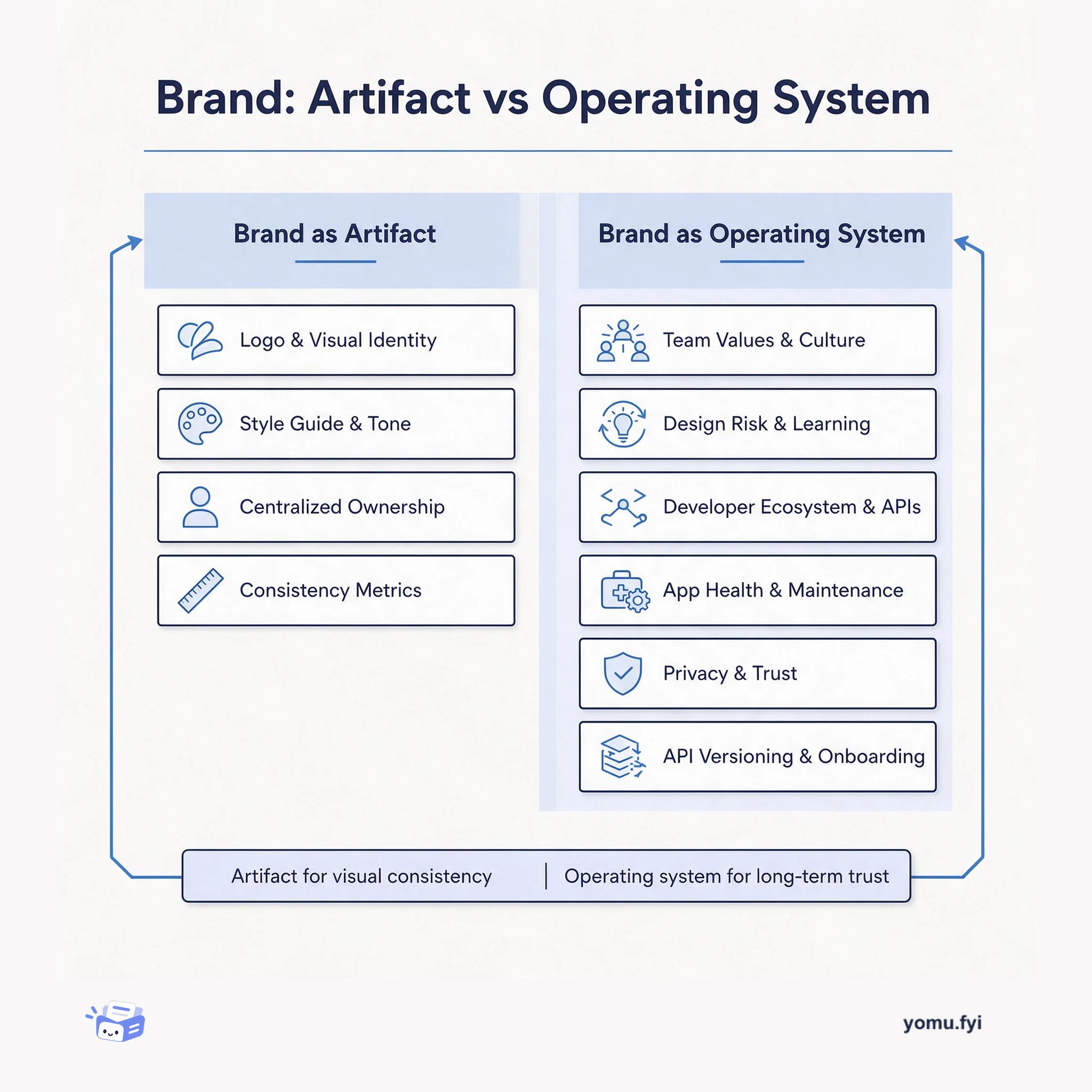
Compare two mental models for brand: a static artifact (logos, guidelines, centralized control) and a living operating system (values, APIs, support, trust). See which choices fit your engineering team.
Loading…
Topic
446 posts about Developer Experience. Every summary links to the original.
See the idea
Compare two mental models for brand: a static artifact (logos, guidelines, centralized control) and a living operating system (values, APIs, support, trust). See which choices fit your engineering team.
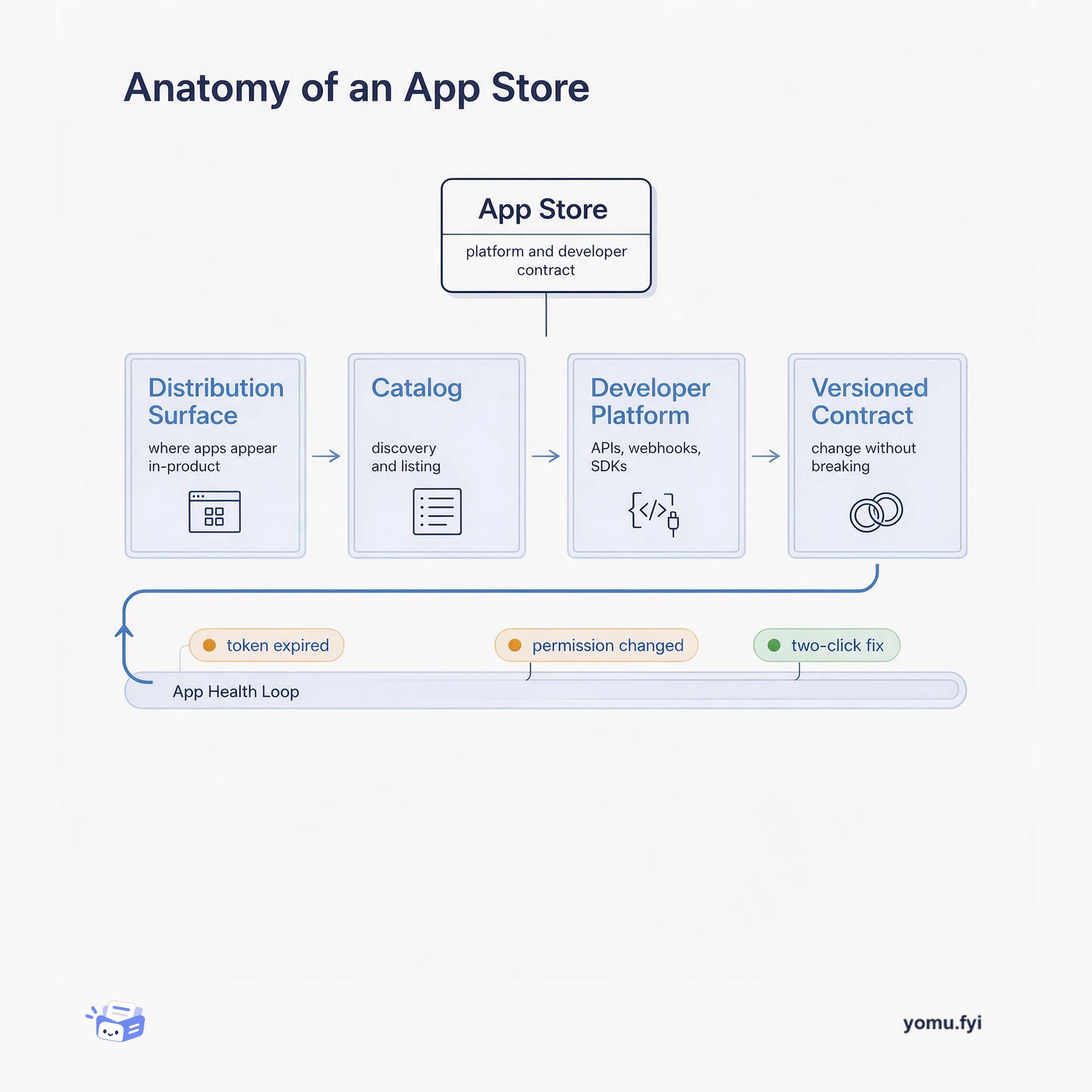
An app store is a distribution surface, a versioned contract, and a health loop between a platform and its developers. Here is how those parts fit together and why each one fails loudly if ignored.
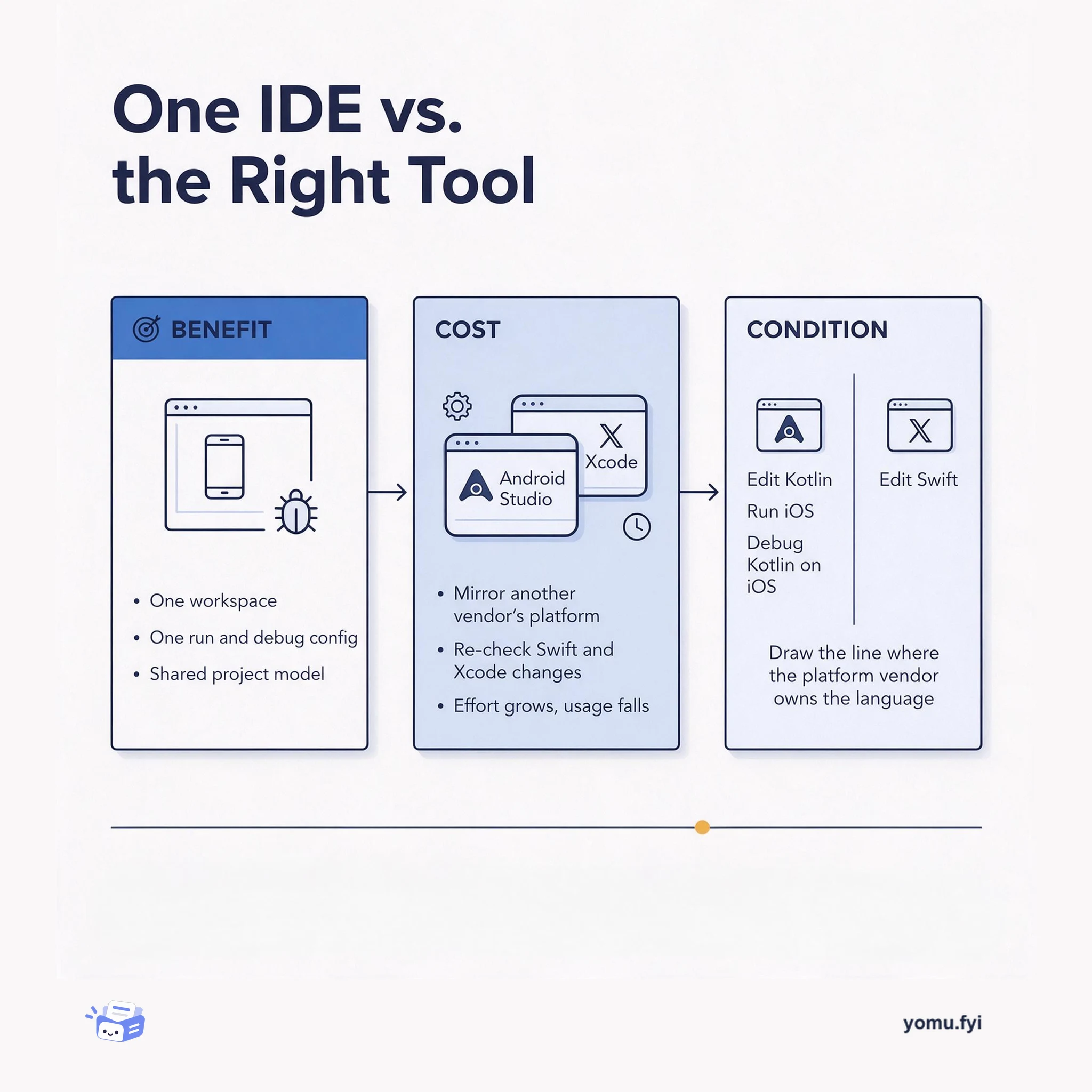
Android Studio keeps cross-platform Kotlin run and debug in one workspace but hands Swift editing to Xcode. This explainer maps the benefit, cost, and condition behind that boundary.
The Good Stuff
Paid picks we use ourselves. Links carry a referral code — a subscription through one earns us a commission at no extra cost to you.
Newest first
Google Cloud’s Gemini Enterprise developer experience (DevEx) Program pressure-tests enterprise AI tooling by walking fixed developer workflows without internal credentials or shortcuts, logging friction, and working with engineering on fixes. This sprint focused on governance across five dependency-ordered workflows: provisioning an agent identity, registering it, binding it to an Agent Gateway, applying policies and content safety, and verifying an authorized request with auditable decisions. Changes included documenting the Identity-Aware Proxy API prerequisite, fail-closed Model Armor extension examples, automatic allowance for essential Google-managed APIs, Private Service Connect and private Cloud DNS guidance, corrected IAM CEL syntax, clearer bind-time versus runtime evaluation, and ready-made Logs Explorer queries. The program says fixes are rigorously re-verified through continued user-journey testing to improve reliability, security, and end-to-end usability.
Stack Internal 2026.6 is a release focused on administrative security, API control, developer portal integration, knowledge-health automation, and accessibility for enterprise AI workflows. Its new Admin Security page supports X-API-Key headers for API v2.3 requests, inactivity windows, per-application daily limits up to 10,000 requests per day, and service-credential rotation with non-displayable secrets. The release adds scheduled expiration for Announcement articles, generally available community broadcasts, expanded custom award limits, tag preference and synonym APIs, richer user data, and a Backstage plugin update supporting the New Frontend System alongside the legacy architecture. Accessibility work improves screen-reader announcements, keyboard and reflow navigation, focus management, high-zoom layouts, contrast, and semantic markup, while additional fixes address tags, suggested edits, and Slack rendering.
Genie One’s latest updates target the manual work that follows an AI-generated answer, including accuracy checks, report formatting, sharing, and repeated workflows. The release adds a native macOS desktop app in beta with a global launcher, persistent conversations across web and desktop, and access to documents, skills, scheduled tasks, Genie Agents, and Databricks Apps. Genie One can create editable documents with live visualizations, comments, version history, sharing, PDF export, and external-document editing through MCP writes. Users can also turn conversations into reusable, shareable Genie Agents or distribute read-only chat links containing questions, answers, visualizations, and context. Additional capabilities include ontology snippets, private uploads of supported files, and governed MCP actions, with Unity Catalog, source authentication, and Unity Gateway governing access across assets and connected tools.
Project Loom in IntelliJ IDEA introduces Java developers to three cohesive concurrency features: Virtual Threads (JEP 444, stable since Java 21), Scoped Values (JEP 506, stable since Java 25), and Structured Concurrency (JEP 533, seventh preview in Java 27). The post identifies pain points such as CompletableFuture ignoring interrupt flags, manual ExecutionException unwrapping chains, duplicated cancel() calls across catch blocks, mutable ThreadLocal pitfalls, and flat thread dumps lacking request hierarchy. A CustomerProfileService example is refactored from CompletableFuture.allOf to StructuredTaskScope.ShutdownOnFailure, where sibling tasks are cancelled automatically and a single timeout covers the whole scope. IntelliJ IDEA debugger support from version 2026.1 groups virtual threads forked within a StructuredTaskScope into containers representing their scopes, and the post walks through downloading JDK 27 (EA) and enabling the experimental language level.
Stripe's extensibility SDK was built with AI involved across prototyping, architecture, implementation, and refinement, but the main change was to the development loop rather than code-generation speed. For a custom-object design, one engineer produced a working prototype, demo, and documentation site in roughly two days instead of an estimated two to three weeks, allowing the team to evaluate boundaries and reprioritize the feature for the next major launch. The team then used reviewed, detailed specifications and persistent domain guidance to delegate bounded work, including about twenty ESLint rules covering authoring constraints such as sandbox boundaries, imports, and type safety. AI also helped keep scripts, workflows, SDK generation, runtime enforcement, tooling, documentation, examples, and tests aligned, while human judgment remained responsible for abstractions and trade-offs. The post concludes that AI's leverage came from making more artifacts concrete earlier, enabling earlier feedback and a tighter deliverable.
The CLion development roadmap outlines planned updates for minor releases and the stable 2026.3 release. Development priorities center on agentic workflows, embedded development support, and debugger enhancements. Planned AI features include agent-assisted project setup and a specialized skill for ARM Cortex-M HardFault debugging with register, memory, and disassembly access. Debugger enhancements introduce JSON-based debug profiles, import capabilities from tools such as VS Code, a dedicated Lauterbach TRACE32 profile, and LLDB 21 for Windows MSVC users. Additional additions span QNX project support, default resolve configurations for unlinked files, ISPC language support, bundled toolchain upgrades, and improvements to IDE responsiveness and Dev Container workflows.
The tutorial presents an agent-driven workflow for adapting robot navigation across embodiments and scenes, addressing the repeated cost of collecting data, preparing simulation assets, training, diagnosing, and evaluating each robot-scene pair. Using Boston Dynamics Spot, it applies COMPASS to a built-in warehouse and a SAGE-10K scene, with NVIDIA Omniverse NuRec described as an option for captured environments. COMPASS reuses the pretrained NVIDIA X-Mobility navigation policy and trains a residual reinforcement-learning specialist that corrects base actions for a selected robot and environment; specialists can later be distilled into a shared policy. Repository skills guide dependency checks, asset preparation, smoke testing, training, checkpoint comparison, and packaging, while human gates control scene acceptance, smoke-test continuation, and checkpoint promotion. Runtime integration converts camera images, goals or routes, and speed from odometry into velocity commands, with cuVSLAM available separately when compatible odometry and transforms are unavailable.
JetBrains surveyed over 15,000 professional developers globally in 2026 to measure how much production code is generated by AI agents versus manual authoring. On average, respondents report that agents fully write approximately 47% of their code, while 38% involves AI assistance and 27% is written manually. Adoption varies across ecosystems, with Go, JavaScript, and TypeScript developers reporting the highest agentic code generation at 54% to 55%, while C and C++ developers retain the highest manual share. Senior developers lead adoption over juniors, with about a quarter delegating more than 80% of code generation to agents. Cluster analysis categorizes the developer population into agentic coders (31%), AI-assisted coders (47%), and manual coders (23%).
JetBrains has announced the release of Compose Multiplatform 1.12.0 with targeted capabilities for artificial intelligence integrations, web rendering, and desktop application layouts. The update incorporates an experimental Model Context Protocol server inside Compose Hot Reload, allowing AI agents to trigger reloads, capture screenshots, inspect the semantic tree, and simulate user interactions directly. For web deployments, the framework now provides automatic font fallback by downloading necessary Noto font subsets on demand when unresolved characters occur during rendering. Desktop developers receive an experimental v2 window and dialog application programming interface in the androidx.compose.ui.window.v2 package, which distinguishes requested states from actual window states and permits precise control over positioning, sizing constraints, and multi-screen placement. These combined enhancements improve developer workflows and runtime flexibility across multiple target platforms.
Session replay software varies fundamentally based on architecture, distinguishing tools designed for product analytics from those built for developer debugging. Recording approaches split into DOM snapshot and mutation capture, which optimizes for compression and structured debugging, versus pixel capture, which favors visual fidelity for complex animations. Privacy depends heavily on masking location, where client-side masking redacts data before network transmission, whereas server-side scrubbing acts after transmission. For engineering teams, integration depth connects replays natively to traces, console errors, and backend issues rather than requiring timestamp lookups across separate products. Performance costs across CPU, memory, and network require benchmarking on target applications alongside strategies like error-based sampling.
With the 2026.2 release, JetBrains expanded its OpenTelemetry plugin from Rider to IntelliJ IDEA, GoLand, PyCharm, and WebStorm. The tool captures logs, metrics, traces, and service maps locally without requiring an external observability backend. Developers can search structured log records, plot metric values over time, inspect distributed spans, and verify communication paths across databases and message queues during local runs. To ingest telemetry, the plugin automatically configures OpenTelemetry Protocol environment variables for supported run configurations and terminal sessions, or accepts forwarded data from existing collectors. Additionally, experimental Model Context Protocol support allows AI coding agents to query gathered logs, spans, and service topology.
The official Visual Studio Code extension for Red Hat Ansible Automation Platform includes an automation coding assistant, formerly called Ansible Lightspeed. Initially integrated with IBM watsonx, the extension now supports Google Gemini and OpenAI-compatible endpoints through Red Hat AI. An updated interactive lab demonstrates these capabilities through an end-to-end scenario involving database installation and HTML landing page deployment across two nodes. Learners write natural language prompts to generate Ansible playbooks and roles, evaluate output, and utilize real-time automated linting and integrated documentation. By serving an open-source model through a preconfigured OpenAI-compatible endpoint, the refreshed environment removes external credential setup steps.
CUDA Python 1.0, released with CUDA 13.3, presents Python as a supported way to access the full NVIDIA CUDA platform. It addresses a fragmented ecosystem in which libraries used separate binding layers, complicating shared GPU memory, streams, and resource ownership, and forcing developers toward either CUDA C++ extensions or higher-level libraries. The release combines independently versioned components, including cuda.core, cuda.compute, cuda.bindings, cuda-pathfinder, and nvmath-python, with semantic-versioning and deprecation commitments. cuda.core supplies common Python objects for devices, streams, and buffers, allowing NVIDIA and external libraries to compose on shared resources, while cuda.bindings offers 1:1 CUDA C API coverage. The stack spans runtime services, tuned CUDA libraries, communication tools, and kernel-authoring systems, although some newer kernel languages remain experimental and outside the 1.0 guarantees.
The JetBrains Research Podcast investigates foundational software development and computer science questions through discussions with industry researchers. In team psychology, Cat Hicks demonstrates that collaborative culture and organizational belonging reduce developer anxiety around automated tooling while curbing the risks of overproduction pressure. Historical analysis by Tomáš Petříček shows that programming spans five competing cultures rather than pure specification implementation, explaining why automated code generation historically encounters limits. Regarding artificial intelligence evaluation, Ibragim Badertdinov details how SWE-rebench isolates model capability through dataset decontamination, leveraging the strict verifiability of software test execution for training feedback. Additionally, conversations with Alexander Kulikov and Anna Kogan examine how foundational mathematical understanding aids AI oversight and address adoption hurdles for open-source computer vision infrastructure.
Authentication and identity requirements vary substantially as software organizations scale from solo builders to multi-brand enterprises. Building and maintaining authentication in-house frequently consumes valuable engineering cycles and incurs ongoing costs associated with security patching and edge cases. To address these distinct development stages, Auth0 structures its platform across Free, Essentials, Professional, and Enterprise tiers with differentiated B2C and B2B pricing. Early-stage and growing teams gain access to enterprise connections, SCIM user synchronization, and multi-tenant routing through Auth0 Organizations. Larger customer deployments utilize features like multi-app Single Sign-On and passwordless logins, which have driven reported outcomes such as a 20% conversion lift and a 66% reduction in identity management time.
Rapid application development with AI coding tools often produces unreviewed custom authentication logic that handles sensitive Personally Identifiable Information and regulatory requirements like HIPAA. Autonomous AI agents compound these security challenges by significantly widening an application's overall attack surface. Standardizing on Auth0 provides an established identity layer that integrates into agentic workflows via Claude plugins, an Auth0 MCP server, and standardized agent skill packages. This setup exposes Auth0 Management APIs and official documentation directly to AI agents, achieving integration times of three to four minutes according to Agent Experience metrics. Incorporating these pre-built patterns maintains security baselines while supporting scaling requirements across B2B plans for initial user bases up to 1,000 monthly active users.
Automated accessibility checkers reliably flag missing alt text attributes but frequently miss unhelpful descriptions like raw filenames or repetitive labels. To evaluate image description quality without generating excessive false positives, GitHub built an alt text plugin for the GitHub Accessibility Scanner. The tool combines five deterministic, zero-credential rules that evaluate strings and visual layout spacing with an opt-in vision model check for subjective context. Page context including headings and surrounding prose is extracted alongside images to guide the model using structured outputs and explicit anti-nitpick instructions. While deterministic checks catch unwritten text, the model-driven rule serves as an opt-in prompt for human review rather than an absolute verdict.
Databricks introduces updated IDE and CLI integrations that connect VS Code, Cursor, or a terminal directly to Databricks compute, workspace, and Unity Catalog. Existing Databricks Connect supported local Spark development, but remote non-Spark workloads and dependency synchronization remained pain points. The new SSH tunnel supports interactive execution and debugging of Python and SQL workloads on Serverless, AI Runtime, and dedicated clusters, while keeping files and dependencies aligned with Databricks Runtime and the workspace. CLI flags can select serverless, GPU-backed AI Runtime, or a dedicated cluster, and can start the tunnel in VS Code or Cursor; additional options configure base environments and usage policies, while the IDE can browse Unity Catalog assets.
AI coding agents often generate outdated Go patterns because older syntax dominates training data and new features fall past model cutoffs. To address this gap, the GoLand team released Modern Go Guidelines, an open-source set of skills and CLI tools covering Go 1.0 through Go 1.27. The tool inspects a project's go.mod file or a specific version flag to supply only the language features and standard library additions compatible with that environment. Using a progressive disclosure approach, the CLI provides concise rule identifiers via a list command and expands into before-and-after examples through an explain command. This mechanism minimizes token consumption while helping agents produce up-to-date, compilable code without modifying project files.
Deploying the Junie coding agent locally on Apple MacBook M5 hardware requires overcoming steep performance bottlenecks during model execution. Engineers optimized the entire stack using Qwen3.6-27B rather than Qwen3.8-27B, which severely degrades without token-heavy reasoning enabled. At the agent layer, Junie appends requests directly into a rolling context and caches initial prompt prefixes to maximize KV-cache reuse across tasks. For model inference, the team disabled reasoning, selected 4-bit quantization, and patched MLX-VLM to execute self-attention prefill matrix operations using faster 8-bit instructions on the M5 processor. Combining these prefill improvements with simultaneous multi-token prediction and n-gram speculative decoding delivered up to a 2x generation speedup.
The best engineering reads, once a week.