Brand: Artifact vs Operating System
Compare two mental models for brand: a static artifact (logos, guidelines, centralized control) and a living operating system (values, APIs, support, trust). See which choices fit your engineering team.
Loading…
Topic
448 posts about Developer Experience. Every summary links to the original.
See the idea
Compare two mental models for brand: a static artifact (logos, guidelines, centralized control) and a living operating system (values, APIs, support, trust). See which choices fit your engineering team.
An app store is a distribution surface, a versioned contract, and a health loop between a platform and its developers. Here is how those parts fit together and why each one fails loudly if ignored.
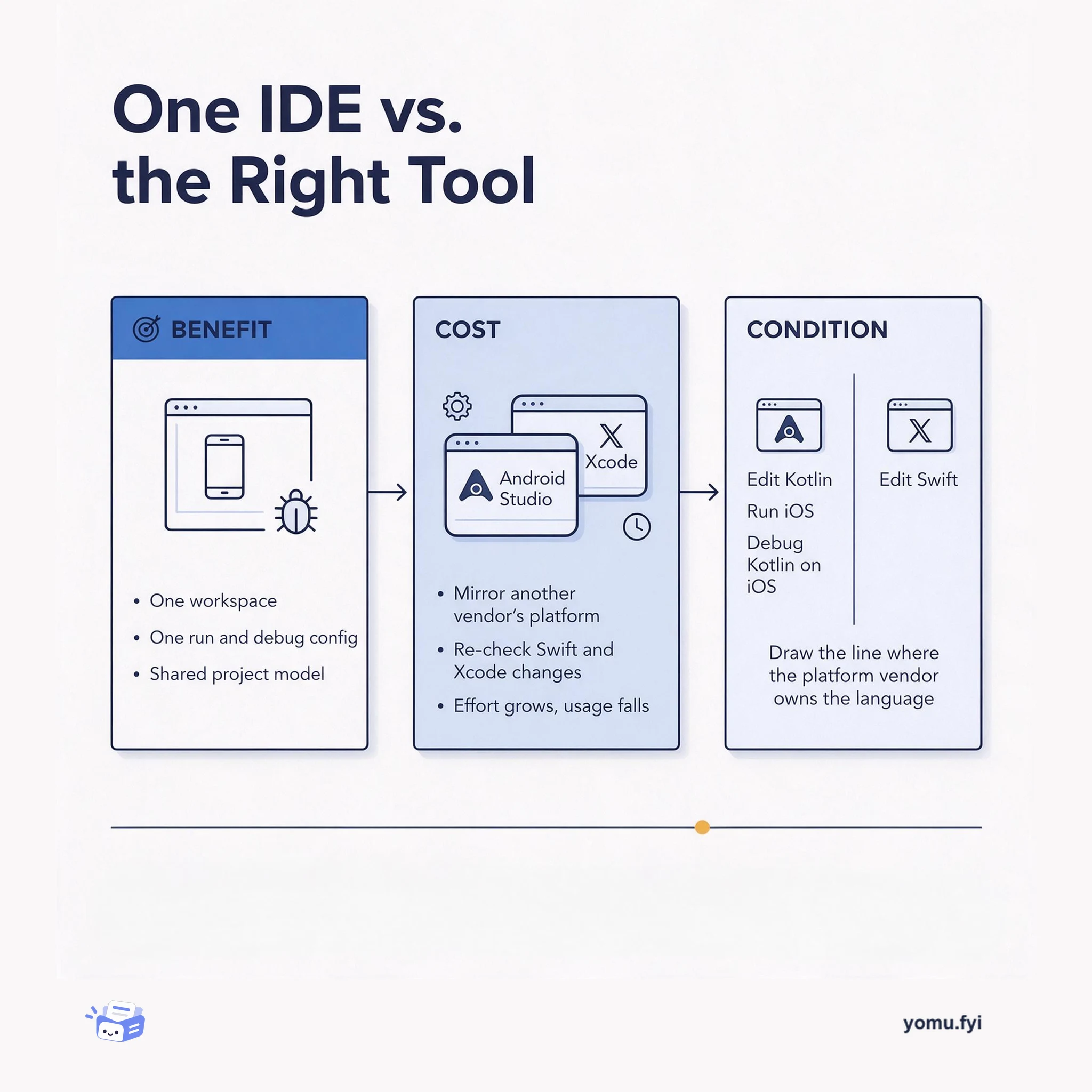
Android Studio keeps cross-platform Kotlin run and debug in one workspace but hands Swift editing to Xcode. This explainer maps the benefit, cost, and condition behind that boundary.
The Good Stuff
Paid picks we use ourselves. Links carry a referral code — a subscription through one earns us a commission at no extra cost to you.
Newest first
AI coding agents often generate outdated Go patterns because older syntax dominates training data and new features fall past model cutoffs. To address this gap, the GoLand team released Modern Go Guidelines, an open-source set of skills and CLI tools covering Go 1.0 through Go 1.27. The tool inspects a project's go.mod file or a specific version flag to supply only the language features and standard library additions compatible with that environment. Using a progressive disclosure approach, the CLI provides concise rule identifiers via a list command and expands into before-and-after examples through an explain command. This mechanism minimizes token consumption while helping agents produce up-to-date, compilable code without modifying project files.
Deploying the Junie coding agent locally on Apple MacBook M5 hardware requires overcoming steep performance bottlenecks during model execution. Engineers optimized the entire stack using Qwen3.6-27B rather than Qwen3.8-27B, which severely degrades without token-heavy reasoning enabled. At the agent layer, Junie appends requests directly into a rolling context and caches initial prompt prefixes to maximize KV-cache reuse across tasks. For model inference, the team disabled reasoning, selected 4-bit quantization, and patched MLX-VLM to execute self-attention prefill matrix operations using faster 8-bit instructions on the M5 processor. Combining these prefill improvements with simultaneous multi-token prediction and n-gram speculative decoding delivered up to a 2x generation speedup.
JetBrains has introduced Junie Local, a feature that runs the Junie coding agent entirely on local hardware without cloud dependencies, subscriptions, or credit meters. Users execute a single command inside Junie to download a 4-bit quantized Qwen3.6-27B model, requiring an Apple M5 Mac with 64 GB of RAM. The team prioritized prefill throughput over pure generation speed by utilizing 8-bit arithmetic instructions on the M5 Neural Accelerator, which increased prefill throughput by approximately 40%. Performance optimizations also include KV-cache reuse, speculative decoding to double generation speed, and disabling reasoning to preserve performance. In JetBrains' evaluations, the local configuration performed comparably to cloud-based Sonnet 4.5 on everyday tasks while ensuring source code, diffs, and prompts never leave the local environment.
Responsible AI adoption struggles when organizations rely on static policy documents instead of integrating guardrails directly into engineering workflows. Developers under delivery pressure inevitably turn to unapproved shadow AI when sanctioned routes introduce friction. Stack Overflow survey data reveals that 84% of respondents use or plan to use AI tools, yet more developers distrust AI accuracy than trust it. Operational controls must be embedded inside repositories, build pipelines, and pull request reviews to match specific failure modes like those listed by OWASP. Organizations achieve dependable adoption by pairing automated controls with clear role ownership, psychological safety, role-specific training, and outcome-based engineering metrics.
As software agents make implementation faster and cheaper, engineering difficulty shifts away from typing code toward defining correctness and verifying behavior reliably. Omitting specifications forces human reviewers into expensive correction loops, while overspecification clutters model context windows with stale prose and competing instructions. To find the optimal middle ground, teams must validate specifications before coding, using one agent to draft minimal constraints and another to attack ambiguities, hidden dependencies, and missing failure modes. Multi-agent architectures demand formal interface contracts, schemas, and executable checks because interpretive drift compounds rapidly across unbounded agent handoffs. Core Extreme Programming and Agile practices such as continuous integration, small release batches, and rapid feedback loops remain essential error-detection mechanisms during agentic development.
Ansible development workspaces in Red Hat Ansible Automation Platform leverage Red Hat OpenShift Dev Spaces to solve environment drift and lengthy developer onboarding. Instead of configuring local environments, developers access cloud-hosted VS Code instances via a web browser using declarative devfile.yaml configurations. The platform enforces immutability with a read-only /var directory at runtime, preventing arbitrary package installations that cause configuration drift. To address differing domain requirements across teams without creating bloated monolithic images, the solution implements a four-tiered image strategy based on OpenShift BuildConfigs and ImageStreams. When base container images receive security patches, the dependent image layers automatically rebuild throughout the entire chain.
At Salesforce, engineering teams discovered that AI coding agents could produce internally consistent code and passing test suites that still failed to meet actual requirements. To ensure correctness before writing code, the team developed an agentic Spec-Driven Development workflow centered on explicit specifications and gated verification. The system separates evidence-based repository lookups handled by agents from subjective judgment calls escalated to human engineers. Implementation plans must cite repository evidence reviewed by a Skeptic Agent, while a Compliance Matrix traces each success criterion directly to executable test proof. Finally, a multi-agent review system evaluates the implementation under an asymmetric rule allowing an independent judge to downgrade passing checks but never override failed gates.
Technical project managers historically spend 60 to 70 percent of their working time managing routine coordination tasks, including manual spreadsheet updates and obsolete status reporting. Engineering organizations are addressing this overhead by integrating generative artificial intelligence, large language models, and agentic workflows into delivery pipelines. Automated agents ingest telemetry directly from Git commits, pull request comments, and CI/CD logs to assess system state while machine learning models execute Monte Carlo simulations to forecast delivery risks. Although this automation reduces administrative overhead below 30 percent, implementations face practical obstacles like inconsistent ticket definitions across teams and algorithmic over-reliance on uncontextualized historical patterns. Consequently, technical project managers are transitioning into strategic roles that coordinate hybrid human-agent workforces while providing critical judgment and organizational context.
Cloudflare introduced OAuth scope customization to replace all-or-nothing consent flows for third-party applications. Previously, users had to approve every requested scope or deny access completely, compelling developers of tools like MCP servers to construct custom pre-consent selection interfaces. With the new feature, developers can designate specific permissions as optional alongside required scopes when configuring an OAuth client. During authorization, users can deselect these optional scopes, while unrequested client scopes remain hidden to maintain task-specific consent screens. Because resulting access tokens contain only the granted subset of permissions, client applications must inspect returned scopes after code exchange rather than assuming full authorization.
According to the 2026 Django Developers Survey, ninety percent of respondents incorporate artificial intelligence into their weekly or daily workflows. While agents generate code rapidly, developers remain accountable for understanding, evaluating, and shipping changes within their applications. PyCharm addresses these demands by integrating support for external agents, local models via Ollama and LM Studio, and customizable agent skills across codebases. The IDE maintains version-specific framework assistance, including auto-completion for Django 6.0 template partials, alongside architectural inspection tools and visual diffs. Furthermore, developers can trace application components, inspect API endpoints, execute HTTP requests, and query database migrations directly through built-in tooling.
GoLand 2026.2 introduces day-one support for Go 1.27 language features, tooling improvements, and profiling capabilities. The Go 1.27 release adds generic methods, promoted field names in struct composite literals, improved function type inference, and a dedicated profile for detecting goroutine leaks. To assist with code maintenance, GoLand integrates official go fix modernizers directly into editor inspections, the Problems tool window, and optional pre-commit checks. Developers can capture, visualize, and analyze goroutine leak profiles alongside existing CPU, memory, and mutex profiles within the IDE. Additionally, updated Modern Go Code Guidelines provide AI coding agents with Go 1.27 context and API changes aligned with the version specified in go.mod.
Software development is experiencing an architectural shift as artificial intelligence agents transition individual contributors into orchestrators and reviewers of automated workflows. Rather than spending effort on manual coding, developers increasingly focus on defining system architecture, guiding agent execution, and managing operational risk through tiered human and agent review loops. The primary bottleneck for agentic systems lies in preparing organizational data so that agents can effectively reason over enterprise knowledge. To address this challenge, Google published an open knowledge format and is adopting agent-driven semantic ontology generation to infer relationships across messy data estates. This evolution transforms ontology building from manual human toil into automated generation, allowing engineers to focus on high-value data curation and strategic system design.
A career progression through community leadership and software engineering led to a new role at Okta. Starting as a campus ambassador and Google Developer Student Clubs lead in India, the author organized hackathons, workshops, and meetups to foster peer learning. To effectively advocate for developers, an internship as a Developer Advocate at Zuplo prompted hands-on engineering experience as a Software Development Engineer at JPMorgan. After mentoring over 10,000 students and growing a technical community to over 600,000 members, the author joined Okta as a Senior Builder Advocate. In this role, advocacy extends beyond traditional coders to support AI builders, low-code creators, and developers utilizing identity and access management tools.
NVIDIA Holoscan is a platform for real-time AI applications at the edge, and HoloHub provides reference applications and components. This post describes an engineer-guided workflow in which a coding agent builds a separate Python endoscopic tool segmentation application from the existing MONAI model, sample video, and Holoscan patterns. The Holoscan CLI, invoked through ./holohub, exposes shared commands for scaffolding, running, modes, tests, and benchmarking, while development skills and documentation guide the agent through project-specific operations. The application connects video replay, preprocessing, TensorRT inference, segmentation postprocessing, telemetry, and HoloViz visualization, with visual, smoke, and benchmark modes; the post reports that the CLI-plus-skills-plus-docs/examples configuration produced a separate application in 40 minutes using 11M tokens, and concludes that this combination offered the lowest resource overhead among the compared configurations.
NVIDIA SkillEvaluator measures whether packaged agent skills improve agent performance by comparing task runs with and without a skill installed. It combines three evaluation tiers: static safety and structure checks, embedding-based distinctiveness analysis, and live evaluations in isolated Harbor sandboxes. In the August 12, 2026 benchmark snapshot, more than 300 verified skills spanning over 30 NVIDIA products were tested across Claude Code and Codex, with macro-averaged Skill Lift of +31 points across all dimensions and +39 excluding Security. Correctness rose from 46 to 87 and Effectiveness from 39 to 78, while Security moved from 97 to 98; token and runtime effects varied by skill, with one reducing both and another increasing them.
Ansible automation development often involves frequent context switching and struggles with AI assistants generating syntactically valid code that hallucinates module parameters or misses local dependencies. To address this gap, the Ansible development tools Model Context Protocol server connects AI assistants to external development tooling through structured interfaces. The server wraps command-line utilities, enabling AI models to deterministically run ansible-lint with automatic fixes, scaffold projects via ansible-creator, manage environments, and build execution environment container images. By surfacing local workspace schemas, documentation, and organizational linting standards, the system grounds AI responses in real environment configurations. The integration operates across multiple MCP-compatible clients without requiring a specific model provider.
Resend announces that Laura Beatris is joining its team as a Software Engineer. She previously worked at Clerk and WorkOS, where she shipped authentication products with an emphasis on developer experience, and she has spoken on React, TypeScript, and learning in public. Laura describes a path that began with learning Python from free tutorials, continued through a technical degree and early project-building after repeated internship rejections, and eventually led to Amsterdam in 2021. At Resend, she says she was drawn to products where details matter, a culture of learning in public, and a new problem space for improving her developer-experience judgment; her advice is to learn, create, then teach, because teaching helps knowledge stick.
Atomistic simulation combines scientific judgment, compute-efficient implementation, and an accessible interface to the simulation stack, but the MLIP ecosystem lacks the mature interfaces available for classical force fields. NVIDIA ALCHEMI Toolkit addresses implementation with composable, PyTorch-native, GPU-accelerated building blocks and in-flight batching, while its agent skills and reference files supply API patterns to coding agents. The post benchmarks 45 generated pipelines across silicon equation of state, copper adsorption, and lithium self-diffusion, checking code features and running representative workloads on NVIDIA H200 GPUs. All 45 scripts used batched GPU execution, 38 completed screening, and all 15 production representatives completed; however, agents did not assess physical validity, and thermostat choices could suppress measured lithium diffusion by 3–5×, so independent validation against DFT, experiment, or another reference remains necessary.
The post argues that the “prototyping tax”—delay between an AI-powered idea and a working MVP—causes initiatives to lose momentum, often because organizational context is fragmented across teams, tools, and codebases. Traditional encapsulation and siloed domain knowledge can leave agents with syntax and contracts but not business intent, making production codebases harder to navigate than personal projects. The proposed response is agentic development grounded in business semantics and governed data, with alignment occurring through working builds while CI/CD, code review, and production rigor remain unchanged. The post recommends tracking time-to-prototype, first-pass acceptance rate, and PoC-to-production rate to distinguish faster demos from durable delivery. It cites a benchmark of 401 data tasks and Abacus Insights results: 77% accuracy at roughly half the cost for a platform-native agent, plus about 40% less manual effort and onboarding to first value in roughly half the time.
Following the February 2025 launch of Okta Learning, user feedback revealed that mixing Auth0 materials into the shared catalog created friction, buried relevant content, and obscured certification progression. In response, Auth0 launched Auth0 Learning, a dedicated platform tailored specifically to developer workflows. The restructured catalog focuses on three distinct product domains: Auth0 as an identity provider, Auth0 for AI Agents (A4AA), and Auth0 Fine-Grained Authorization (FGA). To reduce onboarding friction, developers can access and interact with free, on-demand courses without creating an account or logging in. Users who choose to authenticate gain access to redesigned learning paths that track individual progress and award shareable digital skill badges upon completion.
The best engineering reads, once a week.