Brand: Artifact vs Operating System
Compare two mental models for brand: a static artifact (logos, guidelines, centralized control) and a living operating system (values, APIs, support, trust). See which choices fit your engineering team.
Loading…
Topic
448 posts about Developer Experience. Every summary links to the original.
See the idea
Compare two mental models for brand: a static artifact (logos, guidelines, centralized control) and a living operating system (values, APIs, support, trust). See which choices fit your engineering team.
An app store is a distribution surface, a versioned contract, and a health loop between a platform and its developers. Here is how those parts fit together and why each one fails loudly if ignored.
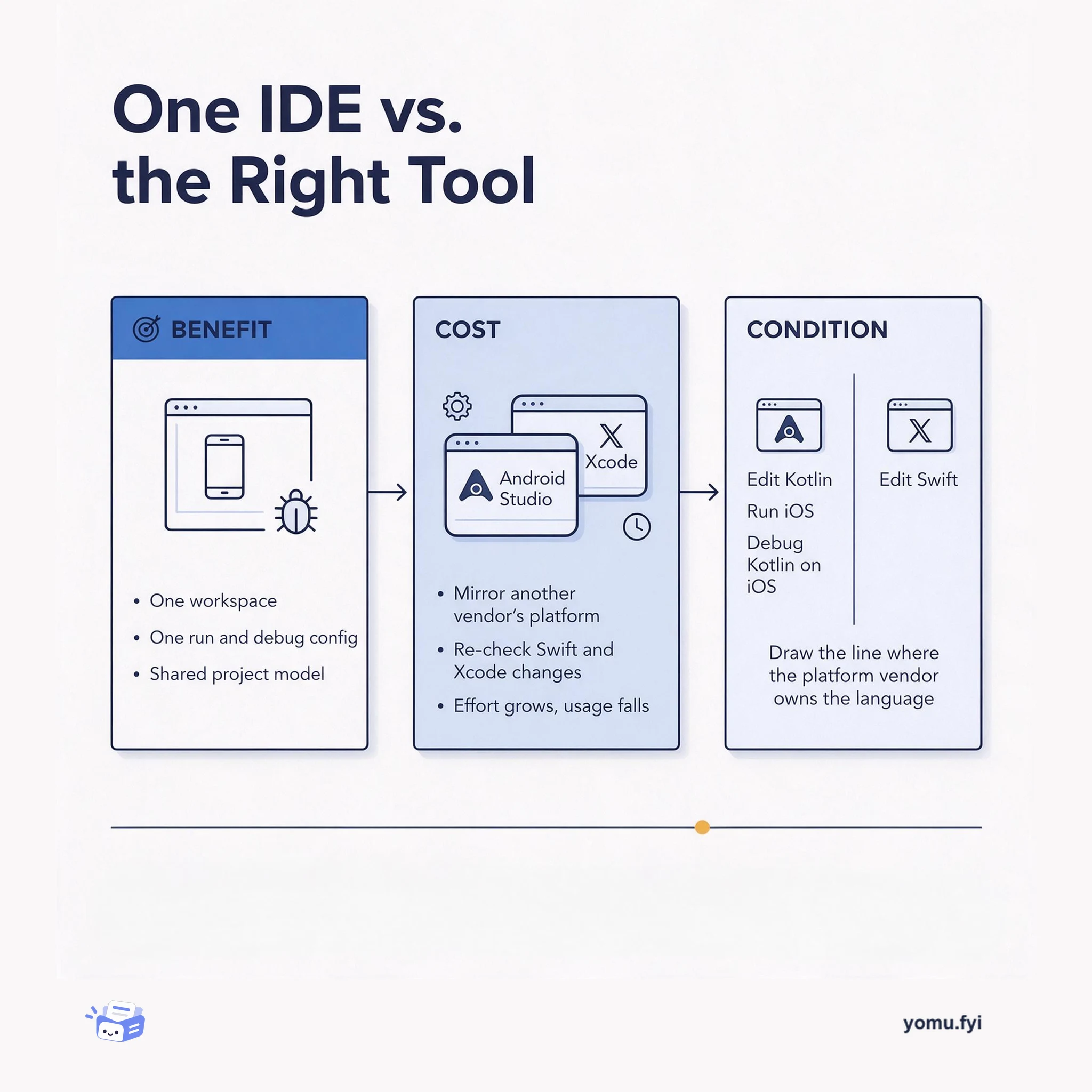
Android Studio keeps cross-platform Kotlin run and debug in one workspace but hands Swift editing to Xcode. This explainer maps the benefit, cost, and condition behind that boundary.
The Good Stuff
Paid picks we use ourselves. Links carry a referral code — a subscription through one earns us a commission at no extra cost to you.
Newest first
Maintaining documentation across separate repositories often leads to severe lag because technical writers must reverse-engineer shipped features weeks after release. To address this in the Aspire project, the team implemented an automated pipeline using GitHub Agentic Workflows to bridge the product and documentation repositories. When product pull requests merge, a bash step maps milestones to docs release branches before an LLM agent evaluates the diff, drafts documentation updates, and emits structured pull request intents. A dedicated safe-outputs handler materializes these drafts via a scoped GitHub App and assigns the original code reviewers to verify accuracy. Across 396 product pull requests, the system generated 82 documentation pull requests that all merged with a median turnaround time of 44.8 hours.
Okta has introduced Journeys, a task-oriented documentation format designed to streamline how developers learn and implement identity management. Rather than requiring engineers to manually assemble information across disparate guides, articles, and API references, each Journey provides an end-to-end curriculum for a specific project. Content is organized into three distinct phases: foundational knowledge in Learn, architectural decision-making in Plan, and curated implementation steps in Build. The initial release includes six Journeys aimed at Okta Customer Identity builders who are implementing authentication, registration, branding, and user management. Future additions will address AI agent governance, integrations for the Okta Integration Network, and migrations from the Classic Engine to the Okta Identity Engine.
ClickStack now supports AI-generated dashboards and linked investigative workflows from natural-language prompts, targeting the effort required to understand telemetry, write queries, choose visualizations, and iterate. Rather than asking an LLM to return a finished artifact, ClickStack uses an AI Notebook with the same MCP tools available to external agents, where queries, visualizations, findings, and reasoning are captured in a persistent, editable investigation. The system explores telemetry, validates assumptions, assembles dashboards, and can connect overview and service-level dashboards through dashboard actions; generated charts remain editable. The same MCP server exposes these capabilities to agents such as Claude, Cursor, and Codex, so users can create, refine, and extend dashboards through one toolchain.
Software development dynamics are shifting as code generation costs decrease, requiring engineering organizations to adapt their leadership and processes. Snowflake addressed this transformation across its software lifecycle by first encouraging widespread, unrestricted experimentation with coding agents before formalizing successful practices. The engineering organization codified these practices into fourteen distinct AI design patterns, including strategies such as planning in markdown and isolating parallel agents. This structured approach, combined with dedicated focus weeks and a progress scale, allowed engineering teams to accelerate both inner and outer loops of development. Consequently, a team of three engineers leveraged coding agents to deliver a 40x improvement to Snowflake's query compiler while significantly shortening release validation times.
Automated evaluations often miss unknown failure modes in AI agents because developers only write tests for anticipated errors. While building an itinerary agent for AI Engineer World's Fair, an open-weight model routed a speaker query to a tool returning only tracks, leading the model to hallucinate famous speakers and falsely claim the tool provided that data. Because a tool was executed, the trace appeared grounded until inspectable tool outputs revealed the discrepancy. To resolve this, the author retained the inexpensive model, corrected query routing, tightened system prompts against ungrounded entities, and added a custom entity-diffing eval in CI. Ultimately, directly reading agent telemetry traces alongside errors and logs is essential for diagnosing root causes and deciding trade-offs between model costs, prompt adjustments, and routing fixes.
Meta has marked ten consecutive years as a sponsor of the Python Software Foundation (PSF) to ensure the language remains robust and sustainable. Python represents the most widely used programming language across Meta's infrastructure, powering applications like Instagram and Threads as well as internal AI research. Beyond financial backing, Meta engineers actively contribute core language features, author Python Enhancement Proposals (PEPs), and build open-source tools such as the Pyrefly type checker. Company sponsorship directly funds the PSF's Developer-in-Residence program, core infrastructure, and security enhancements for the Python Package Index (PyPI). Continued support of the PSF functions as a strategic investment in maintaining the stability of the broader open-source ecosystem.
The team formerly known as Developer Advocacy, within Developer Success, has been renamed Builder Advocacy within Builder Experience (BX). The change responds to an expanded definition of who builds with technology: alongside traditional developers, AI builders and no-code or low-code automators are creating production-level experiences and mission-critical infrastructure. The organization says its advocacy will serve developers, prompt engineers, LLM integrators, AI-agent creators, ML practitioners, and automation-focused builders, while continuing support for traditional coders, engineers, and architects. The announcement cites GitHub’s 180 million developers, 36 million new developers in 2025, and Stack Overflow’s finding that 84% use or plan to use AI tools. The rename is effective immediately and begins broader investments in resources, content, and community programs for this wider builder community.
Designing software for LLMs and agents requires more than extending human developer experience: a polished text-first interface can still produce an AX that is merely functional. The post frames an agent as a combination of model, harness, context, and skills, with behavior varying across providers, models, and harnesses; it focuses attention on commonly used combinations while testing beyond them. In a test setup, agents receive goals and different amounts of context, and model-harness combinations are evaluated by how they reason, which tools they call, how many steps they take, and how consistently they repeat a task. The resulting design questions include friction, context and token efficiency, familiarity with established tools, and the trade-off between fewer steps and higher context or cost; the central conclusion is that agents may abandon a product when friction persists, making testing necessary to expose that behavior.
Next.js provides out-of-the-box tracing for incoming requests, fetch calls, middleware, and server-side rendering, but traces remain invisible without a configured exporter. Developers can use the @vercel/otel package inside an instrumentation file to initialize the OpenTelemetry SDK and transmit traces to any OTLP-compatible destination. While Next.js automatically creates spans for standard request lifecycles, developers can define custom active spans in the Node runtime to capture specific domain operations and contextual attributes. Exporting traces to backends like Sentry requires configuring standard OTLP endpoint and authentication environment variables. Choosing between direct OTLP export via @vercel/otel and the dedicated Sentry SDK depends on requirements, as direct export lacks browser tracing, error monitoring, and Edge custom spans.
Engineering leadership advice often prioritizes personal empathy over commercial competence, which Charity Majors argues is a misdiagnosis of organizational failure. Because over 90% of venture-backed startups fail, tech culture frequently venerates ruthless founders who succeed commercially. New engineering managers frequently focus solely on subjective employee comfort, mistaking business instability or misaligned stakeholder priorities for micromanagement. To champion humane values sustainably, engineering leaders across all tiers must first master business operations, clarify product strategy, and deliver business wins. Advancing to the director level requires moving beyond generic cheerleading, building high-performing teams oriented around continuous improvement, and demonstrating systems thinking alongside business acumen.
Vulkan introduces the VK_EXT_descriptor_heap extension to refactor GPU resource binding, replacing set-based layouts and pool allocations with application-managed descriptor memory heaps. This approach aligns Vulkan closer to Direct3D 12 and benefits workloads like dynamic texture indexing and complex ray tracing shaders. Developers manage memory directly, binding a single resource heap and a separate sampler heap globally to avoid high rebinding overhead. Shaders can access descriptors either through mapping structures using constant offsets or push constants, or directly via untyped pointers enabled by VK_KHR_shader_untyped_pointers. Support is integrated into NVIDIA drivers 610, Vulkan Headers 1.4.340, and Nsight Graphics 2026.2 for frame capture and inspection.
ClickHouse is now a native, preconfigured connection in Notion Custom Agents, allowing agents to access ClickHouse Cloud data without leaving Notion. After an OAuth connection, agents can explore schemas, translate plain-language questions into ClickHouse SQL, run read-only queries, and return results in the workspace. The connection exposes 14 read-only tools covering databases and tables, SELECT queries against ClickHouse and Managed Postgres, and organization, service, ClickPipes, backup, and cost information; users can set each tool to run automatically or require approval. Custom Agents can run on a schedule, including a daily observability report that queries error rates, p99 latency, and request volume from a Managed ClickStack service. The connector is in beta and requires a ClickHouse Cloud service with Remote MCP enabled plus a Notion Business or Enterprise workspace.
Stripe introduces event notification handlers to simplify processing thin events, unversioned JSON payloads that remain identical across API versions. The problem is that current integrations require developers to validate and route notifications, manage Stripe-Context for connected accounts, and manually maintain event-type strings, while API-version or SDK upgrades can cause runtime errors. Handlers move casting, routing, validation, and conversions into the SDK: typed callbacks are registered with handler.on, and callbacks receive a parsed notification plus a StripeClient already bound to the event context. The handler also provides a fallback for unhandled events and supports normal function-level testing, while the webhook endpoint only needs to pass the request body and signature to handler.handle. The pattern is supported in seven server-side SDKs, with feedback sought before general availability and possible future improvements to validation and framework integrations.
The 2026 Developer Survey is open to gather data on software builders' tools, working lives, and emerging practices. Marking fifteen years since its initial 2011 release, the annual survey focuses heavily on the role of artificial intelligence and autonomous agents across the software development lifecycle. Past survey results indicated that while developer adoption of AI and agents doubled, user trust declined alongside escalating concerns regarding generated code quality. In addition to modern AI trends and financial return considerations, the questionnaire maintains traditional inquiries regarding day-to-day technologies and developer workflows. The survey is hosted on the Qualtrics platform, which requires users to pause third-party ad blockers and adheres to regional access restrictions across multiple countries.
NVIDIA CCCL runtime introduces modern C++ abstractions for fundamental CUDA programming concepts starting in CUDA Toolkit 13.2 and CCCL 3.2. Designed as an alternative to the traditional CUDA runtime API, the library eliminates implicit global state by requiring explicit dependencies, such as binding streams directly to specific device references. The API enforces strong typing through owning types and non-owning reference types, omits default stream usage to ensure all streams remain non-blocking, and handles errors via standard C++ exceptions. In addition, CCCL runtime simplifies kernel launches through kernel functors that enable automatic template argument deduction and automatically transforms owning buffer arguments into device spans.
Observability vendors are increasingly betting on a universal SRE agent that combines a platform, telemetry, and natural-language investigation. The post argues that debugging depends on team-specific systems, trusted signals, failure history, runbooks, workflows, and institutional knowledge that cannot be packaged into one vendor’s agent. Agents can compare more time windows and pursue more hypotheses than human investigators, creating demand for low-latency query infrastructure and more complete, high-fidelity historical data. It proposes a more open model in which teams build specialized agents on headless observability foundations, with APIs, data storage, and an observability MCP, while persistent investigation surfaces preserve work for collaboration and reuse. Humans remain responsible for direction, judgment, and action, so the near-term future is presented as human-agent collaboration rather than autonomous incident resolution.
AI coding tools have significantly lowered the cost of generating software, yet many engineering organizations fail to realize overall delivery speed improvements. Applying the Theory of Constraints reveals that eliminating code production as a bottleneck shifts inventory directly into surrounding legacy processes that remain unadjusted. New friction points consistently emerge across underspecified requirements, prolonged design handoff gates, senior engineer review capacity, and external sign-offs from legal or security. Organizations can address these blockers by interrogating legacy agile ceremonies checkpoint by checkpoint to determine if their original constraints still exist. Practical remedies include adopting real-time co-development between product and engineering, treating initial designs as fluid starting points, and restructuring processes around running rapid, high-volume experiments.
Agentic Resource Discovery (ARD) is a draft, open specification for discovering agent capabilities at runtime, addressing a model in which users and developers must pre-install, integrate, and maintain each MCP tool, skill, or A2A agent. It defines a static ai-catalog.json manifest and a dynamic POST /search registry API, using indexed signals such as publisher identity, representative queries, compliance attestations, and tags to move capability selection outside the LLM. Hugging Face's Discover Tool adapts Hub semantic search into ARD catalog entries for running Spaces, exposing skills, MCP servers, or raw Space metadata according to the requested media type and wrapping agents.md files into installable SKILL.md artifacts. The tool is available through the hf CLI, REST, and MCP, while planned work includes federation modes and Hub support for profile-level manifests.
Stripe describes how API changes are propagated across its developer-product suite, including SDKs in seven languages and three release channels, the CLI, Shell, API Explorer, API Reference, changelog, and internal tools. Historically, v1 workflows used OpenAPI or a Ruby-based DSL while v2 APIs used protobuf-based DSLs and an internal API specification, forcing teams to maintain parallel generators and leaving some products without v2 support. Stripe chose OpenAPI as a shared representation and built a pipeline whose generated artifacts are tailored by variant, release phase, and API version, with vendor extensions carrying Stripe-specific metadata. Automated validation, OpenAPI diffs, pre-release comparisons, versioned snapshots, and downstream publishing now connect API definition changes to documentation, code samples, SDK and CLI releases, while older v1 versions remain difficult to regenerate with newly added metadata.
Dropbox developed a system using the Model Context Protocol (MCP) and Dash's semantic search to bridge the gap between security threat models and code implementation. By retrieving original security documents during pull requests, an LLM agent automatically evaluates whether the proposed code adheres to previously agreed-upon security requirements. This approach surfaces design regressions and missing controls that traditional static analysis tools miss.
The best engineering reads, once a week.