APAC Is Not One Region: The Regionalize vs. Standardize Tradeoff
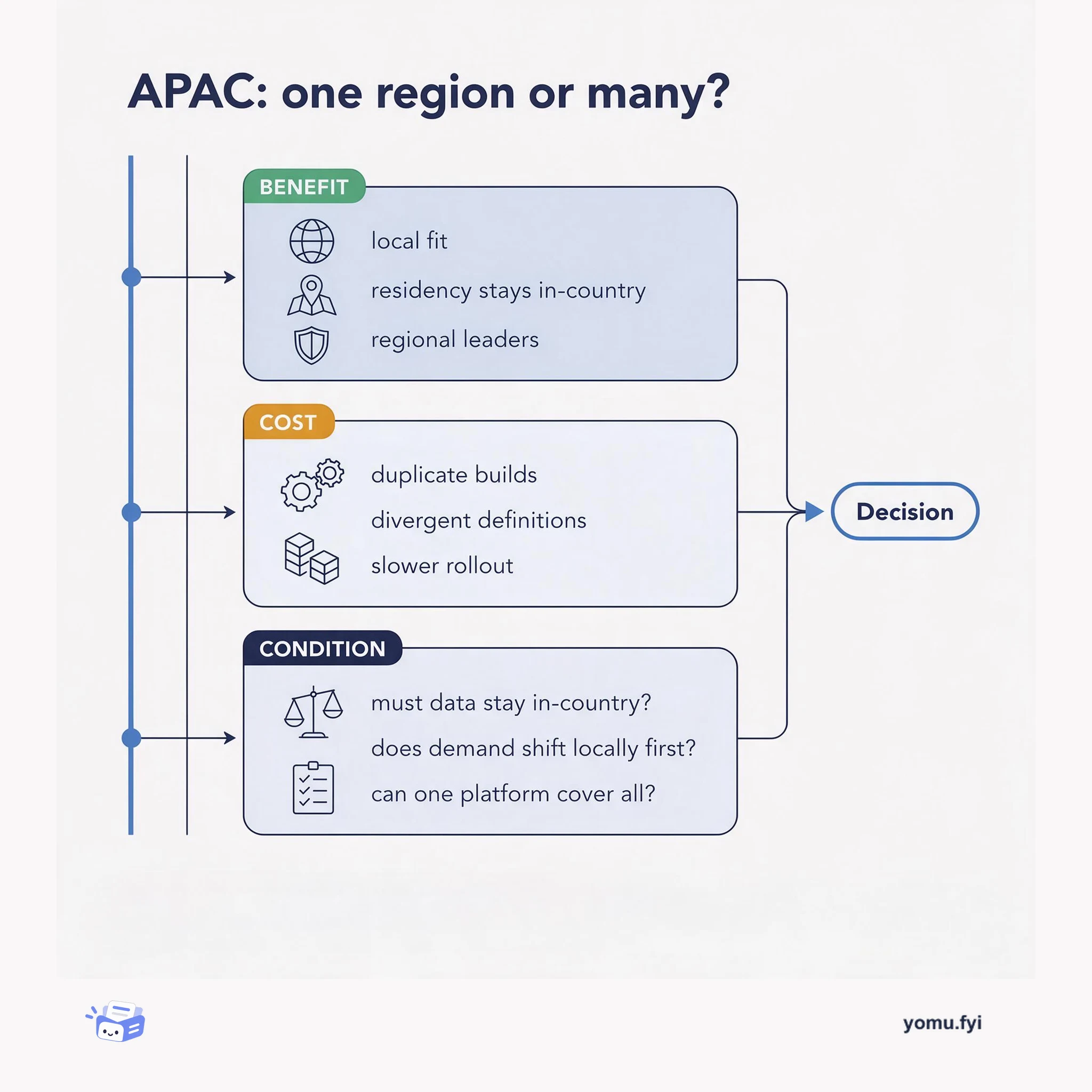
APAC is a federation of markets, not a single deployment region. This diagram maps the tradeoff between local autonomy and one shared platform, and the conditions that decide it.
Agentforce selects actions to complete a task; this explainer weighs native record updates against external services so engineers can place each responsibility sensibly.
Agentforce can select discrete actions, while those actions may run in Salesforce or call external code through an OpenAPI-defined contract. Use Apex for transaction-critical record updates, and consider AppLink or a Heroku service when the work needs external integrations, intensive computation, elastic scaling, or existing Node.js, Python, or Java code. The key trade-off is control and proximity versus extensibility and reuse.
The posts behind it
 Anthropic · · Announcement
Salesforce and Anthropic announced an expanded partnership making Claude a preferred model for Salesforce’s Agentforce platform, with availability aimed at customers in regulated sectors including financial services, healthcare, cybersecurity, and life sciences. Through Amazon Bedrock, Claude traffic will remain within Salesforce’s virtual private cloud and trusted environment, while industry-specific solutions are being developed beginning with financial services. The companies are also deepening Claude’s Slack integration through a Model Context Protocol server that can access channels, messages, and files for summaries, decisions, drafts, searches, and connected Salesforce CRM and Tableau insights. Salesforce is deploying Claude Code across its global engineering organization, and Anthropic uses Claude in Slack for internal sales workflows. Agentforce powered by Anthropic and the Claude-Slack bidirectional integrations are available today, while the regulated industry collaboration and Agentforce 360 integration for Claude remain under development.
Anthropic · · AnnouncementAnthropic is donating the Model Context Protocol (MCP) to the Agentic AI Foundation (AAIF), a directed fund under the Linux Foundation co-founded by Anthropic, Block, and OpenAI, with support from Google, Microsoft, AWS, Cloudflare, and Bloomberg. Introduced as an open standard for connecting AI applications to external systems, MCP now has more than 10,000 active public servers, adoption across major AI products, enterprise deployment support, and official SDKs with 97M+ monthly downloads across Python and TypeScript. The donation places MCP alongside Block’s goose and OpenAI’s AGENTS.md as AAIF founding projects, while its existing governance model remains unchanged. MCP also has a community-driven Registry, and the November 25th specification release added asynchronous operations, statelessness, server identity, and official extensions.
 Heroku · · Tutorial
AppLink Fundamentals III describes how to build Salesforce extensions on Heroku, covering local testing, OpenAPI contract management, deployment workflows, and programming-language selection. For applications that receive Salesforce requests, the supplied invoke.sh script simulates production headers using Salesforce CLI data, can activate session-based permission sets, and accepts JSON payloads for testing; Pattern 1 applications that call Salesforce APIs do not require this special setup. The OpenAPI specification serves as the shared contract for endpoints and Salesforce consumers, with publish-time validation intended to catch misalignment. AppLink also supports Agentforce actions through x-sfdc agent extensions, enabling topics, publishing, input and display settings, privacy controls, and outputs such as generated PDFs in the automotive finance example. The comparison positions Apex for transaction-critical record updates and AppLink languages such as Node.js, Python, and Java for external integrations, intensive computation, elastic scaling, and reuse of existing code.
Heroku · · TutorialThe post shows how to extend Salesforce Agentforce with a Heroku-hosted custom action when customer information remains in older, unstructured cloud archives and requires scalable, real-time processing. It explains that Agentforce selects discrete actions, while Heroku exposes code through External Services using an OpenAPI description of the request and response. The sample uses Java and Spring Boot, an H2 in-memory database, springdoc.org for OpenAPI generation, and Spring AI to convert natural-language questions into SQL before returning results for an Agentforce response. The integration is identified as pilot-only and not intended for production, while the post also points to Heroku Postgres, Heroku Connect, Data Cloud, and pgvector as extensions for other agent use cases.
More like this
APAC is a federation of markets, not a single deployment region. This diagram maps the tradeoff between local autonomy and one shared platform, and the conditions that decide it.
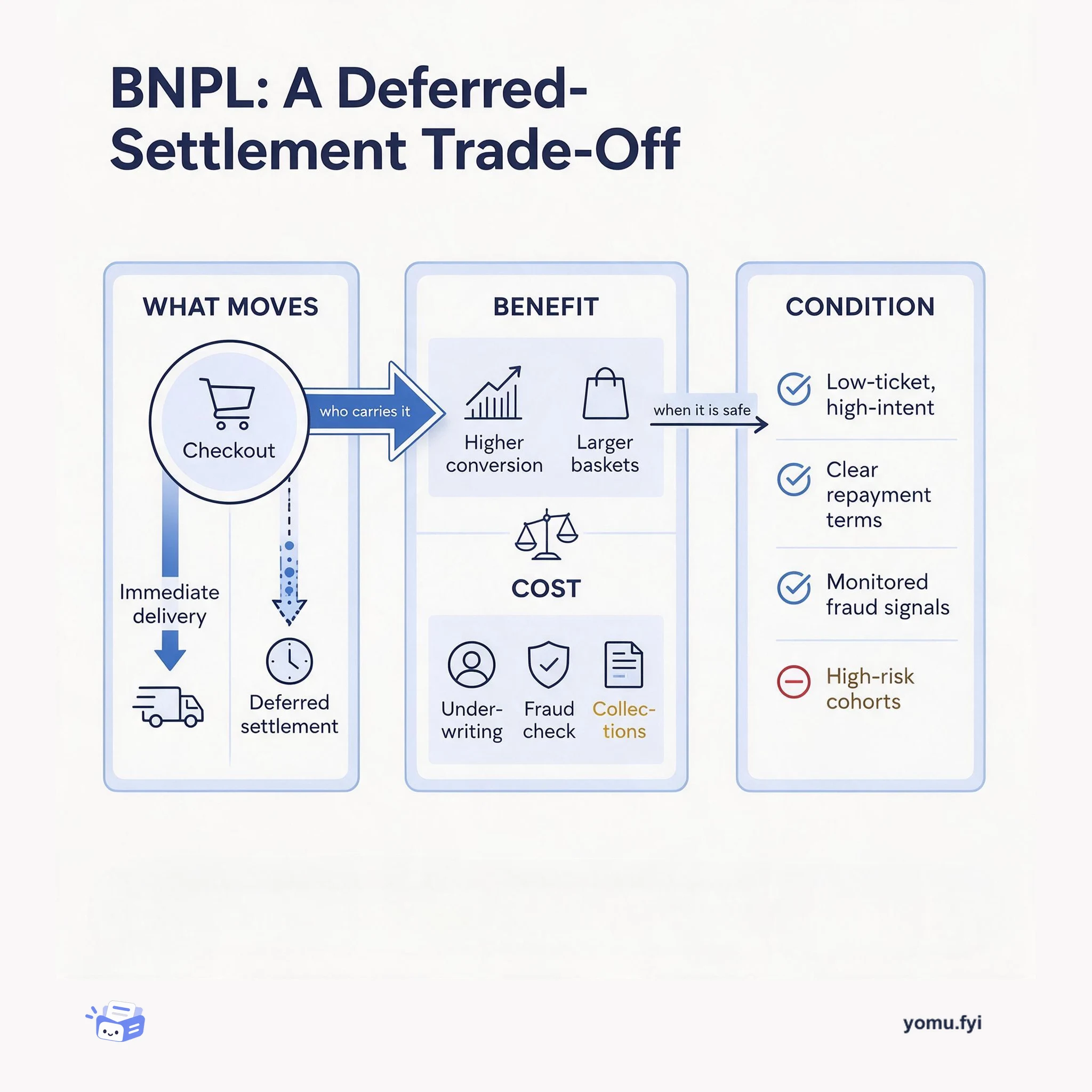
Buy Now, Pay Later is a deferred-settlement trade-off: merchants gain conversion while underwriting, fraud, and collections risk move elsewhere. This diagram maps the benefit, the cost, and the condition that decides.
Bare metal gives engineers direct control over GPU, network, and virtualization layers, but it shifts elasticity and lifecycle work onto the team. This trade-off map shows when that bargain pays off.
The Good Stuff
Paid picks we use ourselves. Links carry a referral code — a subscription through one earns us a commission at no extra cost to you.
One useful email. Unsubscribe anytime.