How to Run an Agent Loop That Actually Converges
A four-checkpoint how-to for agent loops: name a measurable job, bound the tool surface, refresh sandbox fixtures from real traffic, and verify at agent speed.
A five-checkpoint walkthrough of BYOC: name the control you need, split control and data planes, build the landing zone, govern data in place, then operate inside your own tenant.
BYOC (bring your own cloud) means the vendor's software runs inside a cloud account you control, so identity, networking, and encryption stay under your policies while the vendor still operates the service for you. This explainer walks the rollout as five numbered checkpoints: state the control you actually need, separate the vendor control plane from the data plane in your tenant, build the landing zone, keep governed data in place instead of copying it, and operate with your own audit evidence and backups. Each checkpoint is a go or no-go gate — skipping one tends to resurface later as a residency exception, an audit gap, or a surprise bill.
It earns its keep when residency, sovereignty, or regulated data handling rules out a shared environment, or when you need your own keys and network controls without running the software yourself. If none of those constraints apply, the landing-zone build and split-plane support burden may not pay for themselves.
Keep the governed store as the single source of truth and read or write across it through table or sharing APIs instead of bulk-copying records into a second platform. Federated patterns let each party publish validated records to named recipients while the platform enforces access controls, markings, and lineage, so every number stays traceable to its source.
The posts behind it
 Databricks · · Explainer
The California Department of Health Care Services built the Behavioral Health Public County Profile on Databricks, a public dashboard consolidating behavioral health data from all 58 counties for nearly 40 million Californians. Launched on October 1, 2026, following the 2024 passage of Proposition 1, the dashboard supports the new Behavioral Health Services Act (BHSA) tying funding to statewide goals for outcomes, equity, and transparency. The platform uses Spark Declarative Pipelines and Lakeflow Connect for unified data ingestion, Semantic Views for standardized metrics across counties, and serverless compute to process data at scale without infrastructure management. It operates on a FedRAMP-authorized environment meeting federal security standards for health data, with data quality and lineage ensuring every number can be traced to its source. The County Profile enables public comparison of county plans, funding, service delivery, and performance measures, creating a feedback loop between policy intent and measurable outcomes for democratic oversight.
 Clickhouse · · Problem & solution
iSAM Funds, a UK-based systematic asset manager, built an options research platform on ClickHouse Cloud to handle the 10,000x data fan-out from underlying instruments to related options. Migrating from Postgres, the team achieved 35-50x compression and increased single-core ingestion from 8,000 to 800,000 rows per second, while ClickHouse’s native Apache Arrow support eliminated encoding reshuffling. ClickHouse’s columnar storage and vectorized execution made queries fast enough to run on demand, allowing the team to drop pre-computed rollups and materialized views and remove a layer of pipeline complexity. The managed service integrates with iSAM’s AWS footprint and enterprise authentication, pushes backups to iSAM’s own buckets for developer use, and lets them scale instances up for large backfills then down to control costs. The platform gives researchers fast, interactive access to full options history, shortening the time from hypothesis to tested strategy.
Databricks · · Problem & solutionThe Department of War cannot obtain cost transparency across its supply chain of over 200,000 suppliers due to reliance on manual data calls and fragmented spreadsheets. The proposed solution is a federated data exchange where each contractor publishes validated cost and pricing evidence from existing records to named government recipients using open-source sharing protocols. Databricks provides the platform, enforcing governance, access controls, CUI markings, and audit lineage without storing raw records centrally or requiring contractors to adopt Databricks. Small and mid-tier suppliers submit through validated intake forms that produce the same governed data contracts as large primes, requiring no new accounting systems. The reporting obligation already exists through CSDR, FlexFile, and DD Form 1921, so a pilot exchange can launch in months by defining two data contracts on a single program.
 Red Hat · · Tutorial
Local developer workstations introduce three concrete operational risks: production-parity risk from environment drift, slow time-to-first-commit for new engineers, and unmanaged security exposure from misconfigured tools. Red Hat OpenShift Dev Spaces addresses these by moving compute and tooling into containerized workspaces running directly on the cluster, with environments declared as code in a devfile. A production deployment requires four-zone namespace isolation separating control (openshift-devspaces), core server (devspaces-checluster), secure asset (devspaces-openvsx), and sandbox (username-devspaces) zones to prevent operator reconciliation from overriding custom configurations. Resource governance uses a two-tier model with defaultContainerResources fallback limits and containerResourceCaps absolute per-container ceilings, while automated cleanup cron jobs (monthly on the 1st) and inactivity idling (after 4 hours) protect etcd health by removing stopped workspaces after 30 days. The guide concludes with next steps for authentication and private extension registries.
 Cloudflare · · Announcement
The Deno team is joining Cloudflare to merge workerd and celld, aiming to make self-hosting Workers and Durable Objects radically simpler for developers. Ryan Dahl, creator of Node.js and Deno, explains that Durable Objects provide a powerful abstraction: a distributed singleton with a SQLite database that scales by sharding state and WebSocket connections across machines. He started celld to run this model outside Cloudflare with a single Rust binary and object storage as its only external dependency. Kenton Varda counters the theory that Workers’ unique design creates lock-in, noting that workerd is open source and that celld provides an escape hatch for migration. The merged effort, led by Ryan and Bert Belder, will make self-hosting a first-class supported way to build and run apps using the Workers programming model.
Clickhouse · · AnnouncementClickHouse announced a significant expansion of its strategic collaboration with Microsoft at The European Microsoft Fabric + SQL Community Conference, including the public preview of a native ClickHouse workload for Microsoft Fabric that brings sub-second analytical query latency to OneLake. The company also made generally available the ability to read Apache Iceberg tables from OneLake using OneLake Table APIs, and introduced a public preview of writing Iceberg tables back to OneLake. These capabilities eliminate data duplication and ingestion steps, allowing teams to keep OneLake as the governed single source of truth while leveraging ClickHouse’s speed. ClickHouse Bring Your Own Cloud (BYOC) is now available in the Microsoft Marketplace, enabling customers to run ClickHouse Cloud inside their own Azure tenant with full control over IAM, networking, and encryption. The integrations aim to serve real-time agentic workloads, interactive dashboards, and observability without separate cluster provisioning or ETL pipelines.
More like this
A four-checkpoint how-to for agent loops: name a measurable job, bound the tool surface, refresh sandbox fixtures from real traffic, and verify at agent speed.
A five-checkpoint workflow for making large-scale training runs bitwise reproducible: pick the guarantee, fingerprint the run, and trace divergence down to the kernel.
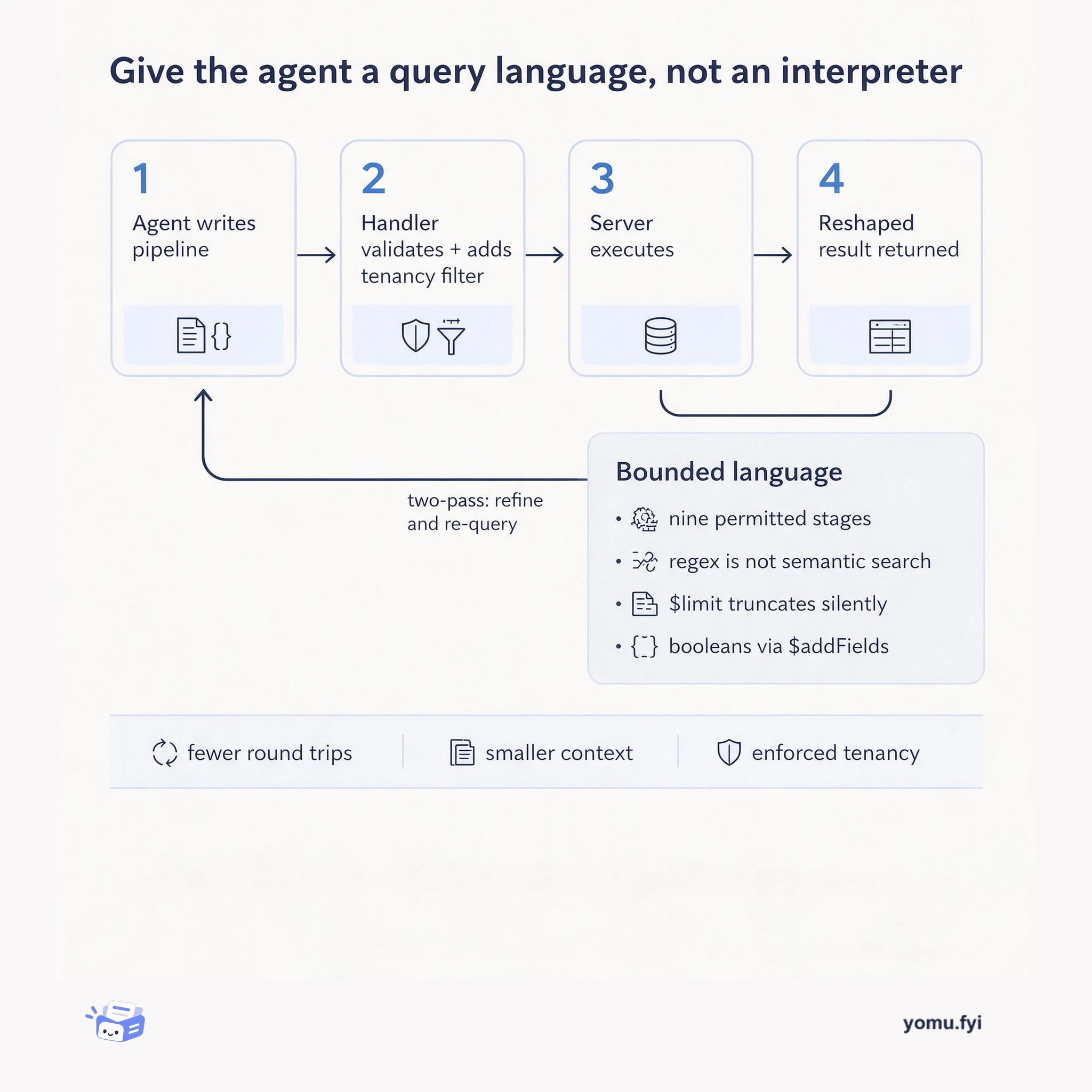
A four-step pattern for letting a document agent write validated aggregation pipelines instead of arbitrary code, so results come back shaped and tenancy stays enforced.
The Good Stuff
Paid picks we use ourselves. Links carry a referral code — a subscription through one earns us a commission at no extra cost to you.
One useful email. Unsubscribe anytime.