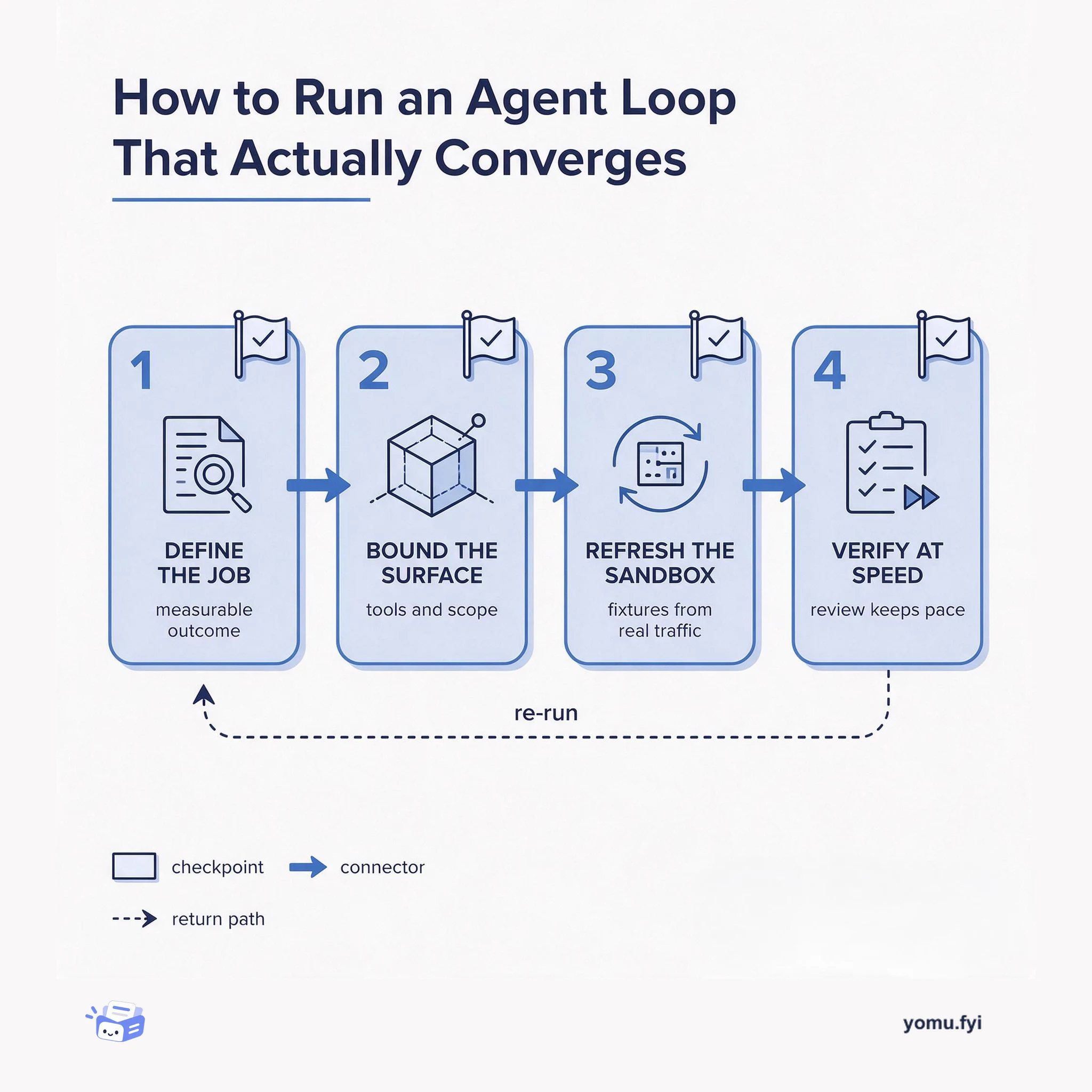
How to Run an Agent Loop That Actually Converges
A four-checkpoint how-to for agent loops: name a measurable job, bound the tool surface, refresh sandbox fixtures from real traffic, and verify at agent speed.
Loading…
Topic
564 posts about AI Agents. Every summary links to the original.
See the idea
A four-checkpoint how-to for agent loops: name a measurable job, bound the tool surface, refresh sandbox fixtures from real traffic, and verify at agent speed.
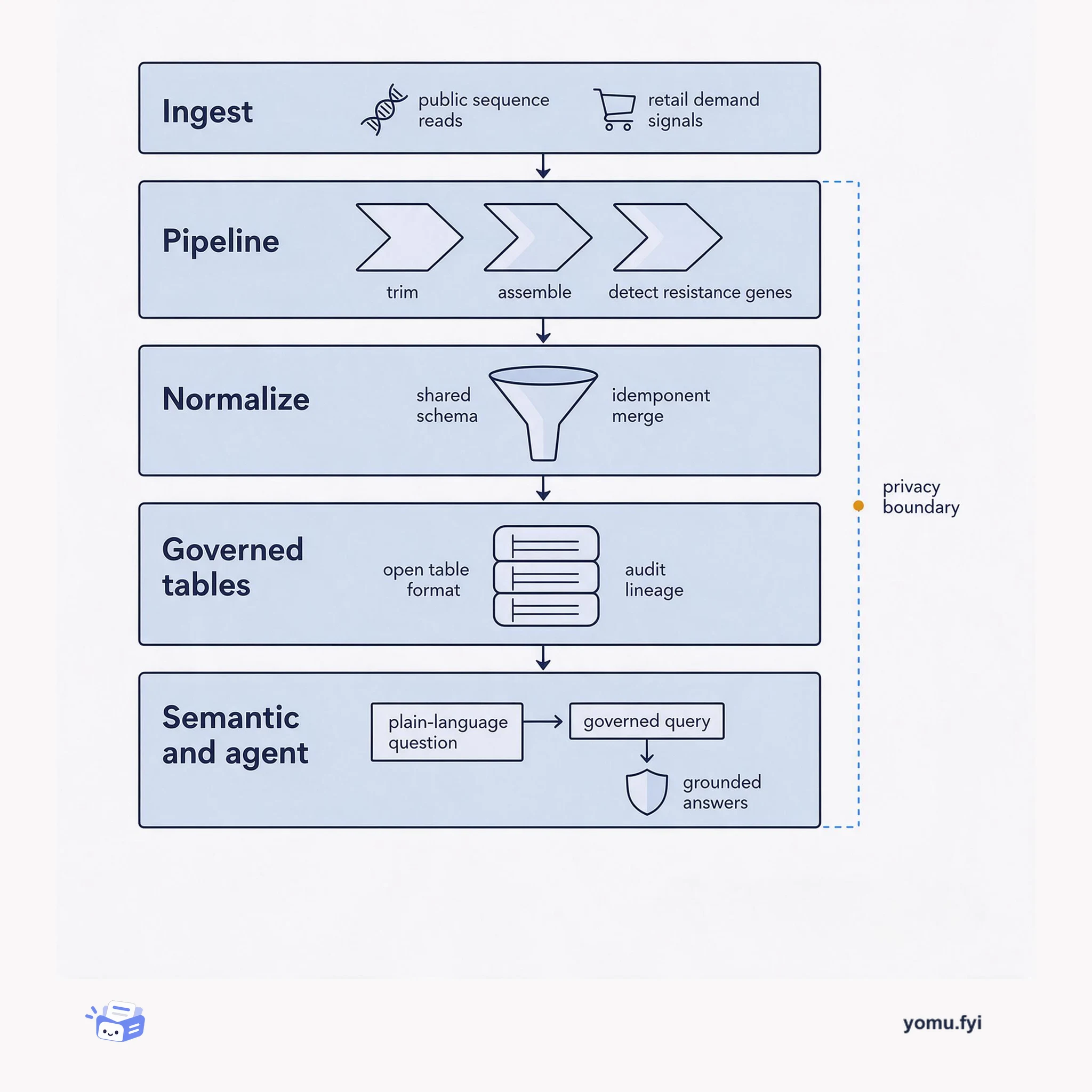
Antimicrobial resistance surveillance is a layered data architecture: raw reads and demand signals flow in, get normalized into governed tables, and answer plain-language queries. The diagram maps each boundary.
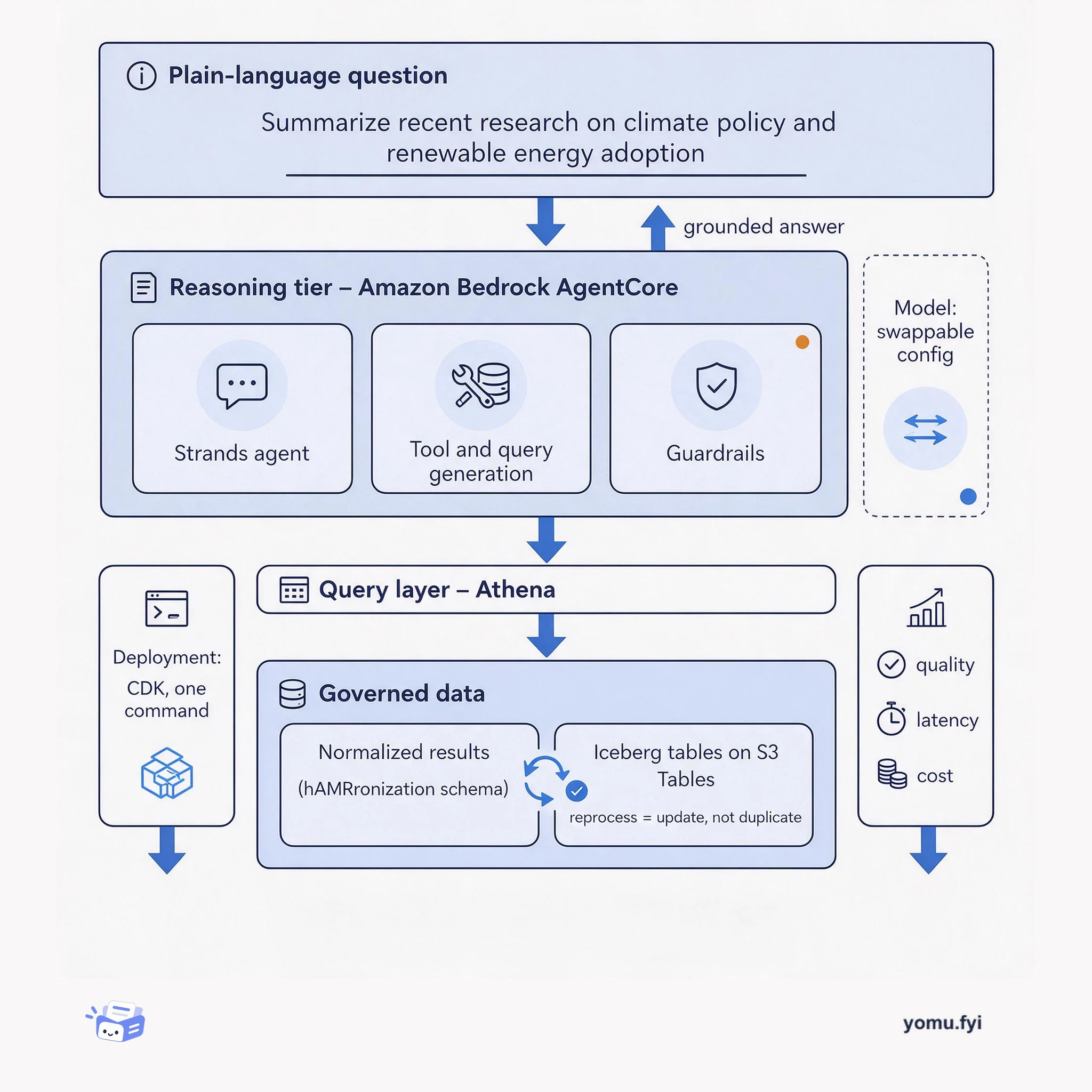
Amazon Bedrock is the managed reasoning tier in an agent architecture, not the whole system. This layered view shows the pipelines, governed tables, query layer, and guardrails around it.
The Good Stuff
Paid picks we use ourselves. Links carry a referral code — a subscription through one earns us a commission at no extra cost to you.
Newest first
The Commonwealth Bank episode in 2025 demonstrated that a deflection metric is not a resolution metric: the bank reversed 45 redundancies after call volumes rose despite a voice bot credited with diverting 2,000 calls weekly. By May 2026, on a rebuilt platform, the same automation program achieved 84.6% end-to-end resolution for self-service messaging interactions. A peer-reviewed 2024 study found Whisper’s match error rate significantly higher for Australian English than American English, an effect of roughly 1.3 percentage points, with non-native accents worst affected. Australian regulation as of September 2026 imposes no affirmative AI disclosure duty, but misleading conduct provisions apply and an automated decision-making transparency obligation commences December 2026. Twilio’s platform offers an Australian region with emergency calling, model-agnostic agent execution, and a memory layer that preserves context during handoffs, addressing the containment quality gap.
AI voice agents in Indian contact centers conduct end-to-end customer conversations using speech recognition, a language model, and text-to-speech, differing from agent assist which only suggests actions. Indian deployments are past pilot: Meesho handles 60,000 calls daily with a 75% cost reduction, and Bajaj Finance reports 71% of DIY service volumes handled by AI at one-third the human cost. The four-stage loop—speech recognition, language model, speech synthesis, telephony—must complete before the pause feels wrong, making architecture more critical than model choice. The Voice of India benchmark shows no system achieves under 20% word error rate across all 15 languages, so engine choice must be per-language and swappable. The RBI FREE-AI committee recommends informing customers they are talking to AI, human handling of complaints, and a route to a person, though these are not yet binding.
In the Philippines, an AI-powered agent usually means a human agent assisted by AI for transcription, answer retrieval, live coaching, and wrap-up, not an autonomous software agent. The contact center sector employs 1.68 million people and earned $33.9 billion in 2025, with 56% of IBPAP members actively implementing AI. Published figures show a 22% reduction in call handling time from Concentrix and a 37% increase in agent satisfaction from TELUS Digital, but no benchmark measures Taglish speech. The IBPAP survey found 8% of operators reduced headcount, 13% increased it, and 24% saw job role shifts, while the IT-BPM sector added 70,000 net staff in 2025. Platforms like Twilio allow composable assist layers using models from OpenAI, Anthropic, or Azure, important where the language problem is unsolved and no Philippine rule requires disclosing AI use.
Building enterprise-grade AI voice agents in production demands managing real-time latency, telecommunication networks, regional accents, compliance frameworks, and unpredictable customer behaviour—issues that standard text-based LLM benchmarks do not capture. The recommended approach combines Microsoft Azure for hyperscale infrastructure, Twilio for global communications, and WIZ.AI for localisation, so engineering teams avoid building low-level infrastructure and focus on unique business value. Field data from WIZ.AI across Asia reveals an ideal conversational response window of 500–800 ms, with a P90 latency under 2.0 s currently acceptable, and real-time code-switching support for languages like Singlish and Hinglish. Success metrics shift from pilot capability to commercial production benchmarks such as connection rate, recognition and tagging accuracy, and measurable business outcomes like Promise-to-Pay conversion. Engineering practices to maintain code quality include cross-model code reviews and strict pull-request line-count guardrails enforced by pre-commit hooks.
Auth0 is bringing secure identity to the Universal Commerce Protocol (UCP) so retailers can safely let AI agents discover and purchase products on shoppers’ behalf. UCP is an open standard that gives AI agents a consistent way to interact with a merchant’s catalog, cart, and checkout, reducing the need for separate integrations per platform. Auth for UCP provides the identity and trust layer, handling agent registration, account linking, and scoped temporary token issuance through an on-behalf-of token exchange. This ensures that every purchase ties to a verified human with time-limited access and a full audit trail, while agents see only the authenticated shopper’s data. Auth0 is opening Auth for UCP Limited Early Access to select customers through its Agentic Commerce Partnership Program.
Cloudflare’s 2026 founders’ letter, marking the company’s 16th birthday, examines rapid changes in internet traffic driven by AI. Since mid-2025, new website creation has exploded, fueled by ‘vibe coding’ tools that allow non-programmers to build apps, with over 7 million developers now using Cloudflare’s platform. Automated traffic from AI agents and crawlers is projected to surpass human traffic by May 2026 and could reach 1,000 times human levels within five years. This surge risks a tragedy of the commons: agents consume resources from many sites but benefit only one, threatening small businesses that lack the information volume older competitors hold. Cloudflare proposes reducing crawler load by fetching only changed content and enabling creators to receive payment when agents use their content, alongside partnerships to shape a fairer internet.
S&P Global Energy aimed to make its structured data estate—spanning LNG, Chemicals, Crude Oil, and other commodities—conversationally accessible via AI agents. The team evaluated approaches and chose Databricks Genie Agents, where subject matter experts curate one agent per dataset group without writing code. Each Genie Agent is automatically exposed as a managed MCP server, providing a governed, zero-deployment integration point. A FastMCP-based proxy composes multiple Genie MCP servers into composite endpoints for cross-domain questions. This architecture shortened time to market from months to days, with governance via Unity Catalog and an open MCP standard enabling both internal and external consumers.
Cloudflare launched Turnstile Spin, an agent-mediated implementation of its Turnstile CAPTCHA alternative that AI coding agents use to set up security on any website. The two-step Turnstile flow requires a frontend widget and a backend Siteverify call, but many sites skip the backend validation, leaving them exposed to bots. Spin uses the user’s AI coding agent to find frontend and backend code, propose a plan, and after approval automatically embed the widget and wire up the Siteverify call without sending code to Cloudflare. It also fixes improperly installed widgets detected by monitoring Siteverify calls and handles migrations from other CAPTCHA providers. Since its July release over 65,000 widgets have been created via Spin and the generated prompt has been copied more than 30,000 times, and the service remains free.
Real-world AI voice agent calls are messy, with background noise, overlapping speech, and callers interrupting mid-sentence. Twilio Conversation Relay handles interruptions through attributes like interruptible, which controls whether caller input stops the agent’s speech, and ignoreBackchannel, which filters out short backchannel phrases. Background noise that sounds like speech can cause false interruptions and garbled transcripts; Twilio’s testing found Deepgram Flux produced zero transcription failures under combined noise, while a tuned Nova-3 setup also succeeded. Turn detection uses either a traditional silence timer or Deepgram Flux’s fused model, which reduces false interruptions by roughly 30% and trims response latency. When a caller interrupts, the app receives an interrupt message with the exact text played before cutoff, allowing it to trim the LLM’s conversation history so the model only remembers what the caller heard.
AI agent orchestration coordinates multiple AI agents working on a single task, deciding routing, carrying context, resolving contradictions, and escalating to humans when needed. It operates at two levels: the agent level, where frameworks like LangGraph route between specialized agents, and the conversational AI level, which preserves customer identity and history across Voice, SMS, and WhatsApp channels. Orchestration comprises four jobs: routing, shared memory and state, conflict resolution, and human escalation, with parallel execution requiring robust memory management. Twilio’s Conversation Orchestrator provides a shared conversation record as a system of record, while Conversation Memory extracts observations and resolves conflicts by updating records with the most recent version. The FAQ section addresses differences from workflow automation, comparison criteria for orchestration tools, and the mechanism for agent-to-human handoffs within the same session without callbacks.
The Docker Sandbox Kit Specification v3 defines how an agent declares the networks, credentials, and volumes it needs, so these grants travel with the artifact rather than living in shell history or dashboards. A Kit is an ordinary OCI image whose manifest carries a descriptor annotation vnd.docker.sandbox.kit.descriptor, so it builds with docker buildx, pulls with docker pull, and gets scanned and signed by existing tooling. Capability types like network-policy@2 and credential@1 are versioned independently, and each normative statement in the specification is covered by a conformance check or a written waiver. Two Kit types exist: a workload supplies the root filesystem, while a mixin adds overlays such as a CLI with its network rule; the runtime rejects required capabilities it cannot satisfy. Composition uses strict provides/requires resolution, so authority changes appear as diffs, and a conforming runtime can gate upgrades that widen the grant set.
Security reviews at Databricks relied on automation but still consumed expert time on predictable work, leaving less room for genuinely novel, high-risk architectures. The author built an agent-based layer on Databricks using Unity Catalog for governed tables containing standards, request data, and decisions; Databricks-hosted foundation models (Claude Haiku, Sonnet, Opus) for classification and reasoning; and Lakeflow Jobs for orchestrating notebook-based workflows on serverless compute. A conversational intake app built with Databricks Apps turns plain-language descriptions into structured requests and provides preliminary risk indications before a formal request is created. Seven focused agents each have a bounded responsibility—intake, risk assessment, requirements, specialized reviews, validation, workflow, and learning—ensuring behavior remains inspectable and testable. Routine requests that once waited days in the queue can now be completed in minutes, and security engineers spend more time on designs requiring genuine expertise.
Concurrence processes 100.8 billion input tokens and 11.2 million LLM calls every 30 days, at an annualized rate of 1.2 trillion tokens. To govern these workflows, the company consolidates on Databricks with Lakebase for operational state, Unity Catalog for governance, and Unity Gateway for centralized AI access. Patient data is recorded as immutable events in Delta tables, from which a current patient state—called the world model—is computed while preserving provenance. All agents are tested against simulated patients before deployment; simulation traffic is approximately seven times production traffic, using immutable event history to replay states. Concurrence routes all coding-agent traffic through Unity Gateway, attributing each request to the engineer, and enforces compliance-gated model routing where HIPAA requirements are met first.
Business concepts like active customer or completed trip are often defined differently across teams, scattered in Slack threads and spreadsheets, causing AI agents to guess confidently when answering questions. Databricks introduces Unity Catalog Pages as a governed home within Genie Ontology where data stewards with Genie Code define the authoritative meaning of those terms and entities. Pages complement existing semantics — metric views how to calculate, domains where to look, and certification what to trust — by capturing what each concept means. Genie Code can bootstrap Pages by extracting definitions from Confluence, Slack, Google Docs, or GitHub via MCP-connected tools, turning weeks of work into minutes. When Genie One uses a Page to ground an answer, the Page is cited as a clickable source so users can inspect the definition and verify the reasoning.
Oppex AI builds AI agents that help developers resolve production incidents by gathering context before the engineer is paged. The agents collect logs, cloud metrics, database health, affected customers, recent code changes, and past incident history, then present a recommendation. Because developer logs are not plain English, the team constructs a knowledge graph of how the entire system connects. They harden the agent by pitting it against a chaos monkey that breaks test systems without revealing the method, forcing the agent to learn. The 15-person team has launched the product with early enterprise customers and aims to bring mean time to resolve under 10 minutes, eventually moving toward autonomous system healing.
Serving inference for coding agents requires trillion-parameter sequence models like Moonshot AI’s Kimi K2.6 to process trillions of input and output tokens at extremely high relative and absolute performance. To be economically viable, these services must achieve large fractions of hardware peak performance, using contemporary matrix math accelerators like Tensor Cores at petaFLOP per second scale. Modal optimized by batching multiple sequences together, caching KV state, and patching SGLang with NVFP4 micro-scaling on Blackwell GPUs like the B200. Per-replica performance improved 2.8x per user and 5.6x across users, transforming ruinously expensive into a price-competitive service. One deployment processed hundreds of billions of tokens daily and trillions total, showing that careful engineering and benchmarking are key to scaling inference.
The post examines the typical lifecycle of customer data in companies, revealing that most data is captured but never effectively used. A survey of 660 business leaders found that 48% struggle to connect customer data across channels, making it the top obstacle over budget or headcount. Data is often captured in volume but siloed across systems, duplicated into separate records for the same customer, and reliant on stale overnight batch updates. This leads to AI agents working with outdated profiles, causing 71% of consumers to abandon conversations when the AI fails to recognize them. The post proposes shortening the path between capture and use through real-time data synchronization, exemplified by Twilio’s Conversations and Conversation Memory products.
The Antigravity SDK now supports local AI models, starting with Gemma 4 26B A4B via Google AI Edge’s LiteRT, enabling offline agentic assistance on local GPU and RAM with a recommended machine of 24GB VRAM or unified memory. Local execution eliminates API costs and rate limits while keeping code and requests on-device, offering privacy and offline resiliency. The SDK supports hybrid workflows where a cloud model like Gemini 3.8 Flash plans while local Gemma 4 instances execute, as in a code auditing task where 97.2% of tokens (3,322 of 3,417) ran locally. A built-in example generates a live-updating CLI resource monitor using psutil and rich from a single prompt, with the agent autonomously writing the script, creating requirements.txt, and testing the code entirely offline. The SDK also supports any OpenAI-compatible server like Ollama, LM Studio, or vLLM via LocalOpenAIAgentConfig without changing agent orchestration.
Database branching creates isolated database environments from a known parent state using copy-on-write, where branches share unchanged data and only store modifications. For a large parent database like one that is 40 GB, two branches may require just 5.6 MB of additional storage instead of 80 GB with traditional full copies. Developers can test schema migrations like adding a NOT NULL column to a table with millions of rows against realistic data and constraints, CI pipelines provision per-pull-request branches for isolated tests, and AI agents experiment across short-lived environments without risking the parent database. Safe operation relies on protecting parent branches from writes and deletions, restricting sensitive data in disposable branches, automating creation and cleanup, and keeping environments reproducible through version-controlled configuration. Databricks Lakebase provides database branching, enabling teams to adopt Git-style workflows for development, CI/CD, and AI agent use cases.
Agentforce Health Monitoring (AHM) addresses silent availability failures in production AI agents that traditional monitoring misses because agents can appear healthy even when unreachable. The team unified telemetry from approximately five or six locations across sessions, reasoning steps, tool calls, errors, and escalations into a coherent representation. End-to-end alerting latency was reduced from roughly 20 minutes to several minutes by converting Data 360 ingestion to streaming and simplifying query complexity. AHM provides 16+ built-in metrics including agent availability, error rate, response/escalation rate, engagement, and latency, with a drill-down interface connecting alerts to session context. The roadmap includes cost, TTFT/TTLT, toxicity, feedback metrics, RAG Quality Monitoring integration, and eventually a runtime insight agent for root-cause analysis and automated remediation.
The best engineering reads, once a week.