How to Run an Agent Loop That Actually Converges
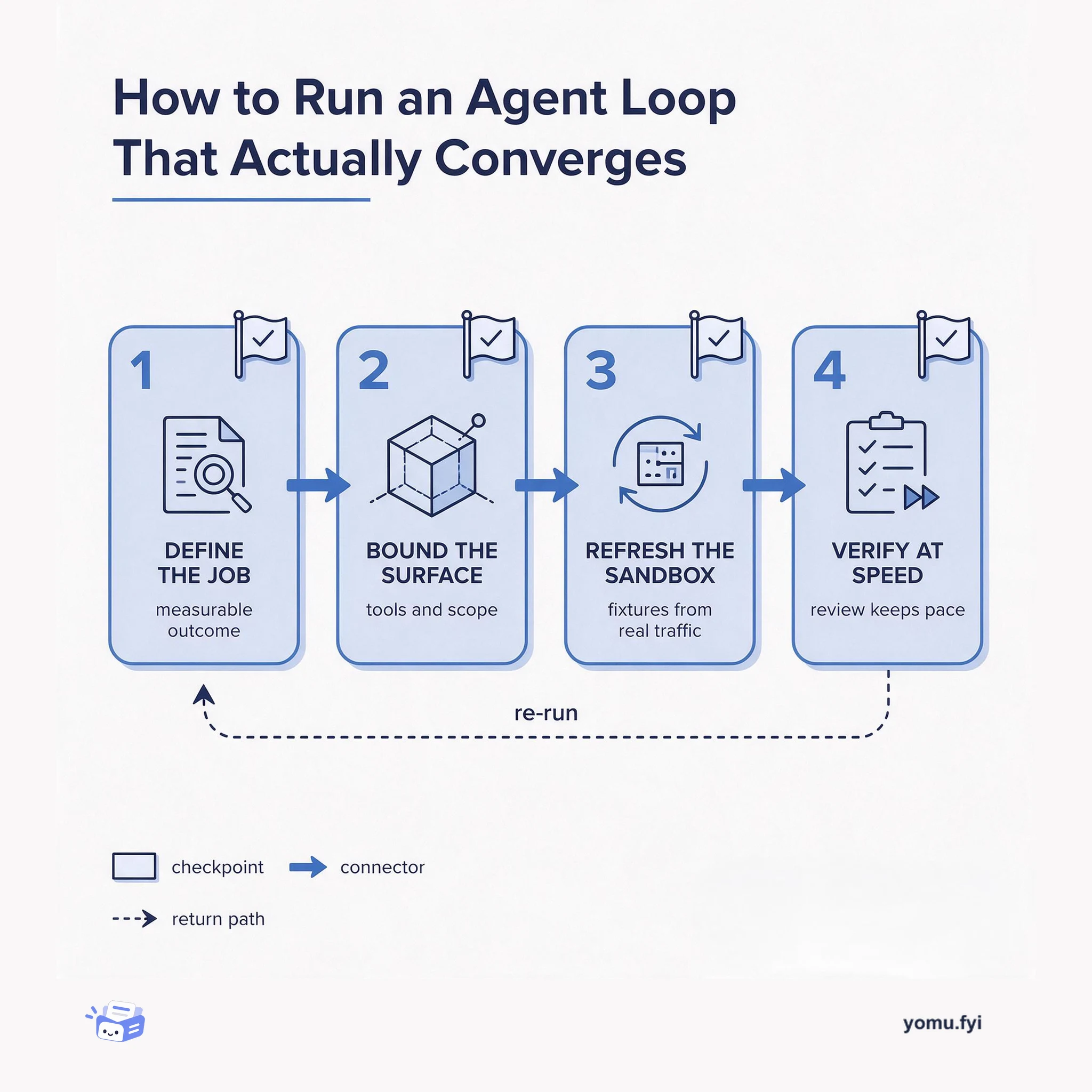
A four-checkpoint how-to for agent loops: name a measurable job, bound the tool surface, refresh sandbox fixtures from real traffic, and verify at agent speed.
Loading…
Topic
564 posts about AI Agents. Every summary links to the original.
See the idea
A four-checkpoint how-to for agent loops: name a measurable job, bound the tool surface, refresh sandbox fixtures from real traffic, and verify at agent speed.
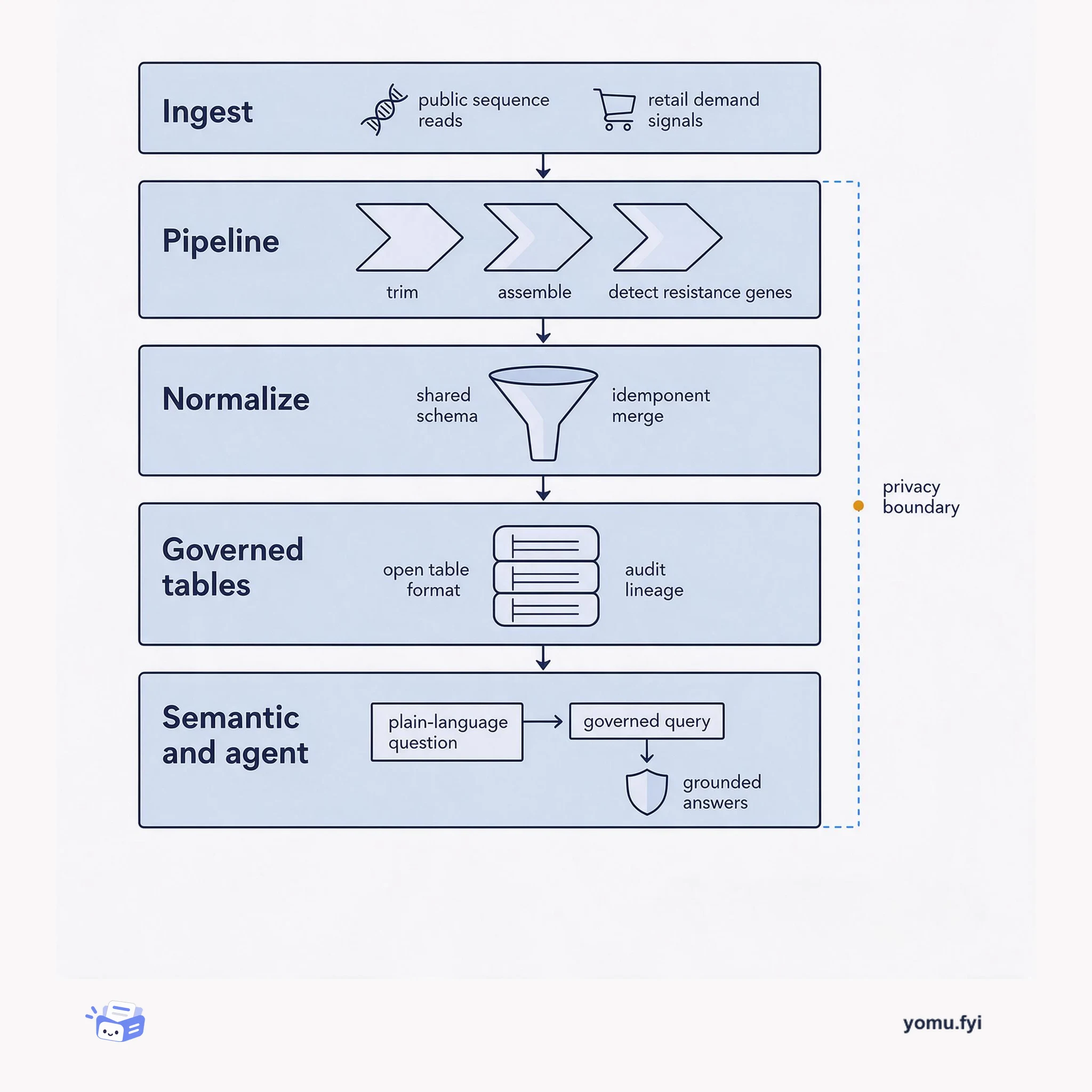
Antimicrobial resistance surveillance is a layered data architecture: raw reads and demand signals flow in, get normalized into governed tables, and answer plain-language queries. The diagram maps each boundary.
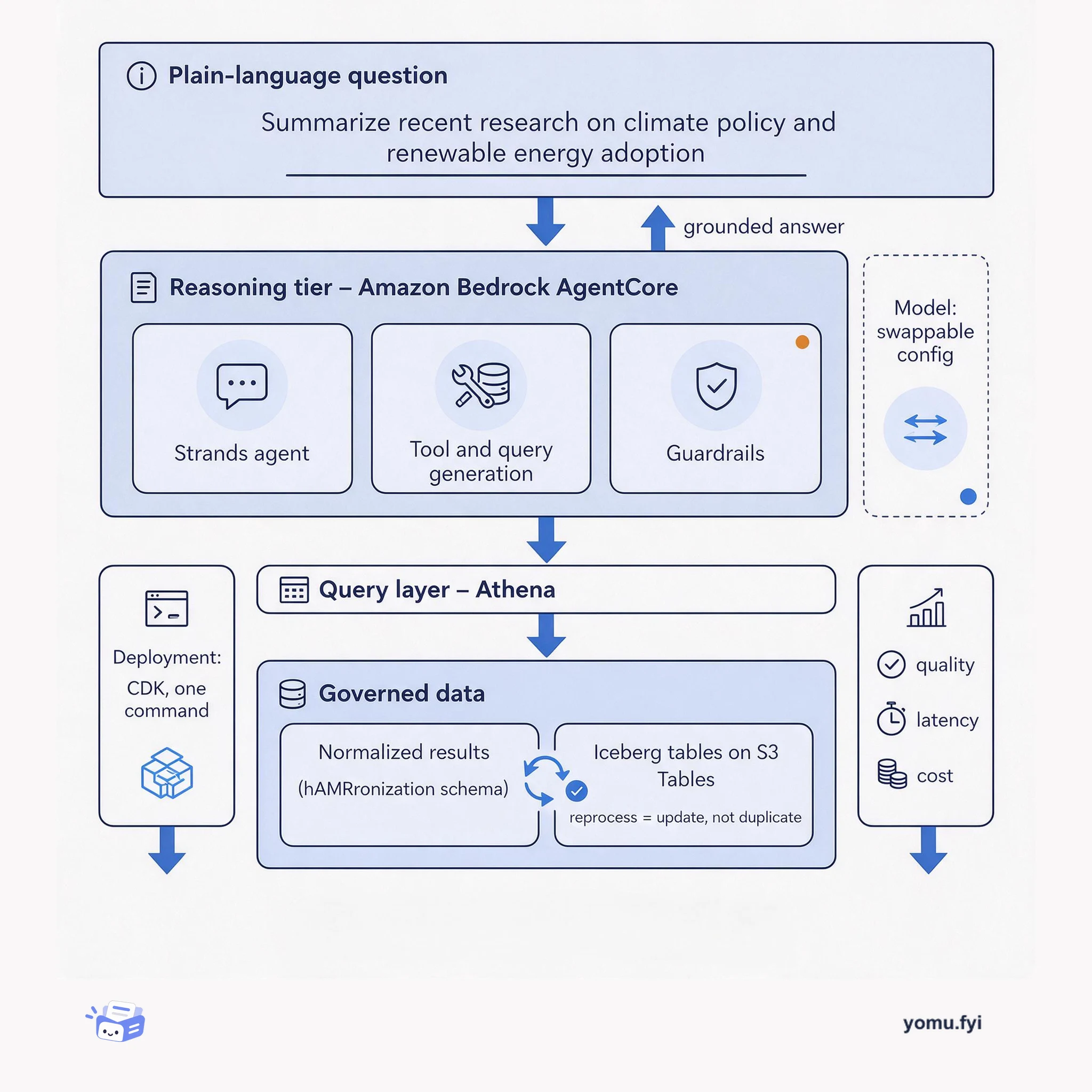
Amazon Bedrock is the managed reasoning tier in an agent architecture, not the whole system. This layered view shows the pipelines, governed tables, query layer, and guardrails around it.
The Good Stuff
Paid picks we use ourselves. Links carry a referral code — a subscription through one earns us a commission at no extra cost to you.
Newest first
Business leaders often have access to plenty of data but still cannot get a reliable answer to a simple question like why net revenue declined 8% at their largest account last week. The answer may span sales, finance, promotions, inventory, and account data, with each source potentially correct in isolation yet different in definitions, detail, relationships, and authority. Without the right business context, general-purpose agents cannot reliably determine what metrics mean, which sources are authoritative, how data should connect, or what each user is allowed to see. Genie One MCP gives governed context to any MCP-compatible AI agent, connecting assistants like ChatGPT, Claude, Microsoft Copilot, and coding agents to Genie One. This lets them answer business questions using approved definitions, trusted data relationships, and permission-aware access controls, with traceable, permission-aware answers grounded in governed business context.
GPU acceleration alone does not guarantee fast ROS 2 graphs because messages may still be serialized or copied through CPU memory. NVIDIA contributed the rosidl::Buffer abstraction and CUDA buffer backend to ROS 2 Lyrical, enabling zero-copy transport of GPU-resident payloads between co-located nodes when they share the same host, CUDA device, Linux user, and a supported RMW implementation, with automatic CPU fallback otherwise. An AI coding agent using the migrate-node-to-rosidl-buffer skill can audit an existing CUDA-accelerated node by tracing data movement, running a copy-boundary audit, and implementing a minimal interface-preserving patch. The tutorial demonstrates this on the Depth Anything 3 TensorRT node, updating subscription options and message storage to use CUDA buffer backend without changing the sensor_msgs/msg/Image message definition. The resulting accelerated workload can be deployed on NVIDIA Jetson AGX Thor, preserving standard ROS 2 messages while avoiding unnecessary serialization and host copies.
JetBrains Air is a system of products for agentic software development, built on the premise that no single model, agent, or service fits every developer, team, or task. It connects products for individual work, team coordination, organizational control, context, and process automation, while remaining open to tools and agents developers choose, including those JetBrains does not build. This openness lets developers select the agent, model, or service suited to a task without forcing the organization to give up context, visibility, or control. The Post notes that every new model, agent, or service an organization adds reduces visibility into its own development work. Because intelligence does not belong to one model, the benefit can extend across supported agents and services.
The Post argues that AI agents are breaking a long-standing assumption in enterprise data: that a human analyst can always resolve ambiguity. Richard Tomlinson explains that while analysts rely on tribal knowledge—like which revenue table is trusted or what ‘active customer’ means—agents lack this context. This gap causes inconsistent answers and erodes trust in self-service tools. The conversation examines why previous ontology efforts stalled and what must be true for an ontology to support agents. The ontology is positioned as the missing context layer that companies have not yet built.
The 2026 Customer Data Platform Report identifies a critical enterprise challenge: while AI tools grow individually smarter, fragmented customer data causes a worsening, not better, experience. The shift is from computational capacity to contextual continuity, as disconnected pipelines force AI agents to start every interaction from scratch. Three failures arise from fragmented systems: agent amnesia, escalating operational costs from wasted tokens, and trapped intelligence that never reaches active workflows. Modern CDPs have evolved from passive audience builders into API-first context engines that support three pillars: pre-execution context with working memory, unified behavioral and conversational data streams, and infrastructure-level governance enforcing compliance before data reaches AI models. Organizations like Twilio, Trustpilot, and Quartz demonstrate that embedding real-time customer context into the conversation layer outperforms deploying the smartest standalone models.
AI-to-human handoffs often fail because context is lost during transfer, forcing customers to repeat themselves. 76% of consumers report that human agents have little to no context about their issue, and 91% of brands have seen customer satisfaction drop due to AI missteps, with 40% attributed to context loss between channels. A cold transfer drops the customer into a new queue with nothing carried over, while a warm transfer briefs the receiving agent beforehand. Five steps to preserve context include defining escalation triggers early, specifying a payload with conversation history and customer profile, generating a three-line summary, maintaining context across channel changes, and writing back learned information to customer records. Measuring repeat-explanation rate and post-handoff resolution rate helps identify whether handoffs are working or if the AI is over-holding conversations.
Stripe implemented WebMCP on its Checkout UIs, which processes around 0.45% of global GDP, to optimize the buying experience for AI agents. Previously, agents relied on slow browser automation, consuming an average of 1.8 million tokens and 38.83 tool calls per transaction, taking over 2.5 minutes. WebMCP exposes MCP tools from the client side, allowing agents to execute actions like get_order_summary or fill_payment_form instead of interpreting the DOM. The implementation uses progressive tool disclosure, revealing only relevant tools; in evaluations across six models, agents using WebMCP consumed 42% fewer tokens, made 38% fewer tool calls, and completed checkout 39% faster. Stripe reused existing UI state and forms via imperative and declarative APIs, avoiding a separate agent-only code path and keeping human and agent experiences aligned.
The Confused Deputy problem, first documented in 1988, describes a program with legitimate authority being tricked into misusing that authority on behalf of a less-privileged actor. AI agents are particularly vulnerable because they process instructions and untrusted content through the same natural-language channel, making prompt injection straightforward. The post traces this pattern through CSRF, SSRF, and recent attacks like Clinejection, where an issue-triage bot executed an attacker-supplied command from a crafted issue title. That attack led to a poisoned GitHub Actions cache and a compromised npm package downloaded 4,000 times. The fix involves task-scoped short-lived credentials, capability-scoped permissions, credential isolation from the model, and human-in-the-loop approval for high-risk actions.
Standard LLM benchmarks are insufficient for evaluating AI agents because they score static outputs rather than multi-step tool-call sequences against a live environment. The post explains that agent evaluation requires two scoring layers: step-level (process scoring) checks each call’s validity and usefulness, while end-to-end (E2E) scoring checks only the final environment state. A trace logs every step and environment state, and metrics roll up through a hierarchy of benchmark, trial, task, turn, and step. Key metrics include task success rate, consistency, tool-call precision, argument accuracy, steps per success, and cost per success. The post argues that benchmarks are converging on tool use because deployed agents always use tools, and enterprise benchmarks should measure task completion against real APIs and policies.
The post announces the open-sourcing of agentic-threat-modeling, an AI-assisted threat-modeling module for Claude Code, Cursor, and Gemini CLI, built to address the bottleneck of security teams reviewing AI-generated code. It runs on Lola, an open source package manager for AI contexts, and profiles likely attackers, generates narrative attack scenarios grounded in actual code, and checks them against six structured threat modeling frameworks (STRIDE, PASTA, LINDDUN, attack trees, and more). The module ties every finding to a specific file and line of code, as shown in a real-world example against a file upload endpoint. It’s designed to produce structured output for AI-assisted triage, though that pipeline isn’t built yet. The team open sourced it because the problem isn’t unique to them, and it’s available in RedHatProductSecurity/agentic-threat-modeling and LobsterTrap/lola.
Sentry’s Laravel AI integration, built during an internal Agent Hackweek, provides Agent Tracing for Laravel AI agents. The author used Claude for coding, which initially produced poor generic helper code. Laravel AI emits lifecycle events for agents and tool calls, but not for individual LLM invocations. To capture these, the integration matches outgoing HTTP requests to active invocations using provider URL prefixes, associating with the most recently started invocation if multiple match. Enabling the integration requires only updating to sentry-laravel 4.27, with no Sentry-specific code. Traces appear in Sentry’s Explore > Agents section, showing conversations, tool calls, and their inputs and outputs.
The author, a Twilio employee, built a personal agentic AI using Hermes Agent and connected it to Twilio SMS to enable phone-based interaction. They chose SMS over a custom Android app because it works out of the box on any phone and globally, making the agent accessible to anyone with the phone number, including non-technical users. The author wired up a toll-free 800 number and tested the setup by sending a text message from a grocery store parking lot, receiving a reply from the agent. The experiment demonstrated that agentic AI can be integrated with legacy protocols like SMS to provide realtime chat capabilities. The author also noted the importance of reading email provider terms of service if creating a new account for the agent.
Twilio research found that 99% of companies report something blocks them from understanding customers, with 48% citing connecting data across channels as the top obstacle. The problem isn’t data collection, which has succeeded, but the missing data activation layer that makes context usable in the eight seconds an AI agent has before a customer gives up. Twilio’s solution involves three elements: continuity across channels, real-time profile freshness, and retrieval of relevant history mid-conversation. Twilio Conversations treats touchpoints as a single lifecycle, Conversation Memory syncs new details in real time, and Conversation Intelligence surfaces approved documents alongside history. Twilio recommends starting small by picking one handoff where customers repeat themselves and making context survive it, rather than feeding the AI more data.
Shopify’s internal tool Helix powers the native migration of its Shopify app, which has over 300 screens. The company previously rebuilt the Shop app in just 12 weeks using similar methods. Helix is a set of tools and skills that help LLMs migrate features and screens from the React Native app while following a highly opinionated architecture. Unlike most tools that gather information, create specs, and implement everything at once, Helix aims for consistent, high-quality, and maintainable results. The approach is now being applied to the larger Shopify App after its success with Shop.
The post details how to add secure human-in-the-loop approval to an AI expense agent built with Microsoft Agent Framework and Auth0, completing the four-part series that handles identity, authorization, and action. Because approval is a security-sensitive action requiring the same cryptographic rigor as any authentication event, the agent uses Client-Initiated Backchannel Authentication (CIBA) to push a notification to the manager’s phone instead of accepting chat input. The notification includes a binding message describing the expense by ID, amount, vendor, and context, giving the manager enough information to decide from a lock screen. The agent polls Auth0’s token endpoint until the manager approves or denies, then uses the CIBA-issued access token scoped with approve:expenses to record the decision on a separate Expense API. This design ensures approval decisions are cryptographically bound to the manager’s identity and verifiable by downstream services, completing the secure loop.
JetBrains presents the AIDEs Framework as a model for understanding how AI development tools evolve, rather than trying to track every market change. The post describes a progression from single-line completion through multiline completion, IDE chat, AI code editors, agentic development environments, and cloud-based agents. It defines an Artificial Intelligent System as a system that demonstrates intelligence in helping users achieve goals, and an Artificial Intelligent Development Environment (AIDE) as an AIS for creating software; intelligence may come from deterministic heuristics as well as LLMs. The framework treats principals and agents as potentially human or AI actors and views software creation as a broader delegation process than coding alone. It proposes examining assumptions, building a model, and validating it against ongoing change, while suggesting a possible future of vertically integrated Agentic Software Production Platforms that use AI as an “intelligence” resource.
Junie Local’s update introduces Qwen3.8-3.6-27B-blend, a merged model that balances speed and capability for local coding agents. The blend, created by merging Qwen3.6 and Qwen3.8 weights in equal proportions, completed 37 tasks in a 100-task internal benchmark, compared to 34 for Qwen3.6 and 39 for Qwen3.8, while generating 71% fewer output tokens than Qwen3.8. The runtime uses multi-token prediction (MTP), with a two-token proposal on M5 MacBook Pro making decoding 60% faster. A four-bit MTP head was kept over an eight-bit one due to similar acceptance rates and memory savings. The update also brings experimental NVIDIA RTX support on Windows for machines with at least 24 GB of VRAM.
The post defines a database for AI agents as infrastructure for short-term, episodic, procedural, and operational memory, rather than merely a place to retrieve documents. It proposes five evaluation criteria for moving agent workloads from prototypes to production: per-agent branch isolation, serverless scale-to-zero, hybrid search, ACID guarantees, and unified platform access. The technical rationale is that agents perform repeated reads and writes, resume tasks, share state concurrently, and need current data across vector, keyword, and metadata retrieval; zero-copy branches, sub-second wakeups, and single-query hybrid search address specific operational constraints. It concludes that a database missing more than one minimum bar becomes a production risk, while standard Postgres alone supplies ACID but not branching, scale-to-zero, or unified operational and analytical access.
Baseball teams can use Databricks to turn Statcast and team-derived pitch-level data into game-day plans for hitters, bullpen changes, pinch-hit choices, advance scouting, and roster decisions. Genie, on Unity Catalog, queries governed Delta tables and reusable Unity Catalog SQL functions for tendencies by count, handedness, pitch type, location, and base-runner state. A Multi-Agent Supervisor built with Agent Bricks and deployed on Model Serving simulates matchup pockets, compares reliever arsenals with hitter profiles, and produces explanations that staff distill into printed decision cards. For advance work, AI Search indexes pitcher and hitter embeddings to find similar arms, while Lakebase Postgres keeps reports, tags, and decisions close to the source data for shared operational memory.
Agentic analytics is an approach in which autonomous AI agents continuously monitor data, detect patterns and anomalies, generate contextual insights, and take actions with minimal human intervention. Unlike traditional business intelligence, which relies on people to query dashboards and interpret reports, these systems operate as goal-directed decision loops that can recommend or trigger alerts, forecasts, workflows, and system changes within defined boundaries. Their architecture combines data access, agent orchestration, LLM-based reasoning, a semantic layer, action integrations, and feedback signals. The source identifies faster insight, lower reporting overhead, reduced analytics backlogs, and potentially better forecasting as benefits, while stressing governance, auditability, security, monitoring, and human oversight to control errors and unintended outcomes.
The best engineering reads, once a week.