How to Give an Agent a Query Language Instead of a Code Interpreter
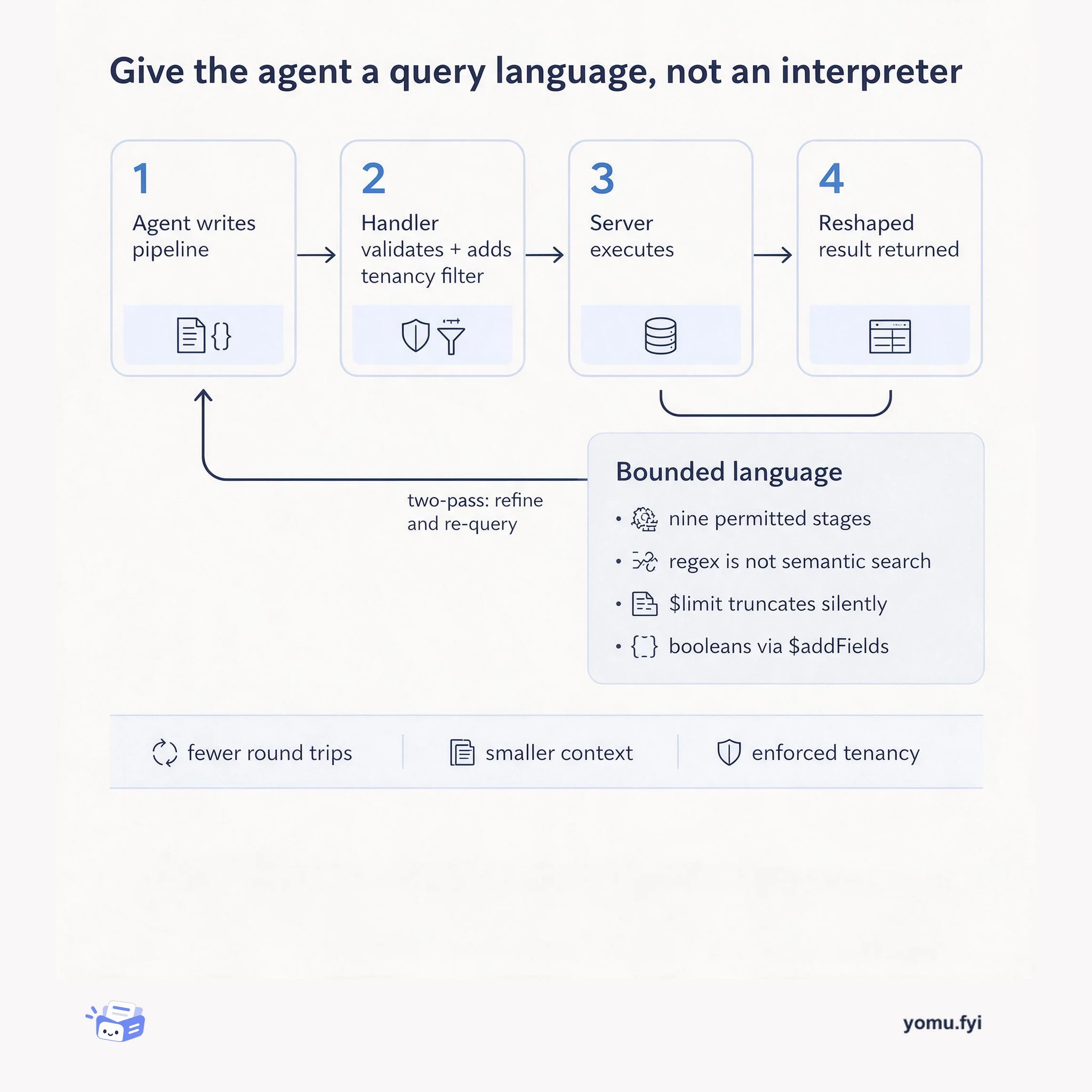
A four-step pattern for letting a document agent write validated aggregation pipelines instead of arbitrary code, so results come back shaped and tenancy stays enforced.
Loading…
Topic
542 posts about AI Agents. Every summary links to the original.
See the idea
A four-step pattern for letting a document agent write validated aggregation pipelines instead of arbitrary code, so results come back shaped and tenancy stays enforced.
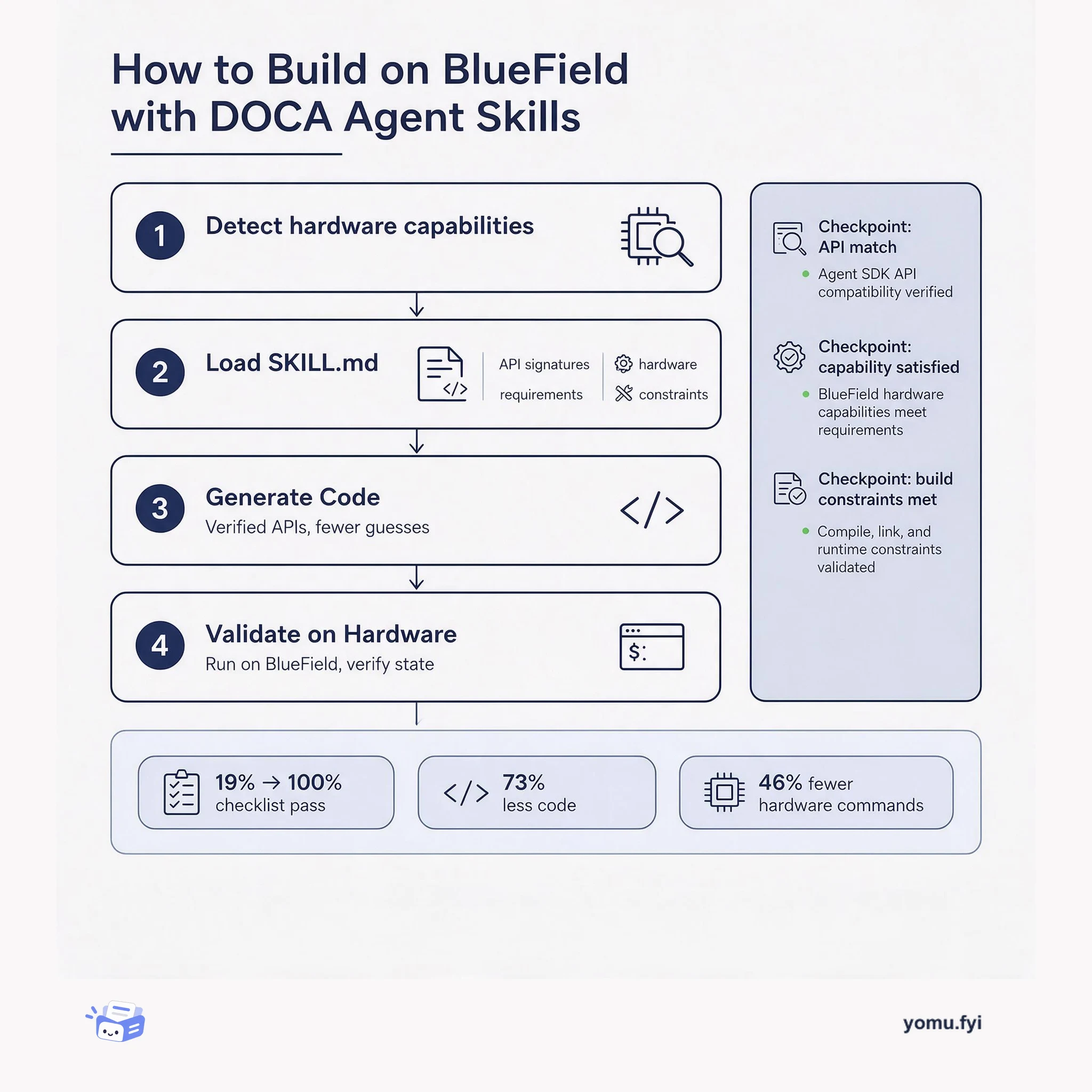
A practical how-to for using NVIDIA DOCA Agent Skills to generate BlueField code with verified APIs and hardware checks, reducing correction cycles and failed builds.
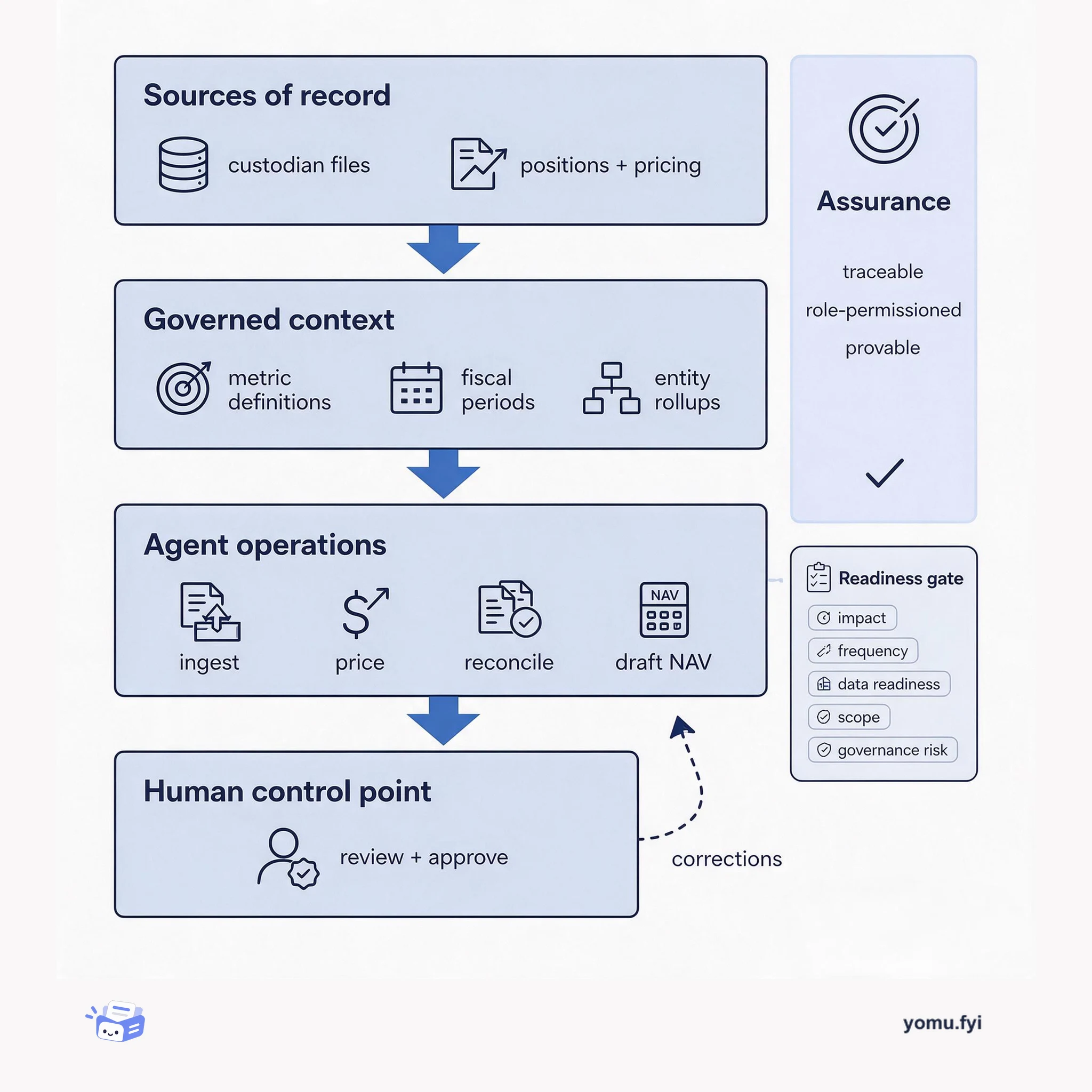
Asset management runs as a layered control plane: custodian and pricing data feed a governed context layer, agents run the overnight fund work, and a human signs off before anything is published.
The Good Stuff
Paid picks we use ourselves. Links carry a referral code — a subscription through one earns us a commission at no extra cost to you.
Newest first
AI deployed in regulated industries such as healthcare and manufacturing often lacks explainability and contestability, creating a barrier to adoption because responsible humans cannot meaningfully challenge AI outputs. The post presents contestable AI as an architectural pattern where multiple specialist agents debate recommendations, a qualified human reviews and overrides arguments, and the system re-scores in real time. In a clinical scenario, a patient analyzer agent retrieves similar cases, specialists argue for and against care options, and a general practitioner overrides as needed before a care plan is finalized. In manufacturing, a site reader agent ingests equipment sensor labels, two specialist agents debate classifications against a standard ontology, and an engineer overrides with context the model lacked, like a fixture offset. MongoDB’s document model stores the AI arguments, human overrides, confidence scores, and final decision in one retrievable document, supporting single-query decision lineage without joining data across systems.
This post presents an inventory automation architecture that moves from zero-shot demand forecasts to validated purchase orders while applying safety stock, minimum order quantities, budgets, and promotional adjustments. It combines Amazon Chronos2, hosted on SageMaker Serverless Inference, with four Claude-powered agents built using the Strands Agents SDK and deployed on Amazon Bedrock AgentCore; deterministic Python tools perform computation and agents handle judgment. Product data and future covariates arrive through CSV files in S3, while business rules remain in JSON, enabling what-if forecasts and onboarding without per-SKU training. In internal testing across 50 SKUs over a four-week horizon, the system reached 12.3% median WAPE, reduced onboarding from 2–3 weeks to under five minutes, and lowered estimated monthly inference cost from about $1,091 to $15. A conditional retry loop surfaces budget violations for user decisions instead of silently truncating orders, with traces and evaluator scores supporting auditability.
Sentry’s Search Query Assistant converts natural-language prompts into Sentry Search Syntax, but its non-deterministic output requires evals and debugging when generated queries are wrong. A production issue caused searches on custom numerical attributes to return no events, so the team used Sentry’s AI Conversation view and Agents filters to find the relevant trace, inspect the timeline, and follow tool calls into the backend API. The trace showed that tool results were being incorporated into the system prompt with the field name bug__predictions_count instead of the required tags[bug_predictions_count, number] form. The team added an eval scenario, fixed the prompt generation, verified the corrected query locally and in production, and confirmed the updated prompt and API parameter in the trace. They also instrumented local eval runs to send data to Sentry, allowing debugging before a pull request.
Cognizant announced plans to deploy Anthropic’s Claude to up to 350,000 employees globally, using it with agentic tooling, engineering platforms, and industry blueprints to move enterprise AI efforts from experimentation to production outcomes. It will make Claude available across corporate functions, engineering, and delivery teams, while Claude Code supports coding, testing, documentation, and DevOps workflows. The rollout also aligns Claude models, Claude Code, the Model Context Protocol (MCP), and the Agent SDK with Cognizant’s platforms for integration with existing data and applications, multi-step work, human oversight, and management of performance, risk, and spend. The stated applications include software productivity through Cognizant Flowsource, legacy modernization, multi-agent systems via Cognizant Neuro and Agent SDK, and regulated industry solutions beginning with financial services. Cognizant also describes responsible AI practices for deployment, monitoring, operations, and governance, and plans client workshops, reference patterns, and platform integrations to identify use cases and move them into production.
Anthropic and Microsoft are expanding their partnership by making Claude Sonnet 4.5, Haiku 4.5, and Opus 4.1 available in public preview through Microsoft Foundry, where Azure customers can build applications and enterprise agents. The integration uses serverless deployment, supports Foundry APIs, tools, and workflows, and works with existing Azure agreements, including MACC, while offering Python, TypeScript, and C# SDKs with Microsoft Entra authentication. Claude models are also available through Claude Code in Foundry, and Microsoft 365 Copilot integrations include Researcher, Copilot Studio custom agents, and a preview Agent Mode option in Excel. In Excel, Claude can generate formulas, analyze data, identify errors, and iterate on solutions. Foundry's Global Standard deployment uses standard API pricing; US DataZone availability is described as coming soon, and the models support capabilities including code execution, web search, citations, vision, tool use, and prompt caching.
Anthropic and Snowflake announced a multi-year, $200 million partnership that brings Claude models to Snowflake’s more than 12,600 customers across Amazon Bedrock, Google Cloud Vertex AI, and Microsoft Azure. The agreement also includes a joint go-to-market initiative for deploying AI agents in large enterprises. Claude can analyze structured and unstructured data through Snowflake Cortex AI, while Snowflake Intelligence and Cortex Agents support natural-language questions, multimodal SQL-based analysis, and custom multi-agent solutions under Snowflake Horizon Catalog governance. Snowflake’s internal benchmarks report greater than 90% accuracy on complex text-to-SQL tasks, and examples include Simon Data and Intercom. The partnership is positioned to help regulated industries move AI agents from pilots to production within governed data environments.
Anthropic is donating the Model Context Protocol (MCP) to the Agentic AI Foundation (AAIF), a directed fund under the Linux Foundation co-founded by Anthropic, Block, and OpenAI, with support from Google, Microsoft, AWS, Cloudflare, and Bloomberg. Introduced as an open standard for connecting AI applications to external systems, MCP now has more than 10,000 active public servers, adoption across major AI products, enterprise deployment support, and official SDKs with 97M+ monthly downloads across Python and TypeScript. The donation places MCP alongside Block’s goose and OpenAI’s AGENTS.md as AAIF founding projects, while its existing governance model remains unchanged. MCP also has a community-driven Registry, and the November 25th specification release added asynchronous operations, statelessness, server identity, and official extensions.
Anthropic and the US Department of Energy (DOE) announce a multi-year partnership under the Genesis Mission, targeting American energy dominance, biological and life sciences, and scientific productivity across potentially all 17 national laboratories. Anthropic plans to give DOE researchers access to Claude and engineers who can build purpose-built AI agents, Model Context Protocol servers connecting Claude with scientific instruments and tools, and Claude Skills for specialized workflows. Proposed applications include speeding permitting reviews, supporting nuclear technology research and energy security, developing pandemic and biological-threat early-warning systems, accelerating drug discovery, and using fifty years of DOE research to surface ideas and patterns. The partnership extends prior DOE work, including a nuclear risk classifier co-developed with the National Nuclear Security Administration and Claude’s rollout at Lawrence Livermore National Laboratory. Anthropic says future arrangements could develop a model for collaboration between AI and human researchers.
Repeatedly optimizing against long-lived machine-learning benchmarks appears to invite overfitting, yet the post notes that gains on heavily reused benchmarks have largely transferred to newly created test sets. It describes a paper that resets LLM-based research agents, gives an explorer repeated access to validation feedback, and passes the resulting strategy through a token bottleneck to a fresh reproducer. Across eight datasets, strategies from hundreds of experiments were reproducible from prompts as short as 16 to 32 tokens; at shorter budgets, performance diverged, showing that the compressed message carried data-dependent choices rather than only prior knowledge. Deliberate overfitting occurred in 38 of 102 runs, with validation accuracy more than 10% above held-out accuracy, but those gains disappeared after compression; possible pretraining side channels remain unresolved.
MongoDB Atlas is now a connected data source in OpenAI’s Data Plugin, powered by the MongoDB Atlas Managed MCP Server. This integration lets analysts and business teams query real-time operational data in ChatGPT Work without leaving the conversation, such as monitoring conversion changes after a deployment, finding orders stuck in payment pending, comparing sales hours across regions, and reviewing customer activity before support calls. Insights can be turned into live charts and dashboards within the conversation. Access respects existing cluster controls via OAuth sign-in, with organization owners able to enable or restrict AI client access to read-only, and every query runs with the permissions of the connected user. Teams that trust MongoDB Atlas as their fully managed, real-time system of record can now question their data directly without waiting for ETL jobs.
Cursor is launching Projects, a beta feature for taking on larger bodies of work such as features, migrations, and full applications. Each Project preserves context over months, runs on its own cloud computer through Cloud Agents, and coordinates parallel subagents rather than having the coordinator write code itself. Shared files synchronize across agents’ cloud and local machines, storing research, artifacts, codebase knowledge, and preferred working practices so later agents can use them. Projects can also subscribe to Slack channels, schedules, or pull requests and delegate work when signals arrive, while local agents handle testing that requires the user’s machine. Projects are accessible from Cursor’s left-hand navigation and are rolling out to all users in beta starting today.
Shopify is moving its mobile apps from React Native to Swift and Kotlin after reevaluating the assumptions behind its 2020 decision as coding models improved. React Native had reduced duplicated implementation and feature-parity work, but agents now handle much of the cross-platform implementation, translation, testing, and review work. Shopify is choosing greenfield rebuilds, with Helix breaking migrations into reviewed checkpoints that require tests, visual comparison, adversarial code review, and human approval. The Shop app reached the app stores as a fully native rebuild in 12 weeks, while the Shopify app migration is underway. The company will continue selected React Native library support while migrating all its apps, and will judge success by product velocity, app quality, and autonomous agent work.
Anthropic has been selected by the UK's Department for Science, Innovation and Technology (DSIT) to help build and pilot a dedicated AI-powered assistant for GOV.UK. The assistant will initially support people entering or re-entering the workforce by helping them find work, access training, understand available support and resources, and route them to relevant services. Powered by Claude, the agentic system is designed to provide individually tailored guidance, maintain context across interactions, and let users control what data is remembered or opt out; personal information will be handled under UK data protection law. Using DSIT’s “Scan, Pilot, Scale” framework, the partners will test and iterate the assistant before wider rollout, building government expertise to maintain it independently.
ServiceNow has selected Claude as the default model for ServiceNow Build Agent and as a preferred model across the ServiceNow AI Platform. Build Agent uses natural-language prompts to help professional coders and citizen developers create applications, design and test agentic automations, while enterprise controls provide access controls, usage monitoring, visibility, and compliance. ServiceNow is also deploying Claude and Claude Code across its workforce of more than 29,000 employees: a Claude-powered sales coaching tool has cut preparation time by up to 95% in testing, while technical teams use Claude Code for coding, reviews, debugging, and repetitive tasks. The partnership targets a 50% reduction in customer implementation time and includes Claude-powered industry applications for healthcare and life sciences, where claims authorization could move from days to hours.
Anthropic announces a $30 billion Series G led by GIC and Coatue, with participation from major investors, valuing the company at $380 billion post-money. It says proceeds will support frontier research, product development, and infrastructure expansion as demand for Claude grows among enterprises and developers. Anthropic reports $14 billion in run-rate revenue, more than 500 customers spending over $1 million annually, and eight of the Fortune 10 as customers. Claude Code’s run-rate revenue exceeds $2.5 billion, enterprise use accounts for more than half of its revenue, and an analysis estimated 4% of GitHub public commits. The company also points to Opus 4.6, expanded products including Cowork, and availability across AWS, Google Cloud, and Microsoft Azure, with training and inference across Trainium, TPUs, and NVIDIA GPUs.
Anthropic and Infosys announced a collaboration to develop and deliver enterprise AI solutions for telecommunications, financial services, manufacturing, and software development. The work combines Anthropic’s Claude models and Claude Code with Infosys Topaz, an AI-first set of services, solutions, and platforms, with an emphasis on governance and transparency for regulated industries. Using tools including the Claude Agent SDK, the partners plan to help clients build persistent agents for multi-step work such as claims processing, code generation and testing, compliance reviews, network operations, risk assessment, and legacy-system modernization. They also describe applications for product design and simulation, software debugging, and routine enterprise operations through Claude Cowork, while noting that Claude is available on Amazon Bedrock, Google Cloud Vertex AI, and Microsoft Azure.
Financial services leaders are shifting from asking whether AI works to asking whether it can earn trust, amid governance and audit concerns. The post frames five operational questions around moving finance from reporting to action, using AI in financial crime without losing control, supporting bankers and investment teams, using real-time data, and managing expanding costs. Examples include governed GL-to-Risk reconciliation with cited evidence, human maker-checker oversight and an audit trail; AML agents that draft SARs while humans file; and multi-agent workflows for client and portfolio analysis. The post also cites Coinbase's sub-100ms P99 fraud-detection benchmark and warns that token costs manageable in pilots may grow in production, making model routing and spend visibility relevant. Databricks presents these topics through live demos, talks and meetings at Sibos 2026 in Miami, scheduled for September 28–October 1, including a session on governing AI in financial-crime operations.
The 2026 AI Sentiment Report examines how end users feel about AI Agents in customer service and other uses such as shopping. Overall sentiment improved: 49% reported positive experiences, up nine percentage points from 2025, and that figure rose to 74% after respondents watched an Agent resolve a real query. Trust remains conditional, with 54% willing to trust AI with simple or routine issues but not complex ones involving discretion, privacy, continuity, accountability, or judgment. The research identifies easy escalation to a human and upfront disclosure that users are interacting with AI as the two leading ways to increase comfort, while trust also varies by channel, with chat strongest and social weakest. It concludes that businesses can treat trust as a design problem, including reassuring customers that shopping assistants serve their interests rather than merely the company’s financial goals.
Solvency II reporting connects data, actuarial reserving, capital calculation, quantitative reporting templates (QRTs), the ORSA, approvals, and disclosure, but fragmented systems make readiness and cross-process questions difficult to manage. The described Databricks implementation provides a governed workflow and control tower around existing actuarial and capital suites, automating ingestion checks, data-quality review, reconciliation, orchestration, reporting, and audit trails. It uses MLflow-managed reserving models alongside engines such as Prophet, RAFM, and Igloo, while narrow-scope AI agents can investigate QRT mismatches, suggest remediation, route questions, and support human review. An LLM can draft an ORSA from current numbers, while scenario analysis assesses doubling a cyber book over 12 months; reviewers retain decision authority. The workflow is presented as easier to monitor and investigate.
Anthropic and PwC are expanding their strategic alliance to use Claude for technology delivery, deal execution, and AI-led redesign of enterprise functions. PwC will roll out Claude Code and Cowork from U.S. teams toward a global workforce of hundreds of thousands, establish a joint Center of Excellence, and train and certify 30,000 professionals. The collaboration targets agentic technology builds, AI-native deal-making, and production operating models for finance, supply chain, HR, and engineering, alongside a new Claude-based Office of the CFO for regulated industries. Reported deployments include insurance underwriting reduced from ten weeks to ten days, an HR application delivered in under two months, and cybersecurity response accelerated from hours to minutes, with improvements of up to 70%.
The best engineering reads, once a week.