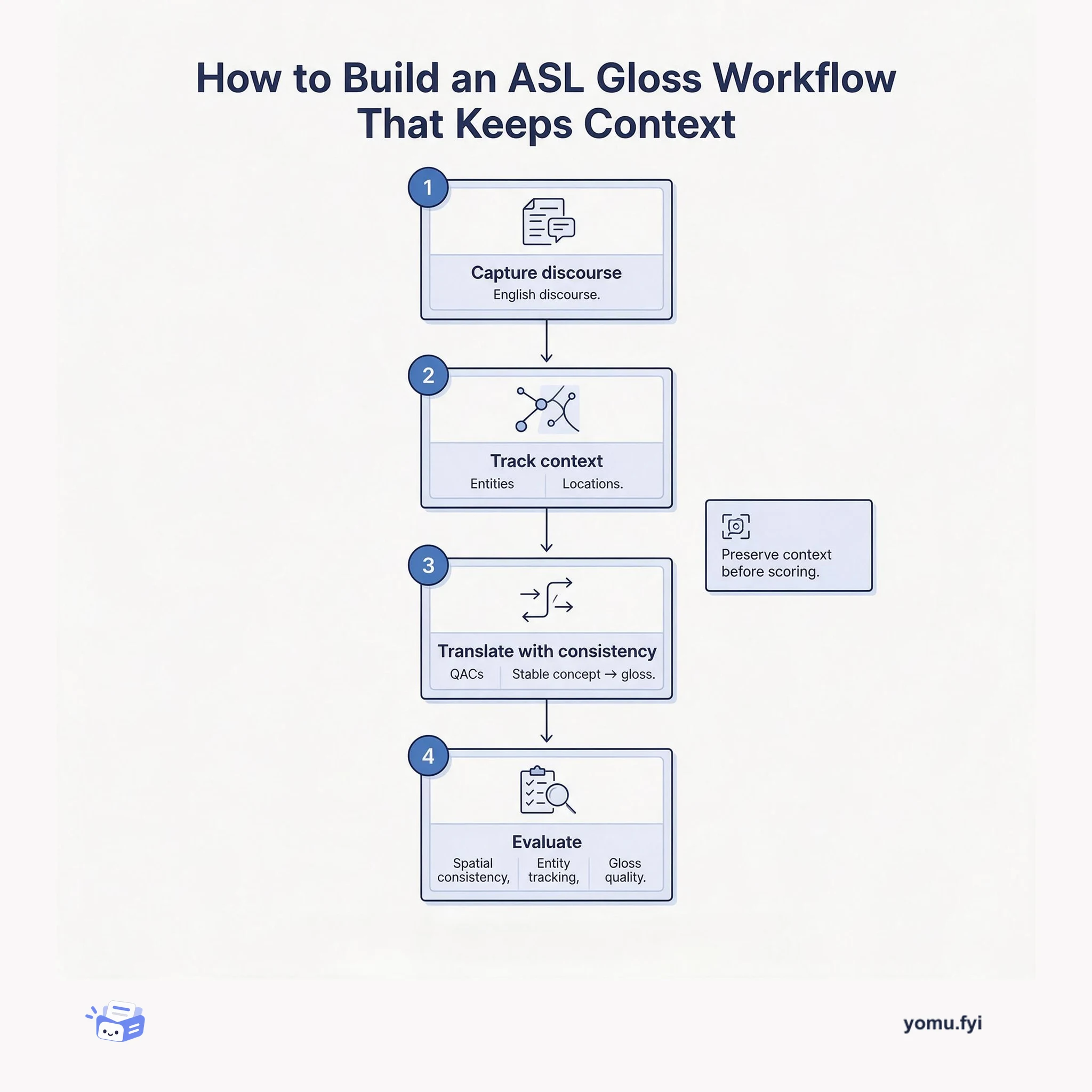
How to Build an ASL Gloss Workflow That Keeps Context
Learn a practical workflow for translating English discourse into ASL gloss while preserving spatial references, question-answer structure, and consistent concept-to-gloss mappings.
Loading…
Topic
483 posts about AI. Every summary links to the original.
See the idea
Learn a practical workflow for translating English discourse into ASL gloss while preserving spatial references, question-answer structure, and consistent concept-to-gloss mappings.
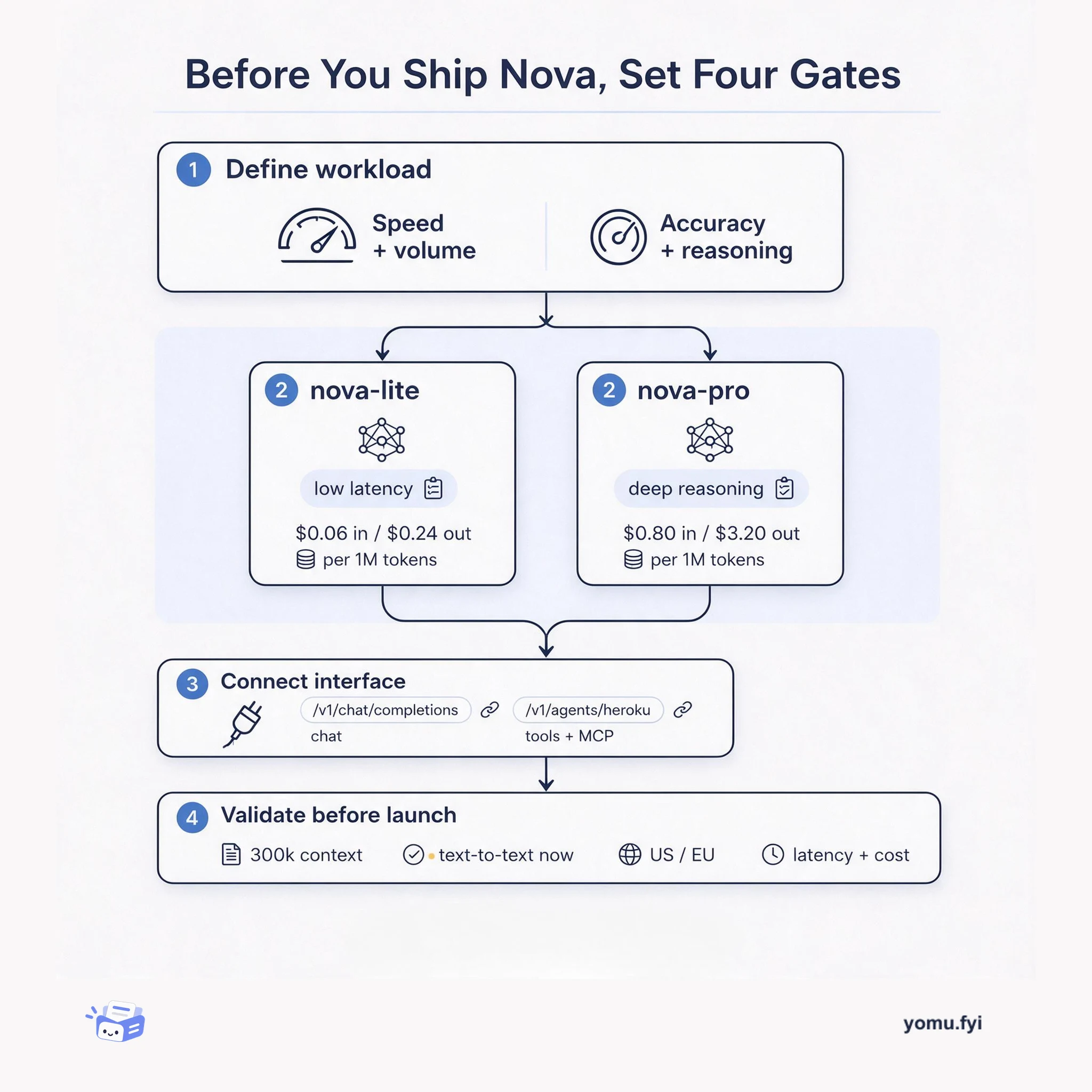
A practical checklist for putting Amazon Nova into an application: choose nova-lite or nova-pro by workload, expose tools, and verify context, modality, region, and cost constraints.
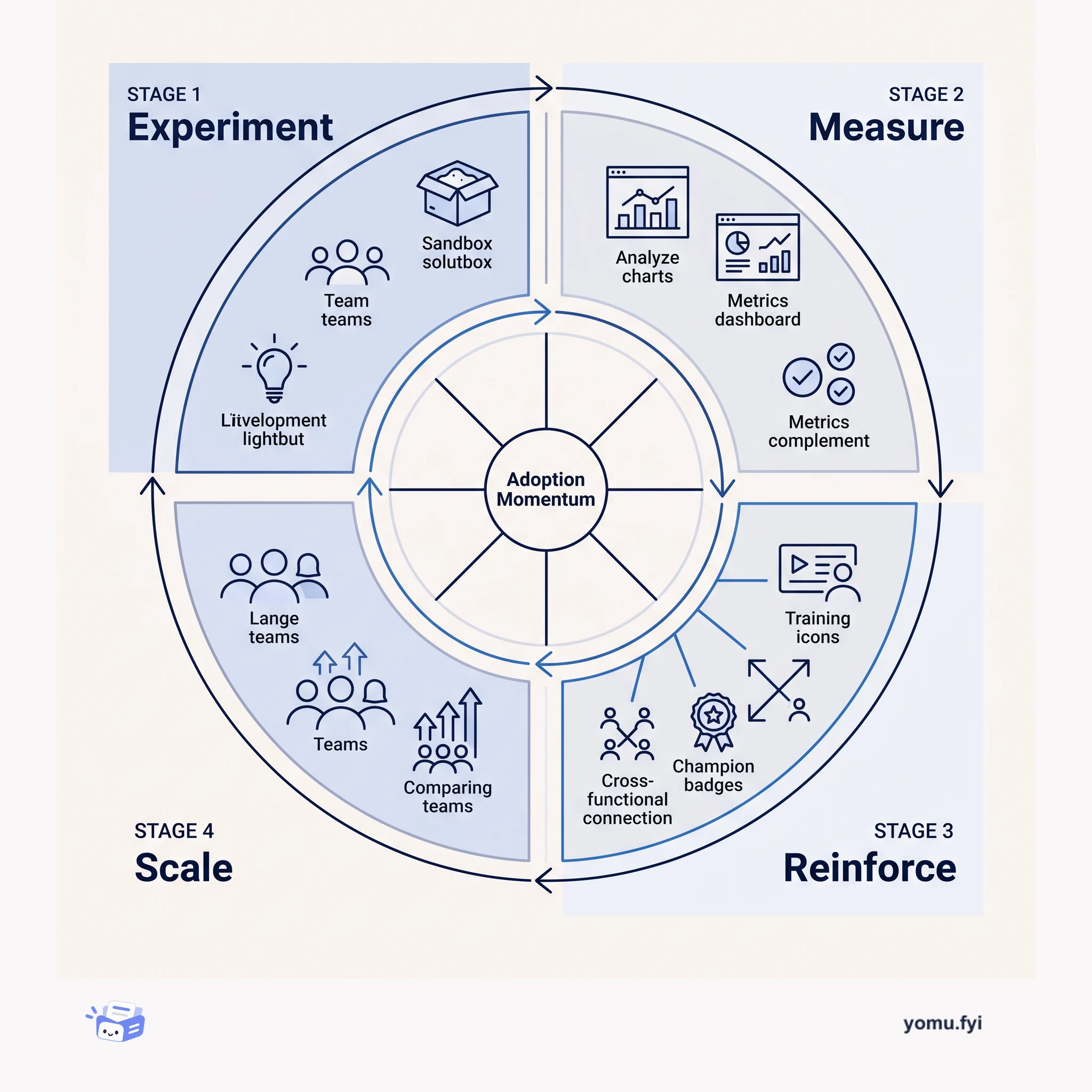
Adoption moves through experimentation, measurement, and reinforcement loops. Learn how leading companies build momentum from pilot programs into enterprise-wide habits and measurable business impact.
The Good Stuff
Paid picks we use ourselves. Links carry a referral code — a subscription through one earns us a commission at no extra cost to you.
Newest first
Cloudflare’s AI Search, a managed pipeline combining Workers AI, Vectorize, R2, and Browser Run, is now generally available after a year of preview. The update adds native image embeddings via the Qwen3-VL-Embedding model with Matryoshka Representation Learning, enabling visual search by texture and composition alongside caption-based text search. AI Search now supports files up to 10 MiB and optical character recognition for scanned PDFs; queries undergo optional rewriting, parallel vector and keyword search, fusion, and optional reranking. Previously reliant on caption generation only, image retrieval now embeds query images directly using multimodal models, while text-only models convert images to text via ToMarkdown. Billing starts November 1, 2026, with a free monthly allotment of 5 million ingestion tokens, 10 GB storage, 1,000 semantic queries, and 1,000 full-text queries, with no capacity units or monthly minimums.
A Twilio survey of 660 business leaders and consumers reveals a gap: 98% of organizations train AI to act more human, yet customers rank issue resolution, speed, accuracy, and availability above personality. Only 54% of consumers want human-like AI, versus 73% of brands. Behaviors customers call empathetic—acknowledging the specific situation, offering multiple solutions, using conversational language, offering compensation—depend on personalization and context, not tone. 51% of consumers find AI robotic, and 39% of businesses cite weak emotional understanding as a top dissatisfaction driver. The report recommends prioritizing context and personalization over personality, using tools like Twilio Conversation Memory and Conversation Orchestrator to make agents useful before charming.
Drawing on 15 years of data, the post compares 2024 and 2025 Developer Survey findings across AI evolution, work settings, and community demographics ahead of the 2026 results. AI tool usage grew from 62% in 2024 to 79% in 2025, while agent adoption jumped from 31% in 2025 to 59% in an April 2026 pulse survey, with ChatGPT and GitHub Copilot as primary gateways. Among learners, AI tool use rose from 63% to 73.3%, but favorable sentiment dropped from 72.2% to 52.8% and confidence in output accuracy declined, signaling growing skepticism. Work settings evolved, with fully remote falling from 38% to 32.4% and hybrid models gaining ground, yet 82% of respondents retained some remote flexibility in 2025. The post raises open questions for the 2026 survey, including whether the gap between AI use and enthusiasm persists and how agent delegation affects developer workflows.
Salesforce’s Assistive Authoring aimed to reduce prompt-template creation from 25 minutes to under a minute by using Agent Graph. A router node dispatches natural-language requests to specialized sub-agents for creation, refinement, or clarification while state variables carry context. Deterministic controls prevent the LLM from corrupting routing, record identity, or structured output through guarded transitions and a server-side transpose layer. A discovery service normalizes available data fields into an allowlist, and the LLM can only select from validated references. A human-in-the-loop gate ensures the agent never saves or executes, presenting output as an accept-or-reject diff only.
Cloudflare’s Impact programs have reached $100 million in donated services, protecting journalists, governments, election bodies, and public schools. The programs began as free services for developers and small businesses but evolved after discovering that some free customers doing essential work faced large attacks. Project Galileo, launched in 2014, now includes over 3,500 domains in 120 countries and blocked over 38.5 billion cyberattacks in 2025; a 2026 report found participants faced vulnerability exploit attempts at seven times the average rate. Other programs include the Athenian Project for election websites in 33 U.S. states and eight countries, Cloudflare for Campaigns with over 530 websites, and support for critical infrastructure like public schools and Ukraine. Cloudflare is expanding beyond cybersecurity to help public interest groups adapt to AI, including a hackathon for journalists that produced winning tool AIdas for studying AI bias, and a non-profit startup program.
Cloudflare released Auto Router in public beta through AI Gateway. Set the model to “cloudflare/auto” and the gateway automatically routes each request to a model capable enough for the task, filtering by credentials, access controls, and provider health. A multi-head classifier on Workers AI assigns probabilities across 14 task categories and rates complexity, ambiguity, stakes, and context dependence on a 1-5 scale. A separate scoring matrix combines those signals with model benchmark results and token prices, applying an adaptive cost penalty and switching costs for cached contexts in long sessions. On an internal general knowledge-work benchmark of 97 tasks with three samples each, Auto Router achieved 86.6% success at $0.0084 per success, costing 35% of Claude Opus 5.5 and 80% of GPT-6 Sol while remaining free during beta.
AI answer engines can read a publisher’s page and deliver a summary without the reader ever visiting the site, costing the publisher the visit and its associated revenue. Most publishers cannot negotiate individual licensing deals, and no AI company can contract with millions of sites. Pay Per Use, now in beta, is Cloudflare’s system that lets a buyer define a specific use of content and a price, and lets each publisher choose whether to accept that offer. The buyer reports each downstream use through a single Cloudflare API endpoint, and Cloudflare then bills the buyer and pays the publisher monthly. Publishers can track estimated earnings and usage by buyer and domain in the Cloudflare dashboard, with planned future enhancements such as report context like keywords or product type.
More than half of Internet traffic is now automated, and AI agents are the fastest-growing part of it, with daily requests on Cloudflare’s network growing by more than 1,700% over the past year. This second audience consumes bandwidth without generating ad impressions or subscriptions, causing revenue per request to fall while costs rise. Cloudflare is giving site owners tools to see who is visiting, set terms per bot type, and charge for access. These include AI Crawl Control, Web Bot Auth for cryptographically verified agents, Disallow AI Training to block training without losing search indexing, and Pay Per Use to pay publishers when content is actually used. The goal is to build open standards so any site can set its terms and get paid, rather than a few companies controlling discovery and payment.
Controlling the output of Large Language Models (LLMs) is a central challenge for their reliable deployment, yet current conditioning methods are often evaluated narrowly on effectiveness without considering generation quality. This study systematically investigates a range of conditioning methods in both concept injection and removal scenarios, including efficient steering, activation steering, prompting, and supervised fine-tuning. The authors find that efficient steering methods frequently achieve their conditioning goal at a steep cost to fluency, degrading generation quality. They identify a critical previously overlooked interaction: activation steering methods are far less effective on instruction-tuned models than on their base counterparts. Simple prompting and supervised fine-tuning are viable options for concept injection but are not as good at concept removal, while cheaply computed textual metrics highly correlate with costly LLM-as-judge scores, providing practical insights for evaluation.
AI-driven demand is constant, unpredictable, and extreme, unlike earlier internet and cloud eras where spikes were more predictable. Enterprises need a data layer that can absorb sudden bursts of traffic without re-architecture. MongoDB announced Atlas Infinite, a new deployment option within MongoDB Atlas that independently scales compute and storage within minutes. Atlas Infinite supports replica sets with 10x the data capacity of Atlas Core and delivers 189% more throughput per dollar in internal tests. MongoDB 9.0 was also released, offering up to 35% faster find-one queries and new security features like queryable encryption with prefix, suffix, and substring searches.
The post examines why business intelligence (BI) dashboards lose user trust, even when data is accurate, focusing on how inconsistent metric definitions and opaque data sources cause users to doubt results. Richard Tomlinson argues that AI tools accelerate chart creation but also amplify trust debt if underlying data governance and semantics are weak, since AI can generate many inconsistent charts quickly. He recommends governing data and meaning, preserving provenance, and designing for inspection so visualizations invite investigation rather than presenting unexplained answers. Tomlinson stresses that dashboards should be self-explanatory, traceable, interactive, and context-aware, and that the critical metric for modern BI is ‘time to trust’ not just time to answer. Self-service fails when verifying an AI-generated answer takes longer than asking an analyst, so good visualization must enable inspection and challenge.
Brandwatch introduced seven AI-powered updates to help analysts, marketers, and social media managers keep pace with fast-moving online conversations. Iris AI features like Query Writer and Query Fixer streamline building comprehensive research queries by allowing a user to describe a topic through chat. The Ask Iris AI chat on the homepage and dashboards delivers instant summaries and topic breakdowns without requiring a pre-built query. Enhanced Alert and Signal emails now include AI-generated summaries so users can assess breaking stories or issues without reading individual mentions. Other updates include AI-generated categories for segmenting datasets, industry benchmarks for social performance, semantic search for YouTube creator discovery, and automated message classifiers in Engage.
Static interfaces cannot adapt when generative AI produces variable outputs, such as a medical scan showing one fracture versus twenty ambiguous regions requiring expert review. The solution combines three AWS technologies: the AG-UI protocol for standardized agent-to-UI streaming via Server-Sent Events, the Strands Agents SDK Swarm pattern for peer-to-peer agent collaboration, and Amazon Nova Act for browser-based legacy system integration. AG-UI removes custom WebSocket formats by defining typed events that both agent frameworks and frontends implement as a universal contract. Strands swarm agents debate hypotheses and iteratively refine findings, producing explainable results visible in real time, while Nova Act navigates login screens and fills forms on systems without APIs. A complete radiology assistant walkthrough demonstrates reduced interface development time and HIPAA-compliant data handling for medical imaging.
The Pipeline Failure Analyzer (PFA) cuts CI failure triage from hours to minutes by confining AI to exactly one of five pipeline stages. Four stages remain deterministic: Prepare cleans raw logs by stripping ANSI codes and progress bars, Summarize assembles structured reports, Notify creates tickets, and Publish commits to wikis. The AI Analyze stage groups failures by root cause using semantic reasoning, overcoming traditional string-based algorithms that fail when the same missing dependency produces different error messages across CPU and GPU architectures. Prepare achieves 95–98% compression on 10,000-line traces, reducing them to 200–500 lines with virtually no signal loss by extracting error anchors and merging overlapping context windows. Before AI output proceeds downstream, five validation layers—including 13-field checks, cross-references, path audits, JSON schema, and trace verification—prevent hallucinated diagnoses from entering tickets or reports.
Cloudflare is racing toward a 2029 deadline for full post-quantum readiness, having already upgraded many products to post-quantum encryption but still needing to address authentication and remaining classical cryptography. To manage this massive migration, they built CryptoLabe, an internal AI-powered tool that scans their centralized codebase to discover and classify cryptography usage. The tool operates in two stages: discovery finds raw observations of cryptography across source, configuration, manifests, lockfiles, scripts, tests, and documentation, then analysis re-checks each observation, investigates runtime use and dependencies, and assigns classifications such as classical encryption, signature, or token. CryptoLabe also surfaces prerequisites where PQ migration is blocked by missing standards or library support, enabling Cloudflare to work with standards bodies and ecosystem stakeholders to drive migration plans. The post shares learnings for other organizations, recommending starting with a single repository, validating results, and prioritizing high-impact systems.
An incident in July 2026 showed AI agents autonomously compromising OpenAI and Hugging Face infrastructure, chaining vulnerabilities and credentials over months before executing a final compromise in under 13 hours. Cloudflare argues that application security must become a continuous, connected system rather than isolated controls, because individual alerts miss the complete campaign. It introduces a four-stage framework: discover and prioritize risks, govern access and agent behavior, protect applications at runtime, and investigate, respond, and learn. New capabilities include LLM-based WAF penetration testing, expanded threat intelligence for all customers, automated positive security deployment, and an Autonomous Security Operation framework with three agent stages. Cloudflare’s network visibility across over 20% of the web enables correlating isolated signals into coordinated attack timelines, turning every investigation into stronger protection.
Cloudflare built a WAF tester that uses frontier AI models to iteratively mutate attack payloads based on real-time response feedback. The tester, implemented in Python, orchestrates an LLM proposal and review loop against an authorized customer staging environment protected by Cloudflare’s WAF. It ran 45 scenarios across six attack categories—XSS, SQLi, CMDi, SSRF, path traversal/LFI, and Log4j—starting from known blocked exploits and varying encoding, request placement, or destination representation. The vast majority of 1,107 recorded attempts were blocked; the few non-blocked requests were triaged by humans and used to create new detections that harden security for all Cloudflare customers. The post stresses that a WAF bypass still needs an exploitable application to succeed, so patching software remains essential, and suggests combining Managed Rules, Attack Signature Detection, and positive security controls for defense in depth.
Kotlin turned fifteen in 2026, and the State of Kotlin in 2026 report examines how the language built a mature ecosystem and gained worldwide adoption. The report combines JetBrains research with independent industry data to assess Kotlin’s evolution and answer questions about its staying power and scalability. While Kotlin remains deeply established in Android development, more than half of Kotlin developers now work on backend projects. Among surveyed Kotlin developers, 93% use at least one AI coding tool, and 81% report that AI-generated Kotlin code is fully correct or requires only minor fixes. The report concludes that Kotlin’s evolution is defined by increasing diversity across backend, multiplatform, and AI-assisted development.
Software quality assurance (SQA) has evolved from a final gate to a continuous process integrated throughout the SDLC. The 2025 Stack Overflow Developer Survey shows 84% of developers use AI tools, increasing the need for tighter quality reviews. Shift-left analysis moves checks earlier, catching defects when cheapest and easiest to fix, and poor software quality costs the US at least $2.41 trillion annually. Essential SQA tools include static code analyzers, unit testing frameworks, integration testing tools, performance testers, and security scanners, but no single tool covers every aspect, so a layered toolkit is vital. A balance of automated and manual code review remains important, and best practices include automating repetitive checks, integrating testing into CI/CD, monitoring technical debt, and treating security as integral.
A Twilio research report identifies a 35-point satisfaction gap: 86% of brands believe their AI customer service satisfies customers, but only 51% of consumers agree. The discrepancy arises because companies measure metrics such as conversation completion surveys and containment rates, which systematically exclude abandoned or unresolved interactions. 71% of consumers abandon a conversation when the AI fails to recognize them, yet those exits rarely appear in satisfaction data. 49% of consumers say AI never resolved their issue. To close the gap, Twilio recommends tracking abandonment by conversation stage, resolution of the underlying issue across sessions, repeat contact within seven days, containment split by outcome, and escalation quality.
The best engineering reads, once a week.