How to Build an ASL Gloss Workflow That Keeps Context
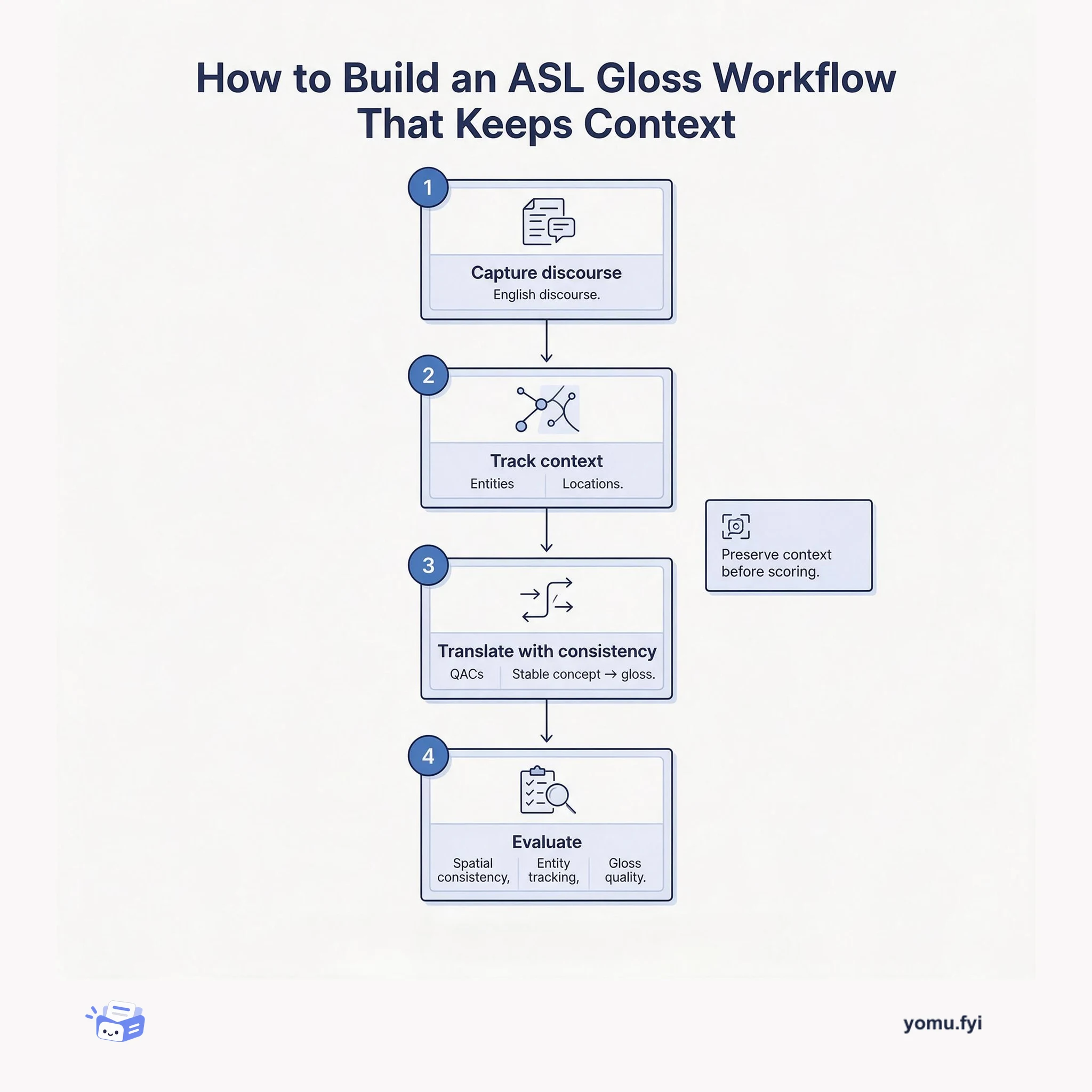
Learn a practical workflow for translating English discourse into ASL gloss while preserving spatial references, question-answer structure, and consistent concept-to-gloss mappings.
Loading…
Topic
483 posts about AI. Every summary links to the original.
See the idea
Learn a practical workflow for translating English discourse into ASL gloss while preserving spatial references, question-answer structure, and consistent concept-to-gloss mappings.
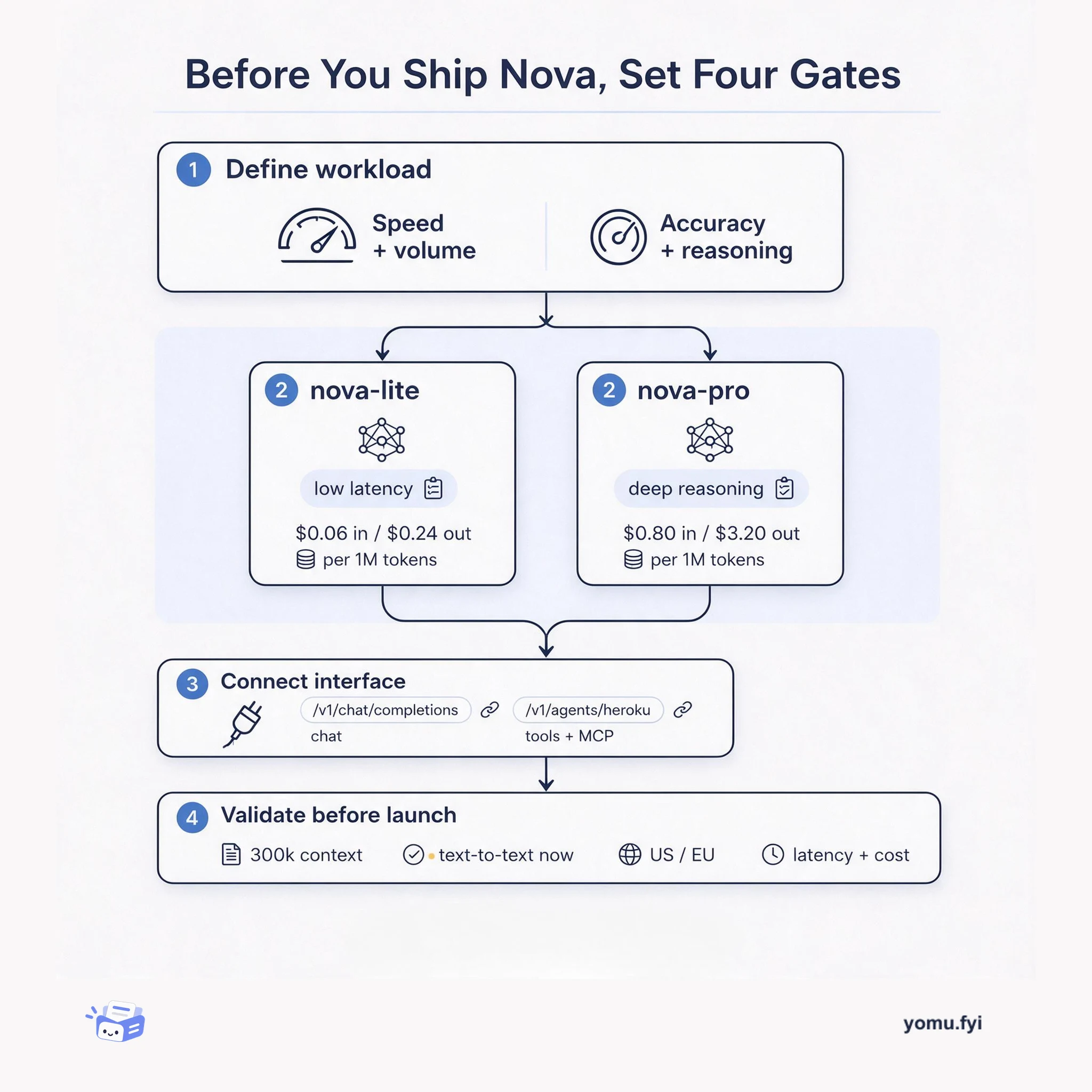
A practical checklist for putting Amazon Nova into an application: choose nova-lite or nova-pro by workload, expose tools, and verify context, modality, region, and cost constraints.
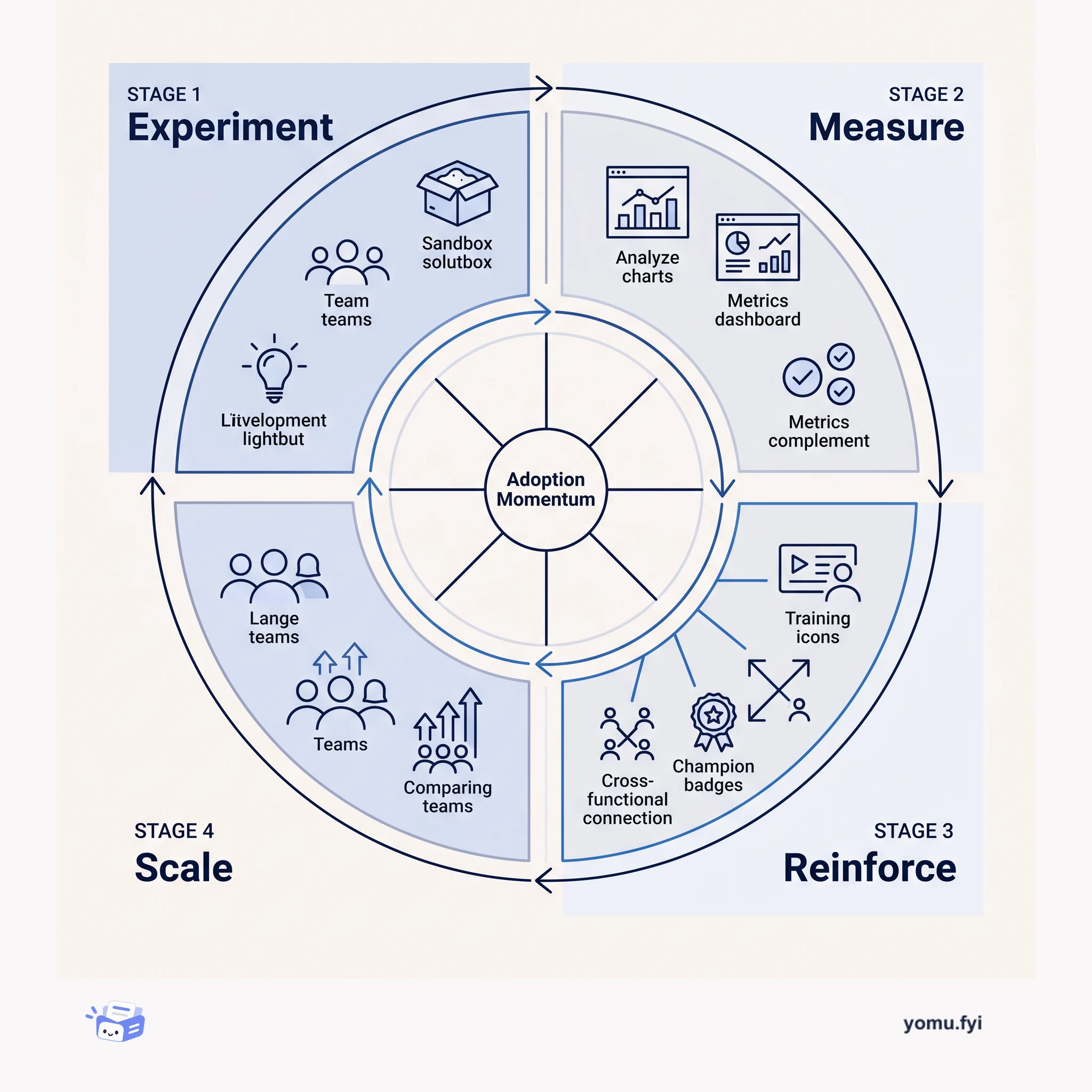
Adoption moves through experimentation, measurement, and reinforcement loops. Learn how leading companies build momentum from pilot programs into enterprise-wide habits and measurable business impact.
The Good Stuff
Paid picks we use ourselves. Links carry a referral code — a subscription through one earns us a commission at no extra cost to you.
Newest first
Manufacturing data is fragmented across systems such as MES, SCADA, QMS, ERP, and PLM, so answering a cross-stage question like whether a scrap spike stems from a supplier lot, machine setup, or process drift requires manual tickets, exports, and reconciliation. Databricks connects the product value chain by pooling or federating these sources using Lakehouse Federation and zero-copy Open Sharing, with Unity Catalog governing both mirrored and federated data under a single permission model and lineage. Lakeflow orchestrates the refinement of raw data into trusted Bronze, Silver, and Gold tables, while Genie and Agent Bricks enable natural-language queries grounded in governed business semantics. A quality engineer can thus ask about a defect’s history across plants and get answers that join MES, supplier, and QMS records without migrating every system. The result is that traceability becomes a query, transforming weeks of manual investigation into minutes of analysis across the entire value chain.
Databricks provides employees Day 1 access to new AI models using Unity Gateway for governance and cost management. The company uses a three-step pipeline: immediate experimental availability, per-user budget constraints, and data-driven promotion decisions. Unity Gateway CLI distributes model configurations to employee laptops, tagging new models as experimental. Per-user budgets include a monthly maximum, daily runaway limit, quality frontier budget, and experimental budget to control costs. Within three days of the Opus 5.5 and GPT-6 Sol launches, Databricks gathered benchmark, user feedback, and cost data to confirm they were on the efficiency frontier and promoted them, with Opus 5.5 showing a 29% cost reduction per session over Opus 4.8 and GPT-6 Sol showing a 48% reduction over GPT-5.6 Sol.
Model versioning alone is insufficient for production AI because changes in inputs, preprocessing, prompts, retrieval, tool contracts, and serving settings can alter behavior independently. The post proposes a versioned release manifest that captures all interdependent components, including model revision, prompt revision, retrieval index revision, embedding revision, pipeline revision, and runtime revision covering token limits, batching, and timeouts. This manifest enables atomic release testing and rollback, with an evaluation gate that tests the full retrieval-generation path using deterministic checks and semantic rubrics on a versioned dataset. Practical steps include canary deployments that compare candidate and control signals, with explicit stop conditions and rollback procedures that restore compatible dependencies rather than just older model weights. The post concludes that the smallest useful implementation is a manifest, evaluation job, load test, release-aware traces, and a rehearsed rollback, and asks whether the on-call engineer can identify and restore a compatible known-good version.
Genie One is an AI coworker that lets business users ask questions in plain language and receive cited answers grounded in governed data. The post outlines a phased rollout playbook: Phase 0 foundations include choosing one team, defining metric views for 10-20 numbers, creating Pages for concepts, and establishing governance with Unity Catalog. Phase 1 runs a 4-6 week pilot with 5-10 users, scoring Genie against 25-50 real questions and logging every incorrect answer to fix root causes, with exit criteria including accuracy holding steady and users reaching for Genie over their old workflow. Phase 2 expands to 2-3 adjacent domains with shared ontology definitions and a lightweight review workflow. Phase 3 aims for organization-wide adoption with federated ownership, MCP server governance, and embedding Genie in Slack, Teams, Excel, or Google Sheets, with a realistic timeline of 1-2 weeks for foundations to 1-2 quarters for full rollout.
Human-in-the-loop (HITL) frameworks integrate human judgment into automated AI workflows to improve reliability and safety, but without careful design they can create bottlenecks. The post reveals key trade-offs: more automation increases speed and reduces cost but raises risk, while more human oversight boosts accuracy and safety but adds latency and cost. Common failure modes include over-reviewing trivial cases, lacking clear trigger logic, and expecting human reviewers to scale linearly. The proposed solution is a tiered HITL system applying the Pareto principle: automation handles 85% of high-confidence decisions using confidence calibration, with three tiers addressing the remaining cases under 3 ms latency, asynchronous review within hours, and real-time oversight with 30-60 second windows. Success requires careful routing, reviewer tooling, and closing feedback loops across seconds, days, weeks, and quarterly cycles to continuously improve model performance and reduce human involvement over time.
Kitesurf, Cloudflare’s browser for AI agents built entirely on Workers, has received a major update. It now supports WebMCP, enabling agents to call site functions like searchFlights() instead of simulating clicks, and site owners can enable WebMCP with one switch. The browser passes over 730,000 Web Platform Tests, up 500,000 since launch, and adds support for CSS Layout, CSSOM, custom elements, URL-based module resolution, and improved iframe behavior. Efficiency optimizations reduce DOM traversal overhead, font fetching, and timer work, keeping CPU usage in line with launch benchmarks despite expanded capabilities. Kitesurf also gains full Browser Run API coverage, including Quick Actions from Worker bindings, and a terminal rendering mode using the Kitty protocol or ANSI text, with open-sourcing planned soon.
Rider 2026.2.3 is released, adding AI performance analysis to the Monitoring tool window and fixing an issue with the AI Agent Setup widget on Windows. The Monitoring tool window collects runtime data every time an application runs, allowing the AI agent to find bottlenecks and link them to code using the Analyze with AI action, which sends a prompt to the agent to begin the investigation. The agent uses the dottrace-analyze skill to show where time was spent, follow hot paths in code, and provide useful performance insights in the chat. This feature requires Windows, dotUltimate or the All Products Pack, and the AI Assistant plugin. The widget fix addresses issue RIDER-143160, where clicking its taskbar icon with display scaling below 175% failed to open the widget, and updates are available from the IDE, Toolbox App, or website.
This guide compares AI contact center platforms for Philippine enterprises, focusing on regulatory and language constraints rather than feature lists. BSP Circular 1160 requires immediate written acknowledgement, 24/7 availability, and a dedicated fraud line, while BSP’s June 2026 AI governance principles hold institutions accountable for outsourced models. The NPC’s draft PIA circular would classify AI as high-risk, giving 90 days to comply after finalization. No independent Taglish benchmark exists, so the guide advises selecting a platform that allows swapping speech engines rather than committing to one vendor’s model. Philippine Airlines reduced wait times from two hours to under one minute and raised satisfaction from 67% to 95% using Twilio Flex.
Indian contact centers face converging regulatory and operational pressures driving AI adoption. The Reserve Bank of India’s 2024 advisory requires customer communications in Hindi, English, and regional languages, while TRAI’s February 2026 direction mandates AI-based detection of unsolicited commercial calls using behavioral pattern analysis. A 31-point satisfaction gap between business perception and consumer reality, per Twilio’s November 2025 research, further compels investment. The vendor landscape divides into four groups: global CCaaS suites, Indian telephony platforms, AI specialists with Indic language models, and infrastructure providers like Twilio that combine carrier network with AI layer. No single solution fits all; the binding constraint depends on whether the operation prioritizes outbound compliance, vernacular accuracy, or data governance under the phased DPDP Act.
AI self-service is deployed in 51% of Australian contact centers but only 38% deliver expected results, with handover failures and regulatory changes driving a new evaluation approach. Only 13% achieve smooth self-service-to-human handovers, and 84% of Australians rate straightforward handover as important, yet 98% expect self-service volume to grow. The Privacy Act amendment effective 10 December 2026 requires disclosure of automated decision-making, affecting routing and scoring logic, while APRA’s April 2026 letter flags single-provider concentration as a risk under CPS 230. Australia reversed its voluntary AI stance in July 2026, announcing mandatory AI Standards and a Digital Duty of Care, with legislation expected in early 2027. Vendor selection now depends on security classification, composability for substitution, and decision logging, with the Commonwealth Bank’s experience—cutting then reversing AI-driven job cuts after increased call volumes—illustrating that containment quality and agent capability are better objectives than headcount reduction.
Cloudflare’s 2026 founders’ letter, marking the company’s 16th birthday, examines rapid changes in internet traffic driven by AI. Since mid-2025, new website creation has exploded, fueled by ‘vibe coding’ tools that allow non-programmers to build apps, with over 7 million developers now using Cloudflare’s platform. Automated traffic from AI agents and crawlers is projected to surpass human traffic by May 2026 and could reach 1,000 times human levels within five years. This surge risks a tragedy of the commons: agents consume resources from many sites but benefit only one, threatening small businesses that lack the information volume older competitors hold. Cloudflare proposes reducing crawler load by fetching only changed content and enabling creators to receive payment when agents use their content, alongside partnerships to shape a fairer internet.
The system uses representative sampling, large language model (LLM) summarization, automated quality checks, and consumer feedback to generate concise summaries from written merchant reviews. Consumers can scan an overall summary or focus on specific topics such as taste, packaging, and portion size, while merchants can identify recurring themes without reading every comment. The pipeline calculates the merchant’s rating distribution, uses a sentiment model to score reviews, and applies stratified sampling to select a representative subset before sending them to an LLM for summary generation. A separate LLM validates that each claim in the generated summary is supported by the source reviews, and summaries that fail this automated assessment are withheld from publication to reduce unsupported claims. The system regenerates summaries when new reviews or negative consumer feedback reach configured thresholds, and the feedback-driven regeneration includes anti-abuse controls to maintain trustworthiness.
91% of brands report a drop in customer satisfaction from AI, and the top behavior causing this is losing context when customers change channels, cited by 40% of businesses. Three of the four main behaviors are context-related, with lack of empathy at 39%, inability to handle exceptions at 38%, and failing to understand at 36%. The infrastructure problem includes session boundaries, identity mismatches, channel-specific tooling, and batch timing that prevent context from following the customer, causing 74% of consumers to repeat themselves and 71% to abandon conversations. Twilio’s structural solutions—Conversations, Conversation Memory, and Conversation Orchestrator—attach context to the customer rather than the session and recommend starting with the chat-to-voice transition. To measure improvement, track repeat-explanation rate after a channel change, recognition rate, and abandonment at transition points.
System One decision models such as Jev produce well-calibrated decisions from discrete options and are fast and cheap for large-scale applications, with potential use cases ranging from analyzing customer support transcripts to applying complex decisions at scale. Open-weight versions like SemIf-OpenJev are available, and Databricks enables serving them on governed data using serverless GPUs via AI Runtime, which provides on-demand GPU compute without managing infrastructure. The workflow is packaged in an importable notebook that downloads the model files, logs and registers the model using Express Deployments, and creates a GPU Model Serving endpoint automatically. The endpoint can be called from SQL via ai_query, which supports arbitrary custom model APIs, allowing structured request formats directly from SQL to return selected classifications and option probabilities as structured columns. The example classifies hotel reviews as good or bad, and users can import the notebook, select Serverless GPU, and run all to get started.
Modal and CMU built Quail, a query-aware inference layer for AI-SQL that combines a query planner with an inference engine to process structured LLM transformations of database entries. On a multi-join query, Quail achieves over a billion tokens per minute per H100 GPU, over 10x faster than vLLM, costing under 6 cents per billion tokens on Modal. The gain comes from using the query plan to order requests for better KV cache management, including a revised Hydragen-style cascade attention and batching small requests to reduce host overhead. On a new AI-SQL benchmark, Quail runs 1.84x faster than vLLM, but falls behind on agent trace processing. The authors see this as part of a trend toward custom inference engines for specific workloads, with a reusable core like databases post-DataFusion, and note that much work was done by prompting coding agents.
Meta AI glasses require cloud processing for advanced AI features like streaming transcription and long-term recall, but traditional cloud architectures expose data during use. Private Processing uses confidential virtual machines with Trusted Execution Environments (TEEs) on CPUs and GPUs to keep data encrypted even while being computed. Before sending context, glasses perform remote attestation, verifying the server’s TEE certificate against a public transparency ledger that records all deployed binary images. Non-targetable routing via blind-signed tokens and third-party OHTTP relays prevents tying requests to specific users, while encrypted storage ensures data is only accessible with user-provided keys. This infrastructure, already proven for WhatsApp and Meta AI, extends to glasses, with security audits by firms like NCC Group and a bug bounty program for independent research.
NVIDIA released NV-Reason-CT, a vision language model for 3D CT analysis that processes volumes as true 3D input rather than independent 2D slices. The model generates structured diagnostic reports covering 30 chest and 29 abdominal abnormalities and emulates radiologist chain-of-thought reasoning with systematic anatomical reviews and uncertainty articulation. Its architecture pairs a Qwen3.5-4B language model with a full 3D ViT encoder that processes volumes resampled to 192³ voxels at 2mm isotropic resolution using 8x8x8 patch tokens and 3D MRoPE for spatial token relationships. Training uses supervised fine-tuning on roughly 550,000 QA examples from CT-RATE, NIH CT, and CancerVerse followed by Group Relative Policy Optimization that refines reasoning quality based on diagnostic accuracy. NV-Reason-CT is an open research foundation not a cleared clinical product and sits within NVIDIA’s Medical AI ecosystem alongside NV-Reason-CXR, NV-Segment-CTMR, and NV-Generate-CTMR.
Anthropic launched a new life sciences research group to use AI agents for fundamental biology discovery. In one of their first programs, Claude agents autonomously analyzed over 200,000 reverse transcriptase sequences from a DNA database. After 21 hours and 210 million tokens, one agent spotted a repeating DNA pattern next to a reverse transcriptase gene, which it identified as a CRISPR-like system. The system, called ART (array-associated reverse transcriptases), consists of the RT, an accessory protein, and an array of non-coding DNA repeats that are expressed as distinct small RNAs. Its function remains unknown, but the pattern of repeats is only found together in other programmable DNA-cutting systems, suggesting ART may be a new tool for biotechnology.
GPU clusters can pass standard health checks yet fail under real AI training workloads due to a single degraded GPU, network link, or misrouted traffic. NVIDIA Cluster Readiness Engine (NVCRE) is an open source Kubernetes controller that runs real distributed workloads across topology-aware node groups before production jobs land, measuring results and reporting which nodes failed each test. Its layered API uses Custom Resource Definitions for Certification, Workflow, and Job resources, attributing each failure to a specific node and category such as NCCL bandwidth or training goodput. The WorkloadRun API handles platform detection, NCCL settings, shared-memory volumes, and gang scheduling, so operators do not need to write those manifests by hand. NVCRE integrates with NVSentinel for passive telemetry and is available under Apache 2.0, with a roadmap for inference and automated lifecycle validation.
Oppex AI builds AI agents that help developers resolve production incidents by gathering context before the engineer is paged. The agents collect logs, cloud metrics, database health, affected customers, recent code changes, and past incident history, then present a recommendation. Because developer logs are not plain English, the team constructs a knowledge graph of how the entire system connects. They harden the agent by pitting it against a chaos monkey that breaks test systems without revealing the method, forcing the agent to learn. The 15-person team has launched the product with early enterprise customers and aims to bring mean time to resolve under 10 minutes, eventually moving toward autonomous system healing.
The best engineering reads, once a week.