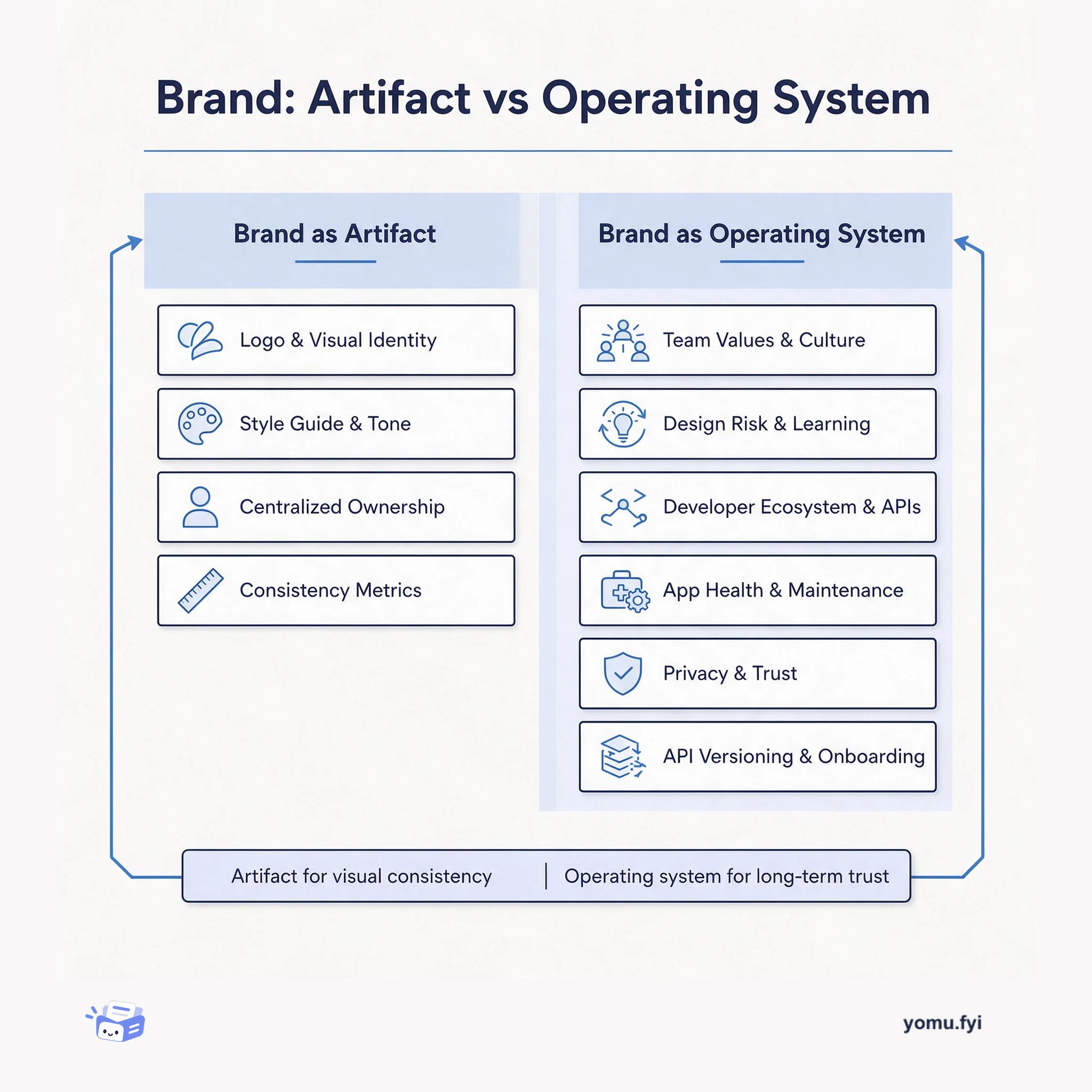
Brand: Artifact vs Operating System
Compare two mental models for brand: a static artifact (logos, guidelines, centralized control) and a living operating system (values, APIs, support, trust). See which choices fit your engineering team.
Loading…
Topic
447 posts about Developer Experience. Every summary links to the original.
See the idea
Compare two mental models for brand: a static artifact (logos, guidelines, centralized control) and a living operating system (values, APIs, support, trust). See which choices fit your engineering team.
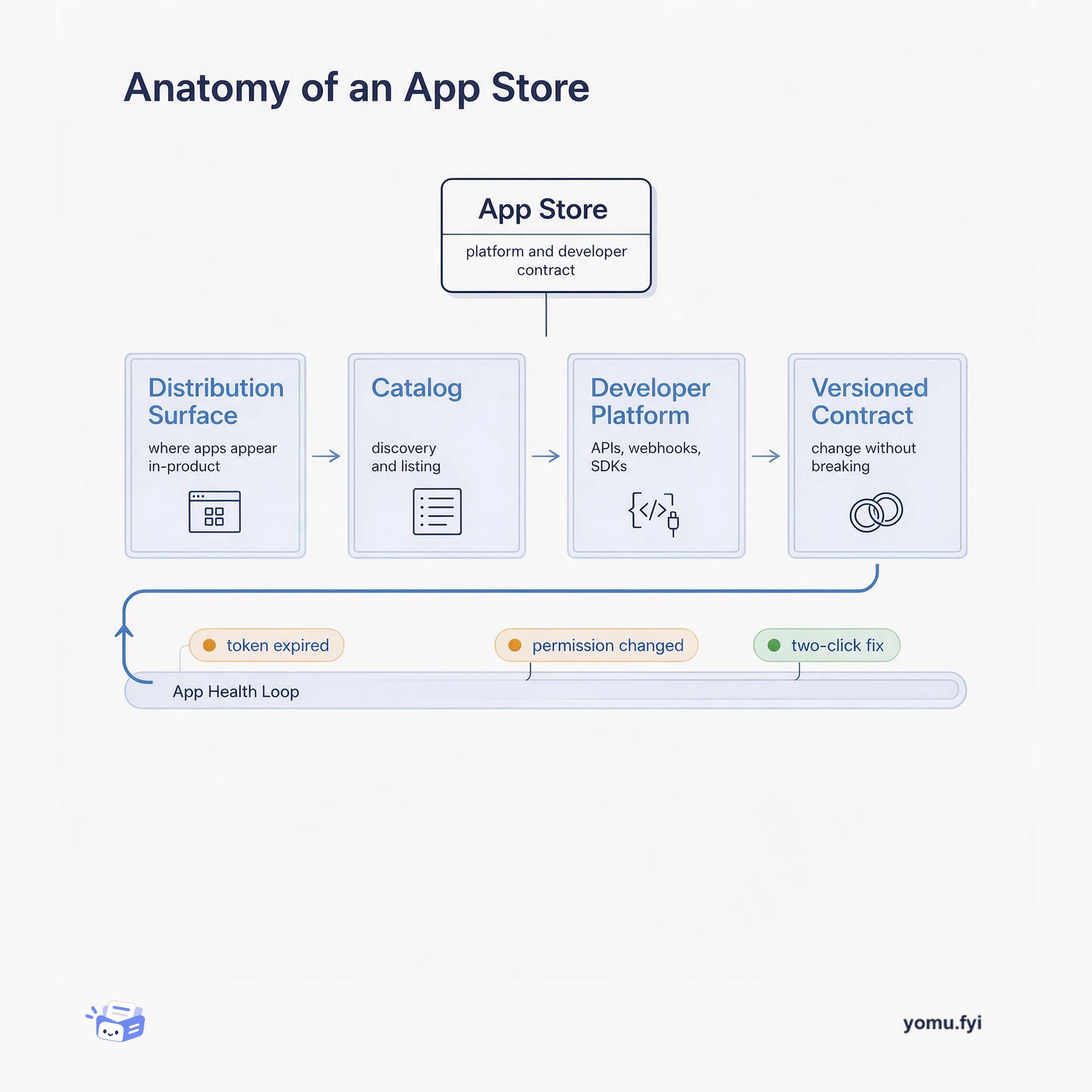
An app store is a distribution surface, a versioned contract, and a health loop between a platform and its developers. Here is how those parts fit together and why each one fails loudly if ignored.
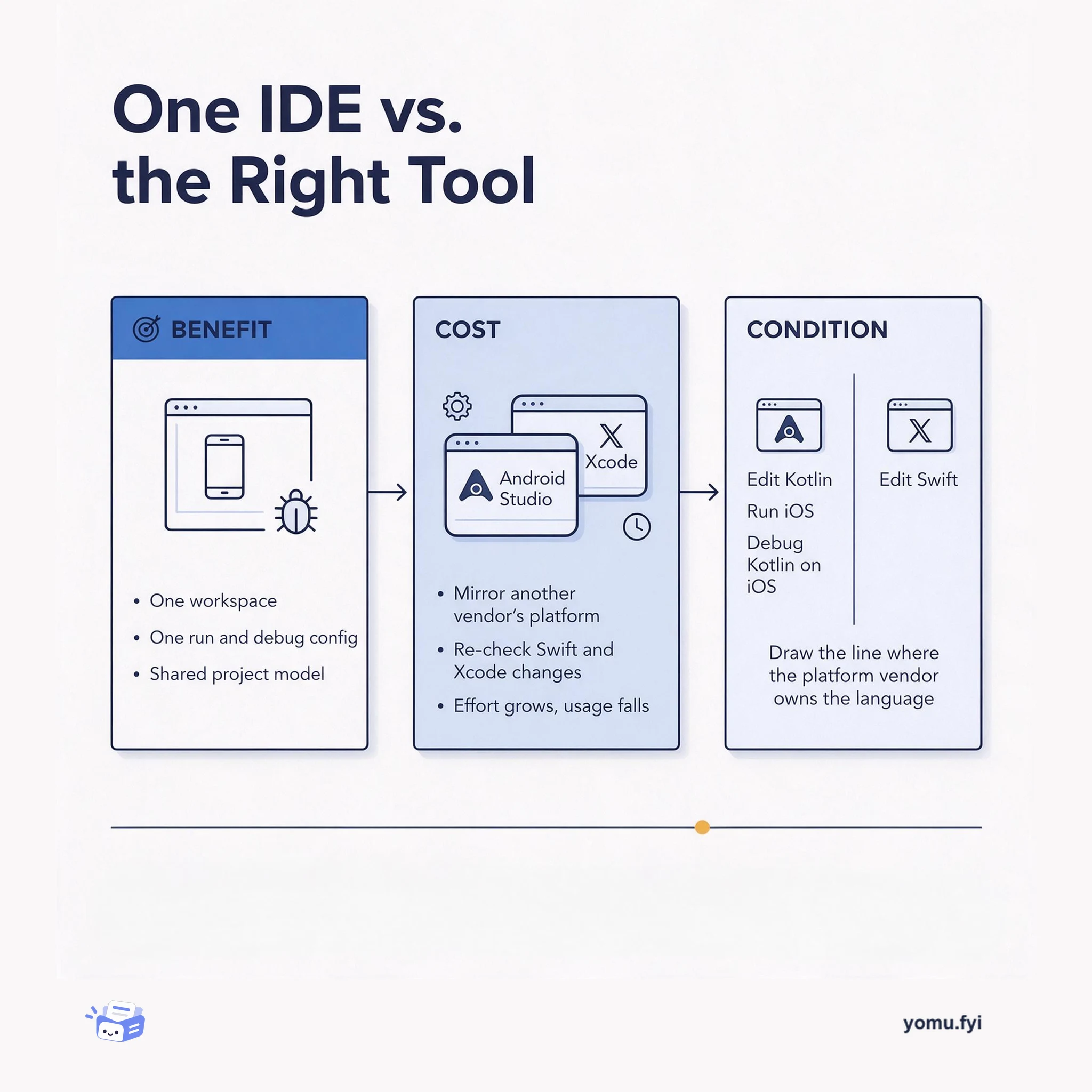
Android Studio keeps cross-platform Kotlin run and debug in one workspace but hands Swift editing to Xcode. This explainer maps the benefit, cost, and condition behind that boundary.
The Good Stuff
Paid picks we use ourselves. Links carry a referral code — a subscription through one earns us a commission at no extra cost to you.
Newest first
AI-assisted development enables employees to build applications rapidly, but unmanaged deployments can accidentally expose internal company data to the public Internet. Cloudflare introduced direct Cloudflare Access integration for Cloudflare Workers, allowing organizations to enforce authentication policies directly at the account or individual Worker level rather than per hostname. When enabled, incoming requests are authenticated before reaching application code across custom domains, routes, workers.dev subdomains, and preview environments. Developers can access authenticated identity data such as emails and groups directly via the Worker context object without manually validating JSON Web Tokens. This capability was implemented on Cloudflare's Rust-based FL2 proxy, which separated Worker routing from Worker execution so routing runs safely prior to Access policy enforcement.
The report analyzes Hugging Face Hub activity from January through August 2026 to assess how open-model releases, usage, licensing, and agent traffic are changing. Public repositories expanded from 2.43 to 2.96 million models, while 85.6% of models had fewer than 200 lifetime downloads and 1.5% of repositories captured 99.2% of downloads. Chinese labs reached monthly ceilings of 754B to 2.78T parameters, while broader portfolios such as Qwen’s generated far more downloads than frontier-only strategies; likes and downloads measured attention and infrastructure dependence differently. Large Chinese releases were often Apache 2.0 or MIT licensed, though newer trillion-parameter models introduced restrictions, while agents became the Hub’s leading user and autonomous-agent activity exposed the practical value of running quantized open models locally.
Unity AI Gateway’s Smart Routing, now in Beta, addresses the cost and choice overload of assigning coding tasks to increasingly diverse models and harnesses. It uses task-aware routing: a small, low-latency model classifies the initial task description and metadata, then a policy selects a cheaper, medium, or frontier model; Omnigent can also choose the coding harness and route sub-agents. The design keeps consecutive turns on one model to preserve cache-hit rates, while escalating complex work and delegating simpler tasks to lower-cost options. On internal coding workloads, Smart Routing achieved 35% savings and outperformed any single model at 65% of Opus 5’s cost; public benchmarks reported matched Opus 5 performance with 56% savings. The team identifies mid-session reassessment, real-session evaluation, and affordable switching as continuing challenges.
Airbnb overhauled its login and registration architecture by transitioning to a server-driven framework called Flexible Authentication. The new system separates user identification from verification, using a backend policy engine to dynamically serve the optimal auth challenge and fallback options based on regional and user context. This shift eliminated dead ends, reduced client bundle sizes, and dramatically sped up experimentation velocity across Web, iOS, and Android.
Shopify’s largest mobile app had become blocked by flaky end-to-end tests, which failed when screens took longer to render and had been removed from pull-request checks. Since 2023, tests used Appium through WebdriverIO and React Native Test IDs, allowing timing shortcuts and assertions about component-tree presence rather than what merchants could see or use. The rebuild hides Appium behind a strict builder-style wrapper that requires an assertion after every action; computer vision uses screenshots, PaddleOCR for text, and OpenCV for icons, with Test IDs as an opt-in fallback. After promotion into blocking CI, stability reached 98% of individual test successes over total runs, up from 50% with the old API, on two platforms. A pre-promotion flakiness gate rejects tests that exceed a failure threshold across repeated runs, while remaining failures largely involve network problems or simulator boot failures.
JetPack 7.2.1 adds support for PyNvVideoCodec 2.2, NVIDIA's Python library for hardware-accelerated video encoding and decoding on GPUs, alongside foundational agentic video skills for Jetson workflows. These skills inspect the live target, query codec capabilities, generate Video Codec SDK or PyNvVideoCodec recipes, execute runs, and return measurements, warnings, and reproducible evidence. PyNvVideoCodec keeps frames in GPU-resident device memory through DLPack and CUDA device buffers, with multi-mode frame sampling and a ThreadedDecoder that pre-decodes frames in a background thread. The release also enables emulation of recently announced Jetson T3000 performance on a Jetson T5000 module in the Jetson Thor AGX Developer Kit, while the video skills are limited to Video Codec SDK and PyNvVideoCodec stages.
Sentry introduced a collection of updates to its logging platform aimed at improving search scalability, export flexibility, and general viewer usability. The system now supports URL-synced log pinning alongside an overhauled export interface that handles aggregate data, full attribute payloads, and high-volume JSONL formats across Logs, Errors, and Tracing. Performance enhancements to the log viewer include a more constrained layout with reduced initial data loads, inline error representations, individual chips for multi-value search terms, and trace-level filtering. To assist large-scale queries spanning hundreds of gigabytes or terabytes, frontend and backend modifications added longer query timeouts with continuations, clearer rate-limiting messages, and in-place retries.
Salesforce faced scaling bottlenecks when individual engineering teams maintained fragmented, custom telemetry pipelines requiring manual data transformations and dashboard creation every release. To resolve these silos, the engineering organization established the Product Data Platform (PDP) using a standardized custom schema built atop Monitoring Cloud infrastructure. This framework mandates core telemetry fields for consistent metric generation while offering governed optional attributes for product-specific flexibility. An AI-driven Model Context Protocol tool assists developers by recommending compliant instrumentation patterns directly within their workflows. Today, the unified platform processes 45 billion rows of data daily across 19,000 distinct events and 2,000 product features, reducing dashboard refresh latency by 97 percent from one month to daily updates.
The GitHub Copilot SDK for Java offers a framework-agnostic client library to orchestrate AI agent sessions and tool execution directly from server-side Java code. Unlike framework-dependent alternatives, the SDK supports direct model providers such as OpenAI, Azure, and Anthropic through custom endpoint configurations without requiring a Copilot subscription. Developers can register tools declaratively using the experimental @CopilotTool annotation processor or dynamically through inline lambda definitions with ToolDefinition.from. When integrated into a Jakarta EE 11 application on Open Liberty, agent workflows run on container-managed virtual threads that propagate CDI and transaction contexts during blocking calls like sendAndWait. Real-time event subscriptions capture model execution steps and tool invocations to stream updates over WebSockets without exhausting platform threads.
Agents Week introduced a series of products and primitives across Cloudflare to support an Agentic Internet where autonomous software and humans interact. Developing capable agents requires addressing technical challenges spanning identity, communication, orchestration, memory, observability, and security. Cloudflare introduced the Agent Development Lifecycle alongside tools like Cloudflare Agents for live tracing, replay, and human-in-the-loop approvals. The releases also included programmable CI/CD pipelines capable of repairing failures, Cloudflare Wallets for agent transactions, and Kitesurf, an agent-first browser running in V8 isolates. New protocols and tools like WebMCP, MCPv2, and Cloudflare AI Search aim to make web data and applications readable, discoverable, and searchable by autonomous software.
Thumbtack migrated 1,500 Android screenshot tests from Firebase Test Lab to Roborazzi to eliminate slow and error-prone testing on remote emulators. The engineering team ported test suites from androidTest to test in batches of 20, adjusting test rules and annotations for Robolectric. Because Roborazzi runs in a single JVM process with parallel execution, the team had to debug shared font cache pollution and cross-platform shadow rendering inconsistencies between macOS and Debian. They resolved configuration repetition by mapping Robolectric annotations into module-level robolectric.properties files and avoided stale cached images by clearing Roborazzi's cache via a custom Gradle task. The migration significantly decreased CI runtimes while making local test recording and verification easier.
Cloudflare introduced an updated community initiative featuring two tracks: Cloudflare Ambassadors and Cloudflare Community Engineers. The Ambassador program selects community leaders for terms lasting up to two years to organize events, lead student groups, and create learning spaces with company-provided credits, resources, and marketing assets. The Community Engineer track offers grants from a new one million dollar open-source fund spanning the next two years to support maintainers of projects such as Astro, Agents SDK, EmDash, Hono, and Vinext. To maintain its Discord server of nearly 100,000 members, a new Discord committee composed of staff and Ambassadors will guide community discussions while automated spam protections handle routine moderation.
Supabase is now available as a connector on Perplexity Computer, allowing the agent to use a Supabase project as a persistent data layer across runs. Computer can read from and write to Postgres tables, answer questions by running queries, retrieve user and payment data for support debugging, and invoke Edge Functions with test payloads. Recurring queries can be scheduled, with results posted to Slack, while workflows can combine Supabase data with Stripe events and route fixes through GitHub pull requests. The announcement presents the connector as a way to keep database work inside Computer’s multi-step workflows across more than 400 apps, without custom glue code.
Cloudflare introduced developer experience improvements and a preview pricing model for Cloudflare AI Search. Previously, users had to manually connect separate Cloudflare primitives like Workers AI, AI Gateway, Vectorize, R2, and Browser Run to build a search solution. The platform now automates crawling, ingestion, embedding, and retrieval across structured and unstructured data sources. Developers can index sites without sitemaps using link discovery, expose public /search and /mcp endpoints across namespaces, bind search instances directly to Workers, or secure endpoints with Cloudflare Access. Cloudflare uses this system for developer documentation, its corporate blog, and the Cloudflare Dev Stack MCP server to supply coding agents with cited documentation.
Sentry automated its internal debugging and issue triage workflows to handle bugs and pull requests generated by AI agents. The company deployed Seer, an AI-powered debugging agent, across several repositories to determine root causes, create fix plans, and open pull requests. To manage the resulting influx of pull requests, Sentry built an automated Slack routine powered by Claude that periodically scans for unaddressed pull requests opened within four hours. The routine asks Seer to identify relevant reviewers using GitHub commit history, verifies pull request status, and tags engineers to request merges, closures, or feedback. Early metrics show a 21 percent increase in pull request action rates, a 13 percent increase in 48-hour response rates, and a 12.5 percent rise in pull requests closed without merging due to duplicate or expanded fixes.
Engineering leadership often responds to rapid AI productivity gains by attempting to isolate and replicate the traits of individual outlier engineers. Vivek Raghunathan, SVP of engineering at Snowflake, frames this dynamic using reinforcement learning's explore-versus-exploit split, where roughly five percent of an organization fearlessly tests new AI tools while ninety-five percent prioritize execution on paved paths. Instead of treating these categories as fixed personality types or relying on external hiring, organizations succeed by viewing them as a continuum. Effective leadership establishes structured learning time, AI communities of practice, and direct mentorship to capture explorer discoveries and elevate the median engineer. Measuring progress requires tracking organizational movement along this capability scale rather than celebrating isolated high-performing individuals.
Coding agents often consolidate full-stack features into monolithic pull requests spanning thousands of lines, resulting in delayed reviews and lower feedback quality. To resolve this bottleneck, engineers can decompose comprehensive features into ordered, single-concern layers using GitHub stacked pull requests and the gh-stack CLI extension. Distinct specialized agents handle individual branches—ranging from foundational data access modules up to client interfaces—while CI checks continuously evaluate each layer against the stack base. When reviewers request upstream modifications, running gh stack sync executes a cascading rebase across all dependent branches, preserving commit signatures and keeping the entire pull request chain mergeable.
A research report by Omdia examines escalating software supply chain security risks driven by growing dependencies on third-party code, open-source software, and artificial intelligence. Over three-fourths of surveyed organizations experienced a software supply chain incident in the preceding year, with known vulnerabilities in third-party software representing the most common exploit vector. Surveyed respondents ranked AI technology as their top supply chain concern, alongside broader issues involving vulnerability remediation and code composition identification. While shifting security left is a high priority for 98% of organizations, 45% still lack confidence in the robustness of their supply chain defenses. Although secure container libraries and Software Bills of Materials provide measurable mitigation benefits, many organizations only generate inventories on a case-by-case basis.
Yelp migrated a 1.4-million-line JavaScript monorepo from Flow to TypeScript after community support and package ecosystem tooling shifted toward TypeScript. To maintain continuous type safety without code freezes, engineers converted the codebase package by package starting at the deepest internal dependencies. The toolchain used flowts for code conversion and flowgen to turn generated TypeScript declaration files back into Flow-compatible headers for downstream consumers. Webcore dogfooded the tooling across 90 packages, automated tracking through internal metrics, and assisted feature teams with bottleneck conversions. Completed in February 2026, the migration increased overall type coverage from 83.15% to 96.44% and unlocked TypeScript-only tooling.
Salesforce addressed the challenge of scaling agentic engineering across thousands of software developers by focusing on organizational learning rather than tooling. While individual engineers initially developed disparate, uncoordinated workflows, the Technology, People, Innovation, and Learning (TPIL) team unified these approaches into the Proficiency Level (PL) Framework. The framework maps developer growth across four mindset-driven stages: AI-Assisted, AI-Validating, AI-Orchestrating, and AI-Native. To facilitate progress across these stages, TPIL introduced global AI camps, weekly working sessions, and manager coaching guides. Rather than tracking course completions or telemetry scores, Salesforce measured transformation through behavioral indicators, such as shifts toward validating agent output, designing multi-agent workflows, and asking higher-level questions regarding human judgment.
The best engineering reads, once a week.