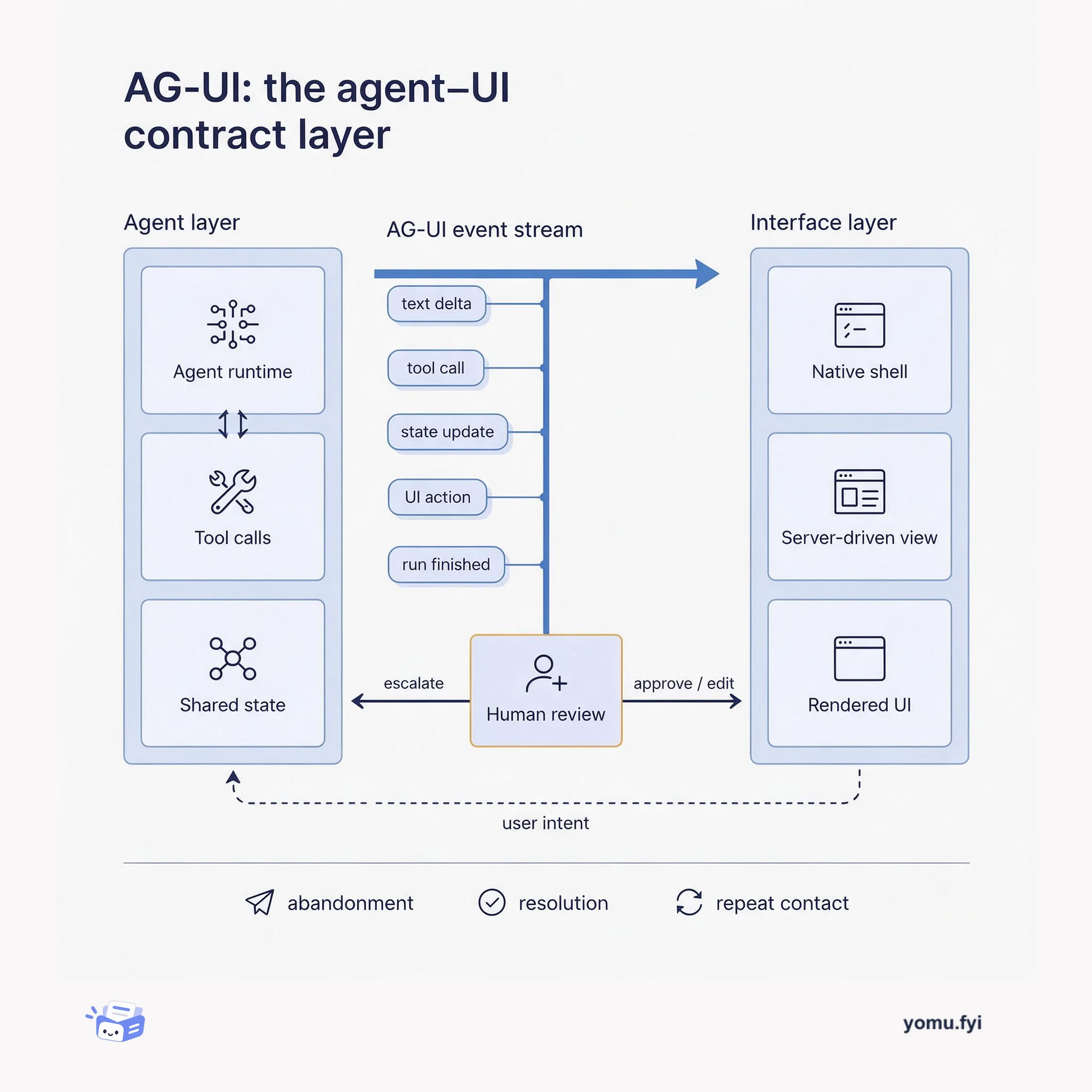
AG-UI as the Agent–UI Contract Layer
AG-UI is a typed event contract between an agent backend and a frontend, turning streamed agent state into UI. This diagram maps the layers and shows where human review plugs in.
Loading…
Topic
123 posts about Streaming. Every summary links to the original.
See the idea
AG-UI is a typed event contract between an agent backend and a frontend, turning streamed agent state into UI. This diagram maps the layers and shows where human review plugs in.
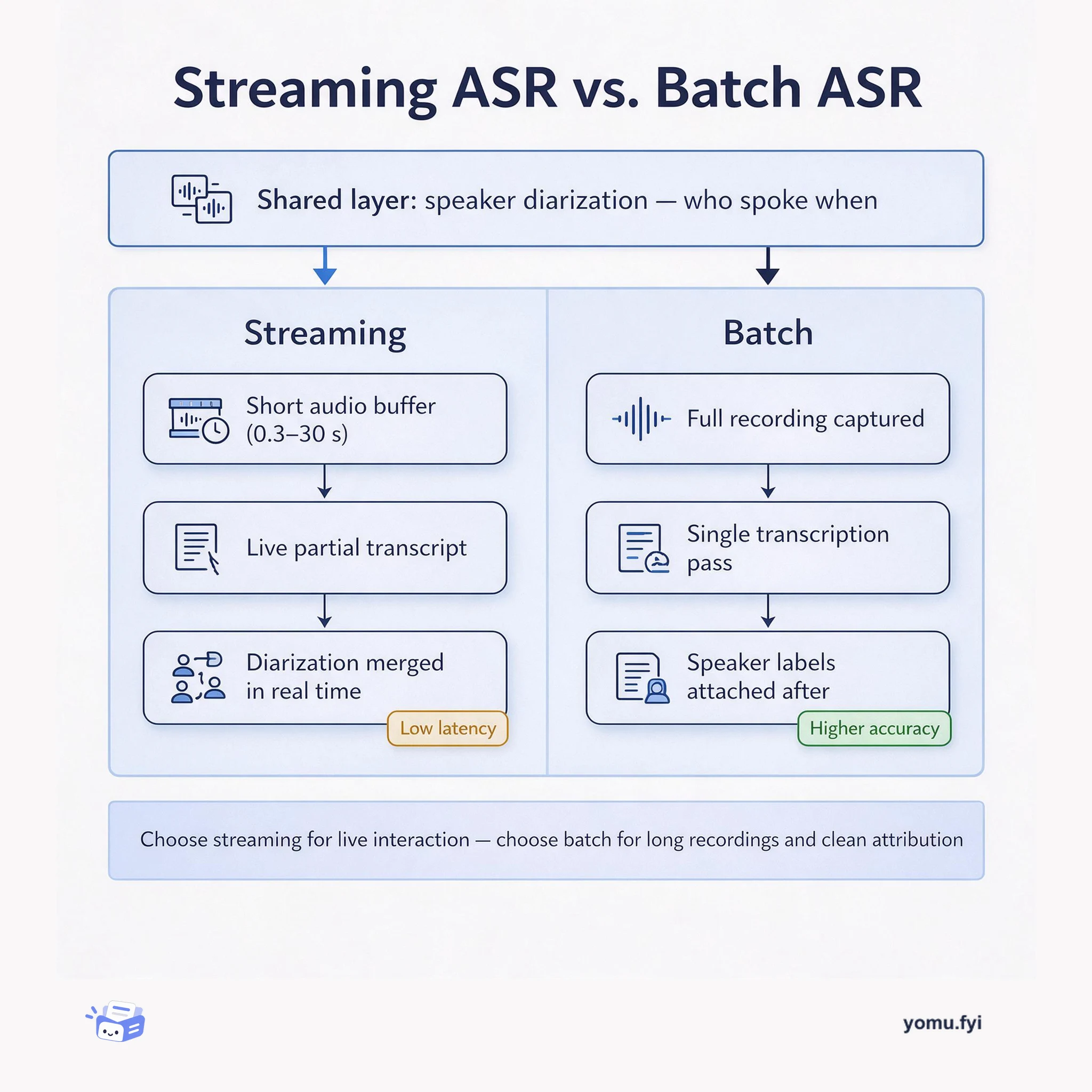
Streaming and batch ASR pipelines compared: how input buffer length, speaker diarization, and where audio is processed trade latency against transcript quality and privacy.
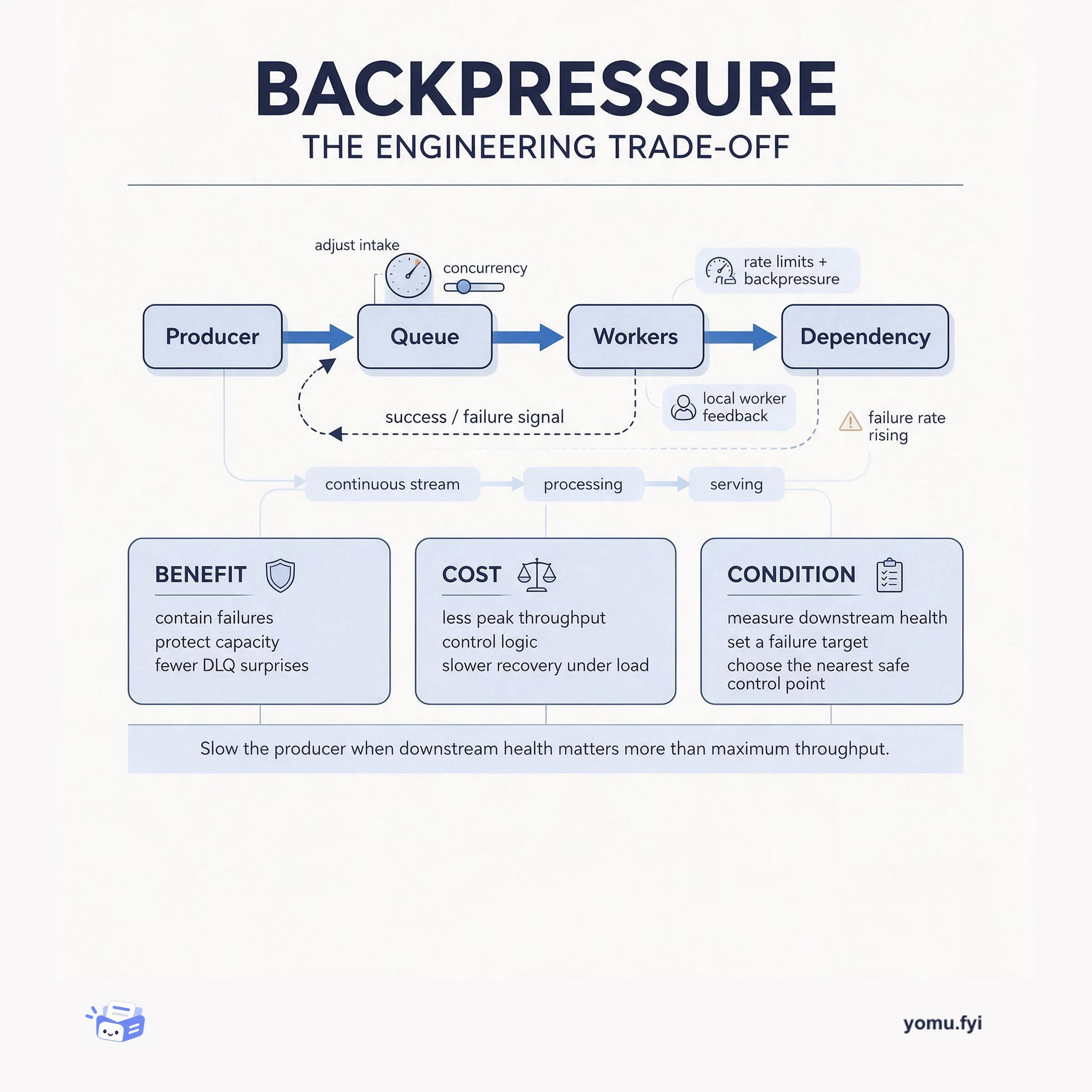
Backpressure is a feedback loop that slows work when downstream capacity or health deteriorates. Compare its gains, costs, and signals for choosing a control point.
The Good Stuff
Paid picks we use ourselves. Links carry a referral code — a subscription through one earns us a commission at no extra cost to you.
Newest first
Grab migrated its stream-processing (write) functionality from an existing service into a separate service while handling 20,000 reads per second from 16 Kafka streams and writing to output streams and DynamoDB tables. The migration required gradual stream-by-stream rollout, production validation, and a no-downtime switchover; feature flags were rejected because deployment timing could cause loss, duplication, or inconsistent values. The team moved processing into shared /commons code, created temporary validation sinks, and scheduled each switchover with a shared map[string]time.Time, allowing both services to change writers at the same time. During each cutover, both services consumed streams, the old service stopped writing to resources, and monitoring continued before old consumption was removed; the result was zero data loss or duplication, no downtime, and completion in about three weeks. It was temporary and tested, but rolling back either service could create inconsistency if systems fell out of sync.
Shopify describes how it built near-real-time text and image embedding pipelines to support semantic search, replacing keyword matching with representations that enable similarity-based retrieval. Using Google Cloud’s Dataflow and Apache Beam, the pipelines process roughly 2,500 embeddings per second, preprocess images, run GPU-backed inference, and write outputs to both a data warehouse and an event topic for downstream ingestion. The engineering discussion focuses on trade-offs among memory, throughput, latency, and cost: reducing harness threads cut memory use about 2.6x and allowed a return to cheaper workers, while model sharing reduced throughput. For batching, bursty input produced bundles of one, and stateful batching was rejected because its shuffle increased latency; Dataflow’s per-process model instances instead provided enough parallelism to saturate GPUs.
Grab details the event processing architecture behind Trident, its internal marketing campaign platform that evaluates If This, Then That (IFTTT) logic over Kafka streams. The core processing unit is a treatment consisting of an event, optional conditions, and actions. Complex campaign capabilities—such as counters, limits, and delays across multiple hours via recursive SQS message scheduling—are assembled from multiple coordinated treatments. To simplify campaign creation, Grab introduced a flowchart-like visual builder represented as a JSON node tree that compiles recursively into treatments while persisting node-to-treatment mappings to reconcile edits over time.
Grab's in-house risk management platform, GrabDefence, relies on ingesting large volumes of upstream data to drive real-time heuristic rules and data science models. To prevent data discrepancies and missing information from degrading fraud detection, the team implemented a real-time data observability pipeline. The solution uses Apache Flink SQL alongside custom table functions like JSONEXPLOAD to flatten nested JSON structures and aggregate metrics over 5-minute tumbling windows. Processed metrics are sent to Datadog, where counters are grouped by source stream and evaluated using anomaly detection algorithms. Alerts are routed directly to Slack, reducing anomaly detection latency from days or weeks down to within the same day or hour.
Traditional data lake setups using Parquet on Hive metastores struggle with frequent updates and long pipeline intervals, introducing significant latency for ad hoc queries. Grab solved this by implementing Apache Hudi to support near real-time analytics across bounded relational databases and unbounded Kafka streams. For high-throughput sources, Flink streams Avro log files to Merge On Read tables and generates compaction plans for asynchronous Spark writers. Low-throughput workloads leverage Copy On Write tables, while relational database sources ingest binlogs via Flink Change Data Capture connectors. This architecture reduced analytics data latency to the minute level without overloading production databases and Kafka clusters.
Grab needed to modernize its marketing analytics from manual ad hoc queries and high data latency to a platform supporting real-time attribution for pricing models like cost per order. The engineering team initially deployed a pure stream-processing engine using Kappa architecture, Kafka, ScyllaDB, and Redis, which reduced latency from days to minutes and merged ads and promo touchpoints. However, stream-only processing faced high costs, out-of-order event issues, and difficulties running multi-touch models across longer historical windows. Grab transitioned to a Lambda architecture pairing Coban stream processing with Spark-based batch ETL and Amazon S3. This hybrid design separated real-time operational metrics from historical batch reporting, cutting real-time processing costs by approximately 25% while maintaining under 1% data discrepancy.
Online data materialised in Kafka topics at Grab traditionally remained uninspected until ingested into the Data Lake as offline data, introducing latency and making stream processing applications difficult to develop. To enable earlier data exploration, Grab adopted Apache Zeppelin notebooks integrated with an internal data streaming platform. Zeppelin uses a Flink interpreter to convert interactive SQL queries into Flink jobs submitted to a Flink session cluster. The platform dynamically translates Protobuf schemas into SQL Data Definition Language statements to simplify table discovery. Security and compliance risks are addressed by combining mutual TLS authentication with Strimzi's Open Policy Agent to enforce read-only access policies and audit logging on Kafka topics.
Grab’s Coban real-time data streaming team initially relied on direct Terraform merge requests for managing self-served resources like Kafka topics and CDC pipelines. This pure Infrastructure-as-Code workflow faced challenges with CI pipeline failures from manual errors, security risks from lacking access controls, and platform team review bottlenecks. To resolve this, Coban implemented a three-tier control plane comprising the Coban UI, a Go backend named Heimdall, and a Git storage and provisioner repository named Khone. Heimdall translates user form submissions into validated merge requests containing Terraform and metadata files, polling Khone's CI status and alerting users. This architecture abstracts infrastructure code behind a graphical self-service portal while preserving underlying Git auditing and automation.
During Etsy’s CodeMosaic hackathon, a team investigated stateful training and online learning to reduce the roughly 40-hour delay between user actions and model-weight updates. They split the work across real-time training data, an incremental-learning service, and evaluation, using Etsy’s Beacon Main Kafka stream, Kafka SQL, Rivulet, and TensorFlow-based Ads models. The data team joined multiple sources despite Avro schema difficulties, while the service team loaded an older model and nearly implemented incremental weight updates; the planned head-to-head evaluation against daily batch training was not completed. The project estimated that replacing daily cold-start training for four ads models could save about $212,000 annually in Google Cloud costs, with possible metric gains from earlier events. Production would still require infrastructure and safeguards against sudden performance degradation.
Grab's real-time data streaming platform team reduced infrastructure expenses by enabling Kafka consumers to fetch from the closest partition replica instead of partition leaders. The platform previously operated across three AWS Availability Zones with three-way replication, resulting in cross-AZ network fees that constituted half of the Kafka platform's total cost. To address this, the team performed a zero-downtime upgrade to Kafka 3.1, configured a rack-aware replica selector using AWS Availability Zone IDs, and updated consumer SDKs to populate the client rack parameter. The rollout produced a 25% drop in cross-AZ traffic within three months under steady data volumes. However, the change increased end-to-end latency by up to 500ms, created potential CPU load skews across zones, and removed graceful isolation during broker rotation maintenance.
Data engineers at Grab require real-world streaming data to tune machine learning models, but user personal data cannot be exposed in non-production environments. To solve this, the data streaming team implemented an automated masking pipeline between production and staging Kafka clusters. Developers explicitly tag Personally Identifiable Information (PII) types in Protocol Buffers schemas, which a CI script validates against a keyword list before packaging the schemas into Scala JARs. An in-house Apache Flink application running in production consumes the unmasked streams, applies dynamic and consistent transformations like keyed HMACs or seeded random values, and produces sanitised records to staging. Untagged new fields in schema updates are automatically dropped by the deserialiser until the masking application is redeployed, preventing accidental data leaks.
Grab's real-time stream processing platform encountered severe consumer lag and CPU throttling when running Go-based Kafka consumer pipelines on Kubernetes. The issue originated when the Vertical Pod Autoscaler (VPA) scaled pod CPU allocations down to floating-point values such as 1.94 cores. Because AUTO-GOMAXPROCS rounds non-integer CPU limits down to integers, Go runtime thread allocation dropped to 1 core, significantly throttling pipeline throughput despite available pod capacity. Setting a minimum floor of 2 cores instantly restored CPU utilization to 95% and cleared the message backlog. To prevent similar throttling, the team utilized integer CPU scaling recommendations available in VPA v0.13 on Kubernetes 1.25 and above.
Stateful stream processing frameworks like Apache Flink present unique deployment challenges because conventional canary and blue-green strategies can cause data inaccuracies or state divergence. Grab's real-time data platform team encountered risks of state loss, manual rollback overhead, and absent health checks in their Kubernetes and Spinnaker deployment pipeline. To resolve these operational issues, the team redesigned the deployment workflow around automated Flink savepointing and programmatic health monitoring. The new pipeline halts existing applications after capturing state snapshots and Kafka offsets, monitors target deployments via API health probes, and executes automated rollbacks using versioned ConfigMaps and replica metadata annotations. This automated process ensures state consistency during upgrades and eliminates manual intervention during deployment failures.
Grab's streaming data platform team migrated the Kafka Control Plane from Role-Based Access Control to Attribute-Based Access Control to eliminate operational bottlenecks and manual permission management. The previous model required defining hundreds of roles, permissions, and group mappings in an internal IAM service, leading to approval delays and stale memberships. Under the new architecture, user attributes sync from the HRMS and token payloads, while resource attributes are tagged upon creation or backfilled to reflect department and team ownership. Open Policy Agent evaluates access requests defined in Rego via middleware by comparing user attributes with resource metadata. This transition eliminated over 200 roles, 200 permissions, and roughly 3,000 unused IAM resources while automating access provisioning for new joiners.
Grab's real-time data platform team transitioned from an Atlantis-driven Terraform workflow to an in-house GitOps platform called Khone to manage streaming infrastructure resources like Kafka topics and Flink pipelines. The earlier setup suffered from coarse-grained access controls, required manual merge request comments, and lacked flexible validation capabilities within native configuration files. Khone derives environment parameters directly from standardized directory paths and uses Python with the python-hcl2 library to inspect and validate resource definitions before executing Terraform stages in parallel. To prevent configuration tampering in merge requests, CI/CD pipeline definitions and execution scripts are isolated in a separate administrative repository and fetched during job runs using shallow Git clones.
Shopify presents three additional practices for optimizing large stateful Apache Flink applications, focusing on parallelism, sink capacity, and combining heterogeneous sources. It recommends starting with execution-environment parallelism, then matching task-manager capacity to the highest parallelism value; for example, parallelism 100 requires 25 task managers with four slots each. Sink bottlenecks can propagate backpressure upstream, so batching writes and correcting data skew—including with key bucketing when a low-cardinality or uneven key is unavoidable—can improve distribution, though bucketed results must later be combined. For archived Kafka topics, HybridSource exposes cloud-storage history and the live Kafka topic as one ordered logical DataStream, automatically switching after the archive is exhausted and using object-storage partitions to accelerate historical backfills.
Grab's real-time data platform team transitioned their large-scale Kafka infrastructure from basic network access controls to a zero-trust architecture. The platform implements mutual Transport Layer Security (mTLS) for offline peer authentication and encryption, driven by HashiCorp Vault's PKI engine and Strimzi on Kubernetes. Policy-Based Access Control is enforced using dedicated Open Policy Agent deployments per cluster, backed by GitOps workflows where topic owners approve JSON authorization rules. To simplify client integration, the team enhanced their Go SDK to handle ephemeral in-memory certificates, automatic renewals, and configurable retries. While the security posture improved, the Java encryption and decryption overhead caused a drop in streaming throughput.
Shopify’s 2022 BFCM Live Map needed to deliver real-time sales and product data to thousands of concurrent users while processing data from millions of merchants. Its 2021 architecture used WebSocket delivery to a presentation layer, which stored messages in a mailbox that clients polled at least every 10 seconds, creating latency and bottlenecks. Shopify replaced that path with a streamlined Flink-based pipeline and a Golang SSE server that subscribes to Kafka topics and pushes JSON data to registered, authenticated clients as soon as it is available. The SSE server ran horizontally behind Nginx load balancers, with a configurable Java client used to load-test concurrent connections. The 2022 system maintained 100 percent uptime, delivered SSE data within milliseconds of availability, and visualized data within 21 seconds of creation, including pipeline processing.
The tutorial builds a simple realtime messaging app with Ionic Angular and Supabase, covering account authentication and database protection. It defines Postgres tables for users, groups, and messages, enables Row Level Security with policies for public reads and authenticated operations, and adds a trigger to copy newly registered users into a public users table. Angular services, route guards, and Supabase client logic handle email/password registration and login, session state, protected navigation, and magic links. For native apps, Capacitor URL events extract access and refresh tokens from a custom-scheme callback before establishing the session and navigating to the groups page. The tutorial concludes that Supabase can support Ionic Angular authentication with magic links, while phone authentication through Twilio is another possible option.
Supabase has released the stable v1 of its supabase-flutter SDK after several months of developer preview feedback and improvement. The release targets developer experience by reducing boilerplate and introducing more intuitive APIs, including removal of the required .execute() call from select, insert, update, delete, and stream operations; query errors are now thrown rather than returned. Authentication methods use more descriptive names such as signInWithPassword and signInWithOAuth, while onAuthStateChange returns a Dart stream. The SDK also adds first-class support for Realtime Multiplayer's broadcast and presence methods, including low-latency data sharing and client-status tracking, and the announcement provides updated documentation, a quick start guide, and a v0-to-v1 migration guide.
The best engineering reads, once a week.