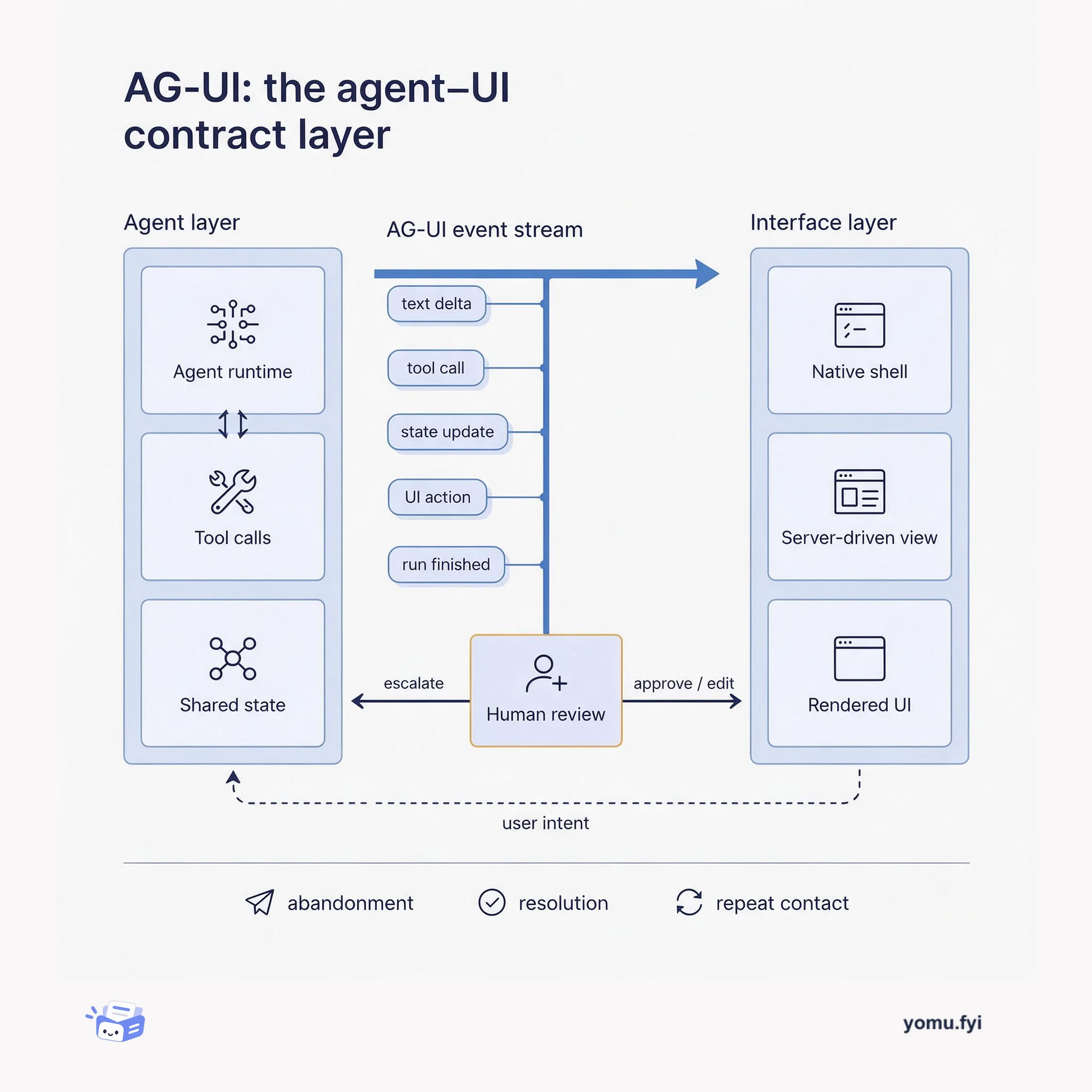
AG-UI as the Agent–UI Contract Layer
AG-UI is a typed event contract between an agent backend and a frontend, turning streamed agent state into UI. This diagram maps the layers and shows where human review plugs in.
Loading…
Topic
123 posts about Streaming. Every summary links to the original.
See the idea
AG-UI is a typed event contract between an agent backend and a frontend, turning streamed agent state into UI. This diagram maps the layers and shows where human review plugs in.
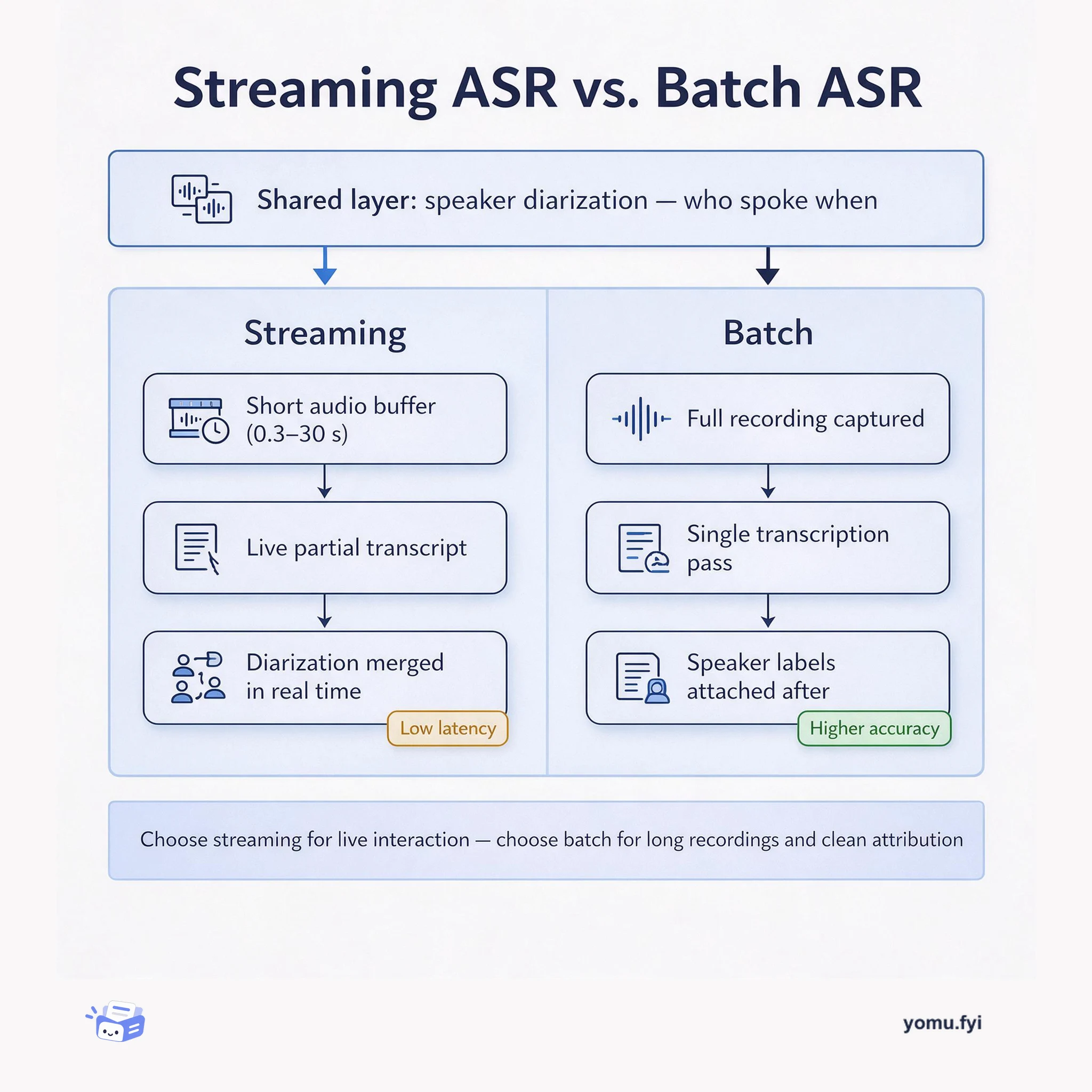
Streaming and batch ASR pipelines compared: how input buffer length, speaker diarization, and where audio is processed trade latency against transcript quality and privacy.
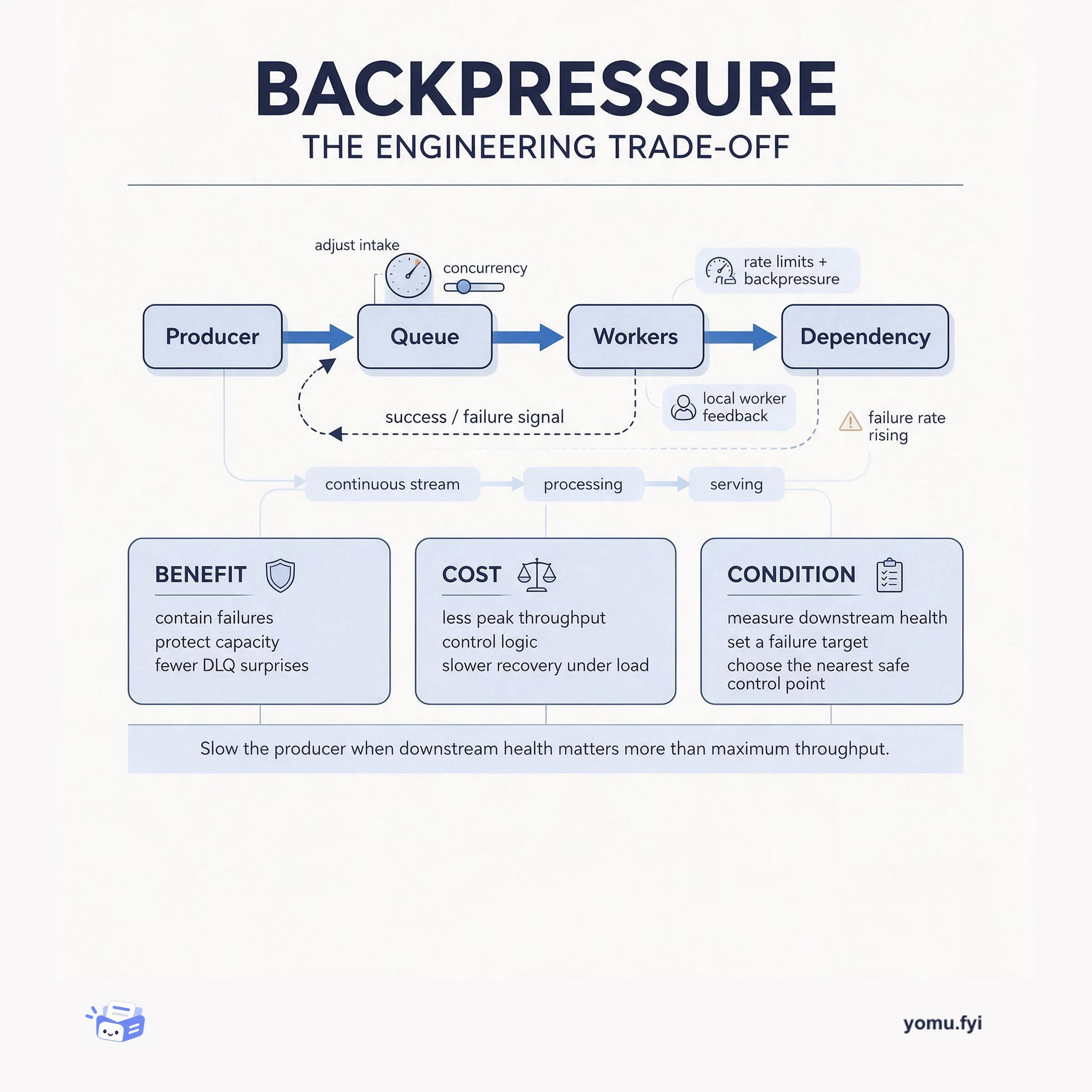
Backpressure is a feedback loop that slows work when downstream capacity or health deteriorates. Compare its gains, costs, and signals for choosing a control point.
The Good Stuff
Paid picks we use ourselves. Links carry a referral code — a subscription through one earns us a commission at no extra cost to you.
Newest first
ProdLine CoPilot addresses in-shift production-line decisions when equipment faults threaten output and data is split across PLCs, SCADA, MES, ERP, and LIMS. The proposed system streams operational technology data into Databricks, joins it with slower business and quality records, and routes questions to domain specialists that calculate recovery, depletion, quality-risk, and maintenance signals. Its orchestrator reads current Unity Catalog state, uses SQL, Genie, AI Search, Model Serving, and Python-based tools, while MILP, stochastic scheduling, Monte Carlo, Bayesian risk, and Pareto methods provide analytical outputs. Recommendations are tested against 1,000 scheduling scenarios and returned with trade-offs in cost, overtime, throughput, quality, and service, but execution remains with line managers, quality leads, and maintenance. The demo drafts work orders, quality deviations, and schedule updates for approval, with traceability storing inputs, assumptions, constraints, approvers, and outcomes.
Apache Spark 4.2 extends the engine’s role in modern data and AI workloads with governed metrics, vector and top-K primitives, Arrow-first Python execution, native change data capture, and stronger streaming foundations. Metric views provide shared business definitions, while Spark Connect uses gRPC and Arrow to let remote clients submit logical plans without a full Spark runtime. Spark SQL adds vector similarity functions, NEAREST BY, geospatial types, sketches, and time-series features; Python interoperability includes Arrow UDFs and can move Spark DataFrames into supported Arrow-native tools without copying or serializing underlying data. Spark Declarative Pipelines adds Auto CDC for SCD Type 1 targets, while Data Source V2 standardizes change streams through CHANGES and expands row-level operations and schema evolution. The release also includes operational updates such as Web UI modernization, Kubernetes improvements, JDK 25 support, and dependency upgrades.
NVIDIA DeepStream 9.1 introduces AutoMagicCalib and Multi-View 3D Tracking skills to resolve the limitations of single-camera 2D tracking and manual camera calibration in large-scale video analytics. Multi-View 3D Tracking projects detections into a shared 3D coordinate system, matching tracklets across cameras via MQTT and maintaining globally consistent object IDs. AutoMagicCalib automates camera intrinsic and extrinsic parameter estimation by analyzing object trajectories across video feeds, optionally using a Visual Geometry Grounded Transformer. These capabilities are integrated into 13 agentic skills that allow coding agents to set up, configure, and execute end-to-end vision AI pipelines from natural language prompts. Outputs include an on-screen display grid, bird's-eye view trajectories, and per-frame protobuf metadata streamed through Kafka.
Bullet operates a DeFi exchange for perpetuals, spot trading, and lending, with trades settled on a blockchain while users retain custody of their assets. Its sub-millisecond trading system produces more than 150 million event rows per hour, creating a need for historical indexing, real-time analytics, and operational monitoring beyond the blockchain’s state-machine model. ClickHouse Cloud consumes events from Kafka, stores them in dedicated tables, and supports user features, leaderboard and reward calculations, P&L charts, audit logs, and Grafana-backed alerts. Replacing Databricks reduced query latency from 10–15 seconds to milliseconds, improved data freshness from 1–2 hours to under 5 seconds, and removed a separate DynamoDB serving layer at comparable cost while handling 1,000 times more data across staging, testnet, and mainnet.
Engineers at Netflix required a unified, real-time view of service dependencies to navigate distributed architecture and improve incident troubleshooting. Traditional batch systems introduced stale data, so the team created a streaming-first platform backed by reactive streams and backpressure handling to ingest flow records from multi-region Kafka streams and Server-Sent Events without data loss. The architecture partitions data into physically separate graph and columnar storage layers covering eBPF network flows, IPC metrics, and distributed traces. Network flow ingestion relies on a three-stage distributed aggregation pipeline using consistent hashing to resolve network intermediaries into logical application connections. The resulting production system serves time-travel and topology queries with sub-second latency while continuously updating dependency views.
The post presents a reusable real-time guardrail pattern for flagging suspicious Ethereum blockchain transactions and routing them for downstream action. Its rules identify impossible blocks where gas_used exceeds gas_limit and scan extra_data for email addresses, JWT tokens, or AWS access-key patterns, producing ALLOW or QUARANTINE decisions with reasons. The implementation uses Apache Spark Structured Streaming Real-Time Mode, whose continuous data flow, pipeline scheduling, streaming shuffle, pre-allocated execution pipelines, and asynchronous checkpointing target millisecond latency without a separate streaming engine. On a four-worker DBR 16.4 LTS cluster, the stateless Kafka-to-Kafka test processed about 23 million records at 69,713 rows per second, with P95 below 0.5 milliseconds and P99 at 1 millisecond. The post notes that RTM with a Kafka sink provides at-least-once delivery and that more complex stateful workloads may incur higher latency.
Lyft developed Aria, an AI-powered assistant allowing approved employees to query ride analytics via natural language through a backend with LangGraph orchestration and SQL generation. However, Aria's user interface was limited to a Streamlit prototype that lacked standard service framework integration, Lyft authentication, and multi-user scalability. To resolve these limitations, a new engineer built a production-grade web client from scratch using Lyft's internal Node.js framework and Next.js as a three-week onboarding assignment. The implementation involved configuring Envoy routing, resolving authentication plugin incompatibilities, debugging service connectivity with Grafana, and managing interface state with an XState state machine. Aria was successfully hardened and launched into production, expanding natural language analytics access across the company.
Databricks describes a security-alert triage system designed to review low-severity alerts that historically received less attention because of their volume and low fidelity. An initial single-agent prompt escalated 50% of alerts, so the team built a fleet of 17 source-specific agents plus a Threat Intelligence agent, using Structured Streaming to ingest alerts, enrich evidence, and route each alert. The pipeline combines deterministic benign-signal filtering, historical and behavioral context, specialized prompt functions, optional tools, structured dispositions, and cost controls before sending escalations to human analysts. Those analysts provide ground truth through MLflow traces and labels, supporting ongoing evaluation across escalate, monitor, and close decisions. After triaging more than 18,000 alerts, the system reached a 3.2% escalation rate, a 10.5-second median triage time, and more than 6,500 analyst hours saved in 30 days; escalated low-severity alerts were roughly 10 times more likely to be true positives than HIGH and MEDIUM alerts.
ClickHouse has achieved the AWS Cloud Operations Competency in the Monitoring and Observability category, recognizing validated expertise in operating reliable AWS systems with logs, metrics, and traces. The post describes observability as a high-volume, high-cardinality, high-concurrency workload where legacy systems may require sampling, field reduction, or short retention. ClickHouse Cloud uses columnar storage, compression, parallel queries, compute-compute separation, and ClickPipes integrations with Amazon Kinesis, Amazon MSK, and Amazon S3 to support full-fidelity telemetry. Customer examples include Modal’s 1 to 2 million events per minute, Exabeam’s 1.2 million events per second per region, and Qonto’s reduction of 231 TB to 376 GB. The company also describes MCP servers, AI Notebooks, and managed ClickStack as investments for collaborative incident investigation.
Professional basketball’s Hawk-Eye SkeleTRACK feed produces roughly 22,620 positional updates per second—about 65 million records per 48-minute game—yet teams often cannot turn that volume into timely, trusted decisions. The integration gap comes from separate vendors for tracking, wearables, video, scouting, and medical data, alongside calibration differences, weak provenance, and compute limits. The Databricks Data + AI Platform is presented as a governed lakehouse that ingests feeds with Lakeflow, refines them through medallion layers, and uses Unity Catalog for lineage, access control, and auditing. Models for shot probability, injury risk, and fatigue can run alongside serving and custom applications, with Lakebase supporting sub-second interactive queries. Applications include proactive load management, real-time coaching intelligence, and enriched broadcast or fan experiences across tracking-rich sports.
Pinterest's CDC ingestion platform relies on a multi-stage pipeline built with Kafka, Flink, Spark, and Iceberg, where upstream schema updates risk disrupting data transformations and offline storage. To prevent pipeline failures and schema drift, Pinterest introduced an automated schema evolution framework based on a staged convergence model. Upstream changes are detected via push-based DDL messages and daily pull-based validation checks. The workflow automatically restricts automated updates to additive changes and numeric precision widening, updating Iceberg table definitions and regenerating Flink and Spark code through auditable pull requests. By decoupling schema divergence, code deployment, and data convergence, the system maintains continuous ingestion availability while working toward eventual schema consistency across all storage layers.
CostBench compares Snowflake and ClickHouse Cloud as end-to-end real-time analytics systems rather than measuring reads on a static, prepared dataset. It evaluates continuous ingest, raw-data organization, pre-aggregation freshness, and continuous query serving while background work continues, testing Snowflake’s standard-table and Interactive Tables paths alongside ClickHouse. The benchmark is designed around fresh data becoming query-ready as it arrives and distinguishes sustained real-time ingest from bulk loading or backfill. In the reported results, ClickHouse achieved 969× better cost-performance than Snowflake’s standard materialized-view setup and 180× better than its Interactive Tables setup; among the tested paths, only ClickHouse incremental materialized views kept pre-aggregations continuously synchronized without lag.
Scientific instruments and high-bandwidth sensors generate immense data volumes, but traditional architectures rely on a store-then-analyze model that bottlenecks real-time discovery and forces extensive data discarding. NVIDIA DAQIRI shifts data acquisition to a software-centric pipeline that connects streaming detectors directly to GPU computing. Built as part of the NVIDIA Holoscan Platform, DAQIRI uses DPDK to bypass the Linux kernel and move UDP and RoCE v2 traffic directly from the NIC into GPU DMA buffers at line rates exceeding hundreds of gigabits per second. The system automates packet reordering, flow steering, and on-GPU data conversions such as mapping wire int4 payloads into fp16 tensors using YAML configuration files and simple C++ or Python APIs. This enables real-time edge processing, filtering, and model inference across experimental pipelines like CERN ATLAS.
A manual mitigation action during an incident corrupted a data feed for a subset of titles, causing playback issues and catalog service failures that existing code canary systems failed to catch. To protect streaming reliability, Netflix built an automated data canary system that validates transformed catalog metadata prior to publication. The architecture utilizes a dedicated orchestrator alongside permanent baseline and canary service clusters to coordinate validation using real production traffic. By leveraging custom chaos experiment thresholds, sticky session affinity, and Starts Per Second playback metrics, the system detects regressions in under ten minutes and blocks publication automatically. Controlled failure injection experiments routing approximately 0.2% of global traffic confirmed that issues could be identified in 2.5 to 4 minutes.
Real-time analytics is presented as a foundational workload for customer-facing analytics, observability, fraud detection, operational applications, and AI agents rather than a niche use case. The discussion argues that performance claims require open, transparent, reproducible benchmarks that disclose methodology, datasets, queries, results, and operating conditions, including continuous ingestion, concurrency, memory pressure, and fresh data. A real-time database should support queryable data within milliseconds to a couple of seconds, incremental transformations, bounded tail latency as writes increase, configurable read-time versus write-time work, unified support for text, vector, JSON, and structured analytics, and efficiency as workload scales. The article connects renewed attention to agentic workloads, whose continuous, high-volume querying makes low latency, concurrency, and fresh context increasingly necessary, and calls for shared standards beyond a single latency number.
Modern data pipelines move raw data from source systems through transformation and storage to downstream consumers, with batch, streaming, or hybrid operation selected according to latency needs. The guidance places service-level agreements first, defining acceptable latency, uptime, and error rates before architecture choices, and compares ETL, ELT, and zero-ETL patterns. It recommends immutable raw landing zones, CDC for transactional sources, schema registries, event replay, incremental loads, and idempotent writes using techniques such as MERGE operations. Performance and reliability practices include partitioning, clustering, data-quality checks, observability, automated CI/CD testing, and cost controls such as autoscaling and storage tiering. Adoption guidance advises piloting a representative pipeline, measuring telemetry and cost, then iterating through regular architecture reviews.
ClickHouse has announced a GCP Pub/Sub connector for ClickPipes, now in Private Preview, to stream GCP infrastructure logs, application events, and operational signals into ClickHouse Cloud in real time. Previously, routing data from Pub/Sub into ClickHouse required GCS or a Dataflow pipeline; the connector instead manages subscription lifecycle, schema inference, and message delivery after a topic and target table are configured. It supports JSON, Avro, and Protobuf, Pub/Sub Schema Registry integration, automatic decompression, attribute-based filtering, and start positions of latest, earliest, or a specific timestamp. ClickPipes supports horizontal and vertical scaling, configurable replicas, automatic retries, built-in metrics and logs, and programmatic management through OpenAPI and the ClickHouse Terraform Provider. The connector is available upon request and free during Private Preview, with access offered through a waitlist or a ClickHouse Cloud account manager.
Building AI experiences for augmented reality and wearable devices requires bridging hardware with live media streams, multimodal models, enterprise tools, and runtime infrastructure. NVIDIA XR AI provides an open-source, modular framework connecting extended reality headsets and smart glasses to GPU-accelerated services across cloud, edge, and workstations. In this architecture, camera frames and microphone audio ingest into an XR Media Hub that routes data while keeping raw video pixels in shared memory to minimize overhead. The ecosystem uses NVIDIA Cosmos models for vision-language grounding, NVIDIA Nemotron models for reasoning and tool invocation, and the Model Context Protocol for enterprise integrations. Optional agent orchestration via NVIDIA NeMo Agent Toolkit and spatial streaming through NVIDIA CloudXR support complex workflows across healthcare and manufacturing.
Data pipeline architecture is the end-to-end blueprint for collecting, processing, storing and delivering data from source systems to people, applications and models. It distinguishes logical design, which defines stages and responsibilities, from physical design, which assigns tools and infrastructure to those stages. The common four layers are ingestion, processing and transformation, storage, and serving and consumption, with orchestration and observability spanning the pipeline. The brief compares batch, streaming, Lambda, Kappa and medallion patterns, explaining trade-offs involving freshness, cost, complexity and operational burden. It also contrasts ETL with ELT and presents governance, monitoring and right-sized processing as reliability practices, concluding that architecture should match the use case and balance freshness, cost and reliability.
ClickHouse has achieved the AWS Retail Competency in the Advanced Data Insights category, a designation recognizing validated technical expertise and demonstrated customer success in retail real-time analytics. Retail workloads described here combine high-volume, high-cardinality, high-concurrency data with hard freshness requirements, including inventory, pricing, personalization, and peak seasonal demand. The post attributes the platform's fit to compressed columnar storage, parallel queries, continuous Kafka and Amazon S3 ingestion through ClickPipes, compute-compute separation, and AWS support for private networking, multi-region deployment, and Marketplace billing. Examples include Mercado Libre's 90-TB-per-day observability ingestion and trace lookups reduced from 15–20 minutes to about two seconds, while other customers report cost, speed, and analyst-efficiency gains.
The best engineering reads, once a week.