Brand: Artifact vs Operating System
Compare two mental models for brand: a static artifact (logos, guidelines, centralized control) and a living operating system (values, APIs, support, trust). See which choices fit your engineering team.
Loading…
Topic
122 posts about Privacy. Every summary links to the original.
See the idea
Compare two mental models for brand: a static artifact (logos, guidelines, centralized control) and a living operating system (values, APIs, support, trust). See which choices fit your engineering team.
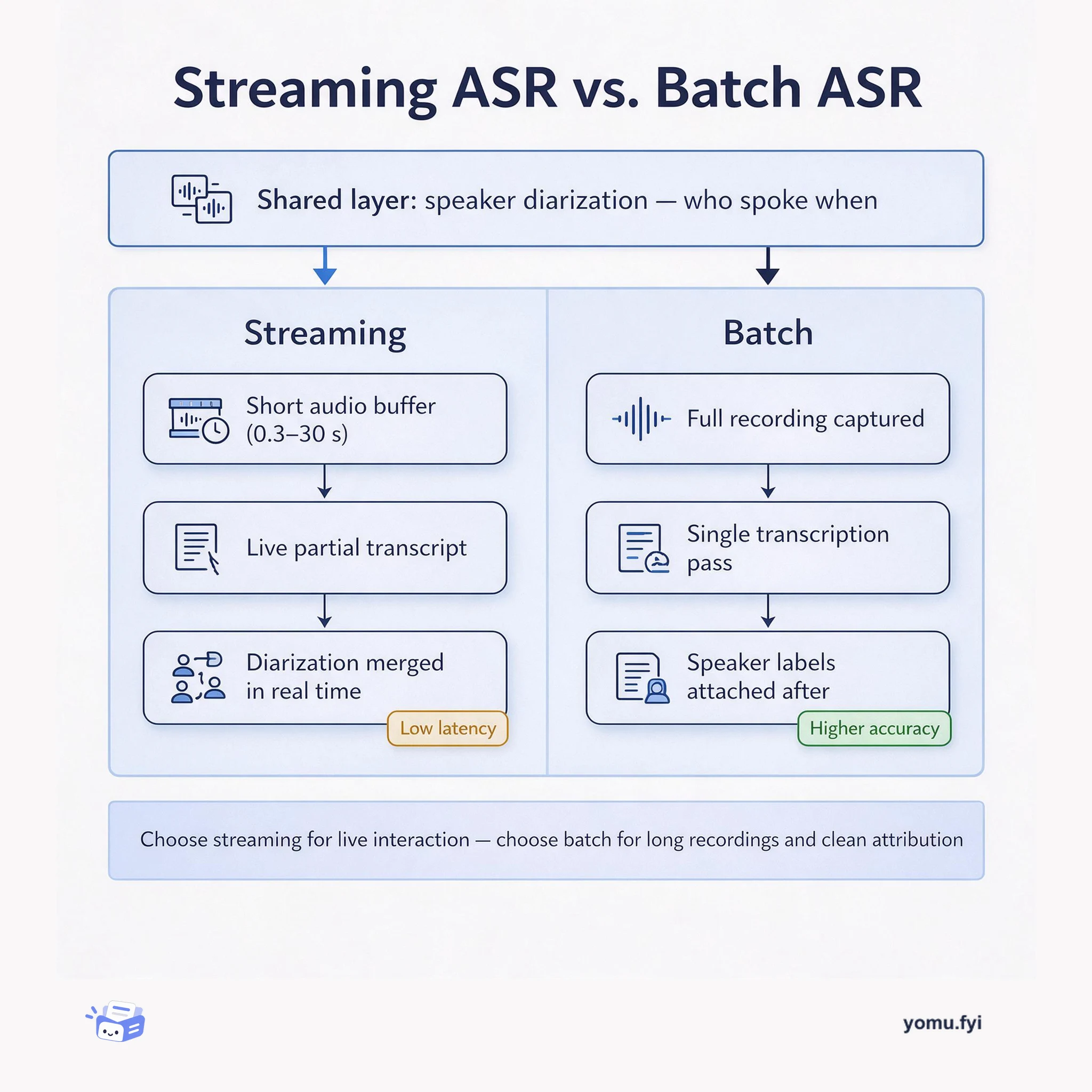
Streaming and batch ASR pipelines compared: how input buffer length, speaker diarization, and where audio is processed trade latency against transcript quality and privacy.
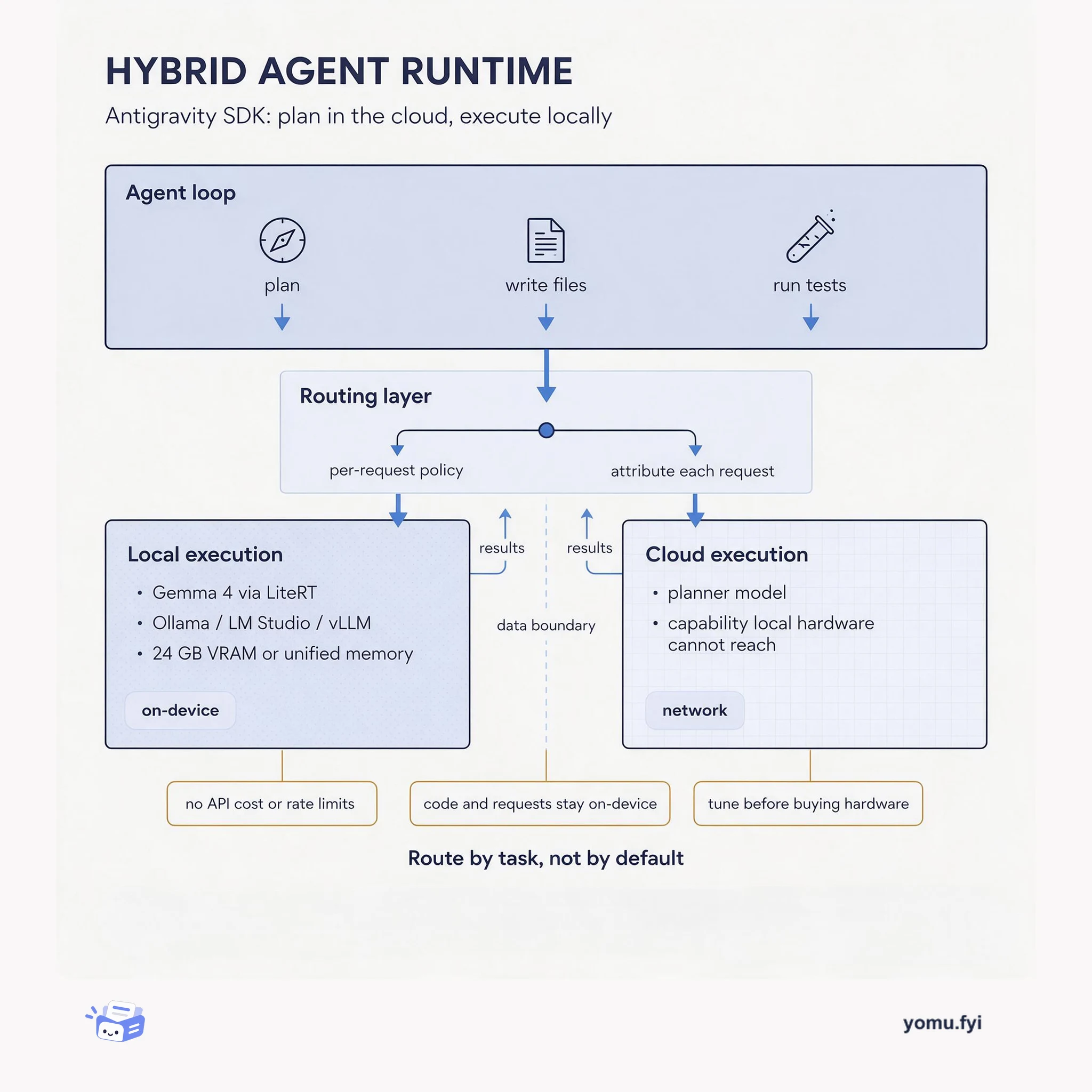
Antigravity SDK's hybrid architecture separates planning from execution: a cloud model plans, local models run most tokens on-device. See how routing, execution, and the data boundary fit together.
The Good Stuff
Paid picks we use ourselves. Links carry a referral code — a subscription through one earns us a commission at no extra cost to you.
Newest first
Microservices whose behavior depends on long-tail production inputs—such as payment cost estimation—are difficult to validate with unit and integration tests alone. The described pattern separates deterministic service logic from transport and side effects, then invokes that logic in Apache Spark across historical records enriched with the required dependency state. The resulting datasets can compare current and candidate implementations, quantify changed outputs, model future rule changes, and identify affected transaction or merchant segments. Replay inputs and artifacts are minimized and protected through tokenized identifiers, redaction, access controls, and retention policies, while smaller privacy-safe golden datasets run in pull-request CI. The approach complements, rather than replaces, unit and integration tests: golden datasets cover known service behavior, and full replays expose changes across the real production distribution before deployment.
amazon.science
Amazon Research Awards has announced 70 award recipients across 49 universities in 11 countries for its fall 2025 funding cycle. The funded research spans six distinct tracks: AI for Information Security, Agentic AI, Automated Reasoning, AWS Cryptography, Cybersecurity and Anti-Abuse Technologies, and Sustainability. Each selected academic team receives unrestricted financial grants, AWS Promotional Credits to access specialized cloud AI and machine learning services, and access to more than 700 Amazon public datasets. Awardees are paired with an Amazon research contact who provides advisory support, consultation, and access to company training sessions. Furthermore, the program explicitly encourages recipients to publish their discoveries, deliver presentations at Amazon offices worldwide, and release associated software implementations under open-source licenses.
Reachy Mini’s conversation app can now run its speech stack locally instead of sending audio to a server, avoiding cloud, API keys, and data leaving the machine. The tutorial uses speech-to-speech as a cascaded VAD → STT → LLM → TTS pipeline exposed through a Realtime API-compatible /v1/realtime WebSocket, with Silero VAD v5, Parakeet-TDT 0.6B v3, Qwen3-TTS, and a selectable LLM backend. It shows llama.cpp serving Gemma 4 E4B with parallel slots, 64k context, flash attention, and full sliding-window attention, then covers vLLM, MLX, Transformers, hosted Responses API endpoints, and network connection to a wireless robot. Once the backend and app are connected, conversations run through the local loop, while individual stages can be exchanged to trade latency, quality, language coverage, and hardware choices.
amazon.science
Amazon and its vendors face an asymmetric information problem when coordinating purchase orders across fulfillment centers because neither party shares proprietary cost, capacity, or demand data. To solve this coordination gap without exposing sensitive information, Amazon's Supply Chain Optimization Technologies organization designed Flo Pro by integrating the Vickrey-Clarke-Groves mechanism with the Consensus Planning Protocol. The distributed optimization framework uses the alternating-direction method of multipliers to coordinate iterative agent responses, calculating cost-benefit transfers across rolling six-week planning horizons. In lower-dimensional settings, Amazon also evaluated a transparent menu-of-contracts approach where vendors select optimal plans priced at Amazon's incurred costs. A nine-week pilot with a consumer-product manufacturer confirmed that Flo Pro successfully aligns incentives and achieves measurable cost savings.
The NHS Federated Data Platform (NHS FDP), delivered by NHS England through a consortium led by Palantir, connects operational data held in separate NHS systems while keeping each organisation’s data under local control. Built on Palantir Foundry, its federated tenants use the Canonical Data Model, encryption, purpose-based access, and Privacy Enhancing Technology for national data flows. As of end December 2025, the post reports 110,078 additional theatre procedures, 797,728 patients safely removed from waiting lists, and 297,943 safely discharged patients, alongside around a 15% reduction in observed discharge delays. The inaugural Build with FDP hackathon brought together over 120 NHS developers and analysts, who built 25 working prototypes on a notional Canonical Data Model to address frontline operational challenges. Projects included early-warning, bed-demand prediction, CAMHS demand balancing, and genomic-optimised waitlist tools.
The article presents three web applications built around OpenAI’s open-source Privacy Filter, a PII detector that labels eight categories in one forward pass over a 128k-token context. Document Privacy Explorer extracts PDF or DOCX text and returns category-labeled spans, while Image Anonymizer combines Tesseract word boxes with character offsets to produce editable pixel redaction rectangles. SmartRedact Paste replaces detected spans with category placeholders, stores public and token-gated views, and evicts expired pastes in a daemon thread. Across the apps, gradio.Server’s @server.api routes model work through Gradio’s queue and gradio_client, while plain FastAPI routes serve custom HTML, views, and lightweight lookups. The implementations keep browser-side filtering, canvas edits, and PNG export out of server round-trips, and the paste service is about 200 lines including storage.
The guide explains how to build a Chrome extension that runs local AI with Transformers.js under Manifest V3, using a browser assistant as the reference architecture. It assigns model orchestration, lifecycle management, tool execution, and conversation state to a background service worker, while a side panel handles chat and a content script handles page extraction and highlighting. The implementation uses Gemma 4 E2B in q4f16 for text generation and all-MiniLM-L6-v2 in fp32 for embeddings, with WebGPU, DynamicCache-based KV caching, explicit download progress, and reusable pipelines. Typed message contracts, model-output parsing, and separate internal and UI transcripts support a deterministic tool loop, while chrome.storage.local, IndexedDB, and background caches place data according to lifecycle and access needs; the guide concludes that separating these runtimes keeps the UI responsive and avoids duplicate model loads.
Supabase announces certification to ISO/IEC 27001:2022, covering its information security management system across Database, Auth, Storage, Realtime, Edge Functions, and the Data API. The post explains that ISO 27001 defines how an ISMS manages information risk through documented policies, processes, and controls, with certification awarded by an accredited third-party auditor after documentation review, interviews, evidence sampling, and control testing. Preparation included formalizing informal policies, documenting risk assessments, running internal audits, selecting an auditor, and mapping existing SOC 2 controls to ISO 27001 Annex A to avoid duplicate evidence collection. The certificate is valid for three years with annual surveillance audits, and Team or Enterprise customers can request it from their dashboard; the certification is presented alongside existing SOC 2 and HIPAA support.
Generative AI in marketing creates content, insights and recommendations that can personalize experiences, optimize campaigns and improve performance. Unlike traditional analytics, which mainly reports on past results, it produces net-new outputs such as ad copy, audience segments, product recommendations, visual assets and strategic summaries. A typical workflow prepares campaign, customer and brand data, grounds or fine-tunes models, generates outputs, applies targeting and optimization, and uses human review and refinement. It distinguishes pretrained tools such as ChatGPT, Claude and Perplexity from customized models and broader AI transformation, noting trade-offs between speed, investment, relevance and strategic alignment. Successful adoption depends on high-quality, consented data, governance, privacy controls, human oversight, monitoring and cross-functional ownership; the conclusion presents AI as a force multiplier rather than a replacement for human creativity and judgment.
HyperDX introduced AI Summarize, a feature designed to translate raw logs, traces, and log patterns into narrative summaries directly within its observability interface. Instead of relying on backend large language models, the tool runs entirely client-side using OpenTelemetry-aware data extraction combined with hand-written phrase pools. The generation logic inspects Kubernetes and OpenTelemetry attributes—such as service names, endpoints, exception details, and query durations—to tailor tone across detective noir, Shakespearean drama, and nature documentary themes. Because processing occurs inside the browser tab without external API calls, the system avoids third-party latency, token expenses, model hallucinations, and data privacy risks. Users can access summaries across logs, spans, and pattern drawers or re-enable the interface toggle via URL parameter through April 2026.
Anthropic is limiting access to Claude models in open agent platforms for Pro/Max subscribers, so the post describes ways to keep OpenClaw, Pi, or Open Code agents running with open models from Hugging Face. It presents Hugging Face Inference Providers as the quickest hosted route: users create a token, run openclaw onboard --auth-choice huggingface-api-key, and select a model such as GLM-5, or set a repo_id in OpenClaw’s config. For fully local inference, it recommends installing llama.cpp, starting a server with Qwen3.5-35B-A3B-GGUF, and connecting OpenClaw to the local OpenAI-compatible endpoint with custom configuration; the example model is described as suitable for 32GB of RAM. The hosted option prioritizes speed and model availability, while local inference offers privacy, zero API costs, full control, and no rate limits.
Supabase describes how regional network blocks disrupted access to its multi-tenant developer platform and shares three incidents from September 2025 through March 2026. It explains that DNS-level or transport-layer blocking can affect every tenant when projects share domains and IP addresses, while adding a hosting domain to the Public Suffix List provides only partial mitigation. In the UAE, a project distributing unauthorized streaming content triggered an approximately 18-day block that ended after removal and engagement with the TDRA. Yemen saw TCP connections dropped for about eight days with no official explanation, while India’s roughly eight-day restriction was rescinded after project enforcement and technical engagement with MeitY. The post says providers should build regulator contacts, strengthen abuse response pipelines, and develop alternatives such as proxy domains, custom domains, and other workarounds.
Modern edge AI deployments require immediate real-time decision-making, local privacy, and offline operation while retaining the analytical scale of central cloud infrastructure. To address these hybrid demands, MongoDB and ObjectBox partnered to release the ObjectBox MongoDB Sync Connector as part of ObjectBox 5.0. ObjectBox operates as a lightweight on-device database with local vector search, multi-language bindings, and high-throughput I/O suited for resource-constrained hardware. In environments such as industrial factory floors and restaurant point-of-sale terminals, devices capture and evaluate operational data onsite without depending on active network connections. The native connector subsequently synchronizes critical operational datasets to MongoDB Atlas for long-term storage, fleet-wide monitoring, and machine learning model retraining.
At CES 2026, NVIDIA presents a desk-based personal assistant that combines DGX Spark processing with a Reachy Mini robot, allowing an agent to converse, perceive camera input, speak, and perform actions. The tutorial assembles NVIDIA Nemotron 3 Nano for reasoning, NVIDIA Nemotron Nano 2 VL for vision, ElevenLabs for text-to-speech, and Reachy Mini hardware or simulation through the NeMo Agent Toolkit and Pipecat. Its configuration routes text, visual, and action requests to different models or a ReAct tool-calling agent, while the robot daemon exposes movement and state capabilities. The guide covers local, cloud, and serverless deployment, then starts the services needed for voice and vision interaction; the completed setup greets users and supports example text and camera prompts.
Realistic voice generation presents significant deepfake risks alongside legitimate communication benefits. To prevent unauthorized voice duplication, a voice consent gate integrates verification directly into the voice cloning workflow. The system relies on a language model to generate novel sentence pairs containing explicit consent and phonetically diverse phrases on random everyday topics. Users must read these generated lines aloud through a direct microphone stream rather than uploading pre-recorded files, and an automatic speech recognition system verifies the utterance against the generated text. Once confirmed, the consenting audio snippet is passed directly to the voice-cloning text-to-speech model as the reference sample for synthesis.
Hugging Face announced a collaboration with VirusTotal to enhance the security of files shared across the Hugging Face Hub. Hosting more than 2.2 million public model and dataset repositories, the platform faces potential threats from malicious payloads, compromised files, and dependencies that execute unsafe code. Starting immediately, public repositories on the Hub undergo continuous scanning powered by VirusTotal threat intelligence. When users view repository or file pages, the Hub checks file hashes against VirusTotal without transferring raw file contents, preserving user privacy. Retrieved metadata displays detection counts, clean or malicious status, and known-bad relationships, enabling organizations to evaluate risks prior to downloading assets or integrating them into deployment pipelines.
Modern vision-language OCR models can transcribe handwritten text, multiple scripts, mathematical expressions, and chemical formulas while also interpreting tables, charts, and images. The guide compares open OCR models and explains how output choices—including DocTags, HTML, Markdown, and structured JSON—affect digital reconstruction, LLM input, and programmatic processing. It also covers locality awareness through anchors or bounding boxes, prompt-based task switching, fine-tuning versus out-of-the-box use, and factors for selecting a model. Practical deployment options include local or managed inference, vLLM, Hugging Face Endpoints, and batch scripts that add OCR results to datasets. The discussion extends document AI beyond transcription to visual retrieval and direct document question answering with vision-language models, especially where converted text can lose layout or visual context.
Most open artificial intelligence datasets reflect Western norms and English-only contexts, limiting model effectiveness across India's multilingual and multi-script landscape. To address this shortage of culturally grounded training data, NVIDIA released Nemotron-Personas-India under a CC BY 4.0 license. The synthetic dataset contains 21 million personas across 3 million records spanning 7.7 billion tokens in English, Devanagari Hindi, and Latin-script Hindi. The generation pipeline utilized NeMo Data Designer, an Apache-2.0 licensed Probabilistic Graphical Model for demographic grounding against 2011 Census distributions, and GPT-OSS-120B for narrative text. All records are entirely synthetic to eliminate re-identification risks while enabling fine-tuning for region-aware AI agents and domain-specific copilots.
Widespread enterprise SaaS adoption has introduced notable security blind spots due to inconsistent controls, visibility, and configurations across disparate vendor applications. While traditional compliance frameworks such as SOC 2 and ISO 27001 evaluate provider organizational security, they typically fail to address customer-facing application capabilities. To resolve this discrepancy, MongoDB collaborated with the Cloud Security Alliance and GuidePoint Security to develop the SaaS Security Capability Framework. This framework establishes actionable technical controls across six critical operational domains, including identity and access management, machine-readable logging, configuration management, and incident notifications. By standardizing customer-side capabilities within the shared responsibility model, the framework simplifies vendor risk assessments and provides engineering teams with structured implementation benchmarks.
MongoDB centers its engineering architecture around resilience, intelligence, and simplicity to minimize developer cognitive and operational burdens when building distributed applications. Security is enforced through dedicated clusters in isolated virtual private networks alongside Queryable Encryption, which allows equality and range queries on ciphertext without decryption keys ever leaving the client. High availability is built on replica sets across independent availability zones and multi-cloud topologies, utilizing consensus mechanisms that commit writes only after majority acknowledgment in the active term. Operational friction in artificial intelligence workloads is addressed by integrating vector search directly into the core query engine, eliminating brittle extract-transform-load pipelines and separate vector databases.
The best engineering reads, once a week.