Streaming ASR vs. Batch ASR: The Buffer-Latency Trade-off
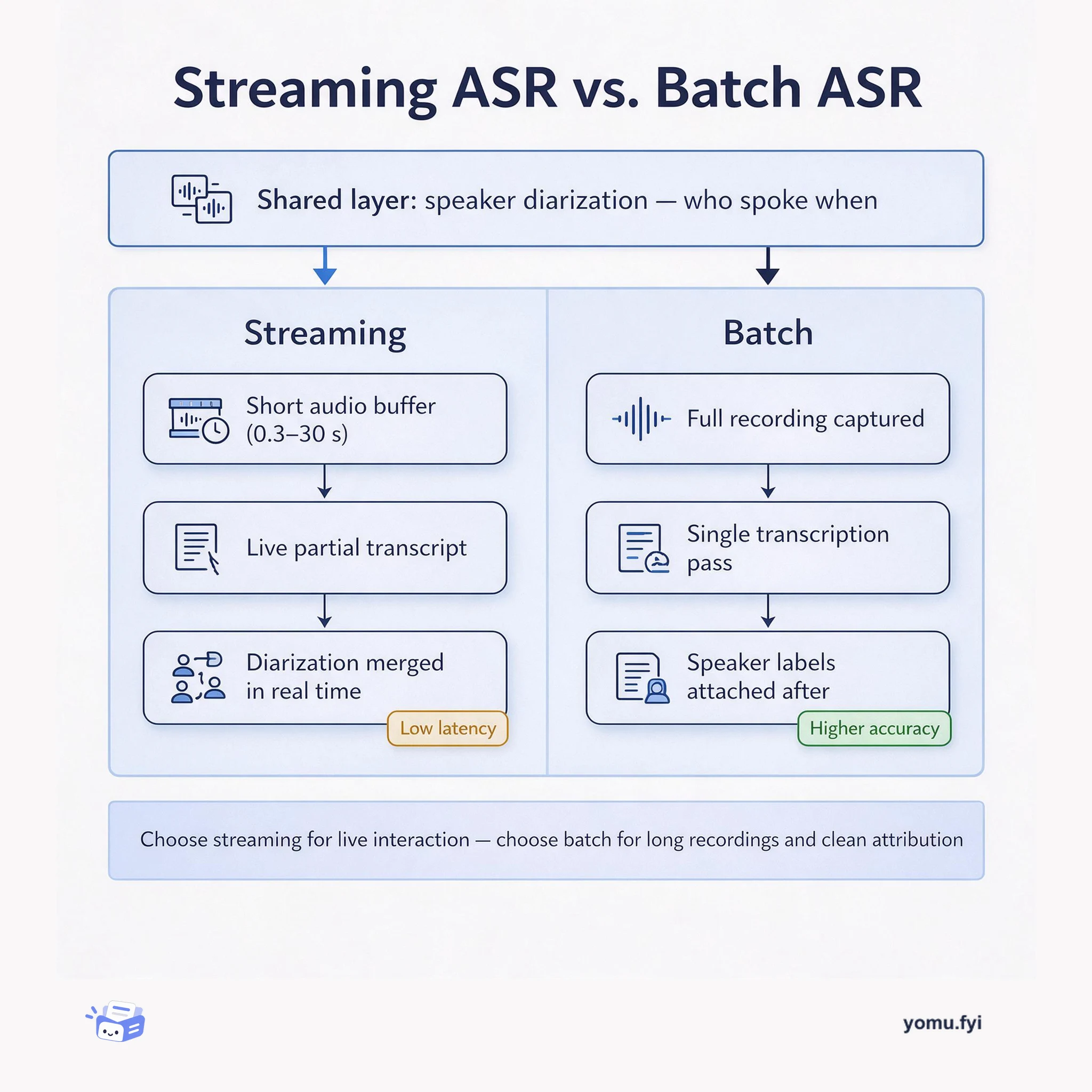
Streaming and batch ASR pipelines compared: how input buffer length, speaker diarization, and where audio is processed trade latency against transcript quality and privacy.
Loading…
Topic
122 posts about Privacy. Every summary links to the original.
See the idea
Streaming and batch ASR pipelines compared: how input buffer length, speaker diarization, and where audio is processed trade latency against transcript quality and privacy.
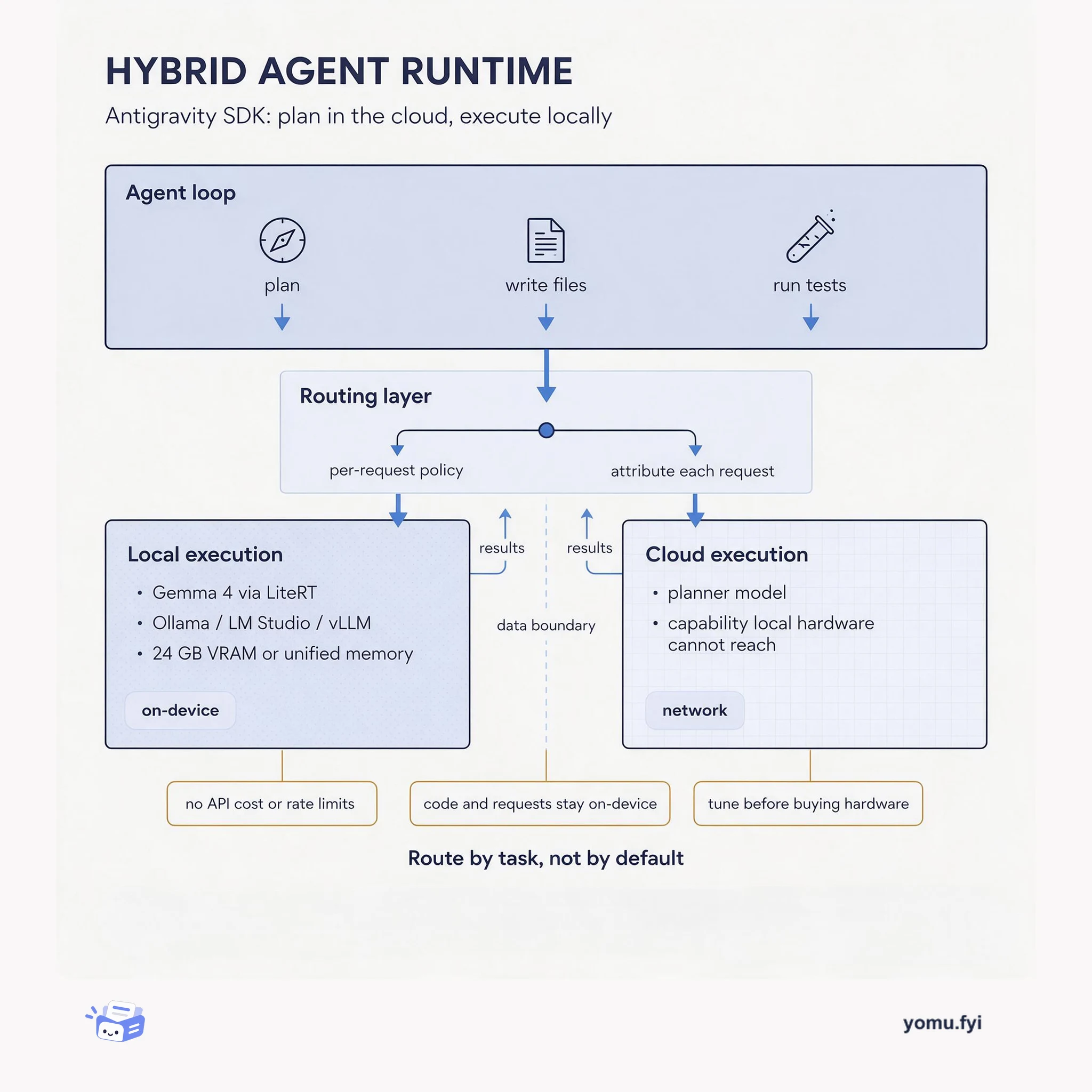
Antigravity SDK's hybrid architecture separates planning from execution: a cloud model plans, local models run most tokens on-device. See how routing, execution, and the data boundary fit together.
The Good Stuff
Paid picks we use ourselves. Links carry a referral code — a subscription through one earns us a commission at no extra cost to you.
Newest first
Supabase is rolling out Sign in with ChatGPT in beta on its login page and through the Supabase plugin in ChatGPT on desktop, web, and mobile. The flow lets new users create a Supabase account with their ChatGPT identity, while existing Supabase accounts with the same email are linked automatically; SSO accounts remain separate. Users can add Supabase from ChatGPT’s plugins directory, authenticate with ChatGPT, review a consent screen, and return to the conversation with the connection enabled. Authentication and plugin authorization remain separate, with access revocable from the Supabase Dashboard, and users must create an organization in the Dashboard before creating projects from ChatGPT. The beta is described as a partnership with OpenAI intended to reduce account setup between ChatGPT or Codex and a Supabase backend.
Compromised versions of the Nx npm package, dubbed the s1ngularity campaign, used a post-install hook to repurpose installed AI coding agents as credential scanners. Because AI command-line interfaces often run with the developer's full user permissions, the malware invoked tools such as Claude Code, Gemini CLI, and Amazon Q with permission-bypass flags to map sensitive files. GitGuardian findings indicate that AI-assisted code leaks secrets at roughly twice the baseline rate, largely because models ingest live credentials into working contexts. Docker Sandboxes addresses this risk by restricting the execution environment to the project workspace and keeping actual credentials on the host. When sandboxed with sbx, agents receive sentinel placeholders, while an egress proxy injects real secrets into outgoing network requests.
The document examines how use of third-party AI model services can expose an organization’s “alpha”—institutional knowledge and tradecraft embodied in data sent to and generated from models—to hosted model providers. It identifies risks involving provider reuse, storage, human review, model or service improvement, contractual liability caps, ZDR-ineligible beta services, safety-classifier triggers, and inference routed through prohibited regions. Its recommended approach combines contractual protections with operational controls: define robust Zero Data Retention, limit data use to service delivery, bind both hyperscalers and relevant AI labs, maintain an allow-list, block beta headers, and constrain unilateral term changes. It also calls for observability and contractual incident safeguards, including investigation periods, migration buffers, and regional routing limits, while noting that the document is not legal advice.
Crash reports in non-deterministic game environments often lack player context, making callstack-only debugging difficult. Sentry's SDK version 1.16.0 for Unreal Engine introduces Session Replay to continuously record gameplay and attach the final video clip directly to crash reports. The cross-platform recording pipeline hooks into Slate's backbuffer presentation on the render thread, uses engine pixel shaders for format conversion, and feeds frames to hardware H.264 encoders via Unreal's AVCodecs plugins. Encoded fragments are organized in a rolling ring buffer and periodically written to temporary MP4 files that are uploaded alongside crash data. Benchmark results in a 4K demo game showed an overhead of approximately 0.20 ms per frame.
Regulated organizations ingesting large data volumes must detect and classify standard and domain-specific personally identifiable information to satisfy compliance mandates like GDPR, HIPAA, CCPA, and PCI DSS. To eliminate manual inspection, an event-driven architecture orchestrates Amazon Macie scans for files landing in Amazon S3. Amazon EventBridge captures upload events and invokes AWS Step Functions, which manages Lambda functions to stage objects, trigger Macie classification jobs with custom regex identifiers, and poll for results. The pipeline separates data across a three-bucket pattern representing raw, staged, and scanned states to prevent mixing unprocessed data with validated assets. Finally, the workflow exports timestamped compliance reports in CSV and JSON formats while alerting security teams via Amazon SNS on high-severity findings.
Measuring MongoDB performance in a .NET application requires command details, durations, and enough context to distinguish isolated spikes from recurring query patterns. The post presents an end-to-end setup that uses MongoDB’s built-in OpenTelemetry Activity instrumentation, the .NET OpenTelemetry SDK, Sentry.OpenTelemetry.Exporter, and OTLP ingestion rather than a dedicated Sentry.MongoDB integration. Configuration initializes Sentry with UseOtlp(), subscribes to MongoTelemetry.ActivitySourceName, adds MongoDB instrumentation, and exports spans with AddSentryOtlp(...), while avoiding duplicate spans from overlapping hooks. Query context appears in Sentry traces, span samples, and the Queries experience, with Relay generating parameterized values for aggregation but retaining raw db.query.text per span. The post also demonstrates client-side redaction and describes server-side scrubbing, while exporter propagation bridges preserve correlation with errors and replays.
Responsible AI is presented as a lifecycle-wide practice for designing, developing, deploying, and monitoring AI systems with fairness, transparency, accountability, privacy, safety, and human oversight as requirements. The guide connects technical controls—secure encrypted data pipelines, documented dataset provenance, demographic bias audits, adversarial robustness tests, access controls, and continuous monitoring—with governance mechanisms including named model owners, cross-functional oversight, model-risk assessments, and immutable decision logs. For generative AI, it recommends output policies, training-data leakage testing, guardrails, and red-team testing, while model cards, automated fairness checks, independent audits, and incident response plans support transparency and accountability. Regulatory preparation includes mapping systems to the EU AI Act’s risk categories and documenting design, training data, and intended use; the NIST AI Risk Management Framework and OECD AI Principles are identified as governance references.
The piece argues that agentic marketing depends on modernizing the data and infrastructure foundation first, rather than starting with isolated AI use cases. At Acxiom, moving core products and client solutions from on-premises Hadoop to Databricks reportedly improved workload runtimes by 80 to 90 percent, reducing jobs that took 50+ hours or as long as 90+ hours to 2–3 hours. The migration also reduced manual pipeline and infrastructure work, freeing engineering capacity for products and client outcomes. Those capabilities now support agentic audience planning, media buying, campaign activation, performance analytics, code generation, testing, and ad variation, with a goal of connecting the full marketing value chain. Because workflows handle PII, generated content passes through legal approval, defined controls, and human oversight; Acxiom is also embedding its data in client platforms and privacy-safe clean rooms to make decisions more transparent and native to customer environments.
Uber integrated Apple’s Verify with Wallet API into its cross-app Identity Verification Platform to support government-backed digital IDs across driver onboarding, age-gated ordering, and car rental use cases. The central challenge was allowing each use case to request only its Apple-approved identity data while operating through a scalable, platform-agnostic service rather than separate integrations. Server-side configurations map Uber identity models to PassKit objects, set one-time or persistent storage intent, and validate responses using HPKE decryption, CBOR payloads, session transcripts, MSOs, device signatures, and issuer certificate chains under ISO/IEC 18013-5. A registry of IACA certificates, sourced from jurisdictional portals and AAMVA’s VICAL, supports overlapping certificate rotations, while the platform is intended to accommodate new document types and cross-platform digital credential integrations.
The beta reflection feature helps Claude users review and refine their use of the assistant by tracking and visualizing activity over one, three, six, or twelve months. A dashboard summarizes key topics, usage patterns, frequent tasks, and when Claude is used, while periodically prompting users to consider what they should keep doing themselves; a future view will show time spent. It also assesses activity through the 4D AI Fluency Framework—Delegation, Description, Discernment, and Diligence—and can suggest practices such as using a Project for ongoing context, alongside quiet hours and break nudges. Available on Claude for web and the desktop app to Free, Pro, and Max users with memory enabled, the beta excludes incognito chats, connected-tool source files, and conversations tied to health integrations, with sensitive conversations represented only at a high level.
CipherStash’s integration for Supabase adds searchable field-level encryption to Postgres applications without requiring a schema change. The encrypted Supabase SDK wrapper encrypts marked fields in the application, stores each value as a JSON payload containing ciphertext and Searchable Encrypted Metadata (SEM), and converts queries to SEM so Postgres can filter, sort, and join without plaintext access. ZeroKMS keeps keys under the customer’s control, while decryption policies determine who can read each value; the source states that neither CipherStash nor Supabase can access plaintext data. The integration supports Supabase.js, Drizzle, and Prisma Next, with a one-command setup, and CipherStash Proxy covers analytics, background workers, and other direct database access through the Postgres wire protocol.
NVIDIA Confidential Computing secures enterprise data, proprietary model weights, and the model itself during active AI inference. The architecture integrates silicon-level private signing keys fused during manufacturing, encrypted multi-GPU NVLink, and remote attestation through the NVIDIA Remote Attestation Service alongside CPU Trusted Execution Environments. To mitigate overhead from secure work submission latency and encrypted host-to-device transfers, software optimizations incorporate CC-safe autotuner timing in FlashInfer, asynchronous copy workers in SGLang, and piecewise CUDA graph replay. Benchmarks on an HGX B300 system running the Qwen 3.5 397B-A17B model at FP8 precision show inference performance reaches up to 98% of non-confidential baselines across tested concurrency levels.
Traditional large language models rely on next-token prediction trained over broad text sequences, excelling at conversational synthesis and code generation while struggling with forecasting future user behavior. Predicting intent inherently requires modeling decision-making under conditions of uncertainty, a capability not directly produced by general text pretraining. Dedicated behavioral foundation models address this limitation by training representations directly on proprietary, sensitive behavioral data, such as anonymous browsing sessions and product identifiers. By learning base representations of behavior, these models generalize to unseen predictive tasks, such as optimizing ad campaigns for products absent from the original training dataset. Implementing these behavioral models also necessitates privacy-centric machine learning techniques, ranging from differential privacy concepts to homomorphic machine learning.
Verifiable Digital Credentials (VDCs) are presented as a new trust layer for applications that need to verify claims such as age, licenses, employment, or eligibility without collecting documents and excess PII. The model uses an Issuer-Holder-Verifier trust triangle: authorities sign credentials, users hold them in wallets, and applications request specific proofs, with selective disclosure limiting exposed data. The standards stack combines SD-JWT VC or mdoc credential formats, OpenID4VCI for issuance, OpenID4VP for presentation, and the W3C Digital Credentials API for browser-wallet invocation. Production verification also requires issuer trust lists, trust-framework integration, and key rotation, not merely signature checks. Because browser API rollout is still progressing, the recommended baseline is redirect-based OpenID4VP with the Digital Credentials API added as a progressive enhancement, starting with one bounded verification use case.
Transformers.js browser apps currently redownload and recache identical AI model and WebAssembly resources when they are requested from different origins. Chrome's cache uses a Network Isolation Key composed of the top-level site and current-frame site, so matching CDN URLs do not produce cache hits; the toy example incurs 177 MB of duplicate model storage, while a shared ONNX Runtime Wasm file is 4,733 kB. The proposed Cross-Origin Storage (COS) API addresses this by identifying large files with cryptographic hashes and sharing them across opted-in origins, with a polyfill extension enabling experimentation before native browser support. In the extended Transformers.js flow, a COS lookup can serve resources in milliseconds, while a miss downloads and stores them, and ModelRegistry.is_pipeline_cached() can help select among models already cached.
MosaicLeaks examines privacy leakage in deep-research agents that combine private enterprise documents with external web retrieval. Queries that appear harmless individually can reveal sensitive facts when an observer combines them over multiple hops, producing intent, answer, or full-information leakage. The benchmark contains 1,001 multi-hop chains interleaving local and web questions, and compares baseline behavior with task-only reinforcement learning and Privacy-Aware Deep Research (PA-DR). Task-only training raises strict chain success from 48.7% to 59.3% but increases answer/full-information leakage from 34.0% to 51.7%, whereas PA-DR reaches 58.7% success with 9.9% leakage by rewarding stage-specific decisions and penalizing query-level privacy risk. The evaluation is controlled, using synthetic enterprise documents, a fixed web corpus, three company contexts, and one multi-hop question-answering harness.
Stagwell built a Databricks Marketplace App to let brands match first-party records against its Identity Spine without sending raw customer data outside their own workspaces. It combines Databricks Clean Rooms, Unity Catalog, Jobs and Notebooks, Delta Sharing, and a React/Express interface. Workspace OAuth and On-Behalf-Of authorization enforce the user's Unity Catalog permissions, while separate service principals and a scoped personal access token support app and clean-room operations. Within the clean room, a packaged notebook joins brand data with the Identity Spine, resolves multiple identifiers, and computes match rates, coverage metrics, and household and consumer IDs; results include aggregated audience insights for activation, while raw customer data and proprietary matching code remain separated.
Data engineering for AI extends traditional ETL by adding requirements for model-ready data, unstructured inputs, feature engineering, governance, and production monitoring. The guide addresses data professionals building or scaling AI infrastructure, covering ingestion, architecture, data quality, privacy compliance, generative AI, and career development. It emphasizes shared feature schemas, pipeline data contracts, lineage, statistical validation, drift detection, and PII stripping or anonymization as responsibilities shared across data engineering and data science. For generative AI systems, it describes preparing RAG pipelines by ingesting and chunking documents, creating vector embeddings, and indexing them for semantic retrieval, while evaluating vector databases for latency, scale, and integration. It concludes that reliable AI depends on fresh, accurate, compliant data and ongoing operational and architectural review.
Massachusetts’s Department of Public Utilities (DPU) is considering proposed changes to transportation-network-company regulations that could affect drivers’ platform access, earnings, and operating costs. The proposal would expand the existing two-part background-check process by requiring seven years of driver-license history, birthplace, full Social Security documentation, Driver Verification System enrollment, and possible consultation with other agencies. It would also give DPU broader suspension authority, restrict hearing and deactivation-appeal rights, impose annual training, block vehicles with any open recall, regulate surge, and require rental vehicles to be electric within one year. Uber Black drivers could face new insurance, registration, and inspection requirements, while TNCs could incur fees that may increase fares. The post provides June 8, 2026 public-hearing details and instructions for submitting testimony.
Holo3.1 is a family of computer-use models released to improve robustness across web, desktop, and mobile environments, agent frameworks, and deployment targets. Based on Qwen, it adds native function-calling alongside structured JSON outputs, expands mobile automation, and offers 0.8B, 4B, 9B, and 35B-A3B sizes for different cost, latency, and performance needs. On AndroidWorld, the 35B-A3B model rises from 67% to 79.3%, while the 4B and 9B variants rise from 58% to 72%; function-calling and native execution achieve near-parity across the stated benchmarks, and Holo3.1 improves more than 25% over Holo3 in the Holotab harness. The release also provides 35B-A3B FP8, Q4 GGUF, and NVFP4 checkpoints for local inference: NVFP4 matches FP8 on OSWorld at about two points below BF16, reaches 1.74 times BF16 token throughput on DGX Spark, and with harness optimizations cuts average step time from 6.8 seconds to 3.3 seconds.
The best engineering reads, once a week.